
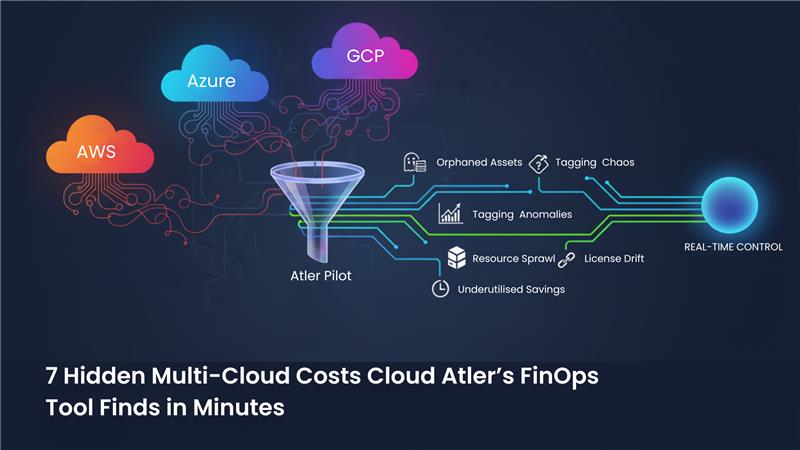
We all bought into the promise of multi-cloud: resilience, vendor optionality, and the ability to cherry-pick the best services from AWS, Azure, and GCP. It’s why multi-cloud adoption is practically universal, currently used by over 87% of enterprises. Yet, this flexibility has a dark side that consists of fragmentation, complexity, and staggering cost opacity.
Companies are increasing cloud spending at a breakneck speed of over 66% year-over-year, but the bitter truth is that an alarming 91% of organizations admit to wasting money in the cloud. This waste isn’t the obvious stuff you spot in a spreadsheet, but it’s the hidden costs that lurk in the gaps between providers. These silent budget killers are slow to detect and can erode profitability long before your finOps team sees the monthly bill.
The core problem is that FinOps teams are stuck in a reactive cycle. To genuinely control multi-cloud budgets, you need to move from monthly reconciliation to real-time action. That requires a unified, intelligent platform. Atler Pilot, one of the best finOps tools, powered by Atler Assistant, cuts through this complexity and identifies the 7 specific, financially dangerous hidden costs we’re about to discuss through this blog. So, let’s go ahead.
The Escalation of Cloud Financial Risk
Let's look at the financial stakes. Global public cloud spending is forecasted to total a breathtaking $723.4 billion in 2025. Now, layer on the industry consensus that between 27% and 30% of total cloud spend is wasted or unoptimized. That’s not just a margin. That’s hundreds of billions of dollars evaporating.
Why is this waste so persistent? The root cause is fragmentation. Try manually tracking costs across three disparate billing structures, different APIs, and completely independent governance models. It’s impossible. Engineering and FinOps teams are stuck endlessly trying to "inform" and "report," lacking the data unification needed to confidently "optimize."
Critically, traditional cost analysis, even daily reporting, is simply too slow. A single spending anomaly can quickly spiral, representing anywhere from 18% to 200% of a monthly budget if it isn’t caught on the same day it started. The cost of delay in a multi-cloud environment is truly enormous. These delays are precisely what allow the following seven insidious costs to thrive undetected.
The 7 Hidden Multi-Cloud Costs Found in Under a Minute
1. Orphaned Assets and Zombie Storage
This is the cloud equivalent of a ghost town: resources that were provisioned but forgotten, now delivering zero business value while still incurring 100% of their storage fees. We're talking about unattached block storage volumes (like AWS EBS or Azure Disks) and forgotten snapshots that persist long after the main compute instance they supported has been terminated. And the cleanup of such resources can be transformative. One detailed case study by BCN has highlighted a customer saving $7,000 per month just by deleting unused disks identified by an analysis tool.
Fix it with the modern finOps tool, Atler Pilot. It instantly scans across AWS for non-attached "zombie" resources. It flags them by age and cost impact to give FinOps teams a clear view, and provides a secure, one-click remediation ticket directly to the resource owner, eliminating the manual detective work.
2. The Cross-Cloud Egress Shock
Egress is the term for the unpredictable and often exorbitant fees cloud providers charge when your data leaves their network. This includes moving data between different regions, or even just crossing Availability Zones (AZs) within the same region. It’s the toll booth that’s hidden until you try to pass through.
For some data-intensive enterprises, egress fees can become a massive, unplanned burden, consuming 25% to 35% of the total cloud budget. Even seemingly benign internal movements, such as cross-AZ or cross-region transfers, can cost $0.01 to $0.09 per GB, instantly turning a crucial internal process into a major cost driver.
Fix by FinOps Tool: By normalizing all data transfer metrics into a single ledger, Atler Pilot maps cost-intensive data flows across all providers. It immediately identifies high-risk, expensive egress patterns and recommends low-cost alternatives, such as using private networking options or implementing compression at the transfer layer.
3. Tagging Chaos and Attribution Blindness
When resource tags are inconsistent, incomplete, or missing, it becomes impossible to accurately allocate costs to the correct team, product, or environment. This results in large, non-actionable buckets of "Unallocated Shared Cost" that no one takes responsibility for, stalling FinOps maturity. This governance failure is widespread and financially dangerous. Over 20% of organizations confess they have little to no idea how different aspects of their business cost in relation to the cloud. If you can't attribute the cost, you can't manage it, and you certainly can’t charge it back accurately.
Let’s understand how to resolve this issue with Atler Assistant. Atler Pilot provides a smart AI Assistant called Atler Assistant. It uses AI to ingest fragmented, raw billing data and retroactively apply standardized naming and tagging conventions. It instantly flags non-compliant resources across all providers to achieve full cost attribution and enable granular, accurate chargebacks to the teams responsible.
4. Inefficient Commitment Arbitrage
This occurs when teams fail to strategically balance the various discount mechanisms, such as Reserved Instances (RIs), Savings Plans (SPs), and Committed Use Discounts (CUDs) across a multi-cloud landscape. It’s a financial opportunity cost: you might have an idle, paid-for RI in AWS while simultaneously paying full on-demand price for a similar workload running in Azure.
While RIs and SPs can offer deep savings but managing them across multiple clouds introduces a "higher administrative burden" that actively leads to missed optimization opportunities. The sheer complexity of tracking separate contracts across different currencies and utilization rates defeats the purpose. However, Atlerpilot solves the complexity by providing a single, unified dashboard for commitment utilization across all cloud platforms. It quickly identifies unused capacity and matches it against current on-demand usage in other clouds to recommend optimal cross-cloud purchasing or exchange strategies to maximize discounts.
5. "Silent" Cloud Scaling Anomalies
These are unexpected and rapid cost spikes that are the result of runaway scripts, misconfigured auto-scaling policies, or stuck compute jobs that often aren't noticed until the weekly or monthly billing report finally drops. By then, the damage is already done.
Hence, the core value here is time. Moving the Mean Time to Detect (MTTD) from day to hour is the difference between an anomaly and a crisis. Catching a spike on day one prevents it from becoming a 200% budget overrun by month-end. need visibility at the minute-by-minute transactional level.
Leveraging machine learning, our best finOps tool, Atler Pilot, continuously baselines what "normal" spending looks like across all your clouds. It detects sudden, statistically significant deviations instantly, alerts the relevant owner (via Atler Assistant routing), and provides the Root Cause Analysis (RCA) context within a minute of the spike occurring.
6. Configuration Drift and Governance Debt
This is the cumulative financial impact of running non-compliant resources. Examples include using an unnecessarily expensive VM family, deploying to high-cost regions, or failing to enable simple cost-saving features like automatic storage tiering rules. It's the cost of operational sloppiness.
Misconfiguration is consistently cited as the single biggest security and financial threat, identified by 68% of executives in a survey. Good governance, which is the hallmark of FinOps ‘Run’ maturity, requires strict, automated policy enforcement that human eyes simply cannot maintain across a multi-cloud estate.
Here, Atler Pilot, an intelligent finOps tool, acts as a cross-cloud policy engine and constantly scans for governance debt against your defined best practice rulesets. It instantly calculates the cost of non-compliance (e.g., “Switching this fleet from a T3 to an M5 would save X”) and provides the potential savings, moving policy from a compliance headache to a financial lever.
7. The FinOps Friction Tax (Manual Management Overhead)
The most overlooked hidden cost is the opportunity cost. This means wasting the time of the highly skilled engineers, FinOps specialists, and finance professionals who are manually normalizing disparate reports, attending long reconciliation meetings, and chasing down the owners of misconfigured resources.
Furthermore, the operational friction in a fragmented cloud environment is the ultimate hidden tax. Teams spend an estimated 40-60% of their time dealing with cloud-specific configuration and management complexity instead of driving product innovation. When your best people are glorifying data entry clerks, you are losing money. But by fully automating data normalization, attribution, and alerting, Atler Pilot virtually eliminates this friction. It frees engineering and FinOps bandwidth for high-value tasks, transforming cost management from a burdensome, time-sucking chore into a streamlined, automated workflow.
Atler Pilot: Moving from Reactive to Real-Time Cloud Control
The traditional FinOps tools are inherently reactive. It's designed to react to last month's bill. Atler Pilot shifts organizations into the essential "Run" phase of FinOps by unifying the multi-cloud narrative. The ability to perform a complete analysis in less than 60 seconds isn't a marketing gimmick, but it's the required operational speed for controlling massive, modern cloud environments.
Real-Time Data Normalization
The single biggest blocker to effective multi-cloud cost control is incompatibility with data. How do you compare AWS reserved capacity with Azure committed discounts? You can’t, not until the data is standardized. Atler Pilot instantly ingests, normalizes, and correlates billing data from all major providers into a single, cohesive view. This immediately solves the tagging chaos problem and eliminates the friction tax.
The Power of Atler Assistant
This is where the magic happens for engineering teams who are ultimately responsible for resource provisioning. Atler Assistant translates complex, technical financial data into simple, actionable insights and democratizes cost visibility away from the centralized FinOps team.
Imagine this scenario: A developer sees an unexpected spending spike in their weekly summary. Instead of spending hours logging into three different consoles and digging through Azure Monitor logs, they simply ask Atler Assistant: "Why is my GCP project costing 150% in the last hour?"
The Assistant provides an instant, clear response: "The cost spike is due to a configuration drift that launched 5 new high-CPU VMs in the more costly Europe-West region, violating governance policy. It also recommended fixes like Scale down and relaunch using the standard M5 family configuration." It then generates a suggested, cost-optimized remediation script that can be executed immediately after your approval.
Actionable Intelligence
Atler Pilot doesn't just identify the seven problems, but it also provides the solution. By instantly generating the Root Cause Analysis (RCA) and routing the fix directly to the correct resource owner, it dramatically lowers the Mean Time to Remediation (MTTR) for the Scaling Anomalies (Cost 5) and Governance Debt (Cost 6) problems. You don't just see the cost, you get the context, and the click-to-fix action needed to reverse the financial damage at the same minute it occurs.
Conclusion: Control the Budget
The hidden costs of multicloud-orphaned assets, aggressive egress fees, tagging chaos, commitment arbitrage, and governance debt are silent budget killers, but only when they are left unchecked and obscured by fragmentation.
By providing unified, minute-by-minute visibility and AI-powered actionable intelligence, our modern Atler Pilot transforms cloud spending. It empowers engineering, finance, and FinOps teams to collaborate seamlessly and strategically. Stop waiting for the monthly bill to hit you with a massive, retrospective shock. It’s time to move your FinOps practice from reactive detective work to instant, real-time action.
Sign up and use Atler Pilot for free.
All in One Place
Atler Pilot decodes your cloud spend story by bringing monitoring, automation, and intelligent insights together for faster and better cloud operations.