
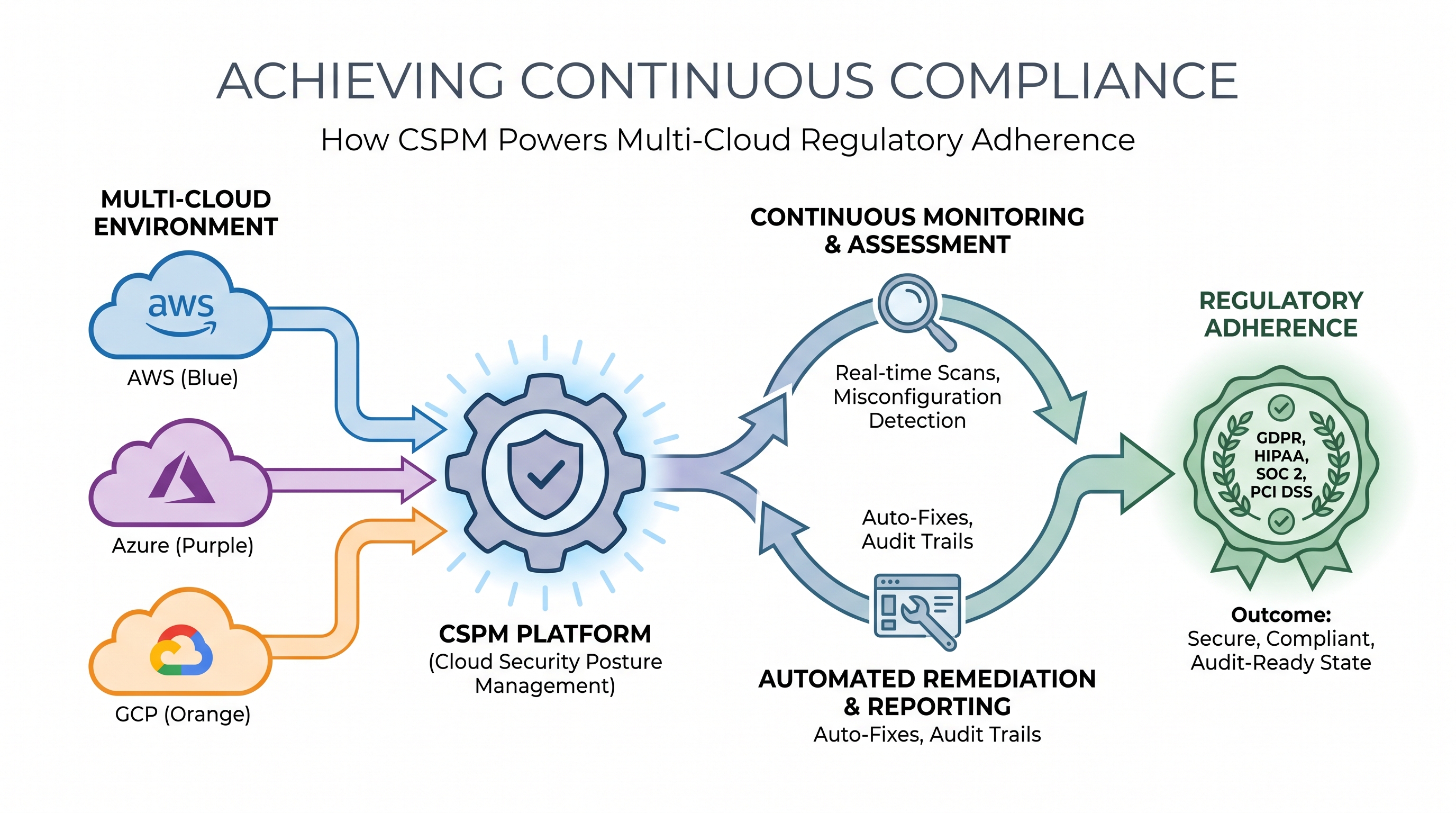
In the relentless pursuit of digital transformation, enterprises are increasingly adopting multi-cloud strategies, leveraging the distinct advantages offered by AWS, Azure, Google Cloud Platform (GCP), and even Oracle Cloud Infrastructure (OCI). While this distributed architecture fosters agility and resilience, it simultaneously introduces a formidable challenge: maintaining continuous regulatory compliance across a fragmented, dynamic infrastructure. The sheer volume of cloud resources, coupled with an ever-evolving regulatory landscape encompassing standards like PCI DSS, HIPAA, GDPR, SOC 2, NIST, and ISO 27001, renders traditional, manual compliance methods obsolete and dangerously inefficient. This is where Cloud Security Posture Management (CSPM) emerges not just as a tool, but as a strategic imperative, providing the automated intelligence and control necessary to achieve and sustain multi-cloud regulatory adherence.
The Multi-Cloud Compliance Conundrum: A Technical Deep Dive
The complexity of multi-cloud compliance stems from several core technical and operational challenges:
Fragmented Visibility and Control Planes: Each cloud provider offers its own set of security services, APIs, and management consoles. Consolidating security events, configuration data, and audit logs from AWS CloudTrail, Azure Activity Log, GCP Audit Logs, and OCI Audit Service into a unified view is a monumental task. Without a centralized aggregation point, identifying and remediating non-compliant configurations becomes a reactive, siloed effort.
Dynamic Infrastructure and Ephemeral Resources: Cloud environments are characterized by rapid provisioning, auto-scaling, and ephemeral resources (e.g., serverless functions, containers). Traditional security scanning, often scheduled or agent-based, struggles to keep pace. A resource might be provisioned, misconfigured, exploited, and de-provisioned before a manual scan can even detect its existence, let alone its compliance status.
Policy Sprawl and Inconsistent Enforcement: Organizations often adopt cloud-native policies (e.g., AWS Config rules, Azure Policies, GCP Organization Policies) within each cloud. However, translating enterprise-wide compliance mandates (e.g., "all sensitive data storage must be encrypted at rest and in transit") into consistent, enforceable policies across disparate cloud platforms is a significant architectural hurdle. Discrepancies lead to compliance gaps and increased risk.
Skill Gaps and Operational Overhead: Maintaining deep expertise across multiple cloud security domains is challenging. Security teams are often stretched thin, spending excessive time on manual reviews, evidence collection, and remediation coordination. This not only increases operational costs but also introduces human error, directly impacting compliance posture.
Audit Fatigue and Evidence Generation: Regular audits require comprehensive evidence of compliance. Manually collecting configuration snapshots, access logs, and policy enforcement records from multiple cloud providers is a labor-intensive, error-prone process. Auditors demand irrefutable proof of continuous adherence, not just point-in-time snapshots.
FinOps and Security Disconnect: Non-compliant resources often incur unnecessary costs or lead to security incidents with significant financial repercussions. For instance, unencrypted S3 buckets not only violate data protection mandates but can also lead to data breaches, resulting in fines and reputational damage. Conversely, overly restrictive security policies without FinOps considerations can lead to inefficient resource utilization.
Understanding Cloud Security Posture Management (CSPM)
CSPM is a category of security tools designed to continuously monitor and improve the security posture of cloud environments. At its core, CSPM automates the process of identifying misconfigurations, policy violations, and compliance risks across an organization's cloud infrastructure. Unlike traditional security tools that focus on network perimeter defense or endpoint protection, CSPM operates at the cloud control plane level, analyzing the configuration of cloud services themselves.
Core Functions of CSPM:
Automated Discovery and Inventory: CSPM tools connect to cloud provider APIs (e.g., AWS Management Console, Azure Resource Manager, GCP Cloud APIs, OCI API) to automatically discover and inventory all provisioned resources across accounts, subscriptions, and projects. This includes compute instances, storage buckets, databases, network configurations, identity and access management (IAM) policies, and serverless functions.
Continuous Configuration Assessment: Once resources are inventoried, CSPM continuously assesses their configurations against a predefined set of security benchmarks, best practices, and regulatory frameworks. This involves evaluating settings like encryption status for storage, network ACLs, public accessibility of resources, IAM role permissions, and security group rules.
Policy Enforcement and Drift Detection: CSPM enables the definition of security policies (e.g., "all S3 buckets must be private," "all VMs must have security updates applied"). It then monitors for any deviations from these policies. When a misconfiguration occurs (e.g., a developer accidentally makes an S3 bucket public), CSPM detects this "configuration drift" in near real-time.
Risk Prioritization and Remediation Guidance: Not all misconfigurations carry the same risk. CSPM platforms often use contextual intelligence (e.g., resource tags, data sensitivity, network exposure) to prioritize findings, helping security teams focus on the most critical vulnerabilities. They also provide actionable remediation steps, often with automated fix options.
Compliance Reporting and Audit Readiness: CSPM tools map detected misconfigurations directly to specific controls within various regulatory frameworks (e.g., PCI DSS Requirement 2.2, HIPAA Security Rule 164.312). This capability is crucial for generating comprehensive, auditable reports that demonstrate continuous adherence to industry standards.
CSPM as the Engine for Continuous Compliance
Continuous compliance is the ongoing process of ensuring that an organization's systems and data consistently meet regulatory requirements, rather than just at audit time. CSPM is fundamental to this paradigm shift.
Automated Discovery and Inventory for Foundational Visibility
Before an organization can enforce compliance, it must know what assets it possesses and where they reside. CSPM's automated discovery process is the bedrock of multi-cloud compliance. By integrating directly with cloud provider APIs, a robust CSPM platform can:
Identify Shadow IT: Discover resources provisioned outside of approved channels, bringing them under compliance scrutiny.
Map Interdependencies: Understand how different resources are connected, which is crucial for assessing blast radius during a compliance violation.
Maintain a Real-time Asset Inventory: Provide an always-up-to-date catalog of all cloud assets, their configurations, and their compliance status across AWS, Azure, GCP, and OCI. This consolidated view, often presented through a unified dashboard, is indispensable for large enterprises.
Real-time Policy Enforcement and Drift Detection
The dynamic nature of cloud environments necessitates real-time monitoring. CSPM solutions continuously evaluate configurations against defined policies. Consider a scenario where an organization has a policy mandating that all compute instances must belong to a specific virtual private cloud (VPC) or virtual network (VNet) and have specific security groups/network security groups (NSGs) applied. If a developer provisions a new instance that deviates from this policy, the CSPM solution immediately flags it. This proactive detection prevents non-compliant configurations from persisting and escalating into significant risks.
Furthermore, CSPM can detect "configuration drift" – instances where an initially compliant resource later becomes non-compliant due to manual changes or automated processes. For example, if an S3 bucket with sensitive data is initially configured for private access but is later inadvertently made public, CSPM will detect this change and alert the security team, often within minutes.
Mapping to Regulatory Frameworks and Industry Benchmarks
One of the most powerful features of CSPM is its ability to translate complex regulatory requirements into actionable, technical controls. A sophisticated CSPM platform provides built-in frameworks and benchmarks:
PCI DSS: Ensuring cardholder data environments (CDEs) meet stringent requirements for network segmentation, access control, encryption, and vulnerability management.
HIPAA: Verifying that Protected Health Information (PHI) is adequately secured, encrypted, and access-controlled according to privacy and security rules.
GDPR: Confirming data processing activities, data residency, and data subject rights are upheld, particularly concerning personally identifiable information (PII).
NIST CSF/SP 800-53: Adhering to comprehensive security and privacy controls often required by government agencies and their contractors.
ISO 27001: Demonstrating robust Information Security Management System (ISMS) controls across the organization.
SOC 2: Providing assurance over the security, availability, processing integrity, confidentiality, and privacy of systems.
CIS Benchmarks: Implementing industry-recognized hardening guidelines for various cloud services and operating systems.
By mapping cloud resource configurations directly to these controls, CSPM automates much of the evidence collection process, significantly streamlining audits and demonstrating ongoing adherence.
Prioritized Remediation Workflows and FinOps Integration
Detecting non-compliance is only half the battle; effective remediation is critical. CSPM platforms often integrate with ITSM tools (e.g., ServiceNow, Jira) to create automated remediation workflows. Findings are prioritized based on severity, potential impact, and associated compliance framework, allowing security teams to address the most critical risks first. For instance, a publicly exposed database containing PII will be prioritized over a non-critical development server missing a specific tag.
From a FinOps perspective, CSPM data provides crucial insights. Non-compliant resources can often be cost-inefficient. For example, over-provisioned resources that are also non-compliant (e.g., an unencrypted, underutilized database) represent both a security risk and a financial drain. A platform that unifies FinOps and security, like CloudAtler, can correlate these insights. By identifying and remediating non-compliant resources, organizations can simultaneously reduce their attack surface and optimize cloud spend. The ability to perform cost impact calculation for proposed remediations further empowers FinOps teams to make informed, risk-aware decisions.
Audit Readiness and Automated Reporting
Manual audit preparation is a notorious time sink. CSPM automates the generation of compliance reports, providing auditors with a clear, verifiable record of security posture over time. These reports can detail:
Current compliance status against selected frameworks.
Historical trends of compliance posture.
Details of all detected violations, including the resource, the policy violated, and the remediation actions taken.
Evidence of continuous monitoring and enforcement.
This capability dramatically reduces audit fatigue, allowing organizations to focus on strategic initiatives rather than reactive data gathering.
Architectural Deep Dive: Integrating CSPM into a Multi-Cloud Enterprise
Implementing a robust CSPM solution in a multi-cloud environment requires careful architectural consideration. The goal is to create a centralized security and compliance hub that ingests data, applies policies, and orchestrates remediation across disparate cloud providers.
1. Data Ingestion Layer
The foundation of any CSPM is its ability to ingest configuration and activity data from various cloud sources. This is typically achieved via:
Cloud Provider APIs: The primary mechanism. CSPM platforms utilize read-only API keys or IAM roles (e.g., AWS IAM, Azure Active Directory, GCP IAM, OCI IAM) to query resource configurations (e.g., S3 bucket policies, VM network settings, database encryption status).
Cloud-Native Logging and Monitoring Services: Integrating with services like AWS CloudTrail, Azure Activity Log, GCP Audit Logs, and OCI Audit Service provides event-driven data, enabling near real-time detection of configuration changes and security events.
Agent-Based Collection (Optional but beneficial): For deeper insights into operating system configurations or specific application settings within VMs, lightweight agents might be deployed. However, CSPM primarily focuses on the cloud control plane.
Data is often normalized and enriched upon ingestion to create a unified data model, abstracting away cloud-specific terminology for consistent policy application.
2. Centralized Policy Engine
At the heart of the CSPM is a powerful policy engine that defines, evaluates, and enforces compliance rules. This engine typically:
Houses Built-in Frameworks: Pre-packaged policies aligned with common regulations (PCI DSS, HIPAA, etc.) and best practices (CIS Benchmarks).
Supports Custom Policies: Allows organizations to define their own specific security and compliance requirements using domain-specific languages or GUI-based policy builders. For example, a custom policy might dictate that "all EC2 instances tagged 'production' must have vulnerability scanning enabled."
Evaluates Policies Continuously: The engine constantly compares ingested configuration data against the defined policies, identifying deviations.
Contextualizes Findings: Uses metadata (tags, resource groups), environmental context (production vs. development), and threat intelligence to prioritize alerts.
This engine operates consistently across all connected cloud environments, ensuring uniform policy application regardless of the underlying provider.
3. Remediation Orchestration and Automation
When a non-compliant configuration is detected, CSPM facilitates remediation. This can involve:
Automated Remediation: For low-risk, well-understood issues, CSPM can trigger automated actions via cloud provider APIs (e.g., disabling public access on an S3 bucket, enforcing encryption). These actions are often executed through serverless functions (Lambda, Azure Functions, Cloud Functions) or automation runbooks, often with pre-approved safe rollbacks.
Semi-Automated Remediation: Suggesting remediation steps to an operator, who then approves and executes the fix.
Manual Remediation with Workflow Integration: Creating tickets in ITSM systems (e.g., Jira, ServiceNow) with detailed remediation instructions, assigning them to the relevant engineering team.
The key is to integrate this orchestration with existing operational workflows, minimizing disruption and accelerating the time-to-remediation. CloudAtler's approach to patch remediation and broader operational automation exemplifies this integration.
4. Role-Based Access Control (RBAC) and Governance
A critical component is the CSPM platform's own RBAC model, ensuring that only authorized personnel can define policies, view compliance findings, or trigger remediations. This also extends to integrating with organizational identity providers (IdPs) like Okta or Azure AD for single sign-on (SSO) and centralized user management.
Furthermore, CSPM is a critical enabler for cloud governance. By enforcing policies and providing visibility, it helps organizations maintain control over their dynamic cloud estate. Features like guardrails within a FinOps platform like CloudAtler can prevent non-compliant resource deployments from the outset, acting as a preventative layer.
Example Scenario: Financial Institution Managing PCI DSS Across AWS and Azure
Consider a financial institution processing credit card transactions, requiring PCI DSS compliance. They utilize AWS for their primary CDE and Azure for analytics and development environments, which also touch sensitive data.
Discovery: The CSPM platform connects to both AWS accounts and Azure subscriptions, discovering all EC2 instances, S3 buckets, RDS databases, Azure VMs, Azure SQL Databases, and associated network configurations.
Policy Mapping: The institution activates the PCI DSS framework within the CSPM. This automatically translates PCI DSS requirements (e.g., Requirement 2.2 for secure configurations, Requirement 3 for data protection, Requirement 4 for encryption in transit) into specific technical checks for both AWS and Azure resources.
Real-time Monitoring:
AWS: CSPM continuously checks if all S3 buckets containing cardholder data are encrypted at rest (SSE-KMS or SSE-S3), private, and have versioning enabled. It verifies that EC2 instances in the CDE are part of specific security groups, have no public IPs, and are running approved AMIs.
Azure: CSPM ensures Azure SQL Databases storing sensitive data enforce Transparent Data Encryption (TDE), are not publicly accessible, and have robust firewall rules. It checks Azure VMs for NSG configurations and approved images.
Drift Detection: If an engineer accidentally modifies an NSG in Azure to expose a database publicly, or if an S3 bucket policy is relaxed in AWS, the CSPM immediately flags the violation.
Prioritized Remediation: The CSPM prioritizes these findings as "critical" due to their PCI DSS impact. It automatically triggers an alert to the security operations center (SOC) and creates a high-priority ticket in Jira with suggested remediation steps (e.g., "apply S3 bucket policy 'deny-public-access'," "re-apply Azure NSG 'CDE-DB-Protection'"). For some low-risk, high-frequency issues, it might even auto-remediate.
Audit Reporting: During an annual PCI DSS audit, the institution can generate a comprehensive report from the CSPM, detailing all PCI DSS controls, the status of relevant resources in both AWS and Azure, and a full audit trail of detected violations and remediation actions, demonstrating continuous adherence.
FinOps and Compliance: A Synergistic Relationship
The intersection of FinOps and cloud security compliance is critical for enterprise success. Non-compliance is not merely a security risk; it carries substantial financial implications:
Fines and Penalties: Regulatory bodies impose significant fines for data breaches or failure to comply with mandates like GDPR, HIPAA, or PCI DSS.
Reputational Damage: Compliance failures erode customer trust, leading to loss of business and long-term brand damage.
Operational Inefficiencies: Manual compliance processes are costly in terms of labor and time. Remediation efforts post-breach are even more expensive.
Increased Insurance Premiums: Non-compliant organizations may face higher cybersecurity insurance costs or even be denied coverage.
CSPM, particularly when integrated into a broader FinOps platform, offers tangible benefits beyond risk reduction:
Cost of Non-Compliance vs. Cost of Compliance: CSPM helps quantify the cost of potential non-compliance (e.g., estimated fines, breach costs) against the investment in proactive compliance, making a strong business case for security.
Resource Optimization through Compliance: Identifying non-compliant resources can often lead to cost savings. For example, a CSPM might flag an unencrypted, unmanaged database instance that also happens to be over-provisioned and underutilized. Remediating its security posture might involve rightsizing or even decommissioning it, leading to direct cost savings.
Automated Tagging for Governance and Cost Allocation: Compliance often hinges on proper resource tagging (e.g., "environment:production," "data-classification:PHI"). CSPM can enforce automated tagging policies, ensuring resources are correctly categorized for both compliance reporting and accurate cost allocation. This is a core FinOps practice.
Proactive Budgeting for Compliance Initiatives: By providing clear visibility into the compliance posture and potential gaps, FinOps teams can proactively budget for necessary security tools, training, and remediation efforts, rather than reacting to costly incidents. CloudAtler's capabilities in budget-aware planning are instrumental here.
CloudAtler's unique value proposition is its ability to unify FinOps, cloud security, and automated operations. This integrated approach ensures that security decisions are informed by financial impact and that cost optimization efforts do not inadvertently introduce security risks. Our financial operations platform provides a holistic view, enabling enterprises to balance innovation, security, and cost-efficiency.
Advanced CSPM Capabilities: AI-Powered Insights and Predictive Compliance
Modern CSPM solutions are evolving beyond basic configuration checks, leveraging AI and machine learning to offer more sophisticated capabilities:
Anomaly Detection: AI algorithms can establish a baseline of normal cloud resource behavior and configurations. Any significant deviation, even if not directly violating a predefined policy, can be flagged as an anomaly, potentially indicating an emerging threat or misconfiguration.
Predictive Compliance: By analyzing historical compliance trends, configuration changes, and threat intelligence, AI can help predict future compliance risks. For example, identifying patterns in developer activities that frequently lead to specific types of misconfigurations.
Contextual Risk Scoring: AI can provide more nuanced risk scores by considering factors beyond just the policy violation itself, such as the resource's criticality, network exposure, data sensitivity, and the potential blast radius. This enables more intelligent prioritization of remediation efforts.
Automated Policy Generation and Refinement: AI can assist in generating new policies based on observed configurations and industry best practices, and even suggest refinements to existing policies to improve their effectiveness or reduce false positives.
Patch Intelligence and Management: Vulnerability management is a critical aspect of compliance. Advanced CSPM, especially when integrated into an operational intelligence platform, can incorporate patch intelligence. This involves identifying missing patches, assessing their security and operational impact, and even automating remediation. CloudAtler's patch remediation features provide a comprehensive solution, including pre-patch impact analysis and post-patch validation, ensuring that security updates are applied without introducing new operational issues or cost overruns.
Implementing CSPM with CloudAtler: A Unified Approach
CloudAtler is designed to address the multifaceted challenges of multi-cloud management, unifying FinOps, cloud security, and automated operations. Our AI-powered platform provides the capabilities essential for achieving continuous compliance across AWS, Azure, GCP, and Oracle environments.
Unified Visibility and Control: Our unified dashboard provides a single pane of glass for all your cloud assets, security posture, and financial data across all providers. This eliminates fragmentation and gives you complete visibility into your compliance landscape.
Comprehensive Security Management: CloudAtler’s security management features continuously monitor your cloud configurations against industry benchmarks and regulatory frameworks. We detect misconfigurations, policy violations, and compliance drift in real-time, offering granular insights into your risk posture.
AI-Powered Insights for Proactive Compliance: Leveraging Atler AI, we provide intelligent insights, anomaly detection, and predictive analytics to help you anticipate compliance risks before they materialize. This moves you from reactive remediation to proactive prevention.
Automated Governance and Guardrails: Implement preventative controls with our guardrails feature, ensuring that resources are provisioned in a compliant state from the outset. Our automated tagging capabilities ensure consistent resource classification, crucial for both compliance reporting and accurate cost allocation.
Intelligent Patching and Vulnerability Management: CloudAtler integrates patch intelligence and patch remediation to ensure your systems are continuously secured against vulnerabilities. We analyze the financial and operational impact of patches, enabling informed decisions and automated, validated deployments.
FinOps-Integrated Remediation: Every security remediation has a potential cost impact. Our platform provides cost impact calculation for remediation actions, allowing security and FinOps teams to collaborate on solutions that are both secure and cost-efficient.
Audit-Ready Reporting: Generate comprehensive, auditable reports on demand, demonstrating continuous adherence to regulatory standards across your multi-cloud estate.
Best Practices for Maximizing CSPM Effectiveness
To fully leverage the power of CSPM for continuous compliance, consider these best practices:
Define Clear Compliance Objectives: Before deploying a CSPM, clearly articulate which regulatory frameworks (e.g., PCI DSS, HIPAA, GDPR) and internal policies are critical. This guides policy configuration and reporting.
Integrate into CI/CD Pipelines: Shift left on compliance. Integrate CSPM checks into your CI/CD pipelines to catch misconfigurations and policy violations during the development and deployment phases, preventing them from reaching production.
Foster Cross-Functional Collaboration: Compliance is a shared responsibility. Ensure close collaboration between security, operations, development, and finance teams. CSPM provides a common language and data set for these teams to work together effectively.
Regularly Review and Update Policies: Cloud services evolve rapidly, and so do regulations. Regularly review and update your CSPM policies to reflect changes in your cloud environment, new services, and updated compliance requirements.
Automate Judiciously: While automated remediation is powerful, start with lower-risk issues. For critical systems, implement semi-automated workflows that require human approval, especially for actions with significant potential impact. Utilize features like CloudAtler's safe rollbacks to mitigate risks associated with automation.
Leverage Contextual Prioritization: Don't treat all findings equally. Use CSPM's capabilities to prioritize risks based on resource criticality, data sensitivity, and actual exposure, focusing efforts where they matter most.
Educate Your Teams: Provide training to cloud engineers and developers on security best practices and compliance requirements. CSPM can also serve as an educational tool, explaining why certain configurations are non-compliant.
Conclusion
Achieving continuous compliance in a multi-cloud enterprise is no longer an aspiration but a fundamental requirement for business continuity, risk management, and financial integrity. The complexity and dynamism of modern cloud environments demand an automated, intelligent, and unified approach. Cloud Security Posture Management (CSPM) is the indispensable technology that provides real-time visibility, automated policy enforcement, and streamlined remediation across fragmented cloud landscapes.
By integrating CSPM with robust FinOps practices and intelligent automation, organizations can transform compliance from a reactive, resource-intensive burden into a proactive, efficient, and cost-aware operational discipline. This synergy ensures not only regulatory adherence but also optimizes cloud spend and strengthens overall security posture.
Don't let multi-cloud complexity compromise your compliance or inflate your costs. It's time to unify your cloud operations. Discover how CloudAtler’s AI-powered platform can help you achieve continuous compliance, optimize your FinOps, and automate your multi-cloud operations across AWS, Azure, GCP, and Oracle. Visit CloudAtler.com today to schedule a demo and transform your cloud journey.
All in One Place
Atler Pilot decodes your cloud spend story by bringing monitoring, automation, and intelligent insights together for faster and better cloud operations.