
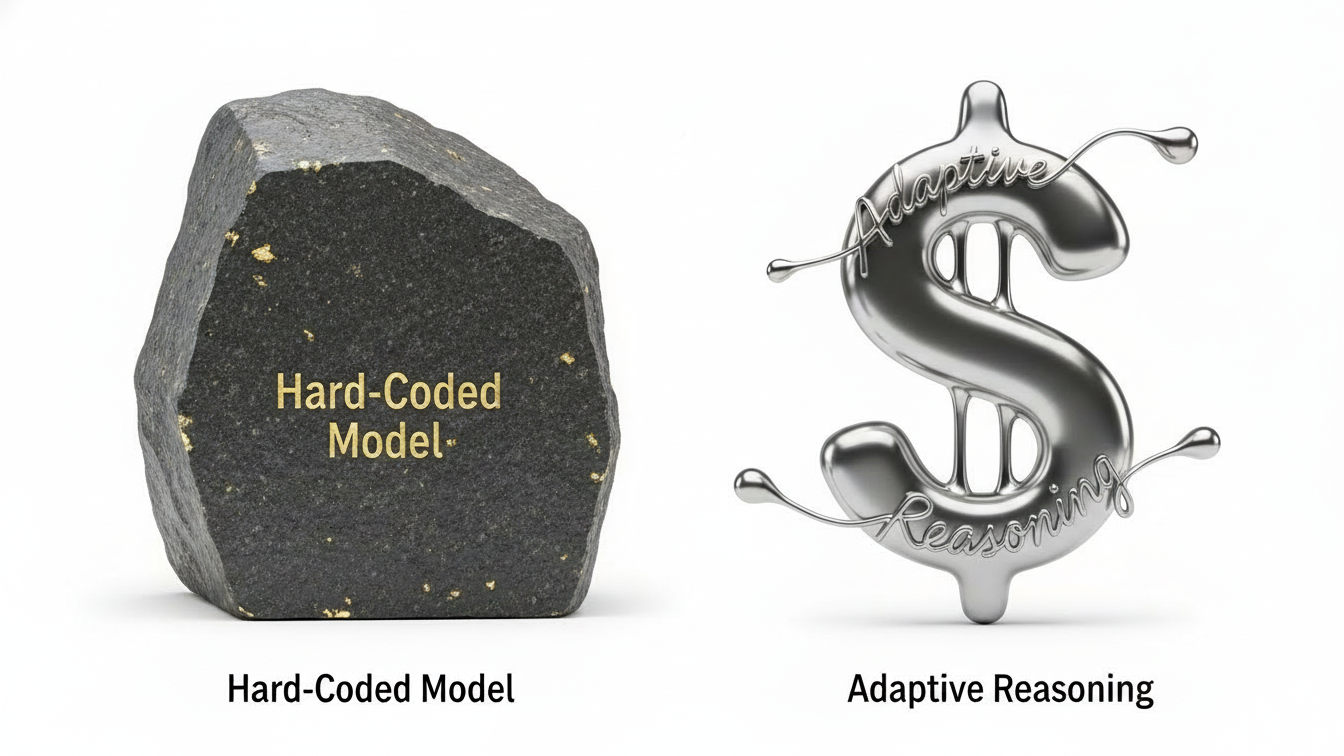
In 2025, the most dangerous configuration in an AI application is a hard-coded model reference. If you are statically pointing to openai/o1 or deepseek-reasoner for every user interaction, you are burning capital on "over-thinking." Not all problems require deep reasoning. Asking a reasoning model to "extract the date from this email" is like hiring a mathematician to calculate a restaurant tip. It works, but it's an economic disaster.
The solution is Adaptive Reasoning—dynamically adjusting the computational effort based on the complexity of the task.
The Economics of "Thinking Tokens"
Reasoning models bill you for the internal tokens they generate while solving a problem.
Low Effort: A simple classification might take 500 thinking tokens.
High Effort: A complex architectural proof might take 20,000 thinking tokens.
If you default to "High Effort" (or let the model decide without constraints), you pay the maximum price for minimum value on simple tasks.
Technique 1: The reasoning_effort Parameter
API providers (OpenAI, Azure, and DeepSeek via some gateways) now support a reasoning_effort parameter. This allows you to constrain the budget of thinking tokens.
Code Example (Python):
Python
def intelligent_query(user_prompt, complexity_score):
    # Map complexity (1-10) to effort level
    if complexity_score < 3:
        # Use standard model (No reasoning cost)
        return client.chat.completions.create(
            model="gpt-4o-mini",
            messages=[{"role": "user", "content": user_prompt}]
        )
    elif complexity_score < 7:
        # Low reasoning budget for intermediate tasks
        return client.chat.completions.create(
            model="o1",
            reasoning_effort="low", # Capped at ~2k tokens
            messages=[{"role": "user", "content": user_prompt}]
        )
    else:
        # Full reasoning for hard problems
        return client.chat.completions.create(
            model="o1",
            reasoning_effort="high", # Uncapped
            messages=[{"role": "user", "content": user_prompt}]
        )
Technique 2: The "Two-Pass" Classifier
How do you determine complexity_score? You use a cheap model to judge the prompt.
Pass 1 (The Router): Send the user prompt to a 1B parameter model (Llama 3.2) with a specific system instruction: "Rate the logical complexity of this request on a scale of 1-10. Output only the number".
Pass 2 (The Worker): Use the output number to select the model or effort level defined above.
Cost Impact:
Without Adaptation: 1,000 queries @ $0.06 (Avg o1 cost) = $60.00
With Adaptation:
300 trivial queries @ $0.001 (GPT-4o-mini)
500 medium queries @ $0.02 (o1-low)
200 hard queries @ $0.06 (o1-high)
Total: $22.30.
The Verdict
Implementing Adaptive Reasoning adds roughly 100ms of latency (for the classification step) but reduces blended inference costs by 63%. In high-volume agentic loops, this architectural pattern is the difference between a profitable product and a money pit.
All in One Place
Atler Pilot decodes your cloud spend story by bringing monitoring, automation, and intelligent insights together for faster and better cloud operations.