
The Multi-Cloud FinOps Imperative: Beyond Reactive Cost Management
In today's enterprise landscape, multi-cloud adoption is no longer an anomaly but a strategic imperative. Organizations leverage AWS, Azure, GCP, and Oracle Cloud Infrastructure (OCI) simultaneously, seeking best-of-breed services, redundancy, and geopolitical compliance. While this distributed architecture offers unparalleled agility and resilience, it introduces a labyrinthine challenge for financial oversight: managing costs. Traditional FinOps, often reliant on manual data aggregation, spreadsheet analysis, and reactive adjustments, struggles to keep pace with the dynamic, ephemeral nature of multi-cloud spend.
The core problem isn't just the volume of data, but its disparate nature. Each cloud provider has its own billing constructs, service nomenclature, discount models (Reserved Instances, Savings Plans, Committed Use Discounts), and monitoring tools. Aggregating this information into a cohesive, actionable view is a Herculean task, often leading to siloed insights, delayed decision-making, and significant financial leakage. Enterprises find themselves constantly playing catch-up, reacting to budget overruns rather than proactively shaping their cloud financial destiny.
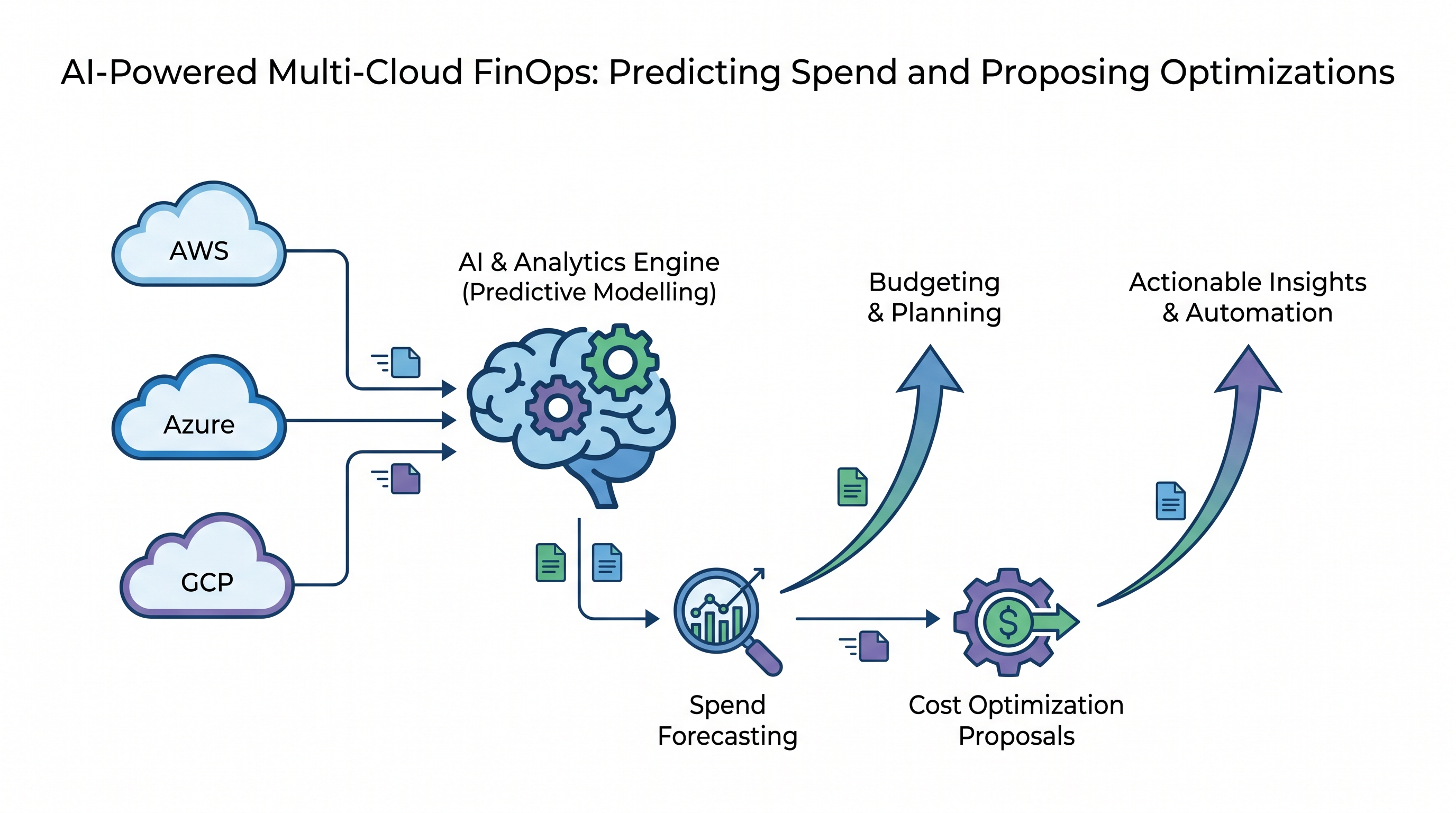
This is where AI-powered FinOps emerges as a transformative force. By leveraging advanced machine learning, predictive analytics, and automation, businesses can transcend reactive cost management, gaining unprecedented foresight into future spend and intelligently identifying the most impactful optimization opportunities. The goal is not merely to cut costs, but to optimize value, ensuring every dollar spent in the cloud directly contributes to business objectives.
Architecting for AI-Powered Multi-Cloud FinOps: The Data Foundation
The bedrock of any effective AI strategy is data. For multi-cloud FinOps, this means consolidating and normalizing vast streams of usage and cost data from every connected cloud environment. This is a non-trivial architectural undertaking.
Unified Data Ingestion and Normalization
An AI-powered FinOps platform must establish robust integrations with the billing and usage APIs of all major cloud providers. This includes:
AWS: Cost and Usage Reports (CUR), CloudWatch metrics, EC2/RDS/S3 usage data.
Azure: Cost Management APIs, Azure Monitor metrics, Billing APIs.
GCP: Cloud Billing Export to BigQuery, Stackdriver Monitoring.
Oracle Cloud: Usage Reports, Monitoring APIs.
Once ingested, this raw, provider-specific data must undergo a rigorous normalization process. This involves standardizing resource names, cost categories, tagging schemes, and metric units across all clouds. For instance, an AWS EC2 instance, an Azure VM, a GCP Compute Engine instance, and an OCI Compute instance, despite their inherent differences, must be mapped to a common resource type for unified analysis. Similarly, CPU utilization metrics (e.g., CloudWatch CPUUtilization, Azure Monitor Percentage CPU) need to be harmonized.
This normalized data is then typically stored in a centralized, scalable data lake or data warehouse (e.g., Snowflake, Databricks, Amazon S3 with Athena, Azure Data Lake with Synapse Analytics). This serves as the single source of truth for all subsequent analytical and AI model training processes. A unified dashboard is critical for visualizing this aggregated data, providing a holistic view that transcends individual cloud provider consoles.
Predictive Spend Forecasting: Anticipating the Future of Cloud Costs
One of the most immediate and impactful applications of AI in FinOps is accurate spend prediction. Gone are the days of relying solely on historical averages or simple linear extrapolations. Modern AI models can account for a multitude of factors, delivering granular and reliable forecasts.
Advanced Time-Series Forecasting Models
AI-powered FinOps platforms employ sophisticated time-series forecasting models to predict future cloud spend. Common techniques include:
ARIMA/SARIMA: Autoregressive Integrated Moving Average models, including seasonal variants, are excellent for capturing trends and seasonality in historical spend data. They require stationary data, often necessitating differencing.
Prophet (Facebook): A robust forecasting library designed for business time series, capable of handling seasonality, holidays, and missing data. It's particularly effective for data with multiple seasonalities (daily, weekly, yearly).
LSTM (Long Short-Term Memory) Networks: A type of recurrent neural network (RNN) well-suited for sequence prediction tasks. LSTMs can learn long-term dependencies in time series data, making them powerful for complex, non-linear spend patterns.
Gradient Boosting Machines (e.g., XGBoost, LightGBM): While not strictly time-series models, these can be adapted for forecasting by creating lagged features and incorporating temporal information. They excel at capturing complex interactions between features.
Feature Engineering for Enhanced Accuracy
The accuracy of these models heavily depends on the features fed into them. Beyond historical spend, effective feature engineering includes:
Resource Usage Metrics: CPU utilization, memory consumption, network I/O, storage capacity, database connections. These are leading indicators of cost.
Business Events: Product launches, marketing campaigns, peak sales seasons, major software deployments, migration projects. These can cause predictable spikes in resource demand.
Economic Factors: Exchange rate fluctuations (for multi-national organizations), inflation rates (though less immediate impact on cloud).
Cloud Provider Promotions/Price Changes: While less predictable, incorporating known future changes can refine forecasts.
Tagging and Metadata: Properly implemented tags (e.g.,
project:X,environment:prod,owner:teamY) allow for granular forecasting at the business unit, application, or environment level. CloudAtler's capabilities extend to automated tagging to ensure data consistency.
The platform must be able to perform budget forecasting with high confidence, offering not just a single prediction, but a range with confidence intervals (e.g., "spend will be between $X and $Y with 90% certainty"). This enables better financial planning and uncertainty planning.
Granularity and Scenario Planning
Effective forecasting isn't just about total cloud spend. It needs to be granular:
Per Cloud Provider: AWS vs. Azure vs. GCP vs. OCI.
Per Account/Subscription/Project: For organizational accountability.
Per Service: EC2 vs. S3 vs. RDS; Azure VMs vs. Azure Storage vs. Azure SQL.
Per Business Unit/Team/Application: Enabled by robust tagging.
Furthermore, AI can facilitate scenario planning. What if a new application launches next quarter? What if a major migration shifts 20% of workloads from on-premises to AWS? The models can simulate these changes and project their financial impact, providing invaluable insights for strategic decision-making.
Intelligent Anomaly Detection: Unearthing Hidden Cost Spikes
Even with robust forecasting, unexpected events can lead to sudden, unexplained cost increases. Manual monitoring for these "anomalies" in a multi-cloud environment is like finding a needle in a haystack. AI excels at this.
Machine Learning for Anomaly Detection
AI models continuously monitor real-time spend data against predicted baselines. Techniques include:
Statistical Process Control: Simple but effective methods like control charts to identify deviations outside expected ranges.
Isolation Forests: An ensemble tree-based model that isolates anomalies by building random decision trees. Anomalies are points that require fewer splits to be isolated.
One-Class SVM (Support Vector Machine): A model trained on "normal" data to identify what constitutes typical behavior, then flags any new data point that deviates significantly from this learned normal.
Autoencoders: Neural networks that learn to compress and reconstruct data. Anomalies are data points that have high reconstruction errors, meaning the model struggles to accurately reproduce them.
When an anomaly is detected, the system doesn't just flag it; it attempts to identify the root cause. This involves correlating the cost spike with recent operational changes, resource deployments, unusual usage patterns (e.g., sudden increase in data transfer, unexpected API calls), or even security incidents. For example, a sudden surge in compute costs on GCP might be correlated with an unauthorized crypto-mining workload, which would also trigger alerts from security management features.
CloudAtler's predictive monitoring operations leverage these techniques to provide early warnings and contextual insights, allowing teams to address issues before they escalate into significant financial liabilities.
Automated Optimization Proposals: Actionable Intelligence for Cost Savings
Prediction and detection are crucial, but the real value of AI in FinOps comes from its ability to propose and, in some cases, automate optimizations. These proposals are highly contextual, data-driven, and multi-cloud aware.
Rightsizing Recommendations Across Clouds
One of the most common forms of waste is over-provisioned resources. AI analyzes historical utilization metrics (CPU, memory, network I/O, disk throughput) from each cloud provider's monitoring services (CloudWatch, Azure Monitor, GCP Monitoring, OCI Monitoring) to recommend optimal instance types or sizes. This is a complex problem due to the vast array of instance types and pricing models.
Compute Instance Rightsizing: An AI model might recommend downgrading an
m5.xlargeEC2 instance to anm5.largeif its average CPU utilization rarely exceeds 30% and memory is consistently low. Similarly, it could suggest moving an Azure VM from anDv3series to anEv3series if memory is bottlenecking while CPU is underutilized. CloudAtler's compute lifecycle analysis provides detailed insights for this.Database Rightsizing: For managed databases (RDS, Azure SQL DB, Cloud SQL), AI can recommend adjusting compute capacity, storage IOPS, or even migrating to a different database tier based on workload patterns.
Serverless Function Optimization: Analyzing Lambda/Azure Functions/Cloud Functions invocation patterns and execution times to recommend optimal memory allocation, directly impacting cost-per-invocation.
The key here is not just identifying underutilization but also considering performance impact. AI models can simulate the effect of a rightsizing recommendation on performance metrics, ensuring that cost savings do not come at the expense of application stability or user experience. This requires an understanding of workload profiles and business criticality.
Intelligent Commitment Management (RIs, Savings Plans, CUDs)
Reserved Instances (RIs), Savings Plans (SPs), and Committed Use Discounts (CUDs) offer significant savings but require foresight and careful management. AI can optimize these commitments by:
Predicting Future Base Load: Using spend forecasts to determine the stable, long-term resource demand across different instance families, regions, and operating systems.
Optimal Purchase Recommendations: Suggesting the ideal blend of 1-year vs. 3-year commitments, Convertible vs. Standard RIs, or specific Savings Plan types (Compute vs. EC2 Instance) to maximize coverage and savings across an entire multi-cloud portfolio.
Utilization Monitoring and Exchange/Modification: Proactively alerting on underutilized RIs/SPs and recommending modifications or exchanges (where supported by the cloud provider) to ensure commitments are fully leveraged. CloudAtler's commitment intelligence helps manage this complexity.
Marketplace Integration: For AWS, AI can analyze the RI marketplace for buying and selling opportunities.
This is particularly challenging in multi-cloud, as commitments are provider-specific. An AI system can analyze the aggregate usage across clouds and recommend a diversified commitment strategy.
Spot Instance and Preemptible VM Utilization
For fault-tolerant or stateless workloads, Spot Instances (AWS), Azure Spot VMs, and GCP Preemptible VMs offer substantial discounts. AI can:
Identify Suitable Workloads: Analyze workload characteristics to determine which applications can gracefully handle interruptions.
Predict Spot Price Fluctuations: Leverage historical spot market data and demand signals to predict optimal bidding strategies and availability, dynamically adjusting bids or fallback mechanisms.
Orchestrate Workloads: Integrate with container orchestrators (Kubernetes, ECS, AKS, GKE) to dynamically provision and manage workloads on spot instances, automatically shifting to on-demand if spot capacity is unavailable.
Storage Tiering and Lifecycle Management
Data storage costs can be a significant portion of the cloud bill. AI can analyze data access patterns, age, and retention policies to recommend optimal storage tiers (e.g., S3 Standard to S3 Infrequent Access, Azure Blob Hot to Cool, GCP Standard to Nearline). It can also propose automated lifecycle rules for archiving or deleting stale data.
Waste Identification and Remediation
AI can systematically scan multi-cloud environments for common sources of waste:
Idle Resources: Unattached EBS volumes, idle load balancers, unused IP addresses, unassociated Elastic IPs.
Zombie Resources: Resources left behind after a project or application has been decommissioned.
Misconfigurations: E.g., S3 buckets without lifecycle policies, databases with excessive backups.
For each identified waste, the platform provides a cost impact calculation, quantifying the potential savings. This empowers teams to prioritize remediation efforts. In some cases, low-risk remediations (e.g., deleting unattached volumes older than 90 days) can be fully automated via integration with cloud APIs, subject to predefined guardrails.
Architectural Considerations for a Unified AI-Powered FinOps Platform
Building a platform capable of these advanced functionalities requires a robust technical architecture, exemplified by CloudAtler's approach:
Multi-Cloud Data Connectors: Secure, fault-tolerant connectors to ingest raw billing, usage, and monitoring data from AWS, Azure, GCP, and Oracle OCI. This requires deep understanding of each provider's API landscape and data schemas.
Data Normalization and Transformation Engine: A powerful ETL (Extract, Transform, Load) pipeline that cleanses, standardizes, and enriches the raw data. This includes applying consistent tagging, associating costs with business units, and mapping disparate resource types.
Centralized Data Lake/Warehouse: A highly scalable, performant data store optimized for analytical queries and machine learning model training. This ensures all FinOps data is unified and readily accessible.
Machine Learning Platform (MLOps): A dedicated environment for developing, training, deploying, and managing AI/ML models. This includes:
Feature Store: To manage and serve features consistently for both training and inference.
Model Registry: To track model versions, metadata, and performance.
Automated Pipelines: For continuous training, validation, and deployment of models.
Explainable AI (XAI) Capabilities: To provide transparency into model predictions and recommendations, crucial for building trust with FinOps stakeholders.
Decision Engine and Automation Layer: This component takes the outputs from the ML models (forecasts, anomaly alerts, optimization proposals) and translates them into actionable insights or automated tasks. It integrates with cloud provider APIs to execute recommended actions (e.g., scaling down an instance, purchasing an RI) while adhering to predefined policies and guardrails.
Role-Based Access Control (RBAC) and Governance: Essential for a multi-cloud, multi-team environment. Ensures that only authorized personnel can view sensitive financial data or execute cost-impacting actions. Integrates with existing identity providers.
Unified User Interface (UI): A single pane of glass for all FinOps insights, dashboards, reports, and controls. This reduces cognitive load and accelerates decision-making for various personas (finance, engineering, leadership).
The synergy between Atler AI and the overarching CloudAtler Financial Operations Platform is precisely this architectural integration, unifying these complex components into a seamless, intelligent system.
Integrating FinOps with Cloud Security and Automated Operations
True cloud maturity extends beyond cost optimization to encompass security and operational excellence. AI-powered FinOps platforms, like CloudAtler, recognize this intrinsic link.
Security-Aware FinOps:
Cost of Insecurity: AI can highlight the financial impact of security vulnerabilities. For example, open S3 buckets might not directly incur a "security cost" but lead to data breaches with massive financial penalties. Unpatched systems might require costly emergency remediation.
Rogue Resource Detection: Anomalies in spend can often indicate unauthorized resource deployments, which are not just a cost issue but a significant security risk. AI-powered FinOps can flag these for security teams.
Compliance Cost Optimization: Identifying cheaper, compliant alternatives for data storage or processing without compromising regulatory requirements.
FinOps-Driven Automated Operations:
Cost-Aware Auto-Scaling: Integrating FinOps insights into auto-scaling policies to ensure that scaling events are not only performance-driven but also cost-optimized.
Automated Remediation: Beyond simple waste removal, AI can trigger automated actions for identified cost anomalies or underutilized resources, like spinning down non-production environments during off-hours or migrating data to cheaper storage tiers.
Capacity Planning Integration: FinOps forecasts directly feed into capacity planning for engineering teams, ensuring resources are provisioned efficiently from the outset.
This holistic approach is what defines a truly intelligent cloud management platform, where FinOps, security, and operations are not separate silos but interwoven disciplines, all enhanced by AI.
Implementing AI-Powered FinOps: A Phased Enterprise Journey
Adopting AI-powered FinOps is a journey, not a sprint. Enterprises should approach it in phases:
Phase 1: Data Foundation and Visibility (1-3 months):
Connect all cloud accounts and billing sources to the FinOps platform.
Establish a robust tagging strategy and initiate automated tagging.
Gain consolidated visibility into current and historical spend across all clouds via a unified dashboard.
Identify initial areas of obvious waste (e.g., unattached volumes).
Phase 2: Predictive Insights and Anomaly Detection (3-6 months):
Start collecting sufficient historical data to train initial AI models.
Implement basic spend forecasting at a high level (e.g., per cloud, per business unit).
Deploy anomaly detection to identify unexpected cost spikes.
Educate teams on interpreting forecasts and anomaly alerts.
Phase 3: Intelligent Optimization Proposals (6-12 months):
Refine AI models with more data and features.
Enable granular optimization recommendations: rightsizing, commitment strategy, storage tiering.
Implement a review and approval workflow for recommendations.
Start with low-risk, manual execution of recommendations to build confidence.
Phase 4: Automation and Continuous Improvement (12+ months):
Gradually introduce automated execution of low-risk, high-impact optimizations (e.g., scheduled shutdown of non-prod environments).
Integrate FinOps insights into CI/CD pipelines and infrastructure-as-code (IaC) processes.
Continuously monitor model performance, retrain models, and adapt to evolving cloud services and pricing.
Foster a culture of FinOps across engineering, finance, and operations teams, making cost accountability a shared responsibility.
Each phase builds upon the previous, ensuring a gradual, controlled, and impactful transition to a truly AI-driven financial operations model.
Conclusion: Unifying Your Cloud Operations with CloudAtler
The era of reactive, fragmented cloud cost management is over. For enterprises navigating the complexities of multi-cloud environments, AI-powered FinOps is not merely an advantage; it is a necessity. By accurately predicting future spend, intelligently detecting anomalies, and proactively proposing data-driven optimizations, organizations can transform their cloud financial operations from a drain on resources into a strategic lever for innovation and growth.
CloudAtler stands at the forefront of this transformation. Our AI-powered platform unifies FinOps, cloud security, and automated operations across AWS, Azure, GCP, and Oracle environments. We provide the intelligence, visibility, and automation needed to predict spend with unprecedented accuracy, identify waste, and execute optimizations that drive tangible business value. Stop reacting to cloud bills and start proactively shaping your cloud future.
Ready to revolutionize your multi-cloud financial operations? Explore CloudAtler today and discover how our unified platform can empower your enterprise to achieve true cloud fiscal efficiency and security.
All in One Place
Atler Pilot decodes your cloud spend story by bringing monitoring, automation, and intelligent insights together for faster and better cloud operations.