
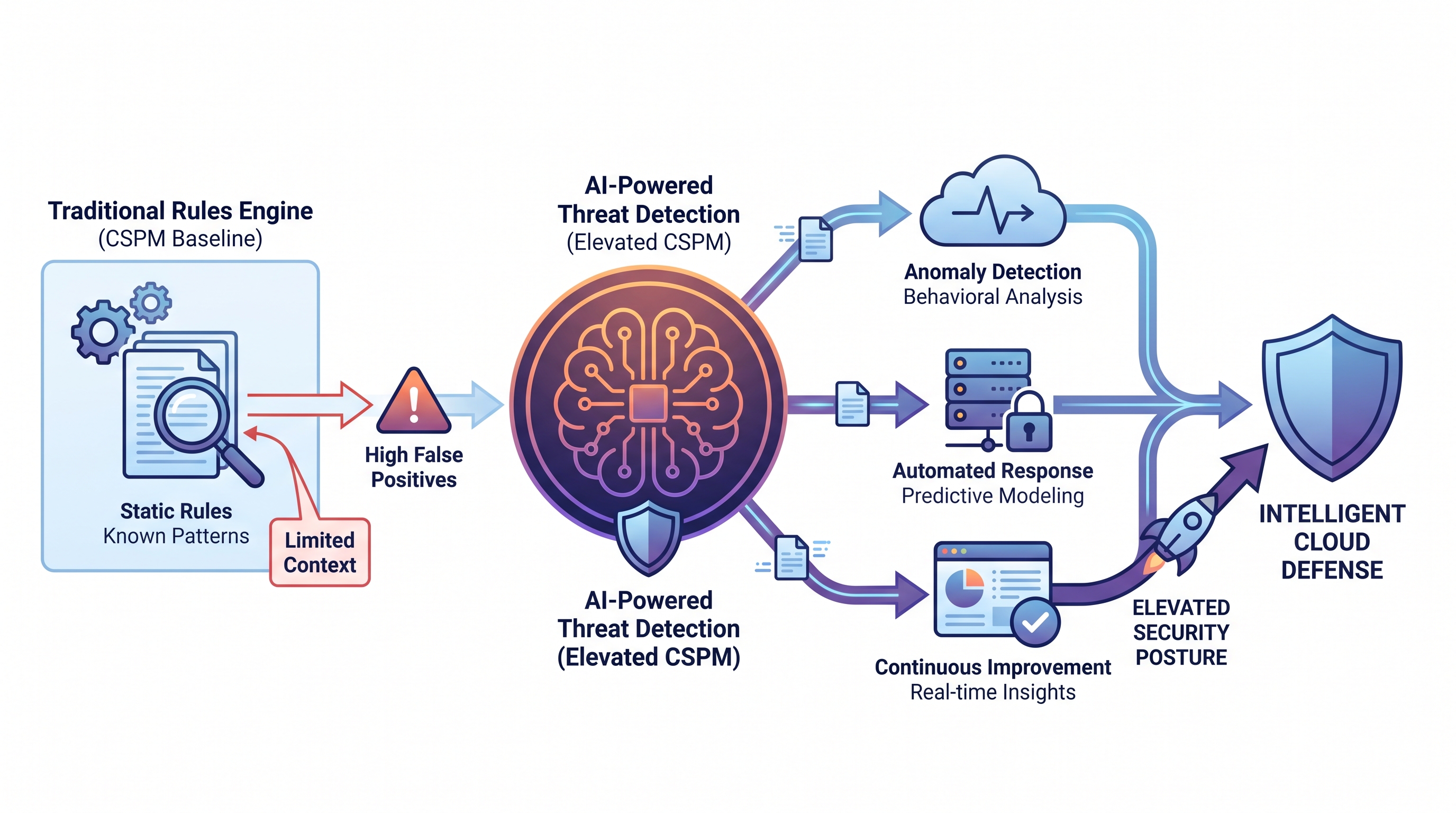
In the relentlessly evolving landscape of enterprise cloud operations, Cloud Security Posture Management (CSPM) has become a non-negotiable pillar of defense. As organizations scale their deployments across AWS, Azure, GCP, and Oracle environments, the sheer volume and velocity of infrastructure changes present an unprecedented challenge to security teams. Traditional CSPM, largely reliant on static rules engines and predefined policies, is increasingly struggling to keep pace, leaving critical vulnerabilities unaddressed and security teams drowning in a sea of alerts. The future of robust cloud security, intricately linked with efficient FinOps, demands a more intelligent, adaptive approach: AI-powered threat detection.
This deep dive will dissect the inherent limitations of conventional rules-based CSPM and articulate precisely how artificial intelligence, machine learning, and advanced analytics are not merely augmenting, but fundamentally transforming cloud security. We will explore the architectural underpinnings of AI-driven threat detection, its profound impact on FinOps optimization, and how it elevates security posture from reactive compliance to proactive, predictive defense across multi-cloud estates.
The Foundational Role of CSPM: A Double-Edged Sword
Cloud Security Posture Management solutions are designed to identify misconfigurations, compliance violations, and security risks within cloud infrastructure. At their core, these systems continuously scan cloud environments against a set of predefined security policies, industry benchmarks (like CIS, NIST, PCI DSS), and regulatory requirements (GDPR, HIPAA). For example, a CSPM might flag an S3 bucket publicly accessible, an unencrypted database, or an IAM role with overly permissive policies. This rule-based approach has been instrumental in establishing a baseline of security hygiene, providing visibility into the security posture of dynamic cloud assets.
However, the efficacy of traditional CSPM is inherently tied to the quality and comprehensiveness of its rule set. This dependency creates several critical limitations that enterprise cloud architects and security leaders must confront:
Static Nature in Dynamic Environments: Cloud environments are fluid. Resources are provisioned and de-provisioned rapidly, configurations change constantly, and ephemeral workloads are the norm. Static rules struggle to adapt to this dynamism, often leading to stale policies or an inability to assess risk in real-time.
Alert Fatigue and Noise: A rigid rule engine often generates a high volume of alerts, many of which are false positives or low-priority issues. Security teams become desensitized, increasing the risk of missing genuinely critical threats amidst the noise.
Lack of Contextual Understanding: Traditional rules engines typically operate in silos. They can identify a misconfiguration, but they often lack the contextual intelligence to understand the blast radius, the business impact, or the interdependencies with other cloud resources. Is an unencrypted S3 bucket critical if it only stores public, non-sensitive data? Is an overly permissive IAM role truly dangerous if it's assigned to a non-production account with no access to sensitive data? Without context, prioritization is guesswork.
Inability to Detect Novel Threats: Rules are based on known patterns. Zero-day exploits, sophisticated attack techniques, or novel forms of insider threat often bypass rules-based detection because there's no predefined signature or policy violation to trigger an alert.
Scalability Challenges and Manual Overhead: As cloud environments grow in complexity and scale, maintaining, updating, and fine-tuning thousands of rules across multiple cloud providers becomes an arduous, manual task. This drains valuable security engineering resources and introduces human error.
These limitations highlight a fundamental gap: traditional CSPM excels at identifying known misconfigurations, but it falls short in detecting anomalous behavior and unknown threats within the intricate web of cloud operations. This is where AI-powered threat detection steps in, fundamentally transforming the security paradigm.
The Imperative for AI in Cloud Security
The modern threat landscape is characterized by its speed, sophistication, and stealth. Attackers leverage automated tools, exploit complex supply chains, and blend into legitimate network traffic. For enterprises operating at scale, the sheer volume of telemetry data generated by cloud environments—API calls, network flow logs, configuration changes, user activity logs, application logs—is astronomical. Manually sifting through this data for indicators of compromise (IoCs) is simply impossible.
AI, particularly machine learning (ML), provides the computational power and analytical capabilities required to make sense of this chaos. It offers a path to:
Handle Data Velocity and Volume: ML algorithms can process petabytes of data in real-time, identifying subtle patterns and deviations that humans would invariably miss.
Detect Anomalies, Not Just Violations: AI can establish baselines of normal behavior for users, applications, and infrastructure, then flag any significant departure from these norms, even if no explicit rule has been violated.
Adapt to Evolving Threats: With continuous learning, AI models can adapt to new attack techniques and evolving threat landscapes without requiring constant manual rule updates.
Reduce Alert Fatigue: By correlating multiple weak signals and providing contextual scoring, AI can significantly reduce false positives and prioritize genuinely critical alerts, allowing security teams to focus on what matters most.
Enhance Predictive Capabilities: AI can analyze historical data and current trends to predict potential vulnerabilities or attack vectors before they are actively exploited.
In essence, AI moves CSPM from a reactive, signature-based approach to a proactive, behavior-based, and predictive security posture. This shift is not merely an enhancement; it's a necessity for robust enterprise cloud security and a critical enabler for effective FinOps.
How AI Elevates CSPM: Beyond Static Rules
AI's integration into CSPM introduces capabilities that fundamentally transform threat detection and response. This goes far beyond simply automating existing rule checks; it enables entirely new dimensions of security intelligence.
1. Anomaly Detection and Behavioral Baselines
One of the most powerful applications of AI in CSPM is its ability to establish and continuously learn the "normal" behavior of every entity within a cloud environment. This encompasses:
User and Entity Behavior Analytics (UEBA): AI models analyze user login patterns, access times, resource access frequency, geographical locations, and API call types. If an administrator suddenly logs in from an unusual location, attempts to access a highly sensitive data store they've never touched, or makes an abnormal volume of API calls, the AI can flag this as an anomaly, even if their credentials are legitimate.
Resource Behavior Baselining: This involves monitoring the typical network traffic patterns (VPC Flow Logs, Azure Network Watcher, GCP Flow Logs), CPU utilization, memory consumption, disk I/O, and inter-resource communication for every EC2 instance, container, serverless function, or database. A sudden spike in outbound traffic from a typically quiet instance, or communication with a known command-and-control (C2) server, would trigger an alert.
Configuration Drift Detection: While traditional CSPM can detect policy violations, AI can learn the "normal" configuration state of resources over time. It can then identify subtle, unauthorized changes that might not violate a static rule but represent a deviation from the established baseline, potentially indicating a compromise or an unauthorized change. For instance, an AI might detect a change in an S3 bucket policy that, while still technically "private," exposes it to a wider internal audience than typical, hinting at an insider threat or misconfiguration.
By building these dynamic baselines, AI can detect subtle deviations that signify compromise, insider threat, or sophisticated attacks that evade traditional signature-based detection. This dramatically reduces blind spots and improves the signal-to-noise ratio for security teams.
2. Contextual Intelligence and Risk Prioritization
The cloud is a highly interconnected ecosystem. A single misconfiguration or anomalous event can have cascading effects. AI excels at understanding these complex relationships and providing critical context for risk prioritization:
Graph Databases and Relationship Mapping: AI can build a dynamic graph of cloud resources, identities, network connections, and data flows. This allows it to understand dependencies: which applications use which databases, which IAM roles can access which S3 buckets, and which network segments are interconnected. When an anomaly is detected, the AI can instantly assess its potential impact across the entire environment. For example, an overly permissive IAM role might be low priority in a non-production account, but if that account has a transitive trust relationship with a production environment containing sensitive data, the risk skyrockets.
Threat Intelligence Integration: AI can continuously ingest and correlate internal cloud telemetry with external threat intelligence feeds (e.g., known malicious IP addresses, C2 domains, malware signatures). If an internal resource attempts to communicate with an IP address identified as a C2 server, the AI can immediately flag it as a critical threat, even if no other anomaly is apparent.
Business Criticality Mapping: By integrating with business context (e.g., tagging resources with application names, data sensitivity levels, or business unit ownership), AI can dynamically assess the true impact of a security event. A critical vulnerability in an application processing sensitive customer data will be prioritized far higher than a similar vulnerability in a non-production, public-facing marketing website. This contextual understanding is crucial for vulnerability prioritization, ensuring security teams focus on the highest-impact issues first.
This contextual awareness allows security teams to move beyond mere detection to intelligent risk assessment, ensuring resources are allocated efficiently to address the most critical threats.
3. Predictive Analytics and Proactive Defense
One of the holy grails of security is predicting attacks before they happen. AI brings us closer to this reality:
Vulnerability Trend Analysis: By analyzing historical vulnerability data, patch cycles, and configuration patterns, AI can predict which types of vulnerabilities are most likely to emerge or be exploited in a given environment. It can identify patterns of misconfigurations that frequently lead to breaches.
"What-If" Scenario Modeling: AI can simulate the impact of potential security changes or new deployments. Before deploying a new application, the AI can analyze its proposed configuration and dependencies to identify potential security gaps or compliance violations, allowing for proactive remediation.
Resource Lifecycle Analysis: AI can monitor the entire lifecycle of cloud resources, from provisioning to de-provisioning, identifying common points of failure or misconfiguration. For example, it might detect that resources provisioned via a specific template frequently end up with overly broad network access, prompting a review of that template.
Predictive capabilities enable security teams to shift from a purely reactive stance to a proactive one, hardening their defenses before an attack can even materialize.
4. Automated Remediation and Response Orchestration
Detection is only half the battle; timely response is critical. AI can significantly accelerate remediation efforts:
AI-Driven Playbooks: For common, well-understood threats, AI can trigger automated remediation playbooks. For example, if an S3 bucket is found to be publicly accessible, the AI can automatically apply a more restrictive policy, notify the owner, and verify compliance. This is particularly powerful when combined with patch remediation capabilities, where AI can identify critical patches and orchestrate their deployment.
Self-Healing Infrastructure: In some advanced scenarios, AI can enable self-healing infrastructure, where detected misconfigurations or security flaws are automatically corrected, returning the system to a secure, compliant state without human intervention. This significantly reduces mean time to remediation (MTTR).
Intelligent Alert Enrichment: When human intervention is required, AI can enrich alerts with all relevant context—affected resources, potential impact, recommended remediation steps, and historical data—empowering security analysts to make faster, more informed decisions.
Automated and intelligent response mechanisms are essential for managing security at the speed and scale of the cloud, freeing up human experts for more complex tasks.
Architectural Deep Dive: Integrating AI into CSPM
Implementing AI-powered CSPM requires a robust architectural foundation capable of ingesting, processing, analyzing, and acting upon vast quantities of cloud telemetry. Here’s a typical architectural blueprint:
1. Data Ingestion Layer
This is the entry point for all cloud telemetry. It must be able to connect to and pull data from diverse sources across multi-cloud environments:
Cloud Provider APIs: Directly integrating with native cloud services like AWS CloudTrail, AWS Config, AWS Security Hub, Azure Activity Logs, Azure Security Center, Azure Monitor, GCP Cloud Audit Logs, GCP Security Command Center, Oracle Cloud Infrastructure Audit. These APIs provide event logs, configuration snapshots, and security findings.
Network Flow Logs: Ingesting VPC Flow Logs (AWS), Network Watcher Flow Logs (Azure), and VPC Flow Logs (GCP) provides crucial insights into network traffic patterns, helping detect suspicious communication.
Runtime Agents: For deeper visibility into container workloads, Kubernetes clusters, and host-level activities, lightweight agents deployed within the cloud environment can stream granular data (e.g., process execution, file integrity monitoring).
External Threat Intelligence Feeds: Integrating with industry-standard threat intelligence providers to enrich internal findings.
This layer is designed for high-volume, real-time data collection, often utilizing streaming technologies like AWS Kinesis, Azure Event Hubs, or GCP Pub/Sub.
2. Data Lake / Data Warehouse
All ingested raw and processed data is stored in a centralized, scalable repository, often a cloud data lake (e.g., AWS S3, Azure Data Lake Storage, GCP Cloud Storage) combined with a data warehouse (e.g., Snowflake, Databricks, Redshift, BigQuery). This allows for historical analysis, model training, and long-term retention for compliance and forensic purposes.
3. Feature Engineering and Pre-processing
Raw telemetry data is often noisy and not directly suitable for machine learning models. This layer transforms and enriches the data:
Normalization: Standardizing data formats across different cloud providers.
Aggregation: Grouping related events over time or by entity (e.g., total API calls by a user in an hour).
Contextual Enrichment: Adding metadata like resource tags, ownership information, business criticality, and geographical data.
Feature Extraction: Deriving meaningful features for ML models, such as:
Frequency of API calls by user/role/resource.
Geographic diversity of access.
Entropy of resource names or configuration values.
Baseline deviations in network traffic volume or port usage.
Temporal patterns (e.g., activity outside business hours).
4. Machine Learning Models and Analytics Engine
This is the core of the AI-powered CSPM, where various ML models work in concert:
Anomaly Detection Models: Unsupervised learning algorithms (e.g., Isolation Forests, Autoencoders, One-Class SVMs, clustering algorithms like K-Means) trained to identify deviations from established baselines. These are crucial for detecting novel threats.
Classification Models: Supervised learning algorithms (e.g., Random Forests, Gradient Boosting, Deep Neural Networks) trained on labeled datasets of known misconfigurations, attack patterns, and benign activities to classify new events.
Graph Neural Networks (GNNs): Increasingly used to model the complex relationships between cloud resources, identities, and network flows, enabling the detection of multi-hop attack paths and systemic vulnerabilities.
Time-Series Analysis: Models to detect trends, seasonality, and sudden shifts in metrics over time (e.g., resource utilization, API call rates).
Risk Scoring Engine: Aggregates outputs from various ML models, contextual data, and threat intelligence to generate a unified risk score for each detected event or resource, enabling intelligent prioritization.
5. Real-time Processing and Alerting
For immediate threat detection, a real-time stream processing engine (e.g., Apache Flink, Spark Streaming) processes incoming data, applies pre-trained ML models, and triggers alerts for critical anomalies. These alerts are then routed to security operations centers (SOCs), SIEMs, or automated response systems.
6. Feedback Loop and Continuous Learning
AI models are not static. A critical component is the feedback loop, where human analysts review alerts, confirm true positives, dismiss false positives, and provide labels for new types of threats. This feedback is used to continuously retrain and refine the ML models, improving their accuracy and adaptability over time. This ensures the system learns from new attack vectors and adapts to changes in the cloud environment.
FinOps and Security Synergy: A Unified Approach
The convergence of FinOps and cloud security is no longer optional; it's a strategic imperative for enterprises. AI-powered CSPM directly contributes to FinOps optimization in several key ways:
Reducing the Cost of Security Incidents: Breaches are astronomically expensive, encompassing direct remediation costs, legal fees, regulatory fines, reputational damage, and lost business. By proactively detecting and preventing threats, AI-powered CSPM acts as a powerful cost-avoidance mechanism.
Optimizing Security Spending: Traditional security tools can be expensive and often underutilized. AI can help identify redundant security controls, right-size security services, and prioritize investments in areas of highest risk and impact. For instance, AI might detect that a specific security group is overly complex and could be simplified, reducing management overhead and potential misconfigurations.
Identifying Cost-Inefficient Misconfigurations: Security misconfigurations often have direct financial implications. An overly broad S3 bucket policy might not only pose a security risk but could also lead to massive, unexpected egress charges if data is exfiltrated. AI can correlate security findings with cost data to highlight misconfigurations that are both security vulnerabilities and financial drains. Understanding the cost impact calculation of such issues is vital.
Eliminating Shadow IT and Orphaned Resources: AI can identify unmanaged or forgotten resources that consume cloud spend without providing business value and potentially introduce security risks. By detecting unusual resource provisioning or activity patterns, AI helps pinpoint shadow IT, allowing for consolidation or de-provisioning, thereby reducing both security surface area and unnecessary costs.
Intelligent Resource Allocation: By providing a clear, prioritized view of risks and their potential impact, AI enables FinOps and security teams to make informed decisions about where to invest resources—whether it's in hardening a critical application, investing in a specific security tool, or optimizing an infrastructure configuration. This also extends to understanding the financial impact of patching, allowing for cost-aware security remediation strategies.
By unifying security posture with financial insights, AI-powered CSPM allows organizations to build a resilient, secure, and cost-efficient cloud environment. This holistic view is paramount for modern enterprise operations.
CloudAtler's Approach to AI-Powered Cloud Security
At CloudAtler, we understand that traditional rules-based security is no longer sufficient for the complexities of multi-cloud enterprise environments. Our platform is engineered to unify FinOps, cloud security, and automated operations across AWS, Azure, GCP, and Oracle environments, with AI at its core.
Our Atler AI engine goes beyond static rules, leveraging machine learning to continuously analyze billions of data points across your cloud footprint. It establishes dynamic behavioral baselines for every resource, user, and application, enabling the detection of subtle anomalies that traditional CSPM solutions miss. This allows for proactive identification of threats, from insider risks and privilege escalation to novel attack patterns and data exfiltration attempts.
CloudAtler provides comprehensive security management by integrating these AI-driven insights with real-time posture assessment. Our platform offers contextual risk prioritization, correlating security findings with business criticality and potential financial impact. This ensures that your security teams are always focused on the most critical threats that pose the greatest risk to your organization's data and financial stability.
With CloudAtler's unified dashboard, enterprises gain unparalleled visibility and control over their entire multi-cloud security posture. This single pane of glass provides actionable insights, enabling rapid response and automated remediation workflows. By intelligently predicting vulnerabilities and offering precise remediation guidance, CloudAtler empowers organizations to elevate their cloud security from reactive compliance to an adaptive, predictive, and cost-aware defense strategy.
Conclusion
The journey from static, rules-based CSPM to dynamic, AI-powered threat detection is not merely an upgrade; it is an essential evolution for any enterprise serious about securing its cloud infrastructure and optimizing its financial operations. The scale, complexity, and dynamic nature of modern cloud environments demand intelligence that can adapt, learn, and predict. AI provides the capability to move beyond simply checking boxes to truly understanding and mitigating risk in real-time.
By embracing AI-powered threat detection, organizations can transform their cloud security posture, drastically reduce alert fatigue, accurately prioritize vulnerabilities, and achieve a symbiotic relationship between security resilience and FinOps efficiency. This integrated approach ensures that cloud security becomes an enabler of innovation, rather than a bottleneck, safeguarding digital assets while driving down operational costs.
Ready to elevate your cloud security and FinOps with intelligent, AI-driven insights? Discover how CloudAtler unifies cloud security, FinOps, and automated operations across your multi-cloud estate. Visit CloudAtler.com today to schedule a demo and experience the future of cloud management.
All in One Place
Atler Pilot decodes your cloud spend story by bringing monitoring, automation, and intelligent insights together for faster and better cloud operations.