
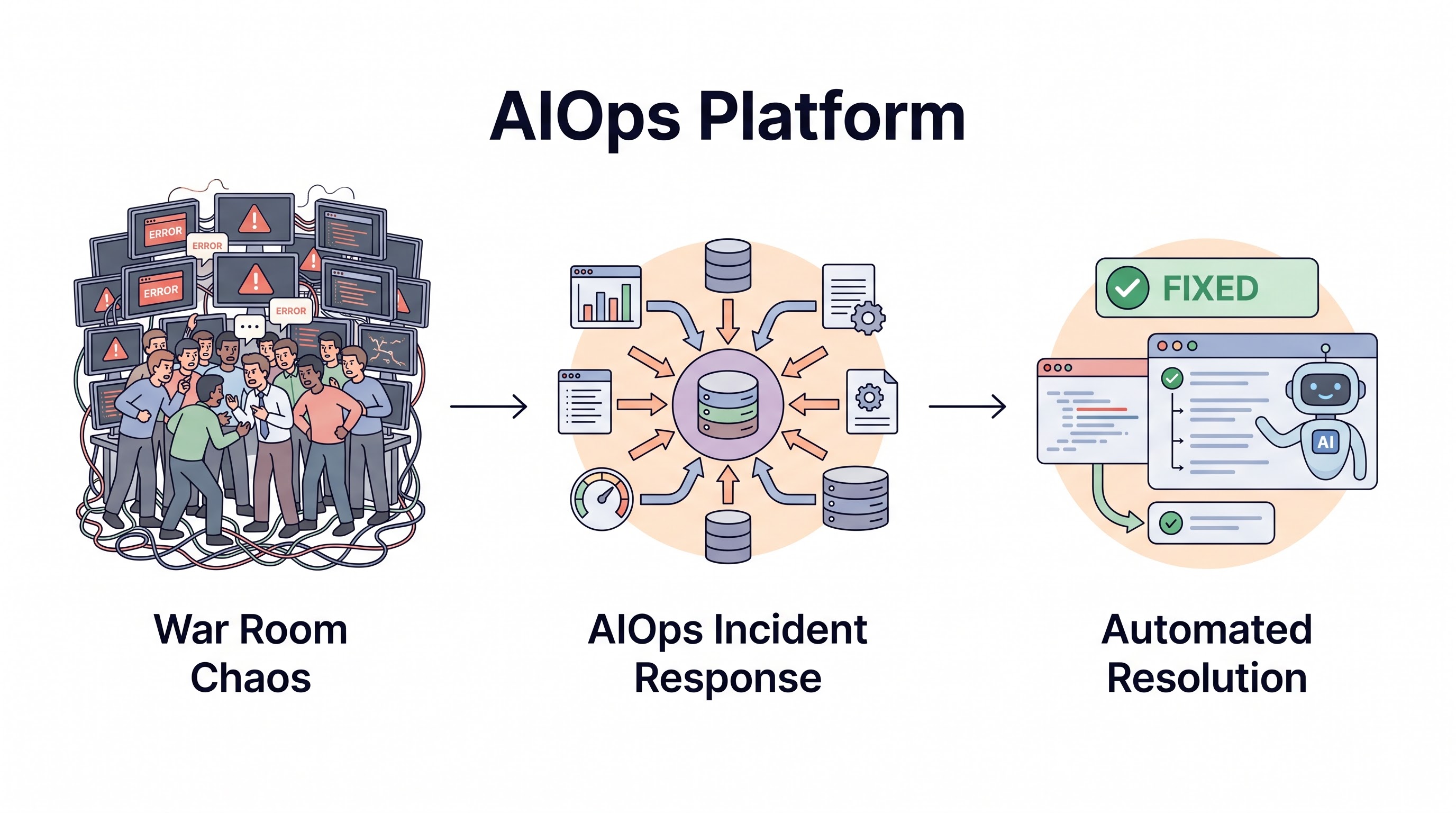
The AIOps Paradigm Shift in 2026
As we navigate through 2026, the complexity of enterprise cloud architectures has fundamentally outpaced human cognitive capacity. With microservices architectures spanning tens of thousands of ephemeral containers across multiple cloud providers, traditional monitoring and dashboarding approaches are no longer sufficient. This is where Artificial Intelligence for IT Operations (AIOps) transitions from a theoretical luxury to an absolute operational necessity.
Modern AIOps platforms ingest vast torrents of telemetry data—metrics, logs, traces, and events—and apply advanced machine learning algorithms to filter noise, identify anomalies, and uncover the root causes of service degradations before they impact end-users. Selecting the right platform in this mature landscape requires a deep understanding of your organization's specific operational gaps and the evolving capabilities of these tools.
Core Capabilities: Beyond Event Correlation
Historically, AIOps was synonymous with event correlation—grouping similar alerts to reduce "alert fatigue." In 2026, the baseline has shifted significantly. The most capable platforms now feature Causal AI. Unlike traditional machine learning that merely identifies statistical correlations, causal AI builds dynamic topology maps of your infrastructure to understand the actual cause-and-effect relationships between disparate system components.
Predictive analytics have also reached unprecedented levels of accuracy. By analyzing historical seasonality and real-time infrastructure metrics, modern AIOps tools can forecast resource exhaustion (e.g., a memory leak in a specific Kubernetes pod) hours or even days before a crash occurs. This allows engineering teams to shift from reactive firefighting to proactive system maintenance.
Furthermore, Generative AI has fundamentally altered how operators interact with their observability data. Natural Language Processing (NLP) interfaces allow Site Reliability Engineers (SREs) to ask complex queries like, "Identify the root cause of the latency spike in the checkout service over the last 45 minutes," receiving not just a dashboard, but a plain-English diagnostic summary complete with relevant log snippets.
Implementation Gaps and Common Pitfalls
Despite these technological leaps, AIOps implementations frequently fail to deliver on their promised ROI. The most persistent gap is data quality and hygiene. An AIOps platform is only as intelligent as the data it ingests. If an organization lacks standardized tagging, consistent log formatting, or centralized observability pipelines, the machine learning models will inevitably produce false positives, eroding trust among engineering teams.
Another significant hurdle is the "black box" nature of some platforms. When an AIOps tool recommends a remediation action but fails to provide the transparent logic or data lineage behind that recommendation, operators are rightfully hesitant to execute it. Explainability in AI is crucial for adoption; engineers must understand why the system is flagging an issue.
Finally, there is a cultural gap regarding automated remediation. While the technology exists to allow AIOps platforms to automatically restart failing services, revert bad deployments, or dynamically provision additional capacity, many organizations lack the cultural maturity to enable "closed-loop" automation. Most remain stuck in an open-loop paradigm where the AI merely alerts a human to take action.
Strict Selection Criteria for Modern Architectures
When evaluating the AIOps landscape in 2026, IT leaders must look beyond marketing jargon and evaluate platforms against strict, pragmatic criteria:
Time to Value (TTV): Does the platform require months of supervised training and manual tagging to establish a baseline, or does it utilize pre-trained, domain-aware models that provide actionable insights within hours of deployment?
Ecosystem Interoperability: A standalone AIOps tool is a siloed tool. The platform must offer seamless, bi-directional integrations with your existing ITSM solutions (e.g., ServiceNow, Jira), CI/CD pipelines, and incident response platforms (e.g., PagerDuty).
Multi-Cloud and Hybrid Support: Native cloud AIOps tools (like AWS CloudWatch Anomaly Detection) are excellent but often fall short in hybrid or multi-cloud environments. Ensure the platform can aggregate telemetry across AWS, Azure, GCP, and on-premises environments equally well.
Pricing Transparency: As data volumes explode, volume-based pricing models can become financially ruinous. Look for platforms that offer node-based or host-based pricing, or those that provide robust edge-filtering capabilities to drop low-value telemetry before it incurs ingestion costs.
Looking Ahead: The Autonomous Cloud
The AIOps platforms of 2026 are the stepping stones toward fully autonomous cloud operations. By rigorously evaluating tools against your organization's data maturity and prioritizing explainability and integration, you can build an operational foundation that not only scales with your infrastructure but actively heals it.
Key Takeaway
AIOps has evolved beyond basic event correlation to feature Causal AI and predictive analytics, but successful implementation hinges entirely on data hygiene and overcoming the cultural hesitation around automated remediation. When selecting an AIOps platform in 2026, prioritize ecosystem interoperability, transparent pricing models, and explainable AI over vendor-locked black boxes.
All in One Place
Atler Pilot decodes your cloud spend story by bringing monitoring, automation, and intelligent insights together for faster and better cloud operations.