
The Multi-Cloud Performance Paradox: Complexity and Consequence
The modern enterprise operates within an increasingly fragmented and dynamic IT landscape. Multi-cloud adoption, spanning hyperscalers like AWS, Azure, GCP, and Oracle, is no longer an aspiration but a strategic imperative for resilience, innovation, and avoiding vendor lock-in. However, this distributed architecture introduces a profound paradox: while offering unprecedented agility and scale, it simultaneously amplifies operational complexity, making traditional incident management approaches obsolete.
Imagine a critical financial application, a core component of your enterprise's revenue stream. Its microservices might be distributed across AWS EKS for compute, Azure SQL Database for relational data, and GCP Cloud Storage for archival, with data flowing through Kafka clusters running partly on-premises and partly on cloud-native message queues. Monitoring such an environment with disparate, vendor-specific tools creates visibility gaps that are not merely inconvenient but catastrophic. Alerts from AWS CloudWatch, Azure Monitor, and GCP Operations Suite arrive in silos, lacking correlation and context. This leads to:
Fragmented Observability: Inability to trace transactions end-to-end across cloud boundaries, making root cause analysis a laborious, manual process.
Alert Fatigue: A deluge of uncorrelated alerts, masking critical issues and desensitizing operations teams.
Slow Mean Time To Resolution (MTTR): Prolonged outages due to the time spent sifting through logs, metrics, and traces from multiple sources, impacting business continuity and customer trust.
Escalating Costs: Inefficient resource utilization, over-provisioning as a hedge against unknown performance bottlenecks, and the direct financial impact of downtime.
Security Blind Spots: Difficulty in identifying anomalous behavior or configuration drift that spans multiple cloud providers, increasing the attack surface.
The consequence is a reactive operational posture, where incidents are detected only after they have impacted users or systems, forcing teams into a constant fire-fighting mode. This is unsustainable for enterprises that demand five-nines availability, stringent security postures, and optimized cloud spend. The solution lies in a paradigm shift: from reactive to predictive, enabled by AIOps.
The AIOps Imperative: Beyond Reactive Monitoring
AIOps, or Artificial Intelligence for IT Operations, represents the application of AI and Machine Learning (ML) techniques to IT operational data. It moves beyond traditional monitoring's threshold-based alerts and siloed dashboards, offering a holistic, intelligent approach to managing complex IT environments. For multi-cloud scenarios, AIOps is not merely an enhancement; it is a fundamental requirement for maintaining performance, optimizing costs, and fortifying security.
The core capabilities of AIOps include:
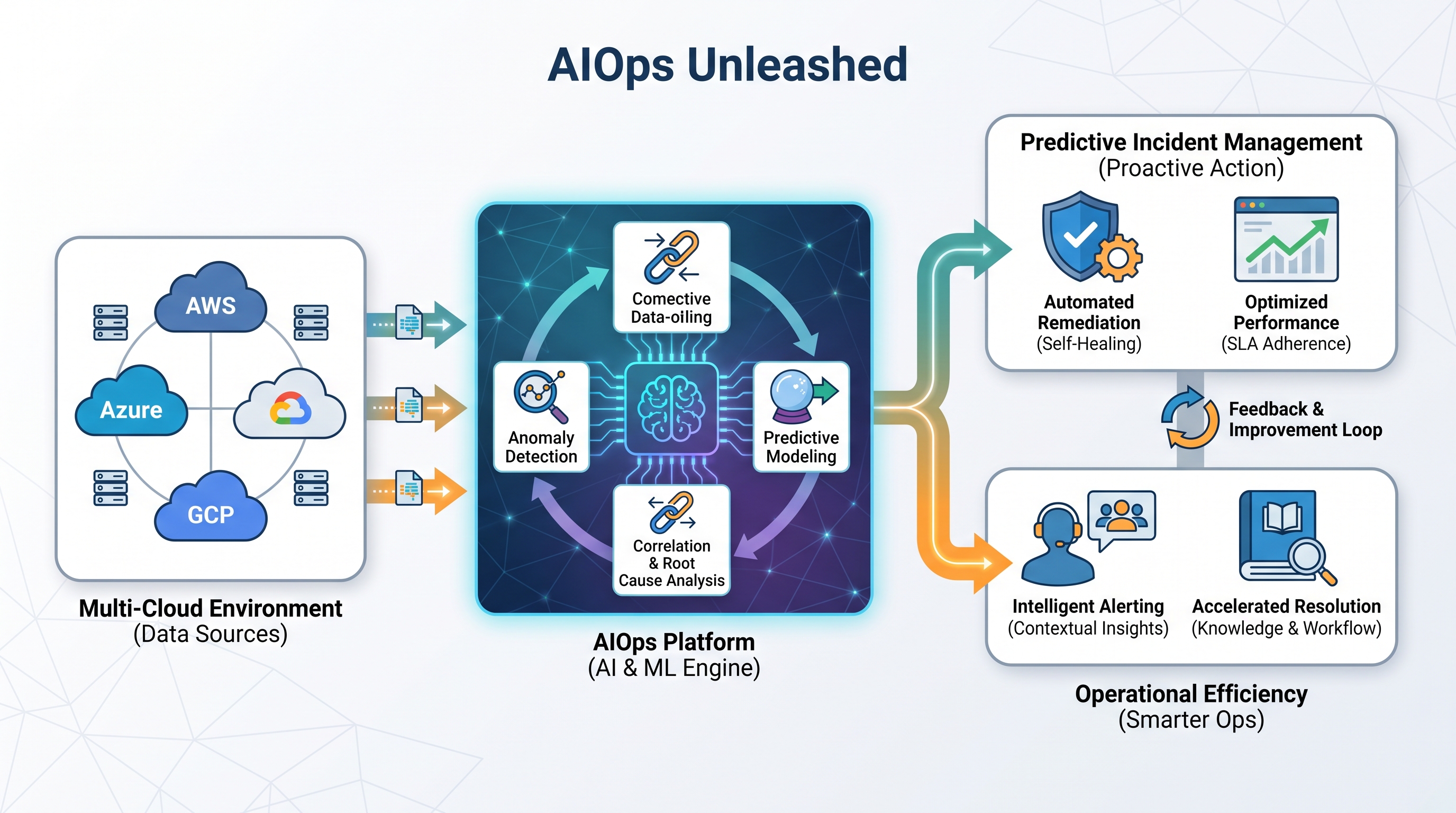
Intelligent Data Ingestion and Normalization: Consolidating logs, metrics, traces, events, and configuration data from diverse multi-cloud sources into a unified data lake.
Anomaly Detection: Automatically identifying deviations from normal operational patterns, often before they escalate into incidents.
Event Correlation and Noise Reduction: Grouping related alerts, suppressing false positives, and identifying causal relationships across different systems and cloud providers.
Root Cause Analysis: Pinpointing the exact source of a problem, even in complex, distributed systems, by analyzing correlated data.
Predictive Analytics: Forecasting future performance degradations, resource exhaustion, or security vulnerabilities based on historical trends and real-time data.
Automated Remediation: Triggering intelligent, policy-driven actions to resolve issues proactively or autonomously.
Consider a scenario where an application's latency begins to spike. Traditional monitoring might alert on high CPU utilization in one VM. AIOps, however, would correlate that CPU spike with increasing database connection pool wait times on a different cloud provider, a sudden increase in network I/O to an external API endpoint, and recent code deployments, to predict an impending service degradation and suggest the precise microservice responsible and the likely cause.
Architecting AIOps for Multi-Cloud: A CloudAtler Perspective
Implementing AIOps in a multi-cloud environment requires a robust architectural foundation capable of handling immense data volumes, diverse data formats, and the complexities of inter-cloud dependencies. CloudAtler is designed precisely for this challenge, providing an AI-powered platform that unifies FinOps, cloud security, and automated operations across AWS, Azure, GCP, and Oracle environments.
Data Ingestion and Normalization: The Foundation of Intelligence
The first critical step in any AIOps architecture is the unified ingestion and normalization of operational data. CloudAtler achieves this by integrating directly with native cloud monitoring services and leveraging open standards:
Metrics: Pulling performance metrics from AWS CloudWatch, Azure Monitor, GCP Operations Suite (formerly Stackdriver), and Oracle Cloud Infrastructure (OCI) Monitoring. This includes CPU utilization, memory usage, network I/O, disk I/O, and custom application metrics.
Logs: Ingesting structured and unstructured logs from various sources (e.g., AWS CloudTrail, VPC Flow Logs, Azure Activity Logs, Azure Diagnostic Logs, GCP Audit Logs, OCI Audit Logs, application logs via Fluentd/Fluent Bit).
Traces: Collecting distributed traces via OpenTelemetry or native SDKs to provide end-to-end visibility into service requests across microservices.
Events: Capturing configuration changes, security events, and operational events from services like AWS Config, Azure Security Center, GCP Security Command Center, and OCI Cloud Guard.
Configuration Data: Integrating with CMDBs and infrastructure-as-code (IaC) repositories (Terraform, CloudFormation, ARM templates) to understand the desired state and detect drift.
The challenge is not just collection but normalization. An EC2 instance's CPUUtilization metric in AWS is semantically similar but structurally different from an Azure VM's CPU % or a GCP Compute Engine's CPU utilization. CloudAtler's ingestion pipeline employs schema mapping and transformation engines to convert these disparate data points into a unified, queryable format. This enables a genuinely cross-cloud perspective, allowing our unified dashboard to present a cohesive view of your entire cloud estate, irrespective of the underlying provider.
AI/ML Engine: The Brain of Predictive Operations
Once data is ingested and normalized, CloudAtler's proprietary Atler AI engine takes over, applying advanced ML algorithms to extract insights and predict future states.
Anomaly Detection: Atler AI employs a combination of statistical baselining, unsupervised learning algorithms (e.g., Isolation Forest, One-Class SVMs, Autoencoders), and deep learning models (e.g., LSTMs) to establish dynamic baselines for every metric and log pattern. It then flags deviations that fall outside these learned normal behaviors. For instance, a sudden, unexplained spike in API gateway latency across AWS and Azure, even if it doesn't cross a static threshold, would be identified as anomalous.
Correlation & Contextualization: This is where AIOps truly shines. Atler AI uses graph-based algorithms to build a dynamic topology map of your multi-cloud environment, understanding dependencies between services, resources, and even different cloud providers. When an anomaly is detected, it correlates related events across logs, metrics, and traces. Natural Language Processing (NLP) is applied to logs to extract entities and sentiments, further enriching contextual understanding. For example, an increase in HTTP 500 errors from an AWS Lambda function might be correlated with a simultaneous spike in database connection errors on an Azure SQL DB instance that the Lambda function depends on, and a recent configuration change log in GCP affecting a shared service.
Root Cause Analysis: Leveraging causal inference and probabilistic graphical models, Atler AI works backward from correlated incidents to identify the most probable root cause. Instead of simply presenting a cluster of related alerts, it can pinpoint that the Azure SQL DB connection error was the primary trigger, caused by a sudden traffic surge leading to resource exhaustion, which in turn impacted the AWS Lambda function.
Predictive Analytics: This is the pinnacle of AIOps. Using time-series forecasting models (e.g., ARIMA, Prophet, LSTM networks), Atler AI predicts future resource utilization, performance bottlenecks, and potential security threats. For instance, based on historical growth patterns and current trends, it can predict that an Azure Kubernetes Service (AKS) cluster will exhaust its available node capacity within the next 48 hours, or that a specific GCP Cloud SQL instance will hit its storage limit next week. This allows for proactive intervention rather than reactive scaling.
A concrete example: Atler AI might observe a gradual increase in network latency between an AWS EC2 instance hosting a critical application front-end and an Oracle Cloud Infrastructure (OCI) database backend. Simultaneously, it notes a rise in database query execution times and a slight, but consistent, increase in CPU utilization on the OCI database server. By correlating these trends and applying predictive models, CloudAtler can forecast an impending performance bottleneck and potential application slowdown, recommending proactive actions like database index optimization, query tuning, or scaling up OCI database resources before users experience any degradation.
Automated Remediation and Proactive Interventions
The true power of predictive AIOps is unlocked when insights translate into automated, intelligent actions. CloudAtler integrates with your existing ITSM (e.g., ServiceNow, Jira) and orchestration tools (e.g., Ansible, Terraform) to enable policy-driven automation across your multi-cloud estate.
Performance Optimization: Based on predictive analytics, CloudAtler can trigger auto-scaling events for compute resources across AWS Auto Scaling Groups, Azure Virtual Machine Scale Sets, or GCP Managed Instance Groups. It can also initiate database scaling operations or recommend resource rightsizing.
Self-Healing: For detected anomalies or predicted failures, the platform can initiate automated remediation workflows, such as restarting services, rolling back recent deployments (with safe rollbacks capabilities), or isolating problematic instances.
Security Response: When a predicted security threat is identified, CloudAtler can automatically trigger security group modifications, network isolation, or activate specific WAF rules across cloud providers to mitigate the risk.
Patch Management: Leveraging patch intelligence, Atler AI predicts which systems are most vulnerable and require patching based on their exposure and criticality. It can then orchestrate automated patch deployments through native cloud services (e.g., AWS Systems Manager Patch Manager, Azure Update Management) or third-party tools, ensuring compliance and minimizing downtime with intelligent scheduling and patch governance.
This automated, proactive approach dramatically reduces MTTR, often preventing incidents entirely, freeing up valuable SRE and operations team time to focus on innovation rather than firefighting.
AIOps for FinOps: Predictive Cost Optimization and Governance
FinOps, the intersection of finance and DevOps, aims to bring financial accountability to the variable spend model of the cloud. AIOps supercharges FinOps by shifting from reactive cost reporting to predictive cost management and optimization.
Predictive Budget Forecasting: By analyzing historical consumption patterns, seasonal trends, and forecasted business growth, CloudAtler's budget forecasting capabilities predict future cloud spend with high accuracy across all cloud providers. This enables finance teams to set more realistic budgets and identify potential overruns well in advance.
Cost Anomaly Detection: AIOps can detect subtle cost anomalies that might indicate inefficient resource usage, runaway processes, or misconfigurations. For example, an unexpected spike in data transfer costs between AWS regions or unusual egress charges from Azure Blob Storage might signal a misconfigured application or a potential data exfiltration attempt, which CloudAtler can flag proactively.
Rightsizing Recommendations: Based on predicted future load and actual resource utilization, Atler AI provides intelligent rightsizing recommendations for VMs, containers, and databases across your multi-cloud environment. It identifies underutilized resources that can be scaled down or even terminated, generating significant cost savings without impacting performance.
Commitment Intelligence: For Reserved Instances (RIs) and Savings Plans (SPs), AIOps analyzes your predicted future consumption patterns to recommend the optimal purchase strategy. It can suggest when and what type of RIs/SPs to buy, ensuring maximum discount utilization and minimizing idle commitments across AWS, Azure, and GCP. This proactive management of commitments can save millions for large enterprises.
Automated Cost Governance: CloudAtler enforces cost policies through automated actions. For instance, if a non-production environment is predicted to incur costs beyond its allocated budget, AIOps can automatically shut down or downsize non-critical resources during off-peak hours, ensuring adherence to financial guardrails.
Consider a scenario where CloudAtler predicts a significant surge in user traffic to a specific microservice hosted on GCP GKE due to an upcoming marketing campaign. The AIOps engine can automatically recommend scaling up the GKE cluster and, crucially, suggest purchasing short-term committed use discounts or even preemptible VMs for the duration of the predicted surge, thereby avoiding the much higher on-demand premium costs. This is not just about saving money; it's about making financially intelligent, performance-aware decisions in real-time.
AIOps for Cloud Security: Proactive Threat Detection and Vulnerability Management
In a multi-cloud environment, the attack surface expands exponentially. AIOps provides a critical layer of defense by shifting security from a reactive audit function to a proactive, predictive one.
Predictive Threat Detection: Atler AI analyzes network flow logs, access patterns, user behavior analytics (UBA), and configuration changes across all your cloud providers. It identifies subtle anomalies that might indicate an impending security incident, such as unusual login attempts from new geographies, sudden changes in IAM roles, or unexpected data transfers to external IPs. For instance, a pattern of failed login attempts on an Azure AD account, followed by successful access from an unusual IP to an AWS S3 bucket, correlated with a spike in egress traffic from that bucket, would immediately trigger a high-priority alert and potentially an automated response.
Vulnerability Prioritization: CloudAtler ingests vulnerability scanning data (e.g., AWS Inspector, Azure Security Center, GCP Security Command Center) and correlates it with actual runtime usage, exposure to the internet, and criticality of the affected resources. This allows AIOps to predict which vulnerabilities pose the highest immediate risk and should be prioritized for remediation, moving beyond generic CVE scores to context-aware risk assessment.
Configuration Drift Detection and Remediation: AIOps constantly monitors your multi-cloud configurations against desired baselines defined in IaC or security policies. Any unauthorized or anomalous configuration drift (e.g., an open security group port on GCP, an unencrypted S3 bucket on AWS, or an insecure storage account policy on Azure) is flagged and can be automatically remediated or rolled back.
Predictive Patch Management: Beyond identifying vulnerabilities, AIOps predicts the impact of unpatched systems. By understanding the dependencies and criticality of your applications, CloudAtler's security management capabilities can intelligently schedule patches to minimize operational disruption while maximizing security posture, ensuring that critical vulnerabilities are addressed before they can be exploited.
Automated Security Response: Upon detection or prediction of a severe threat, CloudAtler can automatically trigger incident response workflows. This might include isolating compromised resources, revoking access keys, blocking malicious IP addresses at the cloud firewall level, or initiating forensic data collection across multiple cloud environments.
A sophisticated example involves detecting a low-and-slow data exfiltration attempt. Atler AI might observe a minute, consistent increase in data egress from a specific AWS S3 bucket, coupled with infrequent, legitimate-looking API calls to an external domain. Individually, these might not trigger alerts. However, the AIOps engine, correlating these subtle indicators with user behavior analytics (e.g., the user accessing the bucket has a history of unusual activity) and comparing it against a learned baseline of normal data transfer for that bucket, can predict a sophisticated exfiltration attempt before significant data loss occurs, triggering immediate containment and investigation.
Implementation Best Practices and Overcoming Challenges
While the benefits of AIOps are compelling, successful implementation in a multi-cloud enterprise requires careful planning and execution:
Data Quality is Paramount: AIOps is only as good as the data it consumes. Ensure comprehensive data collection, consistent tagging strategies across clouds, and clean, normalized data inputs. Garbage in, garbage out.
Start Small, Demonstrate Value: Don't attempt to implement AIOps across your entire multi-cloud estate simultaneously. Start with a critical application or a specific operational domain (e.g., network performance, cost optimization for a single business unit). Demonstrate tangible ROI before expanding.
Integrate with Existing Workflows: AIOps should augment, not replace, your existing ITSM, CI/CD, and security tools. Seamless integration ensures adoption and maximizes efficiency.
Foster Collaboration: AIOps bridges the gap between FinOps, Security, and IT Operations. Encourage cross-functional teams to collaborate on defining policies, interpreting insights, and refining automation.
Gradual Automation and Human Oversight: While the goal is autonomous operations, start with recommendations and semi-automated actions. Build trust in the system's intelligence before enabling full automation, especially for critical remediation steps. Implement human review gates for high-impact changes.
Continuous Learning and Refinement: AIOps models are not static. They require continuous training and refinement based on new data, changing operational patterns, and feedback from human operators.
Unleash Your Multi-Cloud Potential with CloudAtler
The journey to predictive incident management in a multi-cloud world is complex, but the competitive advantages are undeniable. By moving beyond reactive firefighting, enterprises can achieve superior performance, optimize costs with unprecedented precision, and fortify their security posture against evolving threats.
CloudAtler provides the unified, AI-powered platform to make this transformation a reality. Our platform consolidates disparate data, applies advanced machine learning for predictive insights, and automates intelligent actions across AWS, Azure, GCP, and Oracle environments. From granular FinOps optimization to proactive security management and automated operations, CloudAtler empowers your teams to manage complexity, reduce risk, and drive innovation.
Don't let multi-cloud complexity hinder your enterprise's potential. It's time to shift from managing incidents to predicting and preventing them. Unify your cloud operations and unleash the power of predictive intelligence with CloudAtler today.
All in One Place
Atler Pilot decodes your cloud spend story by bringing monitoring, automation, and intelligent insights together for faster and better cloud operations.