
For 95% of Silicon Valley developers, AI integration means import openai. The model lives in a hyperscale data center in Northern Virginia. The data travels over HTTPS. The credit card is charged monthly.
But for the Defense Industrial Base, Healthcare providers, and Critical Infrastructure operators (Energy, Water, Traffic), the Cloud is not a utility. It is a Threat Vector. You cannot send the telemetry of a centrifuges in a nuclear enrichment facility to Sam Altman. You cannot upload patient DNA sequences to a public API endpoint.
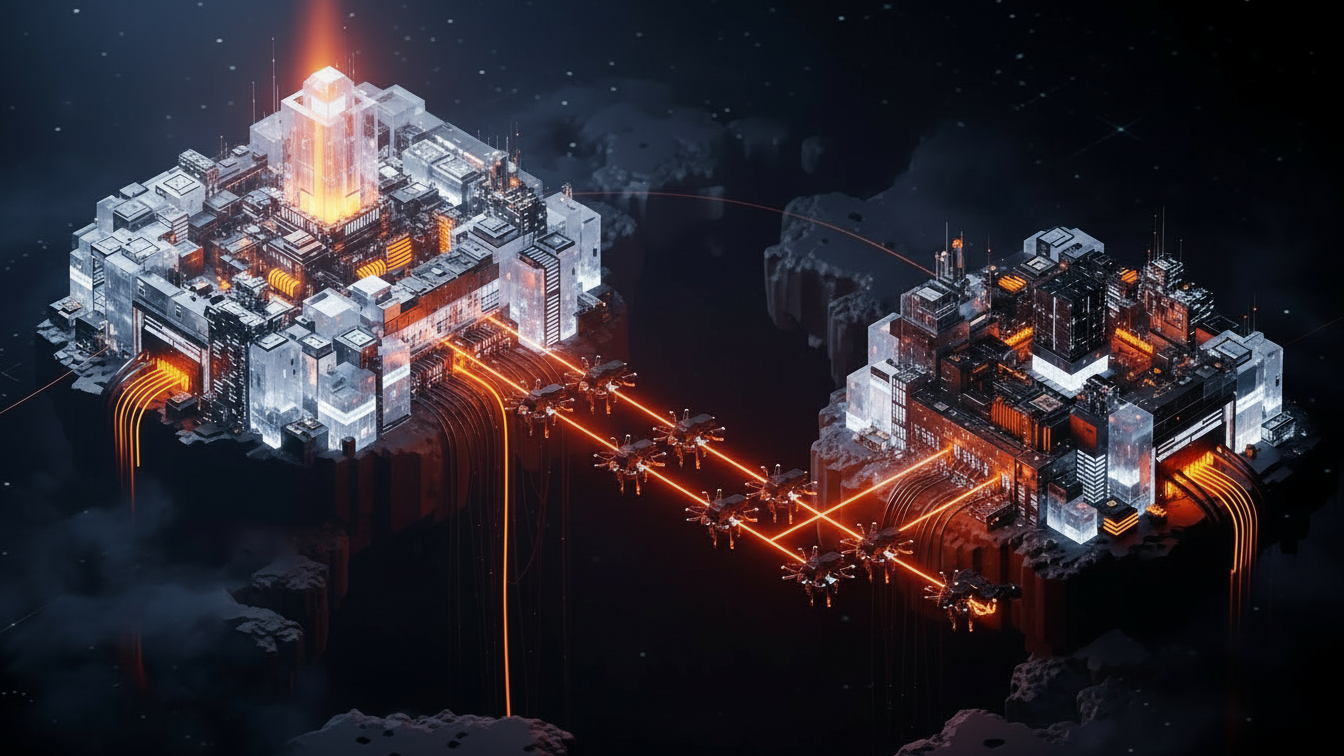
The Air-Gap Rule: An Air-Gapped system has zero physical connection to the outside world. No WiFi. No Ethernet. No Bluetooth. The only way data enters is via a physically scanned interface (like a read-only USB) or a Hardware Data Diode (a fiber optic cable that only allows light to travel in one direction).
In this world, you must bring the Model to the Data, not the Data to the Model. This is the realm of Sovereign AI.
Part 1: The Local Inference Revolution
Until 2023, running a State-of-the-Art (SOTA) model locally was physically impossible for most organizations. GPT-3 (175 Billion parameters) required an A100 cluster costing $200,000 to serve even at slow speeds.
The release of Llama-2 and Mistral changed the physics of AI. Suddenly, a 7B parameter model (which could fit in 4GB of VRAM) could outperform GPT-3.5 on reasoning tasks. This made "Edge AI" viable.
The Quantization Miracle
The breakthrough wasn't just smaller models; it was Quantization. We realized that Neural Networks are remarkably resilient to "Brain Damage." You can reduce the precision of the weights from 16-bit Floating Point (FP16) to 4-bit Integers (INT4) with almost zero loss in intelligence (perplexity).
FP16 Llama-3-70B: Requires 140GB VRAM. (Needs 2x A100s @ $30,000).
INT4 Llama-3-70B: Requires 35GB VRAM. (Runs on 1x RTX 6000 Ada or 2x Consumer RTX 4090s @ $4,000).
Part 2: The Software Stack (Ollama, vLLM, TGI)
How do you serve this model in a secure facility? You don't write raw PyTorch code. You use a specialized Inference Server.
1. Ollama (The Docker of AI)
Ollama has become the standard for "Developer Ease." It packages the model weights, the quantization config, and the runtime (llama.cpp) into a single executable.
Bash
# The Air-Gap Workflow

# 1. On an internet-connected machine:
ollama pull llama3
ollama save llama3 > llama3.tar

# 2. Transfer via Secure USB to the Air-Gapped machine.

# 3. Load and Run
ollama load < llama3.tar
ollama serve

# 4. Query (No internet required)
curl http://localhost:11434/api/generate -d '{
  "model": "llama3",
  "prompt": "Analyze this reactor log for anomalies."
}'
2. vLLM (The Production Beast)
Ollama is great for chat. But if you are processing 10,000 documents an hour, need high throughput, or concurrent users, you need vLLM. vLLM introduced PagedAttention, an algorithm inspired by Operation System Virtual Memory paging. It allows the GPU memory to be fragmented, minimizing waste ("internal fragmentation") in the Key-Value (KV) Cache. Result: vLLM effectively doubles or triples the throughput of a GPU compared to standard Hugging Face Transformers. In an air-gapped environment where hardware is constrained, this efficiency is gold.
Part 3: The Hardware (Building "The Box")
If you are deploying to a submarine or an oil rig, you can't access AWS Elastic Compute Cloud. You receive a ruggedized box. This is often called "Tactical Edge" hardware.
The "AI Edge Rugged" Specification: GPU: Nvidia IGX Orin (Industrial Grade) or RTX 6000 Ada (48GB VRAM). Chassis: IP67 Rated (Waterproof, Dustproof, Shockproof). Power: 300W Max Budget (running off diesel generators or batteries). Storage: 8TB NVMe (RAID 1). You must store the Vector Database locally, as there is no S3 bucket to query. Security: Physical Tamper Switches. If the case is opened, the encryption keys in the TPM are zeroized immediately.
These boxes cost $15,000 - $50,000. You ship them to the factory floor, plug them in, and they run Llama-3 forever without ever seeing a TCP packet from the outside world.
Part 4: Managing Updates via Sneakernet
The biggest challenge in Air-Gapped AI is Drift. The model learns nothing new. It doesn't know about yesterday's news or the new corporate policy. How do you update it?
You rely on the oldest, highest-bandwidth protocol in the world: Sneakernet (Verification via Human Courier).
The Secure Transfer Protocol Step 1: The Clean Room. In a secure HQ facility (connected to the internet), Data Scientists train the new model adapter (
adapter_v2.safetensors).Step 2: The Scrub. The file is scanned by 3 different antivirus engines and a dedicated "Model Scanner" (looking for pickle attacks or malicious tensors).
Step 3: The Burn. The file is burned to a Write-Once Media (like an Optical Disc) or a secure, encrypted AES-256 Hardware Encrypted USB Drive.
Step 4: The Courier. A trusted officer physically travels to the site. They undergo biometric authentication.
Step 5: The Kiosk. The drive is plugged into a "Decontamination Kiosk" (a dedicated machine that sits between the drive and the air-gapped network) to verify the hash and signature one last time before crossing the gap.
Part 5: Unexpected Security Risks
Just because it's offline doesn't mean it's safe. Air-gapped systems are vulnerable to Side-Channel Attacks.
The "Sleepy Agent" Covert Channel
Imagine a spy manages to poison the training data. They train the model to modulate its Power Consumption or Fan Speed based on the secrets it reads.
If the secret info is "0", the GPU runs at 100% load (High Fan Noise).
If the secret info is "1", the GPU throttles to 50% load (Low Fan Noise). An attacker standing near the server with a microphone (or even capturing the power line fluctuations on the electrical grid) can decode the binary stream. This sounds like science fiction, but "Tempest" attacks have been real for decades.
Part 6: Future Outlook (On-Device Learning)
Currently, Edge AI is mostly "Read Only" (Inference). We deploy a frozen model. The holy grail is Federated Learning.
In this future, the model on the submarine learns from the local data (e.g., the specific acoustic signature of a new enemy torpedo). It calculates a "Gradient Update" (a small diff of math). When the submarine returns to port, it uploads just this Gradient Update (not the raw data) to the central server. The central server aggregates updates from 100 submarines to make a smarter global model, which is then pushed back out to the fleet.
Part 7: Implementation Checklist for CISOs
Mandate GGUF/Safetensors: Ban
pickle(.bin) files. They are arbitrary code execution vulnerabilities waiting to happen.Standardize the Runtime: Don't let devs write custom Python scripts. Use a hardened image of vLLM or Ollama.
Physical Kill Switch: Install a hardware button that cuts power to the GPU (but leaves the CPU running) in case the model enters a hallucination loop or exhibits dangerous behavior.
Vector DB Localization: Use SQLite-based vector stores (like Chroma or LanceDB) that run as a single file, rather than client-server DBs like Weaviate/Qdrant which require networking overhead.
Part 8: Glossary
Air-Gap: Network security measure ensuring a secure network is physically isolated from unsecured networks (internet).
GGUF: GPT-Generated Unified Format. A binary format for quantized models designed for fast loading and mapping to memory.
Data Diode: A hardware device that allows data to travel only in one direction (usually via physics of light), preventing data exfiltration.
Side-Channel Attack: Hacking a system by observing its physical implementation (power, sound, heat) rather than its software logic.
Quantization: Reducing the precision of model weights (e.g., from 16-bit to 4-bit) to save memory and increase speed.
Conclusion
Air-Gapped AI is not a niche. As AI permeates critical infrastructure, "Offline First" will become the default deployment mode for safety-critical systems. We are building the "Intranet of Intelligence," where models are powerful, local, and silent.
All in One Place
Atler Pilot decodes your cloud spend story by bringing monitoring, automation, and intelligent insights together for faster and better cloud operations.