
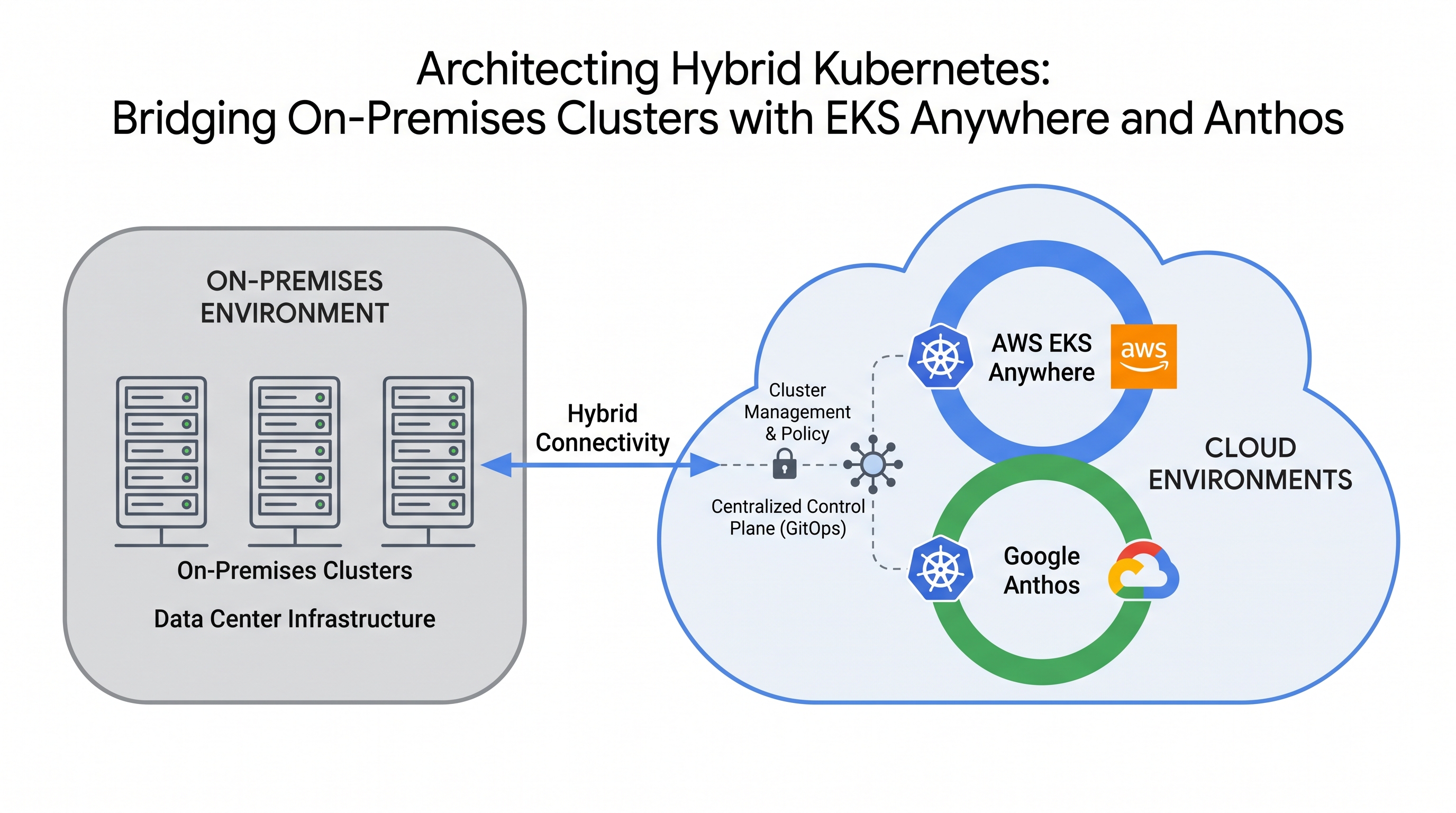
The Modern Hybrid Kubernetes Dilemma
Enterprise cloud adoption has evolved beyond the simplistic model of shifting all workloads to the public cloud. Today, platform engineering teams face the reality of hybrid topologies. Legacy database engines, strict data sovereignty laws (such as GDPR and HIPAA), latency-sensitive edge manufacturing systems, and localized compute investments require keeping substantial footprints on-premises. However, developers expect a uniform, cloud-native API experience regardless of where the underlying physical hardware resides.
This operational divergence is the core hybrid Kubernetes dilemma: how do you deliver a standardized Kubernetes platform across disparate environments without doubling your operational overhead, fragmenting your security posture, and fracturing your financial visibility? Managing vanilla upstream Kubernetes clusters on-premises while running managed services like Amazon EKS or Google Kubernetes Engine (GKE) in the cloud creates two distinct operational silos. Platform teams must maintain separate patching cadences, distinct ingress controllers, differing storage classes, and incompatible identity providers.
To bridge this gap, hyperscalers introduced hybrid Kubernetes control planes: Amazon EKS Anywhere (EKS-A) and Google Distributed Cloud (formerly Anthos). These frameworks extend cloud-native tooling, managed APIs, and governance models down to bare-metal servers and VMware vSphere environments in private datacenters. Implementing these technologies successfully requires architectural precision across networking, storage, identity, security, and cost optimization. Enterprise architects must design these environments using robust hybrid and on-premises infrastructure solutions to ensure seamless operations across physical boundaries.
Deep Dive: Amazon EKS Anywhere Architecture
Amazon EKS Anywhere is an deployment option for Amazon EKS that enables you to easily create and operate Kubernetes clusters on-premises. It is built on top of the open-source Amazon EKS Distro (EKS-D), which is the exact same distribution of Kubernetes used by Amazon EKS in the AWS public cloud. This ensures complete version alignment and API compatibility between your cloud-based and on-premises control planes.
EKS Anywhere Core Components
The architecture of an EKS Anywhere cluster relies on several decoupled, open-source projects managed by AWS:
Cluster API (CAPI) & Cluster API Provider (CAPD/CAPV/CAPM): EKS-A uses Cluster API for declarative, Kubernetes-style lifecycle management of the clusters themselves. It treats nodes and control planes as custom resources within a management cluster.
Bottlerocket: AWS’s open-source, Linux-based container-optimized operating system. It features a read-only root filesystem, lacks a package manager, and uses SELinux in enforcing mode by default, drastically reducing the node attack surface.
Cilium: The default Container Network Interface (CNI) for EKS-A. Cilium leverages eBPF (Extended Berkeley Packet Filter) to provide high-performance network routing, security filtering, and observability directly within the Linux kernel, bypassing the traditional iptables overhead.
Deployment Topologies: vSphere vs. Bare Metal
When deploying EKS-A, architects must choose between VMware vSphere and Bare Metal target platforms. On vSphere, EKS-A leverages the Cluster API Provider vSphere (CAPV) to automate VM provisioning, storage mounting via VMware Cloud Native Storage (CNS), and virtual networking. In contrast, Bare Metal deployments utilize Tinkerbell, an open-source bare-metal provisioning engine. Tinkerbell uses DHCP, TFTP, and metadata services to netboot physical servers, flash the Bottlerocket OS image directly onto physical disks, and bootstrap the Kubernetes control plane.
EKS Anywhere Cluster Configuration Spec
The following YAML manifest represents a production-grade EKS Anywhere configuration spec targeting a VMware vSphere environment, emphasizing secure configuration and explicit resource allocation:
apiVersion: anywheres.eks.amazonaws.com/v1alpha1
kind: Cluster
metadata:
  name: prod-onprem-eks-01
  namespace: default
spec:
  controlPlaneConfiguration:
    count: 3
    endpoint:
      ip: "10.120.10.50"
    machineGroupRef:
      kind: VSphereMachineConfig
      name: prod-cp-machines
  workerNodeGroupConfigurations:
    - count: 5
      name: prod-worker-group-1
      machineGroupRef:
        kind: VSphereMachineConfig
        name: prod-worker-machines
      autoscalingConfiguration:
        minCount: 5
        maxCount: 20
  datacenterRef:
    kind: VSphereDatacenterConfig
    name: dc-onprem-01
  kubernetesVersion: "1.28"
  clusterNetwork:
    cniConfig:
      cilium:
        policyEnforcementMode: "always"
    pods:
      cidrBlocks:
        - "192.168.0.0/16"
    services:
      cidrBlocks:
        - "10.96.0.0/12"
---
apiVersion: anywheres.eks.amazonaws.com/v1alpha1
kind: VSphereMachineConfig
metadata:
  name: prod-cp-machines
  namespace: default
spec:
  datacenter: "OnPrem-Datacenter"
  datastore: "pure-san-ds-01"
  folder: "/vSphere-DC/vm/kubernetes/control-planes"
  numCPUs: 4
  memoryMiB: 16384
  osFamily: "bottlerocket"
  resourcePool: "/vSphere-DC/host/Cluster-01/Resources/k8s-control"
  template: "/vSphere-DC/vm/templates/bottlerocket-v1.28-vSphere"
Deep Dive: Google Distributed Cloud (Anthos) Architecture
Google Distributed Cloud (GDC), still widely referred to by its foundational platform name Anthos, is Google Cloud’s hardware-agnostic platform for managing hybrid Kubernetes clusters. Unlike EKS Anywhere, which focuses heavily on the cluster lifecycle, Anthos was designed from the ground up as a multi-cluster, multi-cloud management framework. It tightly integrates centralized configuration management, service mesh, and unified policy enforcement.
Control Plane Topology: Admin vs. User Clusters
Anthos employs a strict hierarchical management model. To run Anthos on-premises (whether on VMware or Bare Metal), you must first provision an Admin Cluster. The Admin Cluster does not run user workloads; its sole purpose is to manage the lifecycle of User Clusters via the Google-managed Cluster API providers. This architecture guarantees that even if a user cluster's control plane experiences a localized failure or resource exhaustion, the management plane remains isolated and operational. Under the hood, user cluster control planes can be deployed in two topologies:
Shared Control Plane (In-Cluster): The control plane components (kube-apiserver, etcd, scheduler) run as pods inside the Admin Cluster, isolated in dedicated namespaces. This maximizes resource utilization on-premises.
Island Mode Control Plane: The control plane runs on dedicated physical or virtual nodes within the User Cluster itself, ensuring complete network and operational isolation from the Admin Cluster.
Anthos Connect Agent and Fleet Management
Every Anthos cluster on-premises runs the Connect Agent (a local deployment containing multiple microservices like the gke-connect-agent). This agent establishes an outbound, encrypted gRPC tunnel (TLS 1.3) to Google Cloud’s global Anthos control plane. This outbound connection eliminates the need to open inbound firewall ports on-premises, resolving a major security friction point with enterprise network operations teams. Through this tunnel, the cluster registers to a centralized logical grouping inside Google Cloud called a Fleet (formerly an Environ). Fleets allow you to apply configurations, service mesh policies, and security baselines to groups of clusters simultaneously.
Anthos ConfigSync Configuration
A primary differentiator for Anthos is ConfigSync (built on GitOps principles). Below is a declarative configuration manifest used to register a Git repository containing cluster policies and namespace definitions to an Anthos cluster:
apiVersion: configsync.gke.io/v1beta1
kind: RootSync
metadata:
  name: root-sync-ops
  namespace: config-management-system
spec:
  sourceFormat: unstructured
  git:
    repo: "https://github.com/enterprise-org/k8s-fleet-config.git"
    branch: "main"
    dir: "clusters/prod-onprem"
    auth: "token"
    secretRef:
      name: git-creds
---
apiVersion: v1
kind: Secret
metadata:
  name: git-creds
  namespace: config-management-system
type: Opaque
stringData:
  username: "git-ops-bot"
  token: "ghp_secure_github_personal_access_token_to_rotate"
Cross-Platform Networking, Storage, and Identity Federation
Bridging on-premises bare-metal or virtual infrastructure with public cloud hyperscalers requires resolving three core infrastructure pillars: deterministic networking, persistent storage mapping, and federated identity management.
Deterministic Networking & Load Balancing
In a public cloud, creating a service of type LoadBalancer automatically provisions an AWS NLB or GCP Cloud Load Balancer. On-premises, this cloud integration is missing. For EKS Anywhere and Anthos, platform architects must implement software-defined load balancing solutions:
MetalLB: A software load balancer for bare-metal Kubernetes clusters. It operates in Layer 2 mode (using ARP/NDP to advertise a single leader node for an IP) or BGP mode (establishing peering sessions with upstream network switches to distribute traffic via Equal-Cost Multi-Path routing).
Kube-vip: Often used as the control plane load balancer for EKS-A, Kube-vip provides a highly available virtual IP (VIP) using Raft consensus or keepalived VRRP, ensuring the API server is always reachable.
F5 BIG-IP / Citrix ADC integrations: For enterprises with physical load balancing appliances, Anthos offers native integrations to dynamically configure virtual servers on hardware controllers via specialized ingress controllers.
Storage Integration via Container Storage Interface (CSI)
To provide stateful workloads with persistent volumes on-premises, architects must map Kubernetes storage classes to enterprise storage area networks (SAN) or network-attached storage (NAS). For VMware environments, both EKS-A and Anthos leverage the vSphere CSI driver, which communicates directly with vCenter to dynamically provision VMDKs on VMFS or vSAN datastores. For bare-metal deployments, platform teams typically deploy software-defined storage solutions like Rook-Ceph or Portworx, or utilize CSI drivers provided by storage vendors (such as NetApp Trident or Pure Storage Service Orchestrator). These CSI drivers translate standard Kubernetes PersistentVolumeClaims into physical storage allocations, ensuring physical-to-virtual storage mapping parity.
Federated Identity Management
Securing human and machine access across hybrid clusters requires establishing a single source of truth for identity. Architects should avoid managing local kubeconfig files with static tokens. Instead, implement OpenID Connect (OIDC) federation:
AWS IAM Roles for Service Accounts (IRSA) on EKS Anywhere: EKS-A can be configured to use AWS IAM via OIDC federation. By deploying an on-premises OIDC provider (or linking to an AWS IAM Identity Provider), Kubernetes service accounts can assume AWS IAM roles using OIDC federation, allowing on-premises workloads to securely call cloud services like Amazon S3 or DynamoDB without hardcoding AWS access keys.
GCP Workload Identity Federation on Anthos: Anthos natively supports Workload Identity. The Anthos Connect Agent registers the cluster's local OIDC issuer with Google Cloud. When a pod requests access to a Google Cloud resource (e.g., BigQuery), the local Kubernetes service account token is exchanged for a short-lived GCP IAM service account token, establishing a secure, passwordless authentication boundary.
Security and Compliance in Hybrid Topologies
Operating a hybrid cluster fleet drastically expands your organization's threat vector. A compromised physical server in an on-premises datacenter can become a staging ground for lateral movement into public cloud environments. Securing this boundary requires automated, continuous compliance policies and comprehensive enterprise security management tooling.
Policy Enforcement: OPA Gatekeeper vs. Anthos Policy Controller
To enforce compliance, platform teams must prevent insecure configurations from being deployed. Anthos incorporates Anthos Policy Controller (APC), which is built on the open-source Open Policy Agent (OPA) Gatekeeper. EKS Anywhere users typically install OPA Gatekeeper manually or via Helm. Both solutions operate as validating admission controllers, evaluating API requests against declarative policies written in Rego.
For example, a security policy can mandate that no container runs as root, all images must originate from a trusted enterprise container registry (e.g., Amazon ECR or Google Artifact Registry), and every namespace must possess specific billing tags. This ensures that security guardrails are applied uniformly across both on-premises and cloud clusters.
Vulnerability and Patch Management
Maintaining the security posture of hybrid clusters requires a strict, automated patching cycle. Unlike managed cloud services where the cloud provider manages node OS patching, hybrid deployments place this responsibility squarely on the enterprise infrastructure team. EKS Anywhere mitigates this risk by utilizing Bottlerocket, which supports atomic, transactional updates. If an update fails, the OS automatically performs a safe rollback to the previous working state. For Anthos, Google regularly releases updated node images that must be applied via rolling upgrades initiated through the Admin Cluster, minimizing workload disruption.
Securing Network Boundaries with Service Mesh
In a hybrid topology, traffic between on-premises services and cloud-native services frequently traverses public networks or dedicated private circuits (AWS Direct Connect / GCP Interconnect). To prevent interception and unauthorized lateral movement, architects must implement mutual TLS (mTLS) for all service-to-service communications. By utilizing Anthos Service Mesh (ASM) or deploying Istio on EKS Anywhere, you establish a cryptographically secure zero-trust network. Every workload receives an identity certificate issued by a central authority (such as Google Cloud CAS or AWS Private CA), and all transport-layer traffic is encrypted and authenticated at the proxy level (Envoy), completely transparent to the application code.
FinOps and Cost Optimization Strategies for Hybrid Clusters
There is a common misconception among executive leadership that running workloads on-premises is inherently cheaper than the public cloud due to the lack of hourly virtual machine billing. In reality, on-premises infrastructure carries massive hidden costs: power, cooling, physical datacenter real estate, hardware amortization, lifecycle maintenance, and highly specialized labor. Furthermore, hybrid architectures introduce a significant financial risk: network egress charges.
The Real Cost of Hybrid Egress
When an application running in an on-premises EKS Anywhere cluster queries a database hosted in AWS (or vice versa), data flows across the hybrid boundary. While ingress (data flowing into the cloud) is generally free, egress (data flowing out of the cloud) is billed per gigabyte. If a hybrid architecture is designed poorly—for instance, placing a high-throughput microservice on-premises while its data store remains in the public cloud—the resulting egress charges can quickly dwarf the compute savings. Architects must design workloads to minimize cross-boundary traffic, utilizing local caching mechanisms and prioritizing data locality.
Consolidating Costs with a Financial Operations Platform
To achieve true cost optimization, enterprises must unify their financial visibility. Traditional cloud billing consoles from AWS and GCP only display costs incurred within their respective public clouds. They are completely blind to the physical hardware costs, virtualization licensing, and operational overhead of your on-premises datacenters. To bridge this financial gap, organizations must leverage a comprehensive CloudAtler Financial Operations Platform.
By ingesting on-premises infrastructure cost models (such as server depreciation, virtualization licensing, and power costs) and combining them with real-time public cloud billing APIs, platform teams can calculate the true Total Cost of Ownership (TCO) per Kubernetes namespace or application. This unified financial view allows FinOps practitioners to make data-driven decisions about where workloads should run to minimize cost while meeting performance and compliance requirements.
Kubernetes Cost Allocation and Right-Sizing
Within a shared hybrid cluster, multiple business units consume resources simultaneously. Without precise cost allocation, it is impossible to charge back costs accurately. Platform teams should implement the following FinOps tactics:
Resource Requests and Limits Tuning: Developers frequently over-provision CPU and memory requests to ensure application stability, leading to massive resource waste. Use automated vertical autoscaling and historical utilization analysis to right-size container resource definitions.
Namespace-Level Cost Allocation: Map Kubernetes namespaces directly to business cost centers. By utilizing open-source tools like Kubecost integrated into a centralized financial dashboard, you can assign exact dollar values to container resource usage on-premises and in the cloud.
Hybrid Bursting Optimization: Configure your hybrid clusters to run baseline, highly predictable workloads on-premises to maximize utilization of amortized hardware. Utilize the public cloud (EKS or GKE) strictly for elastic, bursty workloads, spinning up cloud nodes dynamically and tearing them down when demand subsides.
Architectural Comparison: EKS Anywhere vs. Google Distributed Cloud (Anthos)
Choosing between EKS Anywhere and Google Distributed Cloud requires evaluating your existing cloud footprint, operational expertise, and long-term multi-cloud strategy. Below is a detailed architectural comparison of the two platforms:
Feature | Amazon EKS Anywhere (EKS-A) | Google Distributed Cloud (Anthos) |
|---|---|---|
Primary Focus | On-premises cluster provisioning and lifecycle management. | Multi-cluster fleet management, policy, and service mesh. |
Operating System | Bottlerocket (default), Ubuntu, Red Hat Enterprise Linux. | Container-Optimized OS (COS), Ubuntu, Red Hat Enterprise Linux. |
Networking (CNI) | Cilium (eBPF-based) included natively. | GKE Datapath V2 (built on eBPF/Cilium). |
Config & Policy Management | Manual GitOps integration (e.g., Flux v2, Argo CD). | Anthos ConfigSync and Anthos Policy Controller (native). |
Control Plane Model | Independent Cluster API-driven clusters. | Hierarchical: Admin Cluster managing multiple User Clusters. |
Pricing Model | Free open-source; optional paid enterprise support subscription per cluster. | Pay-as-you-go per vCPU managed, or committed-use contracts. |
Unified Operations: Bridging the Hybrid Divide with CloudAtler
While EKS Anywhere and Google Distributed Cloud solve the lower-level cluster virtualization and lifecycle management challenges, they still leave platform engineering, security, and FinOps teams with a fragmented operational landscape. Operating a hybrid fleet means juggling multiple cloud consoles, dealing with disparate alerting systems, and manually correlating security vulnerabilities across on-premises bare-metal nodes and cloud-native instances.
This is where CloudAtler transforms hybrid cloud complexity into operational simplicity. CloudAtler provides a unified single-pane control plane that aggregates telemetry, security postures, and cost metrics across AWS, GCP, Azure, and your on-premises datacenters. Instead of logging into separate provider consoles to verify cluster health or troubleshoot network policies, CloudAtler brings all environments into a single, intuitive interface.
Leveraging the advanced Atler AI engine, CloudAtler continuously analyzes your hybrid Kubernetes configurations, identifying cost inefficiencies, detecting security anomalies, and automatically recommending optimization strategies. Whether it is highlighting an over-provisioned EKS Anywhere node on-premises or identifying a misconfigured Anthos Service Mesh policy that exposes a service to the public internet, CloudAtler provides actionable, real-time intelligence to keep your hybrid infrastructure secure, compliant, and cost-effective.
All in One Place
Atler Pilot decodes your cloud spend story by bringing monitoring, automation, and intelligent insights together for faster and better cloud operations.