
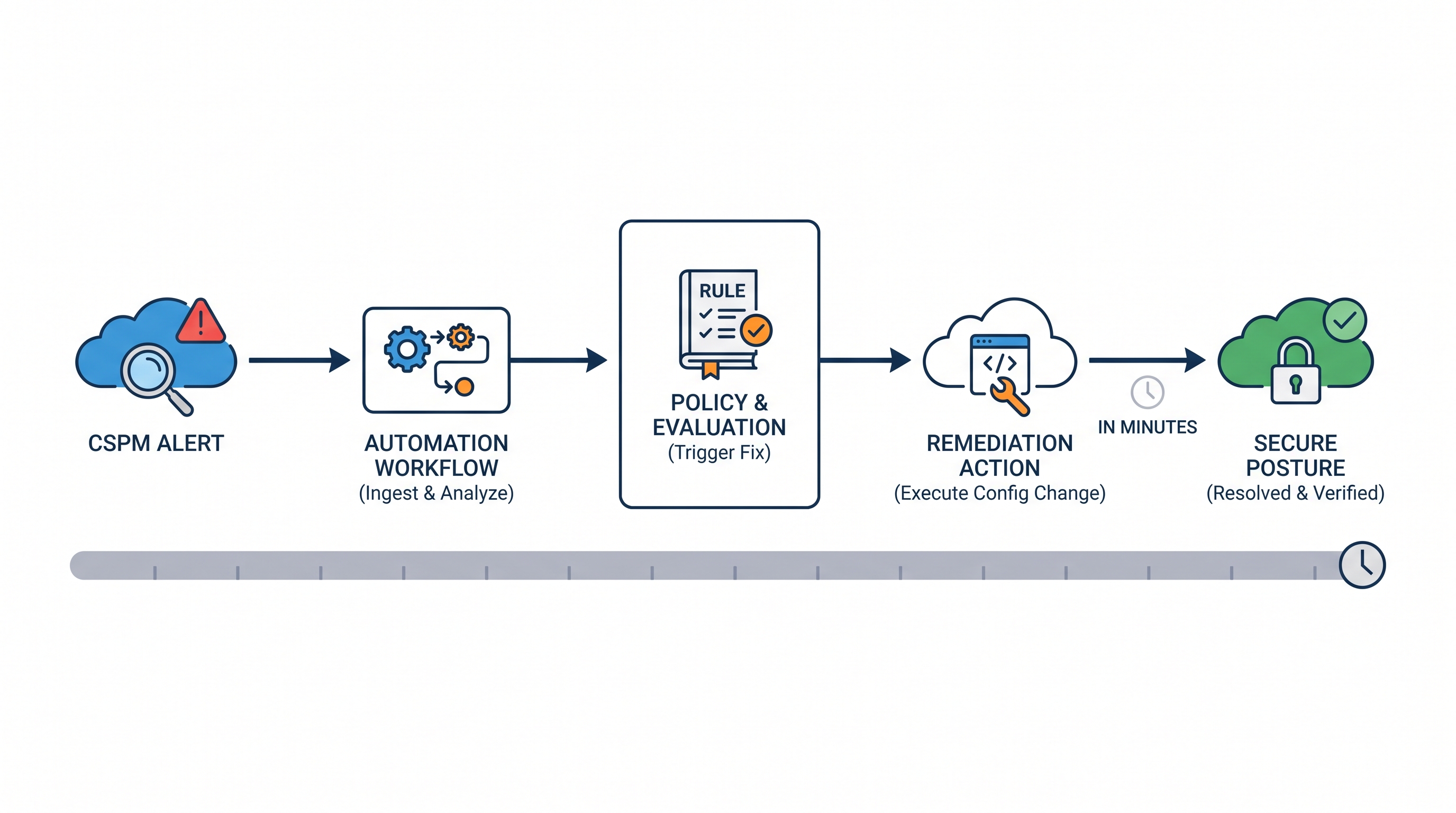
In the dynamic landscape of multi-cloud environments, the velocity of change and the sheer volume of resources present an unprecedented challenge to maintaining a robust security posture. Organizations leveraging AWS, Azure, GCP, and Oracle Cloud frequently contend with thousands, if not tens of thousands, of security alerts generated daily by their Cloud Security Posture Management (CSPM) tools. While CSPM solutions are indispensable for identifying misconfigurations, compliance deviations, and potential vulnerabilities, the journey from an alert notification to a fully remediated, secure state is often fraught with manual processes, human error, and unacceptable delays. This gap between detection and effective action is where the enterprise falls vulnerable, incurring not only security risks but also significant financial inefficiencies.
At CloudAtler, we understand that true cloud security and FinOps optimization demand more than just visibility; they require intelligent, automated action. This blog post will delve deep into the architecture and operational strategies behind automated remediation, demonstrating how it transforms the security lifecycle from a reactive, labor-intensive process into a proactive, "secure-in-minutes" paradigm. We will explore how an AI-powered platform unifies cloud security, FinOps, and automated operations, ensuring your enterprise maintains an optimal, secure, and cost-efficient cloud environment across all your providers.
The Escalating Challenge of Cloud Security Alerts and Manual Remediation
The modern enterprise cloud footprint is characterized by its scale, complexity, and ephemeral nature. Resources are provisioned and de-provisioned at an astonishing rate, often by diverse teams operating with varying levels of security awareness. This distributed ownership, coupled with continuous integration/continuous deployment (CI/CD) pipelines, means that misconfigurations can emerge and persist undetected for extended periods, creating significant attack vectors.
Consider a large enterprise operating across AWS, Azure, and GCP. Their CSPM tools might flag:
Hundreds of publicly accessible S3 buckets or Azure Blob containers.
Thousands of virtual machines with overly permissive firewall rules (e.g., RDP/SSH open to the internet).
Unencrypted database instances or storage volumes.
IAM roles with excessive permissions or inactive keys.
Non-compliant resource tags leading to orphaned resources and budget overruns.
Each of these alerts represents a potential security incident, a compliance violation, and often, an unnecessary cost. The sheer volume leads to "alert fatigue" among security teams, making it difficult to prioritize and address the most critical issues. Manual remediation, involving security analysts, DevOps engineers, and often multiple approval layers, can take hours, days, or even weeks. During this window of exposure, the enterprise remains vulnerable, and compliance postures erode. This slow, manual process also directly impacts FinOps, as misconfigured resources can lead to inefficient spending (e.g., untagged resources complicating chargebacks, over-provisioned compute due to lack of visibility, or costs associated with data breaches).
Understanding Cloud Security Posture Management (CSPM) in Depth
Cloud Security Posture Management (CSPM) tools are foundational to modern cloud security. They continuously monitor cloud environments for misconfigurations, policy violations, and compliance risks. A robust CSPM solution integrates with cloud provider APIs (e.g., AWS Config, Azure Security Center, GCP Security Command Center, Oracle Cloud Guard) to gather metadata about resources and configurations. It then evaluates this data against a predefined set of security policies, industry best practices (CIS Benchmarks), and regulatory compliance frameworks (PCI DSS, HIPAA, GDPR, SOC 2, NIST).
Key functionalities of CSPM include:
Continuous Asset Inventory: Discovering all cloud resources across multi-cloud environments.
Configuration Assessment: Evaluating resource configurations against security policies and best practices.
Compliance Monitoring: Mapping configurations to specific controls within regulatory frameworks.
Risk Prioritization: Identifying and ranking misconfigurations based on severity and potential impact.
Alerting and Reporting: Notifying security teams of deviations and providing audit trails.
While CSPM excels at identifying what is wrong, its traditional limitation lies in how to fix it efficiently at scale. An alert, by itself, does not remediate the issue. It merely highlights a problem. The manual intervention required post-alert is the choke point, hindering agility and leaving organizations exposed. This is precisely the gap that intelligent, automated remediation aims to bridge, transforming raw alerts into immediate, verifiable security improvements.
The Paradigm Shift: From Alert to Automated Remediation
Automated remediation represents a critical evolution in cloud security, moving beyond mere detection to programmatic, policy-driven action. It involves defining a set of automated responses triggered by specific security alerts or policy violations. These responses can range from simple configuration changes to complex workflows involving multiple steps and systems.
The benefits of this paradigm shift are profound:
Speed: Issues are resolved in minutes, not hours or days, drastically reducing the window of exposure.
Consistency: Automated actions eliminate human error and ensure remediation steps are applied uniformly every time.
Scalability: Remediation can occur across thousands of resources simultaneously, a task impossible manually.
Reduced Operational Overhead: Security and DevOps teams are freed from repetitive, manual tasks, allowing them to focus on strategic initiatives.
Improved Compliance: Continuous enforcement of policies helps maintain a consistent compliance posture.
Enhanced FinOps Efficiency: By proactively fixing security misconfigurations that often lead to cost overruns (e.g., unsecured data leading to breaches, non-compliant services requiring expensive audits), automated remediation directly contributes to a healthier cloud financial operation. This includes preventing the deployment of costly, non-compliant services or ensuring resources adhere to tagging policies critical for accurate cost allocation.
Architectural Blueprint for Automated Remediation with CloudAtler
Implementing effective automated remediation requires a sophisticated, multi-layered architecture. CloudAtler's AI-powered platform is designed to provide this end-to-end capability, unifying FinOps, cloud security, and automated operations across AWS, Azure, GCP, and Oracle environments. Here’s a detailed look at the core components:
1. Detection Layer (CSPM Integration and Real-time Monitoring)
The foundation of automated remediation is a robust detection mechanism. CloudAtler integrates deeply with native cloud security services and APIs across all major providers. This includes:
AWS: Integrating with AWS Config for continuous configuration monitoring, AWS Security Hub for consolidated findings, and CloudTrail for API activity logs.
Azure: Leveraging Azure Security Center for posture management, Azure Policy for enforcing rules, and Azure Activity Logs.
GCP: Utilizing Security Command Center for threat detection and posture management, Cloud Asset Inventory, and Cloud Audit Logs.
Oracle Cloud: Integrating with Oracle Cloud Guard for continuous monitoring and OCI Audit logs.
CloudAtler's agents and API connectors continuously ingest configuration data, logs, and security findings. This raw data is then fed into our Atler AI engine, which performs real-time analysis, anomaly detection, and correlation with threat intelligence feeds. This layer identifies deviations from security baselines, policy violations, and emerging threats as they occur, generating high-fidelity alerts.
2. Contextualization and Prioritization Layer
Not all alerts are created equal. A publicly exposed development S3 bucket might have a different criticality than a production database. CloudAtler's strength lies in its ability to contextualize alerts, allowing for intelligent prioritization. This involves:
Asset Criticality Mapping: Understanding the business impact of a resource (e.g., production vs. development, revenue-generating vs. internal tool). This often involves integrating with CMDBs or leveraging CloudAtler's own asset tagging and discovery.
Business Unit Ownership: Identifying the team or owner responsible for the resource, crucial for escalation and accountability. CloudAtler's unified dashboard provides a holistic view of ownership and resource distribution across your multi-cloud estate.
Compliance Scope: Determining if the resource falls under specific regulatory compliance mandates (e.g., PCI DSS for payment processing, HIPAA for healthcare data).
Blast Radius Analysis: Assessing the potential impact if the vulnerability were exploited (e.g., lateral movement, data exfiltration).
Financial Impact Analysis: Calculating the potential cost implications of a security misconfiguration. This includes not only the cost of a data breach but also the ongoing costs of non-compliance, inefficient resource utilization, or potential downtime. CloudAtler's cost impact calculation feature directly feeds into this prioritization, ensuring FinOps considerations are at the forefront of security decisions. For instance, an unencrypted database might incur future compliance fines or require expensive mitigation efforts.
The Atler AI engine processes these contextual factors to assign a dynamic risk score to each alert, ensuring that remediation efforts are focused on the highest-impact issues first, optimizing both security posture and resource allocation.
3. Remediation Orchestration Layer
This is where the "automated" part comes into play. CloudAtler orchestrates remediation actions through pre-defined, tested, and approved playbooks or runbooks. These are essentially codified workflows that execute specific actions in response to different alert types. Key aspects include:
Multi-Cloud Playbook Library: CloudAtler provides a comprehensive library of best-practice playbooks for common misconfigurations across all supported cloud providers. These are highly customizable.
Example 1: AWS S3 Public Access Remediation:
Alert: CSPM detects an S3 bucket with public read/write access.
CloudAtler Action: Trigger an AWS Lambda function via CloudWatch Event. The Lambda function will:
Apply a bucket policy to explicitly deny public access.
Enable S3 Block Public Access settings at the bucket and/or account level.
Encrypt existing unencrypted objects (if policy dictates).
Notify the resource owner via SNS/email with details of the change.
Log the remediation action in CloudTrail and CloudAtler's audit trail.
Example 2: Azure VM RDP Exposure Remediation:
Alert: CSPM detects an Azure Virtual Machine's Network Security Group (NSG) allowing RDP (Port 3389) from 0.0.0.0/0.
CloudAtler Action: Trigger an Azure Function or Azure Automation Runbook. The script will:
Modify the specific NSG rule to restrict RDP access to a predefined secure jump box IP range or VPN gateway.
If no secure access path exists, disable the rule entirely and alert the owner for secure re-establishment.
Log the change in Azure Activity Logs and CloudAtler's audit trail.
Example 3: GCP Unencrypted Cloud Storage Bucket Remediation:
Alert: CSPM identifies a Google Cloud Storage bucket without customer-managed encryption keys (CMEK) enabled, violating policy.
CloudAtler Action: Trigger a Cloud Function. The function will:
Update the bucket's default encryption configuration to use a specified CMEK.
If existing objects are unencrypted, initiate a rewrite operation to encrypt them.
Enforce an Organization Policy for future bucket creations to mandate CMEK.
Record the action in Cloud Audit Logs and CloudAtler.
Example 4: Oracle Cloud Infrastructure (OCI) Database Weak Password Policy:
Alert: CSPM detects an OCI Database instance with a password policy that does not meet corporate or compliance standards (e.g., minimum length, complexity).
CloudAtler Action: Trigger an OCI Function or use Terraform via OCI Resource Manager. The script will:
Update the database's password policy to enforce stronger requirements (e.g., minimum length, requiring uppercase, lowercase, numbers, special characters).
Initiate a password rotation for non-compliant user accounts, requiring users to set new, compliant passwords.
Log all actions in OCI Audit and CloudAtler.
Approval Workflows & Guardrails: While the goal is automation, critical changes might require human approval. CloudAtler integrates approval steps into workflows, ensuring that high-impact remediations are reviewed before execution, but the process itself remains automated. Our platform also provides guardrails to prevent unintended consequences.
Pre- and Post-Remediation Checks: Before executing a remediation, CloudAtler can perform checks to ensure the action is safe and won't disrupt critical services. Post-remediation, it automatically verifies that the fix was successful and didn't introduce new issues.
Automated Rollback Capabilities: In the rare event a remediation causes unintended side effects, CloudAtler's safe rollbacks feature can automatically revert the changes to a known good state, minimizing downtime and risk.
4. Feedback and Reporting Layer
The final layer ensures transparency, accountability, and continuous improvement. CloudAtler provides:
Comprehensive Audit Trails: Every detection, decision, and remediation action is meticulously logged, providing an immutable record for auditing and compliance.
Compliance Reporting: Automated generation of reports demonstrating adherence to various regulatory frameworks, simplifying audit processes.
Performance Metrics: Tracking key metrics such as mean time to remediate (MTTR), reduction in critical alerts, and operational cost savings.
Integration with SIEM/ITSM: Seamless integration with existing Security Information and Event Management (SIEM) and IT Service Management (ITSM) systems (e.g., Splunk, ServiceNow) to centralize alerts and incident management.
Real-World Scenarios and FinOps Impact
Scenario 1: Publicly Accessible S3 Bucket with Sensitive Data
The Problem: A developer accidentally deploys an S3 bucket with public read access containing customer PII, violating GDPR and corporate policy. Manual detection and remediation would expose the data for hours or days.
Automated Remediation with CloudAtler:
Detection: CloudAtler's CSPM module detects the publicly accessible S3 bucket within minutes of deployment.
Contextualization: Atler AI identifies the presence of sensitive data (PII) using data classification, tags the bucket as "critical," and calculates the potential financial impact of a breach (e.g., GDPR fines, reputational damage, customer notification costs).
Orchestration: Based on the high criticality, a pre-approved, high-priority automated playbook is triggered. This playbook immediately applies an S3 bucket policy to block all public access, enables default encryption, and restricts access to specific IAM roles.
Notification & Verification: The developer and security team receive an automated notification of the remediation. CloudAtler then verifies the bucket's security posture is compliant.
FinOps Impact: This automated process prevents a potentially catastrophic data breach, saving millions in fines, legal fees, and reputational damage. It also reduces the operational cost of manual incident response and ensures continuous compliance, which can lower audit costs and insurance premiums. This directly aligns with CloudAtler's security management capabilities.
Scenario 2: Unencrypted Database Instance in a Regulated Environment
The Problem: A new database instance is provisioned without encryption at rest, violating PCI DSS requirements for a financial application. This could lead to a compliance failure and substantial penalties.
Automated Remediation with CloudAtler:
Detection: CloudAtler's CSPM identifies the non-compliant database instance within minutes of its creation.
Contextualization: The Atler AI engine recognizes the database is part of a PCI-compliant application (via tags or service context) and assigns a high compliance risk score. The financial impact of a PCI non-compliance fine is calculated.
Orchestration: An automated playbook is initiated to modify the database instance, enabling encryption at rest using a customer-managed key. For some databases, this might involve a snapshot, encryption, and restoration process, all automated.
Verification & Reporting: CloudAtler confirms the encryption is active and updates compliance reports, demonstrating continuous adherence to PCI DSS.
FinOps Impact: Avoids hefty regulatory fines, maintains certification, and reduces the cost of manual compliance audits. It ensures that infrastructure adheres to security standards that are often tied to financial risk and operational efficiency, preventing costly re-architecture or data migration down the line.
Scenario 3: Over-Permissive IAM Role Leading to Potential Cost Overruns
The Problem: An application's IAM role has permissions far exceeding what it needs, including the ability to provision expensive resources or modify billing settings. This not only creates a security vulnerability but also a potential avenue for unauthorized cost escalation.
Automated Remediation with CloudAtler:
Detection: CloudAtler's CSPM and IAM posture management capabilities detect the overly permissive IAM role based on usage patterns and defined least-privilege policies.
Contextualization: Atler AI analyzes the actual permissions used by the role over time versus the granted permissions, highlighting the unused and risky privileges. It calculates the potential financial impact if these excessive permissions were exploited to provision expensive, unneeded resources.
Orchestration: An automated workflow is triggered to generate a "least privilege" policy based on observed activity. This new, more restrictive policy is then automatically applied to the IAM role. In some cases, if the role is completely inactive, the workflow might propose its deletion.
Monitoring & Feedback: CloudAtler continues to monitor the role's activity to ensure the new policy is sufficient and does not break legitimate application functionality.
FinOps Impact: By enforcing least privilege, the risk of unauthorized resource provisioning, which directly leads to unexpected cloud spend, is significantly reduced. This proactive security measure aligns perfectly with FinOps principles, preventing cost leakage and ensuring financial accountability across cloud resources. This is a core component of CloudAtler's financial operations platform.
Implementing Automated Remediation: Best Practices
While the benefits are clear, successful implementation of automated remediation requires careful planning and adherence to best practices:
Start Small, Iterate Often: Begin with high-frequency, low-risk, and well-understood issues. For example, blocking public access to non-production storage buckets or enforcing tagging policies. Gradually expand to more complex remediations as confidence grows.
Rigorous Testing: All automated playbooks must be thoroughly tested in non-production environments. Utilize dry-run capabilities and simulate various failure scenarios before deploying to production. This includes testing rollback procedures.
Granular Permissions: The service accounts or roles used by your automated remediation platform (like CloudAtler) must adhere to the principle of least privilege. Grant only the specific permissions required to perform the remediation actions, nothing more.
Clear Ownership and Incident Response: Define who is responsible for creating, maintaining, and reviewing playbooks. Establish clear incident response procedures for when automated remediation fails or causes unintended issues.
Continuous Review and Refinement: Cloud environments and security threats evolve. Regularly review and update your remediation playbooks to ensure they remain effective and aligned with current security policies and cloud provider capabilities.
Integrate with Change Management: Even automated changes need to be visible. Integrate remediation actions into your existing change management processes and ITSM systems for full transparency and auditability.
Leverage AI for Smarter Prioritization: As demonstrated by CloudAtler, AI can significantly enhance the contextualization and prioritization of alerts, ensuring that automated actions are always aligned with business criticality and potential impact, including financial implications.
Focus on Prevention: While remediation is critical, also invest in preventative measures like Infrastructure as Code (IaC) linting, policy-as-code (e.g., OPA Gatekeeper, Azure Policy, AWS SCPs), and developer education to reduce the number of misconfigurations introduced in the first place.
The CloudAtler Advantage: Unifying Security, FinOps, and Operations
Achieving truly automated remediation, where CSPM alerts seamlessly translate into a secure posture in minutes, demands a platform that transcends traditional silos. CloudAtler is purpose-built to address this need, offering an AI-powered solution that unifies FinOps, cloud security, and automated operations across AWS, Azure, GCP, and Oracle environments.
Our platform provides:
Unified Visibility: A single pane of glass for all your multi-cloud security and financial posture, eliminating blind spots and reducing complexity.
Intelligent Automation: Leveraging Atler AI to provide deep contextualization, risk prioritization, and adaptive remediation playbooks that learn and improve over time.
FinOps Integration: Bridging the gap between security and finance by directly linking security posture to cost implications, enabling "secure by default" to also mean "cost-efficient by default." This ensures that security investments are financially optimized and that security risks impacting costs are prioritized.
Proactive Governance: Implementing guardrails and automated policy enforcement to prevent misconfigurations from occurring, complementing reactive remediation.
Operational Efficiency: Automating repetitive security tasks, freeing up valuable engineering and security team resources to focus on innovation and higher-value activities.
By bringing together these critical functions, CloudAtler empowers enterprises to move beyond reactive firefighting. We enable a strategic approach where security is embedded into every stage of the cloud lifecycle, where cost efficiency is a natural byproduct of a secure posture, and where the time from a security alert to a fully remediated state is measured in minutes, not days.
Conclusion
The journey from a CSPM alert to a secure cloud posture in minutes is no longer an aspirational goal; it is an operational imperative for any enterprise serious about cloud security and FinOps. Manual remediation simply cannot keep pace with the velocity and scale of modern cloud environments. Automated remediation, powered by advanced CSPM and AI, provides the speed, consistency, and scalability necessary to defend against evolving threats, maintain continuous compliance, and optimize cloud spend.
By embracing automated remediation, organizations can drastically reduce their window of exposure, mitigate compliance risks, and free their security and operations teams from the burden of repetitive tasks. More importantly, it fosters a culture where security is proactive, integrated, and inherently tied to the financial health of the cloud infrastructure. This holistic approach, where security and cost optimization are two sides of the same coin, is the hallmark of a mature cloud operation.
Ready to transform your cloud security and FinOps operations? Discover how CloudAtler unifies your cloud environment, delivering automated remediation and optimal posture in minutes. Visit CloudAtler.com to learn more and schedule a demo today.
All in One Place
Atler Pilot decodes your cloud spend story by bringing monitoring, automation, and intelligent insights together for faster and better cloud operations.