
Introduction: The Friction Between Velocity, Stability, and Security
In modern, multi-cloud enterprise environments spanning AWS, Azure, GCP, and Oracle Cloud, the sheer volume of security vulnerabilities is overwhelming. Security teams are inundated with thousands of Common Vulnerabilities and Exposures (CVEs) daily. Traditional vulnerability management processes rely on manual triage, ticket creation, developer assignment, and scheduled maintenance windows. This manual lifecycle introduces a dangerous lag—often stretching to 60 or 90 days—during which critical infrastructure remains exposed to active exploitation.
The obvious solution is automation. However, mention "automated remediation" or "auto-patching" in a room full of Site Reliability Engineers (SREs) and system administrators, and you will likely be met with immediate resistance. The fear is well-founded: a blind, automated package upgrade can easily introduce breaking changes, disrupt API contracts, degrade performance, or trigger cascading outages across microservices. The business cost of a critical production outage often dwarfs the theoretical risk of an unexploited vulnerability.
To overcome this impasse, organizations must transition from blind automation to intelligent, context-aware automated remediation. By unifying runtime observability, progressive deployment strategies, and robust cloud economics, enterprises can safely auto-fix vulnerabilities. This guide details the technical architecture, validation strategies, and operational guardrails required to achieve zero-touch, safe remediation without compromising production stability.
The Anatomy of a Safe Automated Remediation Pipeline
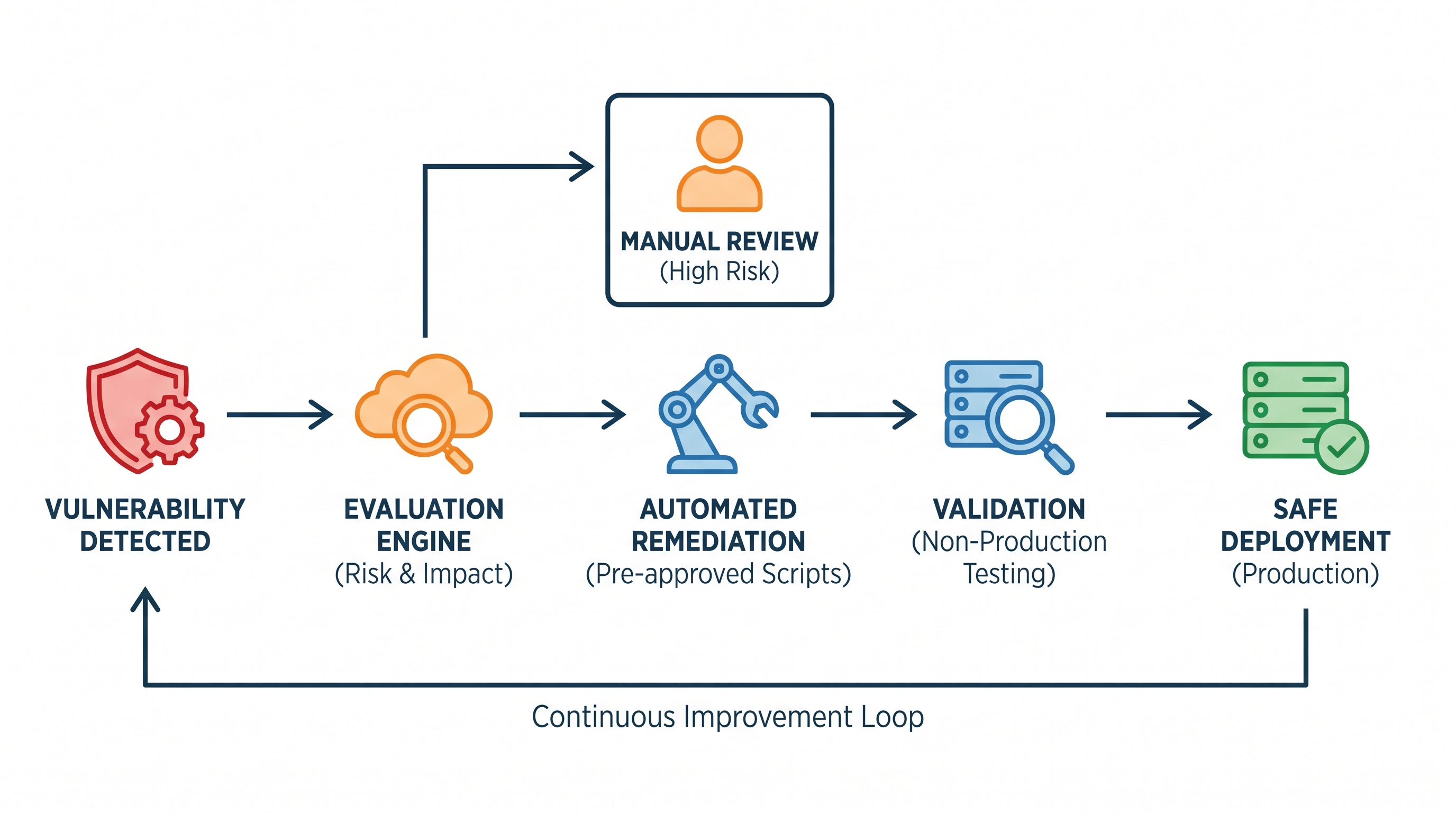
A safe automated remediation pipeline must not operate as a simple cron job that runs yum update -y or npm audit fix. Instead, it must be designed as a closed-loop control system that continuously senses, decides, acts, and verifies. Each stage of the pipeline must be governed by strict gates that can halt or roll back the operation at the first sign of trouble.
The diagram below represents the logical flow of a production-grade automated remediation pipeline:
[Continuous Scanning] -> [Reachability & Context Triage] -> [FinOps & Resource Impact Check]
                                                                        |
[Automated Rollback]  <- [Continuous Canary Monitoring]  <- [Progressive Deployment (Canary)]
Let's break down the core phases of this pipeline:
Continuous Scanning & Detection: Real-time discovery of vulnerabilities across container images, running hosts, serverless functions, and infrastructure-as-code (IaC) templates.
Reachability & Context Triage: Filtering out the noise by verifying if the vulnerable component is actually loaded into memory, exposed to the internet, or configured in a way that makes exploitability possible.
FinOps & Resource Impact Assessment: Calculating the computational and financial overhead of the remediation action (e.g., the cost of spinning up temporary staging clusters or executing rolling updates of large auto-scaling groups).
Progressive Deployment & Canary Testing: Applying the fix to a tiny fraction of production traffic while monitoring key performance indicators (KPIs) and error rates.
Continuous Monitoring & Validation: Analyzing logs, traces, and metrics to ensure the patched system behaves identically to or better than the baseline.
Automated Rollback: Instantly reverting the patch if any anomaly, latency spike, or error rate increase is detected during the validation window.
Smart Prioritization: Moving Beyond CVSS to Runtime Reachability
One of the primary reasons automated patching fails or causes unnecessary friction is poor prioritization. Relying solely on the Common Vulnerability Scoring System (CVSS) score leads to "vulnerability fatigue." A CVSS score of 9.8 (Critical) on a package that is installed but never executed, isolated from the public internet, and lacks any known active exploits does not warrant breaking a production system.
To implement safe automation, organizations must adopt an advanced approach to enterprise cloud security management that incorporates runtime reachability analysis. Using technologies like eBPF (Extended Berkeley Packet Filter), security platforms can observe the operating system kernel in real-time to determine if a vulnerable shared library (e.g., openssl or log4j) is actually being loaded into memory and executing system calls.
For example, if a container contains a critical vulnerability in a image-processing library, but the application code never imports or calls that library, the vulnerability is "unreachable." Automated remediation engines should deprioritize or ignore these unreachable vulnerabilities, focusing engineering and computational resources exclusively on reachable, exploitable vectors. This reduces the blast radius of auto-patching by eliminating up to 80% of unnecessary package updates.
Architecting Safe Rollbacks and Canary Deployments
The golden rule of automated remediation is that every fix must be treated as a software deployment. This means applying the same rigor, testing, and deployment patterns used by application developers. When a patch is identified as safe to apply, the system must utilize automated patch remediation workflows that deploy the change progressively.
1. Canary Deployments for Patched Infrastructure
Instead of patching an entire cluster or Auto Scaling Group (ASG) at once, the remediation engine should leverage a canary deployment strategy. In a Kubernetes environment, this involves:
Cloning the target deployment definition and updating the base image or package version.
Routing a minimal percentage of production traffic (e.g., 2% to 5%) to the new "patched" pods using an ingress controller or service mesh (such as Istio or Linkerd).
Comparing the golden signals (latency, traffic, errors, saturation) of the canary pods against the stable baseline pods over a defined observation window (e.g., 15 to 30 minutes).
2. Automated Rollback Mechanisms
If the canary pods exhibit an increase in HTTP 5xx errors, database connection timeouts, or CPU spikes, the remediation system must execute safe rollbacks automatically. This is achieved by instantly shifting traffic back to the original stable pods and tearing down the canary instances. The failed remediation attempt is then logged, and a ticket is automatically generated for the development team, enriched with the exact telemetry and logs that triggered the rollback.
Consider this example of a Prometheus PromQL query used by an automated remediation engine to detect anomalies during a canary patching phase:
sum(rate(http_requests_total{status=~"5..", job="patched-canary"}[5m]))
/
sum(rate(http_requests_total{job="patched-canary"}[5m])) > 0.01
If this error rate ratio exceeds 1% during the canary window, the remediation controller immediately halts the deployment and triggers the rollback process, ensuring zero impact on the broader user base.
The FinOps Connection: Cost-Aware Patching and Resource Lifecycles
Automated remediation is not just a security and engineering challenge; it is also a cloud financial management (FinOps) challenge. Executing rolling updates across large-scale clusters, rebuilding hundreds of container images, and spinning up parallel canary environments can significantly impact cloud spend if not properly managed.
When designing an automated remediation strategy, organizations must perform a detailed cost impact calculation before executing any widespread patch. For example, updating the operating system on a cluster of 500 memory-optimized EC2 instances via a rolling replacement strategy will require spinning up temporary "surge" instances to maintain capacity during the transition. If not managed carefully, this temporary capacity surge can lead to unexpected cloud bill inflation.
To optimize this process, safe auto-remediation systems should integrate with cloud lifecycle policies and compute commitment models (such as Savings Plans and Reserved Instances). Key FinOps considerations for automated remediation include:
Remediation Action | FinOps Impact | Mitigation Strategy |
|---|---|---|
Rolling ASG Rebuilds | Temporary spikes in compute costs due to surge capacity. | Schedule updates during off-peak hours when demand is low, or utilize spot instances for temporary validation nodes. |
Container Image Rebuilds | Increased CI/CD runner costs and container registry storage fees. | Implement aggressive caching of base image layers and automate the pruning of orphaned, unpatched historical images. |
Cross-AZ Traffic | Inter-Availability Zone data transfer fees during state replication of patched nodes. | Optimize deployment topology to keep canary validation traffic localized within the same availability zone. |
Step-by-Step Technical Implementation: Auto-Patching a Vulnerable Web Service
To understand how this works in practice, let us walk through a highly technical, step-by-step implementation of an automated remediation workflow for a vulnerable Node.js web application running on an AWS EKS (Elastic Kubernetes Service) cluster.
Step 1: Vulnerability Detection and Reachability Analysis
A continuous scanner detects a critical remote code execution (RCE) vulnerability in a dependency (e.g., express) used by the application. The system's runtime sensor utilizes eBPF tracing to verify that the application indeed calls the vulnerable express routing functions, marking the vulnerability as Critical & Reachable.
Step 2: Automated Branch Creation and Pull Request
The remediation engine automatically clones the application repository, creates a new Git branch (e.g., security/patch-CVE-XXXX-XXXX), and updates the package.json and package-lock.json to the safe, patched version. It then submits a Pull Request (PR).
Step 3: Staging Environment Validation
The creation of the PR triggers a CI/CD pipeline that builds a temporary Docker image containing the patch. This image is deployed to an isolated staging namespace. An automated suite of integration and regression tests is executed to verify that core application functionality remains intact. If the tests pass, the PR is automatically merged into the main branch.
Step 4: Canary Deployment in Production
The merge to main triggers the production deployment pipeline. The deployment controller uses a progressive delivery tool (such as Argo Rollouts) to deploy the new image. It starts by routing 5% of production traffic to the new version. The controller continuously queries Prometheus metrics to monitor the error rate and p99 latency of the patched pods.
Step 5: Promotion or Rollback
After a 15-minute observation period with zero anomalies, the controller automatically promotes the deployment, scaling up the patched version to 100% and gracefully terminating the old, vulnerable pods. If any anomaly had occurred, the controller would have immediately scaled the patched replica set to zero and restored full traffic to the original pods.
Overcoming Organizational Friction and Building Guardrails
Even with robust technical architectures, the success of automated remediation relies heavily on organizational trust and cultural alignment. Security, development, and SRE teams must collaborate to define clear boundaries and operational guardrails.
To build this trust, organizations should start by implementing a "read-only" or "dry-run" phase. During this phase, the remediation engine executes all steps of the pipeline—including reachability analysis, cost impact estimation, and testing—but stops short of applying the fix in production. Instead, it generates a comprehensive report showing exactly what would have been patched, the estimated cost impact, and the validation tests that would have run. This allows SRE teams to gain confidence in the system's decision-making process.
Furthermore, security leaders should establish strict "no-fly zones." These are specific times, events, or critical assets where automated patching is temporarily disabled or requires manual approval. For example, automated patching might be blocked during major retail holidays, financial end-of-quarter processing, or for legacy, stateful database clusters that require specialized handling. By providing CISOs and security leaders with these granular controls, organizations can confidently scale automation. To explore how to align security policies with executive oversight, consider reviewing tailored CISO and security leadership solutions.
Conclusion: Unify Your Cloud Operations with CloudAtler
Safely auto-fixing security vulnerabilities without breaking production is no longer a pipe dream—it is an operational necessity. By combining runtime reachability analysis, progressive canary rollouts, automated rollbacks, and deep FinOps cost-awareness, enterprises can dramatically shrink their window of vulnerability from months to minutes while preserving the absolute stability of their production environments.
However, building and maintaining these complex, interconnected pipelines across multiple cloud providers (AWS, Azure, GCP, and Oracle) is an immense engineering burden. This is where CloudAtler excels.
CloudAtler is the industry's premier AI-powered platform designed to unify FinOps, cloud security, and automated operations into a single, cohesive pane of glass. With CloudAtler, you don't have to choose between speed, cost, and security. Our platform provides intelligent reachability analysis, automated patch remediation with built-in safe rollbacks, and precise cost impact calculations to ensure your cloud infrastructure is always optimized, compliant, and secure.
Stop managing cloud operations in silos. Empower your security, SRE, and finance teams with a unified platform built for the modern enterprise.
Ready to transform your cloud operations? Visit CloudAtler today to schedule a personalized demo and discover how to safely automate your cloud security and FinOps at scale.
All in One Place
Atler Pilot decodes your cloud spend story by bringing monitoring, automation, and intelligent insights together for faster and better cloud operations.