
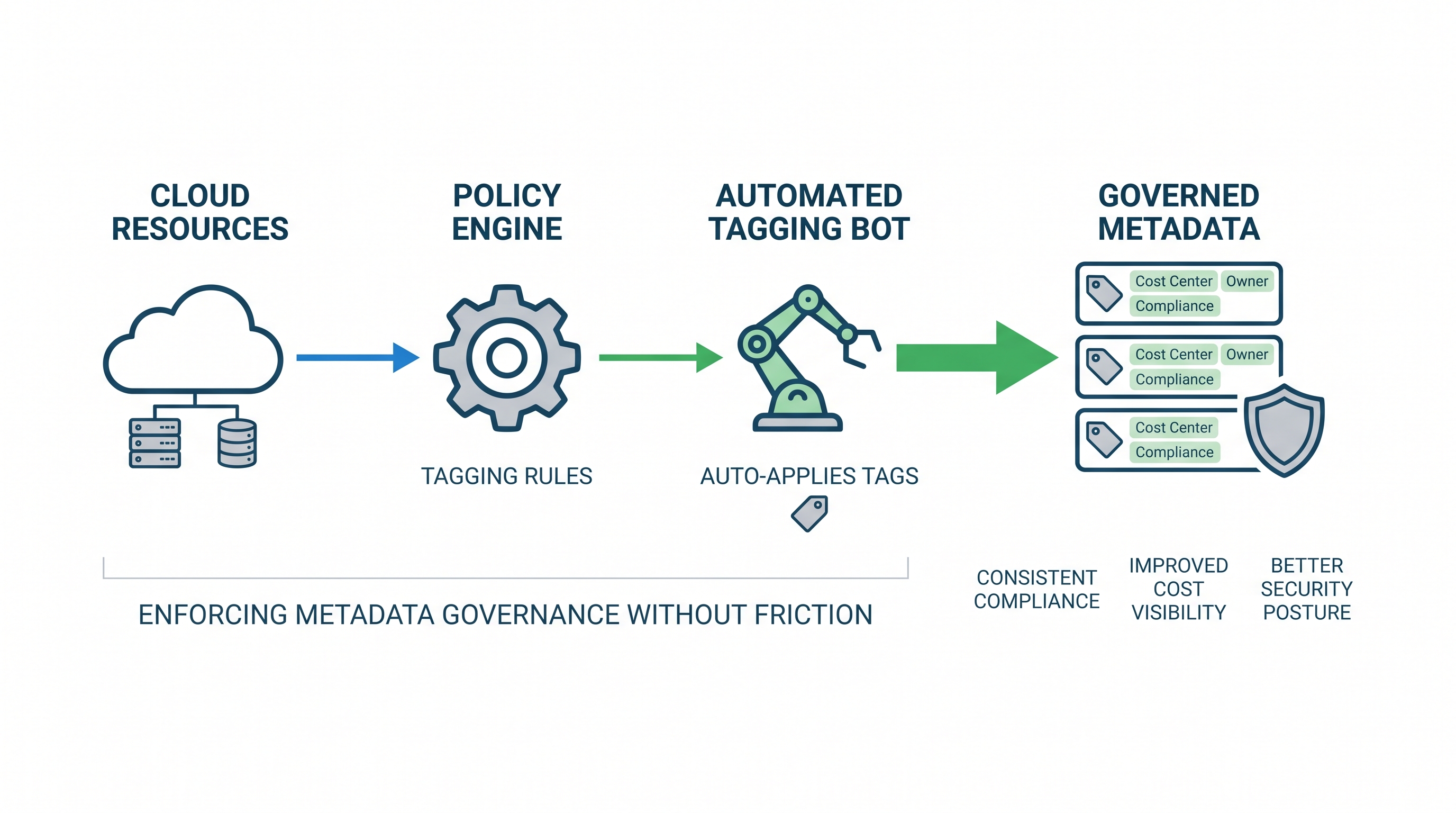
The Metadata Dilemma in Multi-Cloud Enterprises
In modern, highly distributed enterprise environments, cloud infrastructure changes at a velocity that manual processes simply cannot match. Developers spin up thousands of ephemeral resources daily—from auto-scaling compute groups and serverless functions to Kubernetes namespaces and dynamic database instances. Without precise metadata, this rapid elasticity quickly devolves into operational chaos.
When resources lack accurate tags, the downstream consequences are severe. FinOps teams cannot accurately allocate cloud spend, resulting in unallocated "orphaned" costs that bloat the corporate budget. Security teams struggle to identify resource ownership, data classification levels, or compliance boundaries during an active security incident. Without metadata, your unified FinOps and financial operations platform is starved of the granular telemetry required to generate actionable optimization insights.
Historically, organizations have attempted to solve this problem by introducing rigid gating mechanisms. They mandate strict manual tagging policies, blocking deployments in CI/CD pipelines or using Service Control Policies (SCPs) to outright reject untagged resource creation. While this approach technically enforces compliance, it introduces massive developer friction. It turns the central cloud platform team into a bottleneck, slowing down product delivery and encouraging engineers to bypass controls. True metadata governance must be invisible, continuous, and automated.
The Anatomy of a Production-Grade Tagging Schema
Before automating your tagging workflows, you must establish a standardized, resilient tagging schema. A poorly designed schema is just as problematic as no schema at all. Common pitfalls include inconsistent casing (e.g., Environment vs. environment), ambiguous values, and lack of clear ownership indicators.
A production-grade tagging taxonomy categorizes metadata into three distinct pillars: Technical, Business/Financial, and Security/Compliance. The table below outlines a standard enterprise-grade schema:
Tag Key | Pillar | Description / Purpose | Example Values |
|---|---|---|---|
| Technical | Identifies the engineering team or individual responsible for the resource. |
|
| Technical | Defines the lifecycle stage of the resource to apply correct monitoring and patch schedules. |
|
| Business | Maps resource costs back to specific corporate ledger accounts. |
|
| Business | Groups resources belonging to a single application, service, or microservice architecture. |
|
| Security | Determines compliance boundaries and encryption/access control requirements. |
|
| Security | Indicates if the resource falls under regulatory frameworks (PCI-DSS, HIPAA, GDPR). |
|
To avoid hitting cloud-provider limits (for example, AWS has a limit of 50 tags per resource, while Azure and GCP have their own specific limits and character constraints), keep keys concise and use consistent lower-case naming conventions. Furthermore, namespace your keys with a prefix—such as your organization's name or a platform identifier like cloudatler:—to prevent naming collisions with third-party tools or cloud-native default tags.
Architectural Patterns for Automated Tagging
To implement metadata governance without slowing down development, you must deploy a multi-layered automation strategy. This involves shifting left (applying tags during infrastructure definition), reacting in real-time to resource creation events, and enforcing guardrails proactively.
Pattern A: Shift-Left via Infrastructure-as-Code (IaC)
The most efficient place to apply tags is at the moment of definition. If your engineering teams utilize Terraform, OpenTofu, or Pulumi, you can leverage provider-level configurations to automatically inject default tags into all managed resources.
Consider this Terraform AWS provider configuration, which guarantees that every resource instantiated within the workspace inherits baseline metadata:
provider "aws" {
  region = "us-east-1"

  default_tags {
    tags = {
      "cloudatler:managed-by"         = "terraform"
      "cloudatler:workspace"          = terraform.workspace
      "cloudatler:repository"         = "github.com/enterprise/billing-service"
      "cloudatler:environment"        = var.environment
      "cloudatler:cost-center"        = var.cost_center
    }
  }
}
By defining default tags at the provider level, developers do not need to manually write block-level tags for every aws_instance, aws_s3_bucket, or aws_rds_cluster. The IaC engine handles this implicitly during the planning phase. To enforce this via CI/CD, you can use policy-as-code engines like Open Policy Agent (OPA) or Sentinel to scan the Terraform plan file and reject PRs if required inputs (like var.cost_center) are missing or invalid.
Pattern B: Reactive Event-Driven Auto-Tagging
While IaC covers managed infrastructure, it does not account for resources created via the cloud console, CLI, or automated scaling actions. To catch these resources, you must deploy an event-driven serverless architecture that detects resource creation events in real-time, extracts the creator's identity, and retroactively applies the correct tags.
In AWS, this is achieved by capturing CloudTrail API calls via Amazon EventBridge and routing them to an AWS Lambda function. The diagram below illustrates this architectural flow:
[Resource Created (Console/CLI)] ➔ [CloudTrail Logged] ➔ [EventBridge Rule Matches] ➔ [Lambda Execution] ➔ [Resource Tagged]
Here is an enterprise-grade Python Lambda function designed to intercept EC2 instance creation events, identify the IAM principal who initiated the action, and apply a cloudatler:owner tag automatically:
import boto3
import logging

logger = logging.getLogger()
logger.setLevel(logging.INFO)

ec2_client = boto3.client('ec2')

def lambda_handler(event, context):
    logger.info(f"Received event: {event}")

    try:
        # Extract details from CloudTrail event
        detail = event.get('detail', {})
        event_name = detail.get('eventName')

        if event_name == 'RunInstances':
            items = detail.get('responseElements', {}).get('instancesSet', {}).get('items', [])
            instance_ids = [item.get('instanceId') for item in items if item.get('instanceId')]

            # Extract IAM Principal identity
            userIdentity = detail.get('userIdentity', {})
            principal_type = userIdentity.get('type')

            owner_value = "unknown"
            if principal_type == 'AssumedRole':
                owner_value = userIdentity.get('arn', '').split('/')[-1]
            elif principal_type == 'IAMUser':
                owner_value = userIdentity.get('userName')

            if instance_ids and owner_value != "unknown":
                logger.info(f"Tagging instances {instance_ids} with owner {owner_value}")
                ec2_client.create_tags(
                    Resources=instance_ids,
                    Tags=[
                        {
                            'Key': 'cloudatler:owner',
                            'Value': owner_value
                        },
                        {
                            'Key': 'cloudatler:auto-tagged',
                            'Value': 'true'
                        }
                    ]
                )
    except Exception as e:
        logger.error(f"Error executing auto-tagger: {str(e)}")
        raise e
While writing and maintaining custom serverless functions across multiple clouds is highly customizable, it introduces operational overhead. Organizations must manage the deployment, updating, and permissions of these lambdas across hundreds of accounts. Utilizing advanced automated resource tagging engines minimizes this complexity by centralizing tag policy enforcement within a single, cloud-agnostic platform.
Pattern C: Proactive Guardrails and Policies
To prevent non-compliant resources from ever being deployed, you can implement native policy engines. In AWS, you use Service Control Policies (SCPs) within AWS Organizations. In Azure, you leverage Azure Policy definitions.
The following SCP JSON policy prevents developers from launching an EC2 instance unless they specify a valid cloudatler:cost-center tag:
{
  "Version": "2012-10-17",
  "Statement": [
    {
      "Sid": "EnforceCostCenterTagOnEC2",
      "Effect": "Deny",
      "Action": "ec2:RunInstances",
      "Resource": [
        "arn:aws:ec2:*:*:instance/*",
        "arn:aws:ec2:*:*:volume/*"
      ],
      "Condition": {
        "Null": {
          "aws:RequestTag/cloudatler:cost-center": "true"
        }
      }
    }
  ]
}
Implementing strict "Deny" policies can cause friction if introduced too quickly. Instead, organizations should initially configure policies in "Audit" or "Report" mode, using comprehensive governance guardrails to identify non-compliant resources without disrupting existing workflows. This allows the cloud platform team to build an accurate inventory and remediate legacy resources before moving to hard enforcement.
FinOps Optimization: Connecting Tags to the Bottom Line
The primary driver for metadata governance in the enterprise is cost allocation. Without accurate tagging, cloud spend becomes a monolithic black box. FinOps practitioners cannot determine whether a sudden spike in AWS bills was caused by a runaway testing script or a legitimate scaling event in a revenue-generating application.
By automating the application of cost-center, project, and owner tags, organizations can execute precise cost allocation and build unit economics models. This level of granularity is critical when aligning cloud investments with a corporate CIO FinOps strategy. For example, instead of looking at a raw bill for database instances, a CIO can see exactly how much it costs to run the "customer checkout" transaction flow versus the "internal reporting" microservice.
Handling Shared and Containerized Infrastructure
A major challenge in modern FinOps is allocating costs for shared resources, such as Kubernetes clusters (EKS, AKS, GKE) or database clusters shared by multiple business units. Standard cloud billing files only show the cost of the underlying virtual machines, not how those machines are consumed.
To solve this, your tagging automation must extend down into the container orchestration layer. By integrating Kubernetes namespace-level labels with cloud provider billing data, teams can split cluster costs proportionally. For instance, if the payment-processing namespace consumes 40% of a cluster's CPU and memory, 40% of the underlying EC2 instance costs should automatically inherit the corresponding business unit's cost-center tag in your financial reports.
Security & Compliance: Tag-Based Access Control (TBAC)
Metadata governance is not merely a financial tool; it is a fundamental pillar of modern cloud security. By utilizing Attribute-Based Access Control (ABAC) or Tag-Based Access Control (TBAC), security teams can write dynamic, scalable IAM policies that automatically adapt as resources are provisioned or decommissioned.
Dynamic IAM Policies via Resource Tags
Rather than maintaining complex IAM roles that explicitly list allowed resource ARNs, security administrators can write a single IAM policy that grants access based on matching tags between the IAM user/role and the target resource. Consider the following IAM policy:
{
  "Version": "2012-10-17",
  "Statement": [
    {
      "Sid": "AllowAccessIfProjectMatches",
      "Effect": "Allow",
      "Action": [
        "ec2:StartInstances",
        "ec2:StopInstances"
      ],
      "Resource": "arn:aws:ec2:*:*:instance/*",
      "Condition": {
        "StringEquals": {
          "aws:ResourceTag/cloudatler:project": "${aws:PrincipalTag/cloudatler:project}"
        }
      }
    }
  ]
}
In this architecture, an engineer assigned to the "billing-engine" project (as defined on their IAM user/role) can only start or stop EC2 instances that carry the exact same cloudatler:project = billing-engine tag. If the engineer is transferred to the "analytics" team, an administrator simply updates the tag on their IAM principal, and their access permissions update across thousands of cloud resources instantly, without modifying any resource-level policies.
Automated Data Security and Compliance Audits
By enforcing data classification tags, security teams can automate compliance auditing and data protection rules. For instance, an automated cloud security management engine can scan for S3 buckets or Azure Blob stores tagged with cloudatler:data-classification = restricted. If the scanner detects that a restricted bucket has public access enabled, it can trigger an automated remediation workflow to immediately block public access and alert the security operations center (SOC).
Overcoming the Friction: The Automated Governance Lifecycle
Enforcing a strict metadata governance policy in an active production environment requires a thoughtful, phased approach. Outright blocking deployments or terminating untagged resources on day one will cause widespread outages and alienate development teams. The key to success is a progressive, frictionless remediation lifecycle.
The Friction-Free Remediation Lifecycle:
Discover & Analyze: Run continuous scans across your entire multi-cloud estate to identify untagged or non-compliantly tagged resources. Establish a baseline of metadata health.
Auto-Inherit & Enrich: Apply automated heuristics to tag resources. For example, if an EBS volume is attached to an EC2 instance, it should automatically inherit the instance's tags. If a resource is within a specific resource group or folder, inherit the parent container's tags.
Notify & Warn: Send automated, contextual alerts to the resource owners (identified via IaC history or creation logs) via Slack, Microsoft Teams, or Jira, providing a direct link to remediate the missing tags.
Quarantine (Non-Production): If a resource in a development or staging environment remains untagged after a designated grace period (e.g., 72 hours), automatically apply restrictive security groups or stop the resource to prevent further cost accumulation.
Decommission: In non-production environments, permanently delete or archive resources that fail to comply with metadata governance after a extended warning period.
By establishing this predictable, automated lifecycle, organizations can rapidly achieve near-100% metadata compliance without disrupting critical production environments or burdening platform engineers with manual cleanup tasks.
Achieve Absolute Cloud Governance with CloudAtler
Building, maintaining, and scaling custom tagging scripts, lambda functions, and policy engines across AWS, Azure, GCP, and Oracle Cloud Infrastructure is an incredibly expensive and error-prone engineering distraction. To truly eliminate the friction of metadata governance, enterprises require a unified, intelligent platform.
CloudAtler provides an AI-powered, multi-cloud platform that unifies FinOps, cloud security, and automated operations. With CloudAtler, you can instantly deploy intelligent tagging guardrails, automate event-driven remediation, and gain complete visibility into your cloud spend and security posture through a single pane of glass. Stop chasing untagged resources and start driving business value.
Ready to automate your metadata governance and optimize your multi-cloud operations? Explore CloudAtler today or schedule a personalized demo with our cloud architecture experts.
All in One Place
Atler Pilot decodes your cloud spend story by bringing monitoring, automation, and intelligent insights together for faster and better cloud operations.