
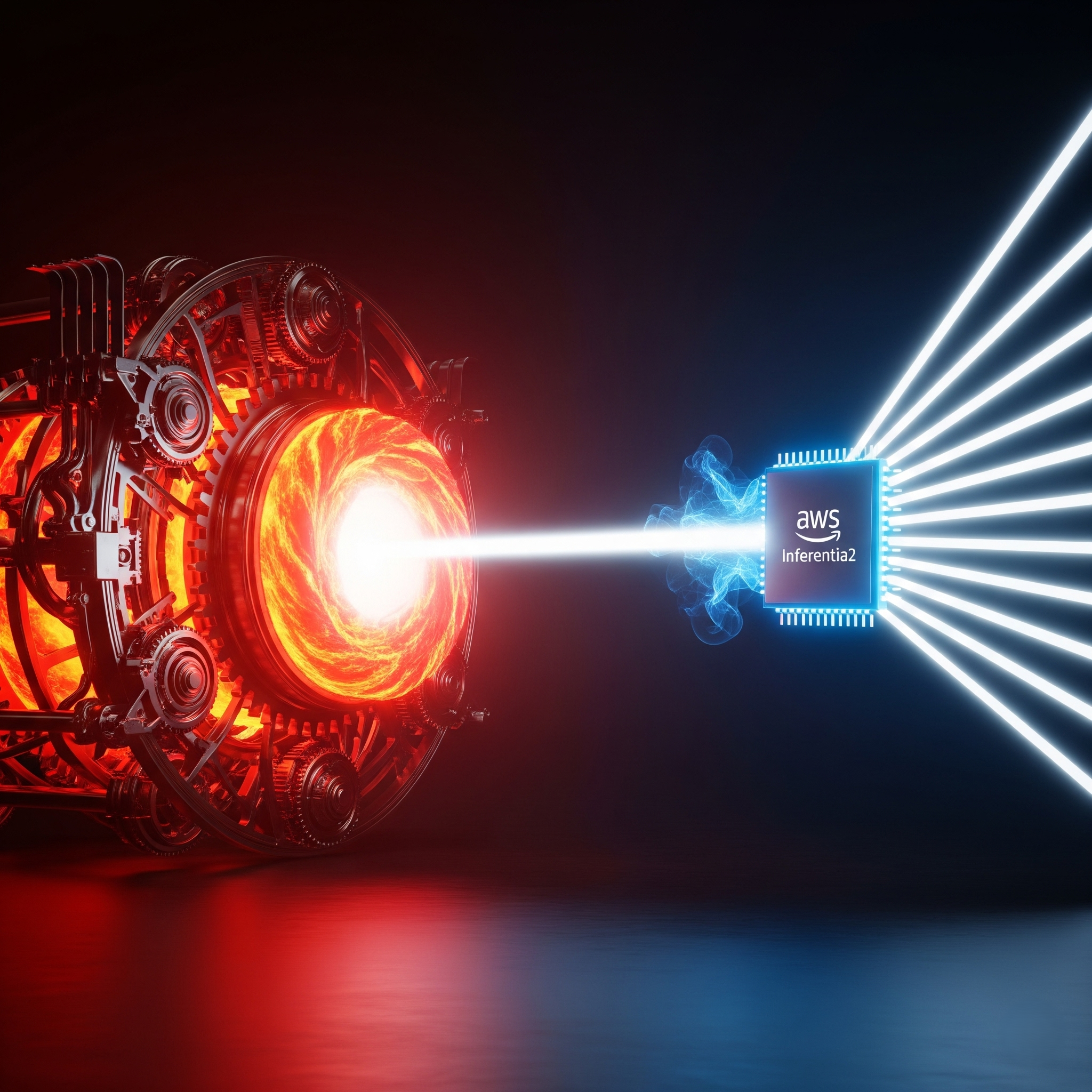
For years, NVIDIA GPUs have been the undisputed champions of AI and machine learning workloads. However, their high cost, especially for 24/7 production inference, has created a significant financial barrier. In response, AWS has invested heavily in developing its own specialized AI hardware, designed to offer superior price-performance. The most prominent of these for inference is the AWS Inferentia2 accelerator.
But is switching from a familiar GPU-based workflow to this custom silicon worth the effort? A cost-effectiveness analysis reveals that for the right workloads, AWS Inferentia2 can be a powerful lever for dramatically reducing the operational cost of AI. This guide explores the benefits, challenges, and ideal use cases for this specialized hardware.
What is AWS Inferentia2?
AWS Inferentia2 is a custom-designed machine learning chip built by Amazon for one purpose: high-performance, low-cost inference. Unlike general-purpose GPUs, Inferentia2 is optimized specifically for running trained ML models. It is the successor to the first-generation Inferentia chip and is available through Amazon EC2 Inf2 instances. For training, AWS offers a complementary chip called AWS Trainium, which is designed to provide a more cost-effective alternative to GPUs for model training.
The Cost-Effectiveness Proposition
The primary value proposition of Inferentia2 is a lower Total Cost of Ownership (TCO) for production inference workloads compared to equivalent GPU-based instances. This is achieved through several factors:
Higher Throughput: Inf2 instances are designed to deliver significantly higher throughput (inferences per second) for many common model architectures, including large language models (LLMs) and diffusion models. This means a single Inf2 instance can handle the same traffic as multiple GPU instances.
Lower Cost-Per-Inference: The combination of higher throughput and a competitive instance price results in a dramatically lower cost-per-inference. AWS claims that Inf2 instances can deliver up to 40% better price-performance than comparable GPU-based instances.
Energy Efficiency: As a purpose-built chip, Inferentia2 is more energy-efficient than general-purpose GPUs for inference tasks, which can translate to lower operational costs.
The Challenges and Considerations
While the potential savings are significant, migrating to Inferentia2 is not a simple drop-in replacement for a GPU. It requires a deliberate engineering effort.
Model Compilation: To run on Inferentia2, your trained model must be compiled using the AWS Neuron SDK. This is an extra step in the MLOps workflow that converts the model into an optimized format that can be executed by the Inferentia hardware.
Workload Compatibility: Inferentia2 is highly optimized for certain types of models and operations. It's crucial to validate that your specific model is supported and performs well on the hardware.
Ecosystem and Tooling: The ecosystem around NVIDIA GPUs (CUDA, cuDNN, etc.) is incredibly mature. While the AWS Neuron ecosystem is growing rapidly, it is newer and may have fewer community resources.
When is Inferentia2 the Right Choice?
Inferentia2 is most cost-effective for organizations with stable, high-volume production inference workloads. Ideal use cases include:
Large Language Model (LLM) Serving
Computer Vision applications performing image recognition or object detection at scale
Recommendation Engines serving millions of recommendations per day
It is generally not the right choice for:
Model Training
Low-volume or experimental workloads where the engineering effort for compilation may not be justified
Teams with no MLOps capacity to handle the migration effort
Conclusion
AWS Inferentia2 represents a significant step forward in making AI more accessible by tackling the high cost of production inference. For organizations willing to invest the engineering effort to compile and optimize their models, the payoff can be substantial. As the AI/ML landscape matures, a hybrid approach—using GPUs or Trainium for training and specialized hardware like Inferentia2 for high-volume production—is emerging as the most cost-effective strategy.
All in One Place
Atler Pilot decodes your cloud spend story by bringing monitoring, automation, and intelligent insights together for faster and better cloud operations.