
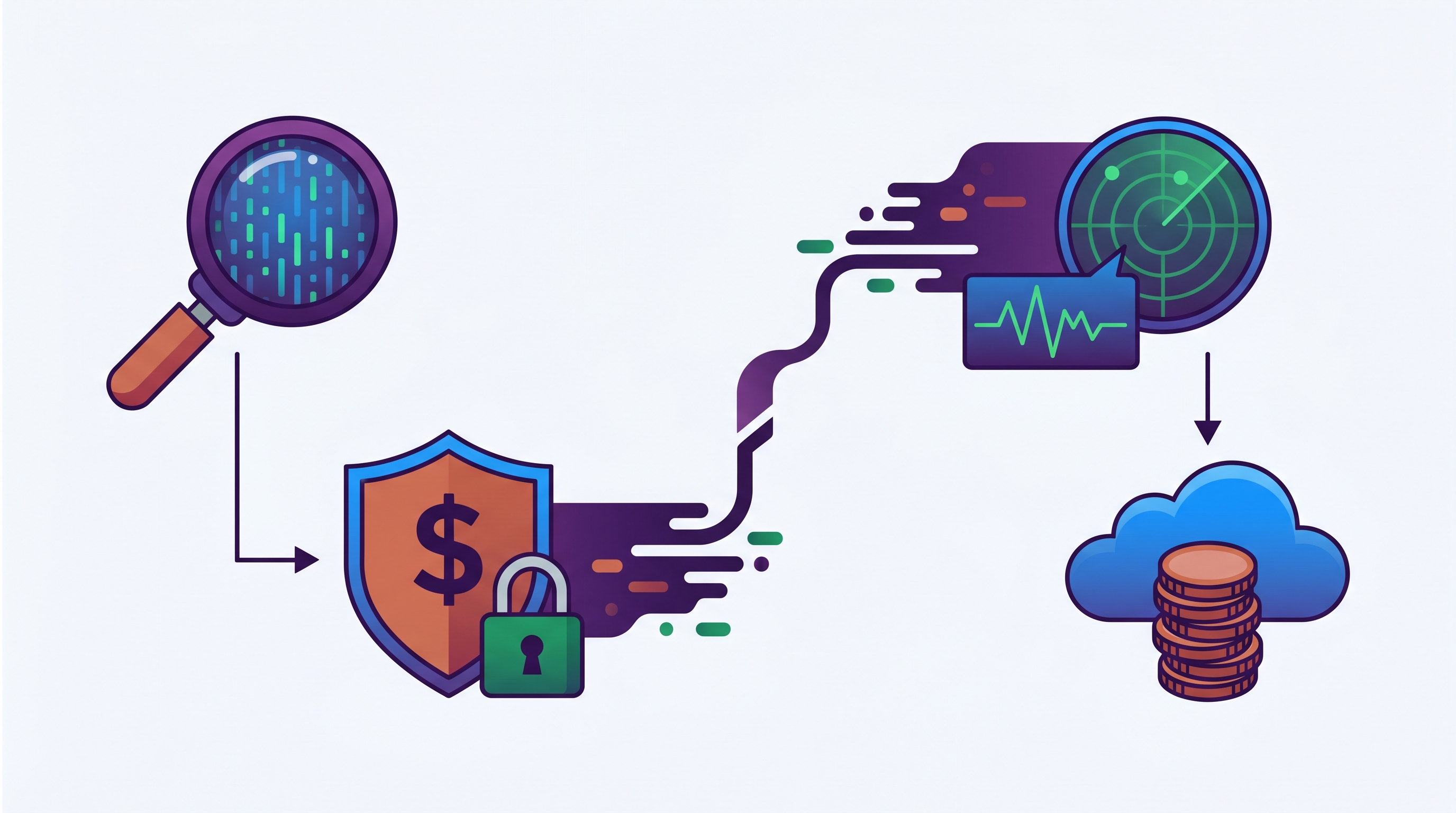
The FinOps Challenge of Cloud Security Posture Management
As organizations scale their cloud footprints, securing massive datasets and complex network perimeters becomes a paramount concern. Amazon Web Services (AWS) provides a robust suite of native security tools, most notably Amazon Macie for data privacy and Amazon GuardDuty for threat detection. While these services provide critical security observability, they operate on consumption-based pricing models that can rapidly spiral out of control if deployed indiscriminately. For the FinOps practitioner, the challenge lies in balancing the rigid mandates of the Chief Information Security Officer (CISO) against the economic realities of the IT budget. Deploying advanced security telemetry across petabytes of data without a granular cost-optimization strategy often leads to catastrophic billing surprises, transforming essential security tools into financial liabilities.
Understanding the architectural differences and distinct cost drivers between AWS Macie and GuardDuty is foundational to constructing a sustainable Security FinOps model. These services do not operate on fixed monthly licenses; their costs are dynamically dictated by the volume of data they process, the specific logs they ingest, and the frequency of their scanning algorithms. To optimize this spend, engineering teams must shift from a "scan everything" mentality to a highly targeted, risk-based deployment architecture.
AWS GuardDuty Architecture and Volumetric Cost Dimensions
Amazon GuardDuty is an intelligent threat detection service that continuously monitors malicious activity and anomalous behavior. Unlike traditional agent-based endpoint protection, GuardDuty is a purely network and control-plane focused service. It operates by seamlessly analyzing three foundational AWS log sources: AWS CloudTrail management events, Amazon VPC Flow Logs, and DNS query logs. Additionally, it has expanded to include specialized protection modules for Amazon S3 (data events), Amazon EKS (audit logs), Amazon RDS, and AWS Lambda.
The billing architecture of GuardDuty is fundamentally volumetric. You are charged per gigabyte (GB) of log data analyzed by its machine learning models. The most significant financial trap in GuardDuty deployments involves VPC Flow Logs. If an organization runs a high-throughput microservices architecture or massive data ingestion pipelines, the volume of internal VPC network traffic can be astronomical. Because GuardDuty analyzes the metadata of this traffic, the gigabytes of VPC Flow Logs generated can quickly result in tens of thousands of dollars in monthly GuardDuty charges. Crucially, you are billed for the volume of logs analyzed by GuardDuty even if you have not explicitly enabled VPC Flow Logs in your own account; GuardDuty pulls this telemetry directly from the underlying hypervisor.
GuardDuty FinOps Optimization: Intelligent Sampling and Exclusions
Optimizing GuardDuty costs requires strategic scoping at the AWS Organizations level. A common, expensive mistake is enabling GuardDuty universally across all accounts—including development, sandbox, and testing environments—with identical configurations. FinOps best practices dictate a tiered security architecture. Tier-0 production accounts containing sensitive customer data (PII/PHI) mandate full GuardDuty coverage. However, ephemeral sandbox environments, where developers are constantly spinning up and tearing down resources, generate massive amounts of anomalous CloudTrail noise and network traffic. Disabling GuardDuty in these non-production accounts, or selectively disabling the high-volume EKS or RDS protection modules where not strictly required by compliance, is a primary lever for cost reduction.
Furthermore, managing the cost of the underlying logs themselves is critical. While GuardDuty pulls its own feed of VPC Flow Logs, many organizations explicitly enable VPC Flow Logs for their own SIEM (Security Information and Event Management) ingestion. To reduce the storage and processing costs associated with these logs, architects should implement flow log sampling (e.g., logging only 1 in every 10 packets) or filter logs to only capture 'REJECT' traffic rather than 'ALL' traffic. While this doesn't directly reduce the GuardDuty analysis bill (as GuardDuty analyzes the raw hypervisor feed), it drastically reduces the associated CloudWatch and S3 storage costs, optimizing the holistic security budget.
AWS Macie Architecture and Deep Packet Cost Dynamics
While GuardDuty focuses on network and identity threats, Amazon Macie is dedicated to data security and data privacy. Macie utilizes pattern matching and machine learning to discover, classify, and protect sensitive data (like credit card numbers, API keys, and social security numbers) stored natively within Amazon S3 buckets. The architectural approach of Macie is fundamentally different from GuardDuty; it must physically read and inspect the actual contents of the objects within S3, rather than just analyzing metadata.
The cost structure of Macie is split into two primary dimensions. First, there is a flat fee per S3 bucket evaluated for bucket-level security posture (e.g., checking for public read access or unencrypted buckets). This cost is generally negligible. The catastrophic cost driver is the second dimension: Automated Data Discovery and targeted Sensitive Data Discovery jobs. You are billed heavily per gigabyte of S3 object data processed and inspected. If an organization carelessly enables Macie automated discovery across a multi-petabyte data lake containing massive parquet files or compressed historical archives, the resulting Macie bill can easily eclipse the cost of the S3 storage itself.
Macie Cost Optimization: Sampling, Exclusions, and Metadata
The FinOps mandate for Macie is precision. Executing a full, 100% scan of an S3 bucket is rarely economically viable unless mandated by a specific, point-in-time compliance audit. Instead, organizations must leverage Macie's automated data discovery feature with rigorous exclusions. Automated data discovery operates on a sampling model; Macie intelligently selects a representative subset of objects within a bucket to scan each day, providing a probabilistic assessment of the bucket's sensitivity while capping costs.
To further optimize Macie spend, FinOps practitioners must aggressively exclude specific file types and bucket prefixes. Macie cannot extract text from compiled binaries, video files, or certain proprietary formats. If a bucket contains terabytes of .mp4 video assets or compiled .jar files alongside text-based application logs, Macie must be explicitly configured to ignore the media and binary prefixes. Furthermore, organizations should implement strict data tagging architectures. If a data engineering team has already classified a bucket as "Public/Non-Sensitive" via S3 object tags or bucket policies during the CI/CD deployment phase, Macie scanning jobs should be explicitly configured to skip these tagged resources, focusing expensive compute cycles exclusively on untagged or high-risk data repositories.
Comparing the Cost Drivers: Macie vs. GuardDuty
When analyzing the FinOps impact of both services, it is critical to recognize their divergent scaling behaviors. GuardDuty costs are driven by system activity and network velocity. A DDoS attack, a massive data migration, or a sudden spike in microservice communication will cause GuardDuty costs to surge unpredictably due to the increased volume of VPC Flow Logs and DNS queries.
Conversely, Macie costs are driven by storage volume and configuration logic. Macie costs are highly predictable if configured via manual discovery jobs, but can be financially dangerous if automated scanning is enabled without strict boundaries. A common architecture involves using GuardDuty as the broad, continuous perimeter defense, while utilizing Macie selectively as a deep-inspection tool. For example, if GuardDuty detects anomalous access patterns from an unknown IP address downloading objects from a specific S3 bucket, a Lambda function can automatically trigger a targeted Macie job to scan that specific bucket to determine if PII was exposed. This event-driven security architecture maximizes threat visibility while minimizing continuous scanning costs.
The Hidden Costs of CloudTrail Integration
Both Macie and GuardDuty rely on AWS CloudTrail to provide context regarding identity and access management. CloudTrail inherently tracks Management Events (e.g., CreateBucket, RunInstances) for free. However, robust security observability often requires tracking Data Events (e.g., GetObject, PutObject within S3, or Invoke on Lambda). CloudTrail charges significantly for ingesting Data Events.
If an organization enables S3 Data Events across all buckets to provide maximum visibility to GuardDuty, the CloudTrail ingestion bill will skyrocket. The FinOps solution is utilizing CloudTrail advanced event selectors. Instead of logging every S3 GetObject request, the event selectors should be configured to only log data events for specific, high-risk buckets containing PII (as identified by Macie) or critical production configuration files. Aligning CloudTrail verbosity with the data sensitivity classification provided by Macie ensures that the organization only pays for premium telemetry where the risk profile justifies it.
S3 Intelligent-Tiering and Macie Cost Implications
A sophisticated FinOps strategy heavily utilizes Amazon S3 Intelligent-Tiering or Glacier to move infrequently accessed data to cheaper storage classes. However, integrating Macie with these lifecycle policies requires careful orchestration. Macie can scan data in S3 Standard, Standard-IA, and Intelligent-Tiering. If Macie scans an object in Intelligent-Tiering, it does not change the access tier of the object.
However, Macie cannot scan data that has been archived to S3 Glacier Flexible Retrieval or Glacier Deep Archive. If a compliance mandate requires a retroactive Macie scan on historical data, the data must first be restored from Glacier to a synchronous storage class. This restoration process incurs massive data retrieval fees and early deletion penalties. Therefore, all Macie data discovery and classification jobs must be executed shortly after the data is ingested into S3 Standard, before lifecycle policies transition the data to cold storage. Neglecting this temporal dependency can destroy the financial benefits of Glacier archiving.
EKS Runtime Monitoring with GuardDuty vs Alternatives
The expansion of GuardDuty to include EKS Runtime Monitoring introduces a new cost vector. This feature requires deploying a GuardDuty security agent (a DaemonSet) to every node in the Kubernetes cluster. This agent collects operating system-level events (file access, process execution, network connections) and sends them to the GuardDuty backend for analysis.
The billing for this feature is based on the number of vCPUs running the agent and the volume of data processed. For massive EKS clusters, this agent-based pricing can become exorbitant. FinOps practitioners must evaluate this cost against open-source, eBPF-based alternatives like Falco or Tetragon. While Falco requires internal engineering effort to deploy, maintain, and integrate into a SIEM, it does not incur per-vCPU SaaS fees. The decision matrix must weigh the "managed service" convenience of GuardDuty EKS Protection against the engineering overhead and infrastructure savings of managing a native eBPF security stack.
Automation and Cost Remediation via EventBridge
To proactively prevent security billing spikes, organizations must implement automated financial circuit breakers. AWS Budgets can track GuardDuty and Macie spend, but they are often reactive, alerting only after the daily cost has been incurred. A more advanced FinOps architecture leverages Amazon EventBridge and AWS Lambda to create real-time remediation workflows.
For example, if the daily estimated cost of Macie exceeds a predefined threshold, an EventBridge rule can trigger a Lambda function that utilizes the Macie API to automatically pause all active data discovery jobs. Similarly, if GuardDuty costs spike due to an unexpected surge in VPC Flow Logs during a massive internal data transfer, a Lambda function can temporarily disable the GuardDuty service in that specific non-production account until the transfer is complete. These automated circuit breakers provide absolute financial safety nets, ensuring that runaway security telemetry cannot compromise the overall cloud budget.
The CloudAtler Perspective on Security Spend
Integrating security costs into the broader FinOps culture is a complex organizational challenge. Security teams are incentivized to maximize visibility, while FinOps teams are incentivized to minimize spend. Bridging this gap requires platforms like CloudAtler, which provide unified visibility into both domains. CloudAtler ingests billing data alongside security posture metrics, allowing organizations to calculate the "Cost per Finding" or the "Cost of Compliance."
By analyzing GuardDuty and Macie usage through CloudAtler, engineering leadership can identify specific AWS accounts or product teams that are generating disproportionate security costs. CloudAtler's anomaly detection algorithms can instantly identify if a developer accidentally enabled full Macie scanning on a multi-petabyte log bucket, alerting the FinOps team before the monthly invoice is generated. Furthermore, CloudAtler facilitates chargeback models, ensuring that the heavy security costs incurred by data-intensive applications are appropriately billed to the respective product lines, rather than being absorbed as a centralized IT overhead.
Infrastructure as Code (IaC) for Security Service Deployment
Manual enablement of Macie and GuardDuty via the AWS Console is a FinOps anti-pattern. Enterprise governance demands that all security services are deployed and managed via Infrastructure as Code (IaC) using tools like Terraform or AWS CloudFormation, deeply integrated with AWS Organizations.
Using Terraform, the security architecture becomes version-controlled and auditable. A central security account can be designated as the delegated administrator for GuardDuty and Macie. Terraform modules can be written to automatically enable GuardDuty in all new member accounts, but crucially, these modules can accept variables to conditionally enable or disable expensive features (like EKS Protection or S3 Data Events) based on the specific tagging of the member account. This IaC-driven approach ensures consistent baseline security across the organization while providing the granular levers necessary for localized cost optimization.
Strategic Consolidation: AWS Security Hub Economics
GuardDuty and Macie are merely sensors; they generate findings. To operationalize these findings, organizations typically route them to AWS Security Hub. Security Hub acts as the centralized CSPM platform, aggregating findings from GuardDuty, Macie, Inspector, and IAM Access Analyzer.
While Security Hub is essential for alert management, it also carries its own cost, billed per finding ingested and per security check evaluated. If GuardDuty generates 10,000 low-severity findings regarding internal SSH scans, Security Hub will charge to ingest every single one of those findings. FinOps optimization requires rigorous tuning at the GuardDuty level to suppress low-value findings before they are forwarded to Security Hub. By utilizing GuardDuty suppression rules to filter out benign, accepted operational noise, the organization simultaneously reduces the cognitive load on the security operations center (SOC) and significantly reduces the ingestion costs associated with Security Hub and downstream SIEM platforms.
Conclusion: The Maturity of Security FinOps
Mastering the cost dynamics of Amazon Macie and GuardDuty requires a profound shift from traditional, perimeter-based security thinking to a highly dynamic, data-centric approach. Security observability is no longer a fixed infrastructural cost; it is a variable expense driven by data volume, architectural design, and engineering behavior. By implementing intelligent sampling, leveraging targeted event-driven scanning architectures, automating financial circuit breakers, and utilizing comprehensive analytics platforms like CloudAtler, organizations can achieve the dual mandate of the modern cloud era: maintaining uncompromised security posture while rigorously optimizing financial expenditure. The true measure of a mature cloud architecture is not just how secure it is, but how economically sustainable that security is at scale.
All in One Place
Atler Pilot decodes your cloud spend story by bringing monitoring, automation, and intelligent insights together for faster and better cloud operations.