
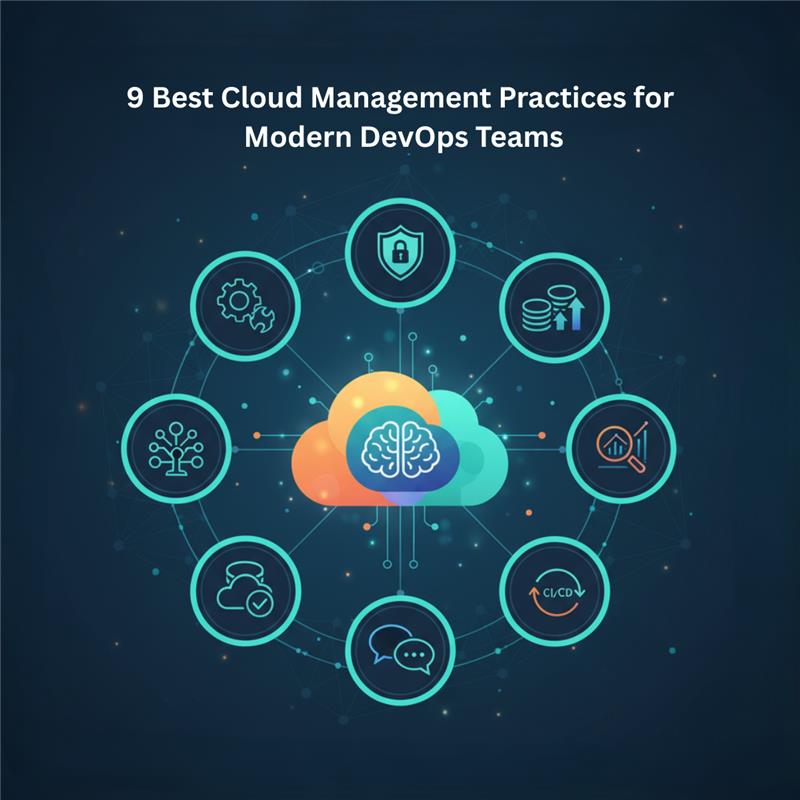
9 Best Cloud Management Practices for Modern DevOps Teams
Are you confident that your cloud environment is fully under control and optimized for both performance and cost? In many organizations, a major shift to cloud computing introduces enormous flexibility and velocity, yet it also demands disciplined management to avoid spiraling costs, security lapses, and operational complexity.
In this blog, we will explore 9 essential cloud management practices for modern DevOps teams. These practices span the full lifecycle of cloud adoption and enable you to implement effective cloud management practices in cloud computing and manage your cloud infrastructure reliably and adopt cloud cost management best practices along the way.
1. Manage Infrastructure as Code (IaC)
One of the foundational types of cloud management practices is the treatment of infrastructure as code (IaC). When you codify your infrastructure configurations (for example, in Terraform, CloudFormation, Pulumi), you enforce version control, peer review, repeatability and auditability. Using Git as the source of truth ensures that changes to your infrastructure are tracked, reversible, and transparent.
In the context of managing cloud infrastructure, this approach eliminates ad-hoc manual changes in consoles, reduces configuration drift, and facilitates environment replication across development, test, staging, and production.
2. Embrace GitOps for Continuous Delivery
Another class of cloud management practices in cloud computing is the adoption of GitOps for both application deployment and infrastructure updates. With GitOps, you treat deployment manifests, infrastructure definitions, and environment configuration as code, and an operator synchronizes actual state to the declared state. This enables you to confidently manage your cloud infrastructure because changes are auditable, drift is eliminated, and rollback becomes straightforward.
In addition, GitOps supports progressive delivery (canaries, feature flags), which aligns with DevOps' velocity while maintaining stability. By pursuing these practices, you align with cloud management best practices that emphasize automation and visibility.
3. Build Smart CI/CD Pipelines
When you implement the cloud management practice that governs the delivery pipeline, you ensure faster and safer software and infrastructure changes. Your CI/CD pipelines should not only compile and test code but also perform infrastructure-as-code linting, security scans (SAST/DAST), dependency vulnerability scans, compliance checks, and cost impact evaluations. These are central to managing the cloud environment reliably while applying cloud cost management best practices. The more you automate the safety gates, the less manual overhead and the fewer surprises in production.
4. Implement Unified Observability
For effective cloud management practices, you need to see what is happening in your infrastructure and applications in real time. Observability means collecting logs, metrics, and traces across your stack so that when incidents occur, you can answer “what happened”, “why it happened”, and “what to do next”. When you are managing the cloud infrastructure, you must ensure that telemetry is integrated early. Use open standards (e.g., OpenTelemetry) so your monitoring spans multi-cloud or hybrid setups. Defining service-level indicators (SLIs) and service-level objectives (SLOs) connects your operational data to business outcomes and supports continuous improvement.
5. Enforce Security
When you practice cloud management in cloud computing, one of the most critical dimensions is security and governance. Embedding security controls early within IaC templates, pipelines, and Kubernetes manifests. Employ least-privilege access, role-based access control, multi-factor authentication, encryption at rest and in transit, vulnerability scanning and continuous audit. These aspects form part of effective cloud management practices.
Moreover, policy-as-code (for example, using tools like OPA/Rego, or cloud-provider policy engines) enables you to codify guardrails such as “all databases must be encrypted”, “no public S3 buckets in production”, etc. This supports your goal of managing the cloud infrastructure in a way that meets compliance and security standards while preserving speed.
6. Apply FinOps
Cloud environments can scale quickly, and without discipline, costs can spiral. To manage this, you need to adopt cloud cost management best practices: tag all assets accurately (for allocation and show-back), monitor spend by team or workload, automate alerts for anomalies, rightsize resources, shut down idle services, use reserved instances or savings plans when appropriate, and continuously forecast spend.
Cloud asset management best practices also play a role here in having full visibility of every asset, owner, lifecycle stage, and usage. Together, these practices ensure you are not just spending but investing wisely.
Action Tip: Effective FinOps platforms, such as Cloud Atler enhance this process by serving as an intelligent cloud cost comparison platform. It helps teams to analyze pricing across providers, uncover savings opportunities, and make smarter, data-driven cloud decisions - all without slowing down innovation.
7. Automate Governance with Guardrails
When managing the cloud infrastructure at scale, manual approvals become hurdles. That’s why automating governance is really important. This means putting in place guardrails that prevent risky configurations while empowering teams to self-serve. Examples include automatically enforcing encryption, preventing public access to production buckets, requiring tagging, controlling VM sizes, and enforcing region constraints. These governance policies should be codified and automated. By doing so, you enable teams to move fast while maintaining reliability, security, and cost efficiency.
Action Tip: This is exactly what Alter Pilot does for you. It is a cloud management platform that provides users with unified dashboards to monitor cloud usage, get security alerts, and add guardrails for governance automation for free.
8. Invest in Platform Engineering
Another important aspect among the types of cloud management practices is enabling developer autonomy without sacrificing control. A platform or SRE team should build and maintain a self-service catalog of approved infrastructure components, CI/CD templates, monitoring dashboards, secure service libraries and automations. This model reduces undifferentiated heavy lifting for product teams and allows them to deploy infrastructure and services safely and quickly. In managing the cloud infrastructure, this model supports standardization, accelerates onboarding, and ensures compliance by default.
9. Improve Continuously & Close the Loop
Finally, any set of cloud management practices is only as good as its measurement and feedback loop. Adopt metrics such as deployment lead time, change failure rate, time to restore, resource utilization, cost per service, and reliability metrics (SLIs/SLOs). Use the industry-proven DORA metrics (lead time, deployment frequency, failure rate, recovery time) to monitor delivery performance and link them with reliability outcomes. Use regular retrospectives and incident post-mortems in a blameless culture to extract lessons. Then refine your practices, tooling, policies, and platform iteratively. This is how you build a culture of continuous improvement in cloud operations.
Conclusion
Modern cloud-centric DevOps teams face both incredible opportunity and significant risk. By actively practicing effective cloud management practices, you ensure agility, reliability, security, and cost-efficiency. Whether you are just beginning to implement infrastructure as code, strengthening your observability, embedding security early, or refining your cost controls, each of these nine areas contributes to a robust cloud management strategy.
All in One Place
Atler Pilot decodes your cloud spend story by bringing monitoring, automation, and intelligent insights together for faster and better cloud operations.