
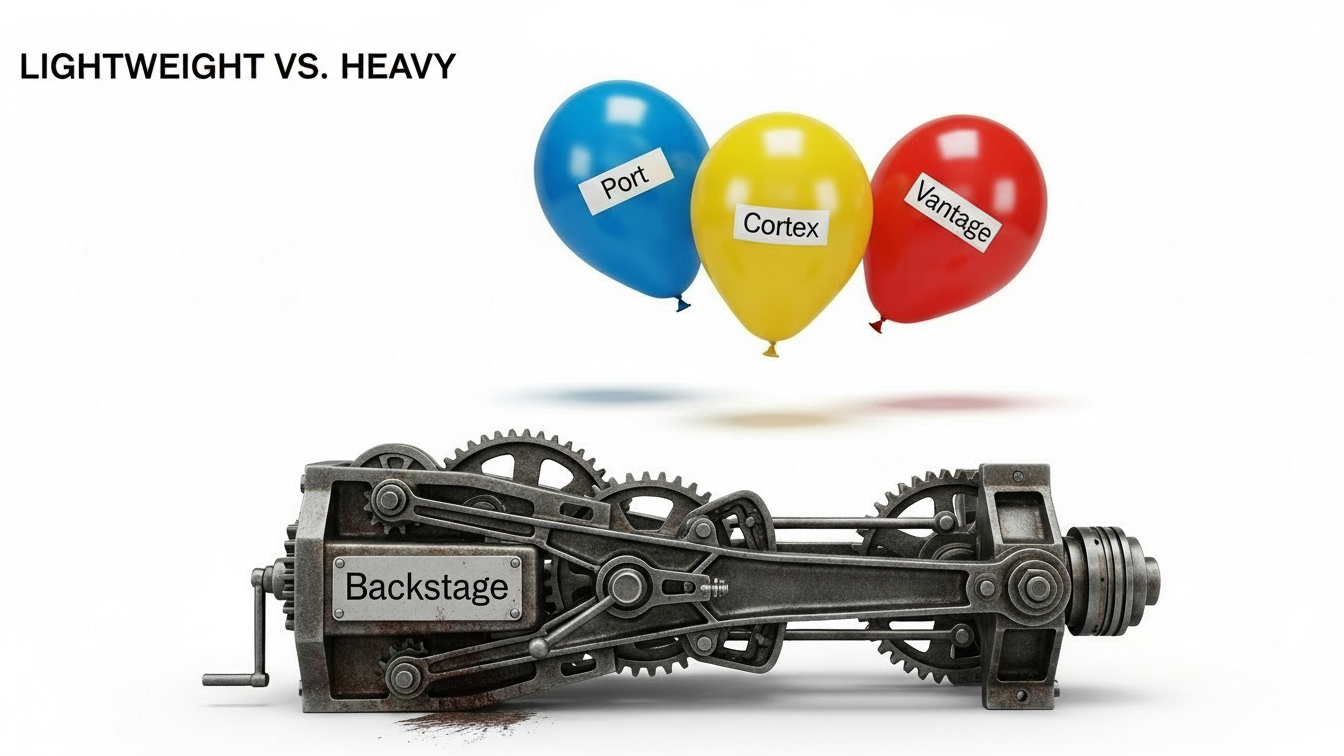
Spotify's Backstage has become the default standard for Internal Developer Portals (IDPs). However, for many Platform Engineering teams, the Cost Insights plugin is a stumbling block. While powerful, it is notoriously difficult to configure, requiring complex data pipelines, manual aggregation, and significant TypeScript customization to render meaningful charts.
If your goal is simply to show developers their cloud spend without maintaining a React app, you don't need to boil the ocean. Here are 5 effective alternatives in 2025.
1. Port (The No-Code Integrator)
Best For: Teams who want cost data in their service catalog today. Port has emerged as the leading "No-Code" IDP. Unlike Backstage, which requires code changes to update the UI, Port uses a flexible blueprint model.
The Integration: Port connects directly to AWS Cost Explorer, Kubecost, or Datadog via webhooks or simple API integrations.
The Developer Experience: You can define a "Service" blueprint that includes a
monthly_costproperty. This property is automatically populated by your CI/CD pipeline or a scheduled lambda, displaying the cost right next to the service owner and runbook links.
2. Cortex (The Scorecard Approach)
Best For: Driving accountability through gamification. Cortex treats cost as a "Scorecard" metric rather than just a dashboard.
Mechanism: You set a rule: "Service monthly spend must be < $500."
Visibility: If a service exceeds this, the scorecard turns red. This drives immediate behavioral change because developers care about their service's "health score" more than they care about abstract finance dashboards.
3. Kubecost (The Kubernetes Specialist)
Best For: Teams whose spend is 90%+ inside K8s clusters. If you don't need a full IDP, Kubecost provides a dedicated "Developer View" (OpenCost).
Why it works: It runs inside your cluster. It handles the difficult math of allocating shared resources (like unallocated node memory) back to specific namespaces or pods, something generalist IDPs struggle with.
4. Vantage (The "Stripe" of FinOps)
Best For: Financial visibility without the "Portal" overhead. Vantage isn't an IDP, but its "Developer Views" are so robust they often replace the need for one.
Feature: It integrates deeply with GitHub. Instead of forcing devs to log into a portal, Vantage posts cost comments directly on Pull Requests (e.g., "This PR will increase monthly spend by estimated $50").
5. Infracost (Shift Left)
Best For: Preventing cost before it happens. Backstage shows you what you spent. Infracost shows you what you will spend.
By integrating Infracost into your Terraform pipelines, you give developers visibility at the commit stage, which is arguably more valuable than a retrospective dashboard.
Verdict: Don't implement Backstage just for cost visibility. The maintenance tax is too high. Use Port for a unified catalog view, or Vantage for pure financial clarity.
All in One Place
Atler Pilot decodes your cloud spend story by bringing monitoring, automation, and intelligent insights together for faster and better cloud operations.