
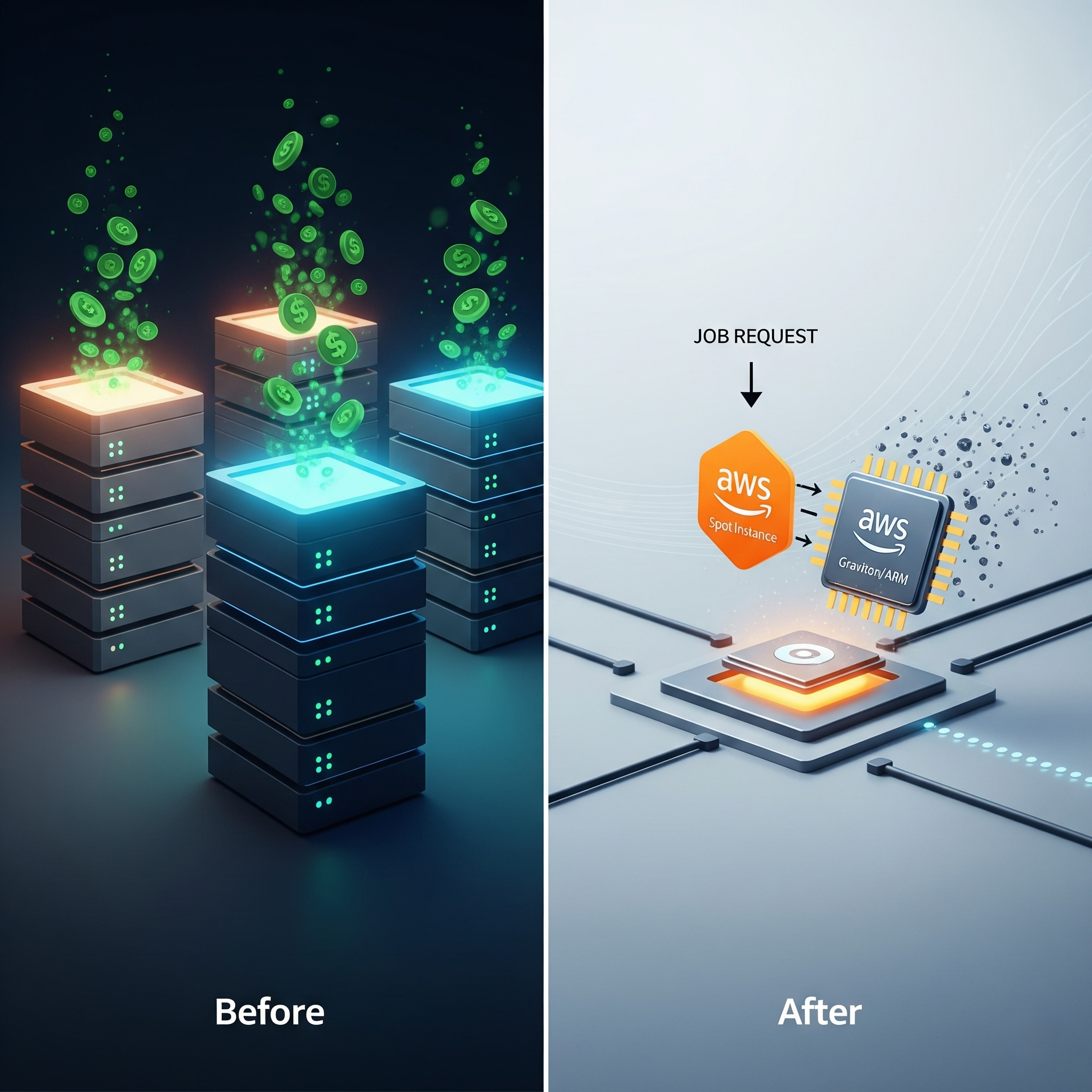
For countless organizations, Jenkins remains the heart of their CI/CD infrastructure. However, a traditional Jenkins setup, with a fleet of statically provisioned, always-on build agents, is inefficient and incredibly expensive in the cloud era. These agents often sit idle, consuming expensive compute resources 24/7.
Achieving significant Jenkins build agent cost reduction requires moving to a dynamic, cloud-native architecture. By embracing ephemeral agents and optimizing self-hosted runners, you can build a highly scalable and dramatically more cost-effective Jenkins environment, with some teams reporting savings of 60-70%.
The Problem: The High Cost of Idle, Static Agents
The traditional Jenkins architecture has numerous problems in the cloud:
Overprovisioning for Peaks: You must provision enough agents to handle your peak build load. During off-peak hours, this capacity sits idle, but you're still paying the full hourly rate for the underlying instances.
Resource Waste: A large agent server running 24/7 consumes resources even when no builds are active.
Manual Scaling: Adjusting capacity requires slow and inefficient manual intervention.
The Solution: Dynamic, Ephemeral Agents on Demand
The modern solution is to treat build agents as disposable, on-demand resources. Agents are provisioned just-in-time to run a job and terminated immediately after completion. This is typically achieved using the Jenkins EC2 Fleet Plugin to dynamically provision agents.
1. Run Agents on AWS Fargate for Serverless Simplicity
How it Works: Configure Jenkins to launch ephemeral build agents as serverless containers on AWS Fargate. You don't manage any underlying EC2 instances.
Cost Benefit: You pay only for the vCPU and memory consumed during the build's execution time. When no builds are running, your agent cost is zero.
2. Use EC2-Backed ECS for Power and Flexibility
How it Works: For builds requiring more power (like Docker-in-Docker), run agents on an ECS cluster backed by a fleet of EC2 instances.
Cost Benefit: This model opens the door to the single most powerful cost-saving lever: Spot Instances.
3. Leverage Spot Instances Aggressively
Why it Works: CI/CD builds are typically fault-tolerant; if a build fails because its Spot Instance was reclaimed, it can simply be retried. This makes them a perfect workload for Spot Instances, which offer up to 90% savings. Lyft, for example, saved up to 90% on their compute costs by moving their CI/CD pipeline to Spot.
Implementation: Configure your ECS cluster's Auto Scaling Group to request Spot Instances.
4. Switch to ARM-Based Graviton Processors
The Benefit: Using AWS Graviton (ARM) processors can provide up to 40% better price-performance than x86 instances. This often translates to 10-25% faster builds at a 20-30% lower cost.
Implementation: This requires building a multi-architecture Docker image for your Jenkins agent.
5. Optimize Agent Images and Caching
Leaner Images: Smaller Docker images pull faster, reducing build startup time.
Externalize Caches: Since ephemeral agents start with a clean file system, a robust caching strategy is essential. Use an external artifact repository and Jenkins plugins to persist directories between builds.
Conclusion
A static, always-on Jenkins agent fleet is a recipe for a bloated bill in the cloud. By re-architecting your environment to use dynamic, ephemeral agents, you can unlock massive opportunities for cost reduction. A combination of serverless Fargate, aggressive Spot Instance usage, cost-effective Graviton processors, and smart caching will transform your CI/CD platform into a scalable and financially optimized engine
All in One Place
Atler Pilot decodes your cloud spend story by bringing monitoring, automation, and intelligent insights together for faster and better cloud operations.