
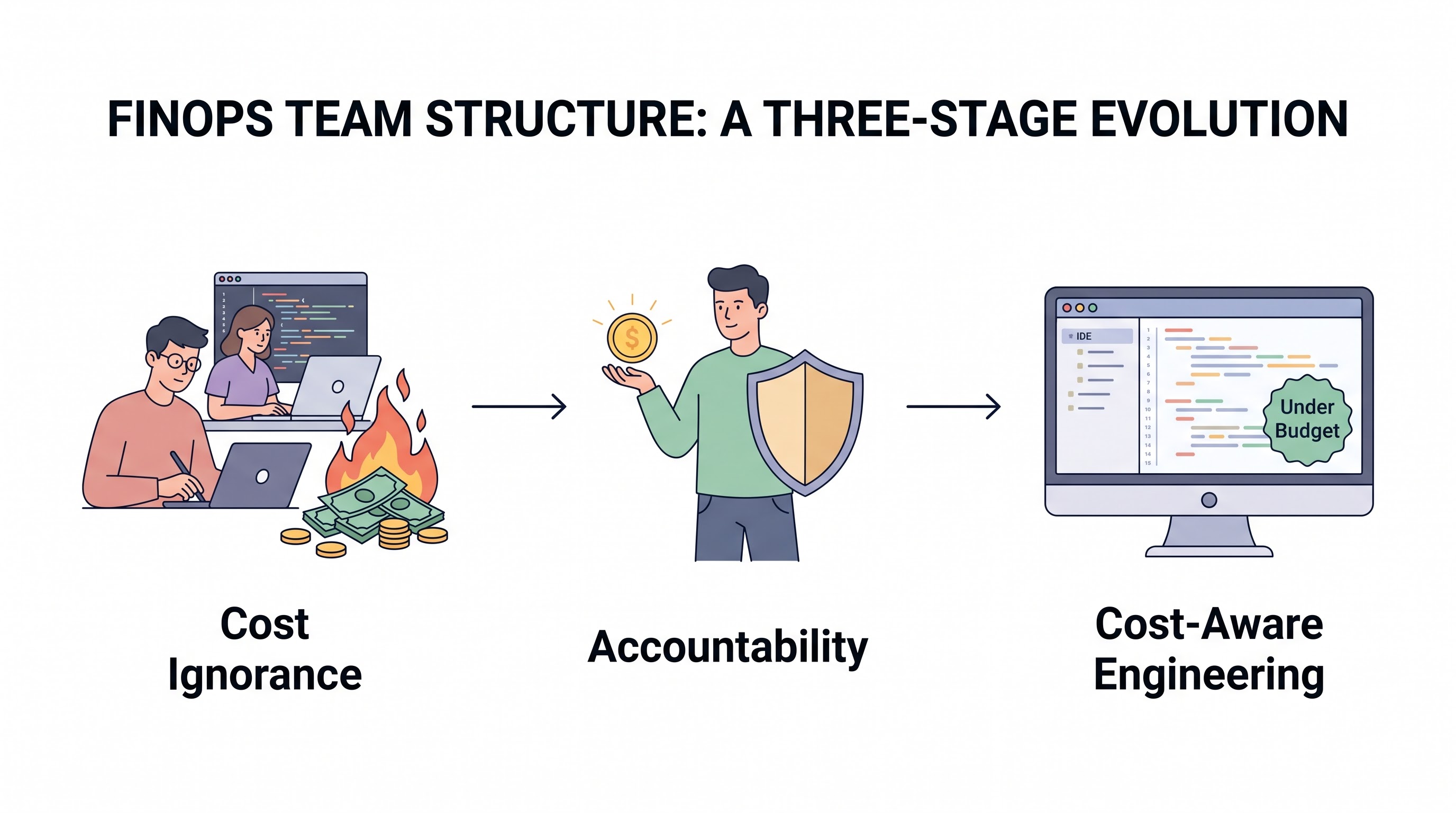
Why FinOps Needs a Dedicated Team
Cloud financial management does not happen organically. Left to its own devices, cloud spend follows a predictable trajectory: upward, accelerating, and increasingly disconnected from the business value it supports. This is not because engineers are wasteful. It is because cloud infrastructure provisions in seconds, bills in hundredths of cents per dimension per hour, and generates invoices so complex that parsing them requires specialized knowledge most organizations do not possess.
A dedicated FinOps team provides the connective tissue between the engineers who deploy infrastructure, the finance team that budgets for it, and the business leaders who need to understand whether cloud spend is an investment or an overhead problem. Without this function, each group operates with partial information: engineering sees utilization metrics but not costs, finance sees costs but not utilization context, and leadership sees neither with enough granularity to make informed decisions.
The FinOps framework describes this as a cross-functional practice by design. But "cross-functional" does not mean "nobody's primary job." Someone needs to own the practice full-time. Someone needs to build the dashboards, maintain the tagging policies, analyze commitment opportunities, and hold engineering teams accountable for their cost targets. That someone — or those several someones, depending on organizational scale — is the FinOps team.
Core Roles and What They Actually Do
FinOps teams vary in size from a single practitioner to organizations of twenty or more at large enterprises. Regardless of size, the function needs to cover four capability areas. At smaller scales, one person covers multiple areas. At enterprise scale, each area may have a dedicated sub-team.
FinOps Lead / Director
The FinOps lead owns the program. This role defines the strategy, sets organizational cost targets in collaboration with finance and engineering leadership, chairs the steering committee, and serves as the executive-facing communicator for all cloud financial matters. The lead needs to be equally comfortable discussing AWS pricing models with a solutions architect and presenting cost trend analysis to a CFO.
This is not an analyst role. It is a leadership role with strong communication requirements. The best FinOps leads come from backgrounds in either cloud engineering (with developed financial acumen) or IT finance (with genuine technical curiosity). Candidates who lack one side of that equation struggle — pure technologists cannot translate insights into business language, and pure finance professionals cannot evaluate whether an optimization recommendation is architecturally sound.
Cloud Cost Analysts (1–3 people)
Analysts are the quantitative engine of the FinOps function. They pull billing data from cloud APIs, build and maintain cost dashboards, run variance analysis when spend deviates from forecast, track tagging compliance trends, and produce the reports that inform steering committee decisions.
The daily work involves SQL queries against billing data warehouses, spreadsheet modeling for commitment purchase analysis, and dashboard maintenance across whatever FinOps platform the organization uses. Strong analysts reduce the time between "something changed in our spend" and "here is exactly what changed, why, and what we should do about it" from days to hours.
Technical requirements: SQL proficiency, familiarity with at least one BI tool (Looker, Tableau, Power BI), comfort with cloud billing APIs and data formats (AWS CUR, Azure Cost Management exports, GCP BigQuery billing exports). Python or R for statistical analysis is a significant plus.
Cloud Cost Engineers (1–2 people)
Engineers execute the optimization recommendations that analysts identify. They rightsize instances, purchase commitments, implement scheduling automation, refactor architectures to reduce networking costs, and build the automation that prevents waste from reaccumulating after cleanup sprints.
These engineers sit at the intersection of infrastructure engineering and financial optimization. They need to understand why an m5.xlarge costs what it does, how Savings Plans interact with Reserved Instances in the billing waterfall, why a NAT Gateway processing 5 TB monthly might be replaced by a VPC endpoint at one-tenth the cost, and how to safely implement these changes without causing production incidents.
In many organizations, cloud cost engineers are embedded members of the platform or infrastructure team who allocate 50–100% of their time to FinOps initiatives. This embedding model works well because it keeps the engineers connected to infrastructure context while focusing their output on cost outcomes.
Business Liaison / FinOps Communicator (0–1 person)
At organizations spending above $5M annually on cloud, a dedicated business liaison role translates FinOps metrics into language that resonates with product managers, business unit leaders, and executive stakeholders. This person builds the unit economics models that connect infrastructure cost to business outcomes — cost per customer, cost per transaction, cost per API call — and tracks those metrics over time to demonstrate whether the business is becoming more or less efficient in its cloud consumption.
Smaller organizations fold this responsibility into the FinOps lead role. But as the program scales, the communication overhead of keeping multiple stakeholder groups informed while also running the operational program becomes unsustainable for a single person.
Right-Sizing the Team to Your Spend
There is no universal formula for FinOps team sizing, but industry benchmarks from the FinOps Foundation provide useful guidelines:
Monthly Cloud Spend | Recommended Team Size | Typical Structure |
|---|---|---|
Under $200K | 0.5–1 FTE | Single FinOps practitioner (often part-time from an existing role) |
$200K–$1M | 2–3 FTEs | Lead + 1 analyst + 1 engineer (possibly shared with platform team) |
$1M–$5M | 4–6 FTEs | Lead + 2 analysts + 2 engineers + optional business liaison |
$5M–$20M | 6–10 FTEs | Director + team leads per cloud provider + analysts + engineers |
Over $20M | 10–20+ FTEs | Full FinOps organization with specialized sub-teams per capability |
These are guidelines, not prescriptions. An organization spending $3M/month across three cloud providers with 200 engineering teams needs more FinOps capacity than one spending the same amount across a single provider with 20 teams, because the complexity of cost allocation, cross-provider normalization, and stakeholder communication scales with organizational complexity rather than just dollar volume.
The ROI test for FinOps team investment is straightforward: a well-functioning FinOps team consistently identifies and executes savings equal to 10x to 30x its fully-loaded team cost. A three-person team costing $500K annually that identifies and drives $5M in annualized savings delivers a 10:1 return. If your FinOps team cannot demonstrate at least 5:1 return, the problem is usually insufficient organizational authority or misaligned operating model rather than team capability.
Where FinOps Reports: Engineering, Finance, or Both
Reporting structure matters more than most organizations acknowledge. Where the FinOps function sits in the org chart determines its access to information, its authority to drive change, and its perceived neutrality between engineering and finance stakeholders.
Reporting to Engineering (CTO / VP Engineering)
Advantages: Direct access to the teams that implement changes. Engineering credibility — the FinOps team speaks the same language as the teams they are trying to influence. Integration with engineering planning cycles and sprint processes.
Risks: Perceived as an engineering function by finance, reducing trust in reported numbers. May deprioritize cost work when engineering leadership faces delivery pressure. Financial modeling rigor may be weaker without finance partnership.
Reporting to Finance (CFO / VP Finance)
Advantages: Strong financial modeling capability. Natural alignment with budgeting cycles. Executive visibility into cost trends through established finance reporting channels.
Risks: Limited ability to drive engineering changes — finance cannot tell engineering how to architect systems. May lack technical credibility when recommending optimization approaches. Recommendations may be ignored by engineering teams who view the FinOps team as "the cost police from finance."
Dual Reporting or Independent Function
The most effective FinOps teams at enterprise scale operate with a dual reporting line — solid line to Engineering leadership for operational authority, dotted line to Finance for budget alignment and executive reporting. Alternatively, some organizations establish FinOps as an independent function reporting to the COO or a dedicated VP of Cloud Economics who sits between engineering and finance.
For organizations just starting, report to whichever leader is more invested in the program's success. The ideal is an Engineering leader who genuinely cares about cost efficiency. The worst case is a Finance leader who mandates cost cuts without engineering partnership — this creates an adversarial dynamic that undermines the collaborative culture FinOps requires.
Hiring Profiles That Work
FinOps is a relatively new discipline, and dedicated "FinOps Engineer" or "FinOps Analyst" candidates with extensive experience are rare. Most successful FinOps hires come from adjacent backgrounds and develop FinOps-specific skills on the job.
Effective hiring profiles include:
Cloud engineers with financial curiosity. DevOps engineers, SREs, or platform engineers who have shown interest in cost optimization beyond their primary responsibilities. They understand cloud architecture and pricing intuitively. Teaching them financial modeling and stakeholder communication is easier than teaching a finance analyst cloud architecture.
Data analysts with infrastructure exposure. Analysts from BI or data engineering teams who have worked with cloud billing datasets. They bring SQL proficiency, dashboard building skills, and analytical rigor. Their gap is typically cloud architecture understanding, which can be developed through structured training and pairing with cloud engineers.
IT finance analysts with technical ambition. Finance professionals who handle IT budgets and want to move closer to the technology. They understand budgeting cycles, variance analysis, and executive communication. Their learning curve centers on cloud pricing models and infrastructure concepts.
During interviews, prioritize candidates who demonstrate curiosity across both technical and financial domains. Ask candidates to explain a cloud pricing model (Savings Plans, for example) in terms a CFO would understand. Then ask them to explain the same concept in terms an engineer would find useful. The ability to context-switch between audiences is the core FinOps communication skill.
Certifications like the FinOps Certified Practitioner (FOCP) provide useful foundational knowledge but should not be hiring requirements. The certification confirms understanding of the framework. It does not confirm ability to implement the practice in a complex organization with competing priorities. The cloud management certification guide covers which certifications provide genuine career value and which are primarily credential theater.
Operating Models: Centralized, Embedded, and Hybrid
How the FinOps function operates day-to-day matters as much as who staffs it. Three operating models have emerged, each with trade-offs that suit different organizational contexts.
Centralized Model
A single FinOps team handles all cost analysis, optimization recommendations, and reporting for the entire organization. Engineering teams submit optimization requests to the FinOps team, which prioritizes and executes them.
Works best for: Organizations with fewer than 50 engineering teams, moderate cloud complexity, and strong executive sponsorship that gives the central team authority.
Breaks when: The organization scales beyond 100 engineering teams or the FinOps team becomes a bottleneck that slows optimization execution because every change must flow through a single queue.
Embedded Model
FinOps practitioners are embedded within engineering teams — one FinOps engineer or analyst per business unit or per major platform team. There is no central FinOps organization; instead, each business unit manages its own cloud costs with embedded expertise.
Works best for: Large organizations with autonomous business units that have distinct cloud environments and budgets. Each unit gets dedicated attention tailored to its specific workloads.
Breaks when: There is no coordination across embedded practitioners. Each unit develops its own tooling, its own tagging standards, and its own reporting formats. Enterprise-wide visibility becomes impossible. Commitment purchases that benefit from pooled analysis get made in isolation, leaving money on the table.
Hybrid Model (Recommended for Most Organizations)
A small central FinOps team (2–4 people) sets enterprise-wide policy, manages shared tooling and platforms, coordinates commitment purchasing, and produces organization-level reporting. Embedded FinOps practitioners or cost-conscious engineers within each major team handle team-level analysis, optimization execution, and local reporting.
Works best for: Most organizations from $1M to $20M+ monthly spend. The central team provides consistency, governance, and scale. The embedded practitioners provide context, speed, and team-level accountability.
The hybrid model requires clear communication channels between central and embedded functions. Weekly sync meetings, shared dashboards, and a common FinOps automation platform that both groups use ensure alignment without creating bureaucratic overhead.
Equipping the Team
A FinOps team without the right tooling is an analyst team producing reports nobody reads. The tooling stack should cover four capabilities:
Multi-cloud cost visibility — a platform that normalizes billing data across AWS, Azure, GCP, and any other providers into a single unified view. CloudAtler's Financial Command Center handles this for organizations operating across multiple cloud providers.
Optimization recommendation engine — automated analysis that identifies rightsizing opportunities, commitment gaps, idle resources, and architecture inefficiencies. The recommendation engine should integrate with the team's workflow tools to create actionable tickets rather than static reports.
Budget management and forecasting — tools that project spend forward based on historical trends, planned deployments, and commitment coverage. Budget forecasting that incorporates business context (product launches, seasonal traffic patterns) produces more accurate projections than purely trend-based extrapolation.
Collaboration and communication — Slack integrations for anomaly alerts, Jira integration for optimization task tracking, and executive reporting templates that the FinOps lead can populate quickly for steering committee presentations.
Scaling the Function as Spend Grows
FinOps team scaling should be proactive rather than reactive. When the existing team is at capacity — optimization backlogs growing faster than execution velocity, report requests queuing for weeks, steering committee presentations getting rushed — it is time to add headcount.
Scaling typically follows this pattern:
First hire: A FinOps practitioner who handles visibility, basic optimization, and reporting. This person establishes the practice from scratch.
Second hire: An analyst to take over dashboard maintenance and cost analysis, freeing the first hire to focus on strategy, stakeholder management, and optimization execution.
Third hire: A cloud cost engineer to handle optimization implementation — rightsizing, commitment purchases, automation development — while the analyst focuses on measurement and the lead focuses on strategy.
Fourth+ hires: Specialize by cloud provider (dedicated AWS analyst, Azure analyst), by capability (commitment management specialist, tagging enforcement engineer), or by business unit (embedded FinOps practitioner for the largest teams).
Each additional hire should demonstrate measurable ROI within their first quarter. A new analyst who identifies $300K in annual savings through detailed cost analysis during their first 90 days has unambiguously justified their salary. Build this expectation into hiring conversations so candidates understand the function is measured by financial impact, not activity volume.
Team Anti-Patterns to Avoid
Certain team structures predictably underperform. Recognize and avoid these patterns:
The Cost Police Model. A FinOps team that positions itself as an approval authority — "you must justify every instance launch through us" — creates friction that engineers route around through shadow accounts, personal credit cards, and creative workarounds. Position the team as an enablement function: "we help you get the same results for less money" rather than "we prevent you from spending money."
The Dashboard Team. A FinOps function that builds beautiful dashboards but does not drive optimization execution has created a reporting function, not a FinOps function. Dashboards are tools, not outcomes. The outcome is measurable cost efficiency improvement.
The Part-Time Function. Assigning FinOps responsibilities to an engineer who also owns infrastructure reliability, deployment pipelines, and on-call rotation guarantees that FinOps work gets deprioritized whenever (and it is always) something more urgent demands attention. FinOps needs dedicated time to produce consistent results.
The Outsourced Function. Outsourcing FinOps to a consulting firm provides valuable initial expertise but creates dependency. Consulting engagements produce recommendations. Internal teams produce sustained execution. Plan for knowledge transfer from day one if you use consultants, with the explicit goal of building internal capability that makes the consulting engagement unnecessary within 6 to 12 months.
The Silo. A FinOps team that operates without regular touchpoints with engineering, finance, and product leadership produces analysis in a vacuum. Weekly syncs with engineering leads, monthly steering committee meetings with finance, and quarterly business reviews with product leadership maintain the cross-functional connections that make FinOps effective.
Key Takeaway
An effective FinOps team combines cloud engineering expertise with financial analysis capability and business communication skill. Size the team proportionally to your cloud spend and organizational complexity. Use a hybrid operating model with a small central function setting policy and shared tooling, and embedded practitioners handling team-level optimization. Position the function as an enablement team rather than cost police, measure impact through efficiency metrics with clear financial ROI, and scale headcount proactively as optimization backlogs signal capacity constraints.
All in One Place
Atler Pilot decodes your cloud spend story by bringing monitoring, automation, and intelligent insights together for faster and better cloud operations.