
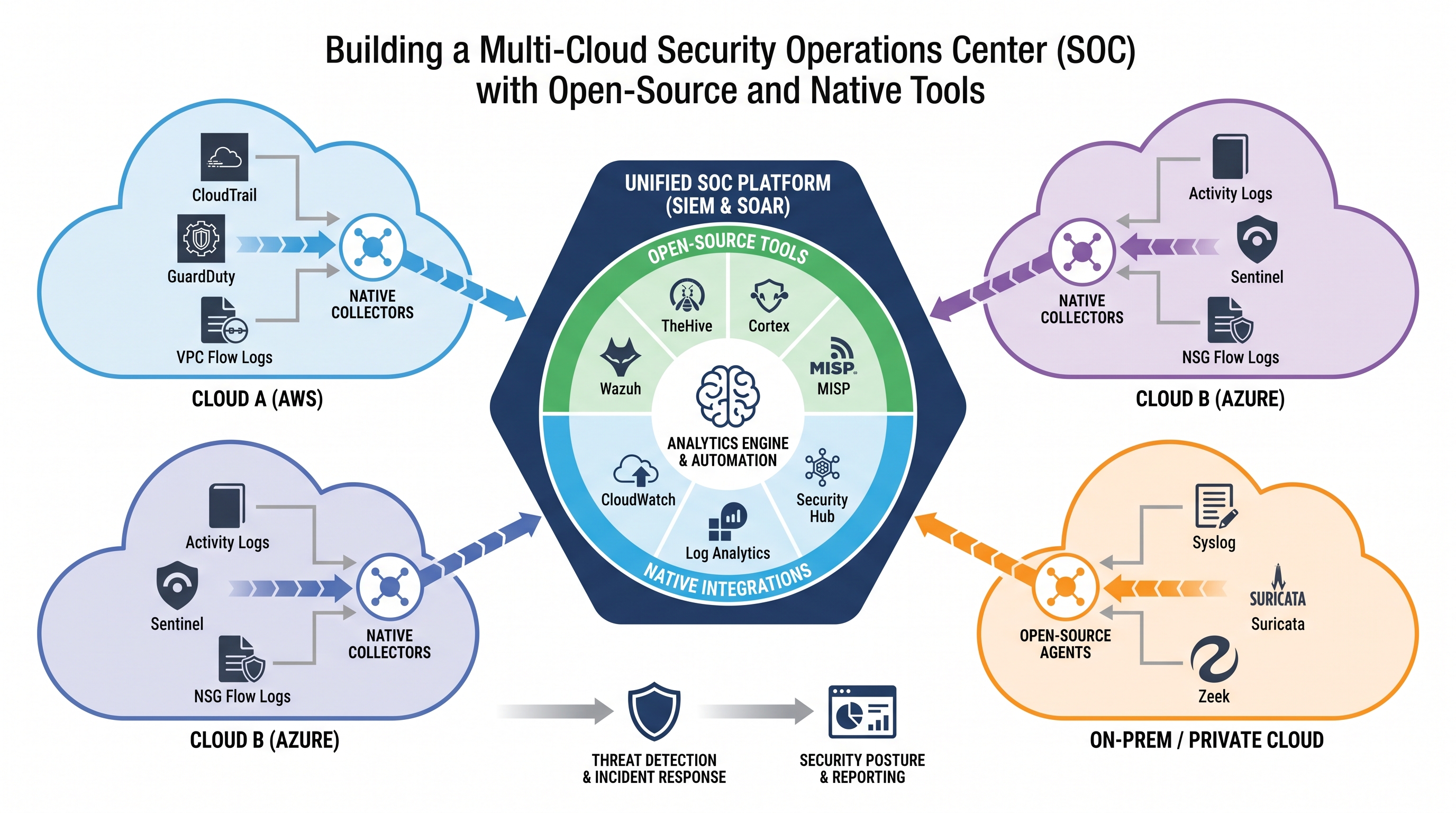
The Modern Multi-Cloud SOC Challenge: Telemetry Sprawl and FinOps Friction
As enterprises scale their operations across Amazon Web Services (AWS), Microsoft Azure, Google Cloud Platform (GCP), and Oracle Cloud Infrastructure (OCI), security teams face an unprecedented challenge: telemetry sprawl. Each cloud service provider (CSP) generates its own proprietary audit logs, network flow logs, and identity management telemetry. Reconciling AWS CloudTrail, Azure Monitor, GCP Cloud Logging, and OCI Audit logs into a cohesive, actionable security posture is exceptionally complex.
Historically, organizations solved this by routing all telemetry directly into commercial Security Information and Event Management (SIEM) platforms. However, this approach introduces a severe FinOps conflict. Commercial SIEMs typically charge based on data ingestion volume (e.g., GB/day) or active indexing nodes. A single high-throughput Kubernetes cluster or an active application load balancer can generate terabytes of verbose, low-value log data daily, leading to astronomical, unpredictable licensing costs.
To build a sustainable security architecture, modern organizations must decouple log collection and ingestion from indexing and analysis. By leveraging native cloud messaging queues, open-source log routing engines (such as Vector or Fluent Bit), and self-hosted or hybrid analytical stores, enterprises can build a highly performant, multi-cloud SOC. This architecture ensures complete visibility without sacrificing budgetary control—a primary focus of CloudAtler's multi-cloud security management platform.
High-Level Architecture of a Hybrid Multi-Cloud SOC
A resilient, cost-optimized multi-cloud SOC relies on a tiered data pipelining architecture. Instead of pulling logs directly from each cloud account to a centralized SIEM, data flows through four distinct architectural stages: Collection, Buffering, Transformation & Filtering, and Analysis & Orchestration.
1. Collection (Native CSP Log Exporters)
To minimize operational footprint and agent overhead, security teams should leverage native cloud logging mechanisms at the perimeter:
AWS: CloudTrail (Organization-level), VPC Flow Logs, and Route 53 DNS query logs routed to Amazon S3 buckets or Amazon Kinesis Data Firehose.
Azure: Diagnostic Settings routing Azure Activity Logs, Microsoft Entra ID (formerly Azure AD) logs, and Network Security Group (NSG) Flow Logs to Azure Event Hubs.
GCP: Cloud Logging Log Sinks routing Admin Activity, System Event, and Data Access logs to Google Cloud Pub/Sub topics.
2. Buffering (Message Queues)
Direct ingestion from collectors to analytical engines creates a single point of failure. If the analytical cluster undergoes maintenance or experiences an ingestion spike, logs are permanently lost. To prevent this, native message queues act as shock absorbers. AWS Kinesis, Azure Event Hubs, and GCP Pub/Sub store raw telemetry durably for up to 7 days, allowing downstream processors to ingest data at a controlled, predictable pace.
3. Transformation & Filtering (The Open-Source Routing Layer)
This is where the FinOps magic happens. Using an open-source routing agent like Vector (developed by Datadog) or Fluent Bit, we can intercept raw JSON payloads, normalize their schemas, strip redundant fields, filter out high-volume/low-value security events (such as read-only API actions), and route them to their optimal storage destinations based on security classification.
4. Analysis, Orchestration & Detection
Normalized logs are routed to a centralized, high-performance analytical store. OpenSearch (the open-source fork of Elasticsearch) or ClickHouse (a columnar database optimized for analytical queries) serves as the primary data lake. For detection and alerting, security teams deploy Wazuh (an open-source security monitoring platform) alongside Sigma—a generic, open-source signature format that allows security teams to write detection rules once and run them across any analytical backend.
Native Telemetry Collection & Pipeline Design
To implement this architecture, we must configure native log exporters to ship telemetry to our central buffering queues. Let's look at how to build these pipelines securely across AWS, Azure, and GCP, keeping data egress costs to an absolute minimum.
AWS Pipeline: CloudTrail to Vector via SQS and S3
For large AWS organizations, routing CloudTrail logs directly to Kinesis can become expensive. A more cost-effective pattern is configuring an Organization-level CloudTrail to write compressed JSON logs to a centralized Amazon S3 bucket. Each time a log file is written, S3 publishes an event notification to an Amazon Simple Queue Service (SQS) queue. The downstream Vector agent polls the SQS queue, reads the notification, retrieves the compressed log object directly from S3, and processes it. This pull-based architecture drastically reduces data transfer costs.
Azure Pipeline: Diagnostic Settings to Event Hubs
Within Microsoft Azure, security teams should configure subscription-level Diagnostic Settings. This telemetry must be directed to an Azure Event Hubs namespace. Event Hubs scale dynamically via "Throughput Units" (TUs), offering a highly predictable pricing model. Downstream Vector instances, running either in Azure Kubernetes Service (AKS) or on-premises, consume events from the Event Hub using the AMQP protocol.
GCP Pipeline: Log Router to Pub/Sub
In Google Cloud, the Log Router is a global, highly available service. By creating an organization-level log sink, security teams can filter and exclude noisy telemetry (such as standard Container Engine stdout logs) before it ever leaves GCP's logging boundary. The sink routes high-fidelity security events directly to a Google Cloud Pub/Sub topic. Downstream consumers pull logs using the gRPC-based Pub/Sub API.
Vector Configuration: Transforming and Filtering Telemetry at the Edge
Vector is highly performant because it is written in Rust, consuming minimal CPU and memory compared to JVM-based alternatives like Logstash. Below is a production-grade Vector configuration (vector.yaml) demonstrating how to ingest AWS CloudTrail logs from S3, filter out noisy read-only API calls (such as Describe*, List*, and Get* queries), normalize the schema, and route the filtered dataset to an OpenSearch cluster.
# vector.yaml - Multi-Cloud SOC Ingestion and Filtering Pipeline

sources:
  aws_cloudtrail_s3:
    type: "aws_s3"
    region: "us-east-1"
    bucket: "company-centralized-security-logs"
    key_prefix: "AWSLogs/"
    compression: "gzip"
    sqs:
      queue_url: "https://sqs.us-east-1.amazonaws.com/123456789012/cloudtrail-s3-notifications"

transforms:
  filter_noisy_aws_events:
    type: "filter"
    inputs:
      - "aws_cloudtrail_s3"
    condition: |
      # Parse the incoming JSON payload
      payload, err = parse_json(.message)
      if err != null {
        false
      } else {
        # Drop read-only, list, and describe API actions to optimize FinOps ingestion costs
        !match_any(payload.eventName, [r'^Describe.*', r'^List.*', r'^Get.*', r'^Lookup.*'])
      }

  normalize_schema:
    type: "remap"
    inputs:
      - "filter_noisy_aws_events"
    source: |
      # Parse JSON and enforce a standardized multi-cloud schema (ECS aligned)
      payload = parse_json!(.message)

      .timestamp = payload.eventTime
      .event.provider = "aws"
      .event.dataset = "cloudtrail"
      .event.action = payload.eventName
      .user.name = payload.userIdentity.arn || payload.userIdentity.userName || "anonymous"
      .source.ip = payload.sourceIPAddress
      .source.geo.country_name = payload.awsRegion
      .raw = payload

      # Clean up metadata fields to save storage space
      del(.message)

sinks:
  opensearch_cluster:
    type: "elasticsearch"
    inputs:
      - "normalize_schema"
    endpoint: "https://opensearch-internal.security.internal:9200"
    mode: "data_stream"
    data_stream:
      type: "logs"
      dataset: "cloudtrail"
      namespace: "production"
    auth:
      strategy: "basic"
      user: "vector_ingest"
      password: "${OPENSEARCH_INGEST_PASSWORD}"
    tls:
      verify_certificate: true
By implementing the filter transform shown above, organizations typically realize a 60% to 75% reduction in log volume. Because read-only API calls rarely indicate active compromise (as opposed to write actions like CreateUser, AuthorizeSecurityGroupIngress, or DeleteBucket), stripping them at the pipeline edge represents a massive win for security teams operating under strict budget-aware cloud planning guidelines.
The Open-Source Detection Engine: Deploying Wazuh and Sigma Rules
With normalized, high-fidelity log data successfully flowing into OpenSearch, the next phase of our multi-cloud SOC is active threat detection. Rather than relying on rigid, vendor-locked detection rules, we leverage Sigma.
Sigma rules are to log files what Snort rules are to network traffic or Yara rules are to files. They provide a declarative YAML format to write detection logic. Using a command-line tool called sigmac (or its modern successor, pySigma), security engineers can compile a single Sigma rule into native OpenSearch Lucene queries, Azure Log Analytics KQL, or GCP Log Common Expression Language (CEL).
Example: Detecting Cross-Cloud Credential Abuse via Sigma
A classic multi-cloud attack vector involves an attacker compromising an IAM credential (such as an AWS Access Key or GCP Service Account key) and immediately testing its permissions from an anomalous, non-corporate IP address. Below is a Sigma rule designed to detect unauthorized cross-cloud credential usage:
title: Multi-Cloud Anomalous Credential Usage
id: 5f98e723-90d2-4bbf-8877-33d3c7a6e112
status: experimental
description: Detects API calls executed from non-corporate, anomalous public IP addresses across AWS, GCP, and Azure.
author: CloudAtler Security Research
references:
    - https://cloudatler.com/playbook
tags:
    - attack.credential_access
    - attack.initial_access
logsource:
    category: authentication
    product: cloud
detection:
    selection:
        event.action|contains:
            - 'Login'
            - 'AssumeRole'
            - 'GetSessionToken'
            - 'CreateServiceAccountKey'
    filter_corporate_ips:
        source.ip:
            - '192.0.2.0/24'  # Corporate Office WAN Range
            - '198.51.100.0/22' # Corporate VPN Range
    condition: selection and not filter_corporate_ips
falsepositives:
    - Legitimate remote administrators connecting without active VPN tunnels (requires exception profiling).
level: high
To deploy this rule in our OpenSearch cluster, we run the following command to compile the Sigma rule into a Lucene query:
sigma-cli convert -t opensearch -p ecs rule-anomalous-credentials.ymlThe output of this conversion is a highly optimized query that can be run continuously via an OpenSearch Alerting monitor, triggering Slack, PagerDuty, or Webhook alerts to security analysts when anomalous behavior is detected.
FinOps Optimization Tactics for Multi-Cloud SOC Log Ingestion
Building a self-hosted SOC architecture using open-source tools provides incredible flexibility, but it does not completely eliminate operational costs. Computing resources, disk storage, and network egress are still billed by your cloud providers. To truly master the economics of a multi-cloud SOC, security leaders must align their architecture with enterprise CIO FinOps objectives. Implement the following optimization tactics to keep your operational expenses under control:
Optimization Target | Technical Implementation Strategy | Estimated Cost Reduction |
|---|---|---|
Log Tiering & Lifecycle Policies | Store only 7 to 14 days of logs in hot, expensive SSD-backed OpenSearch nodes. Transition older logs automatically to warm nodes (HDD backed), then to cold storage (compressed parquet files in Amazon S3 Glacier or Azure Archive Blob) for long-term compliance retention. | 45% - 60% of storage costs |
Compression Optimization | Utilize Zstandard (zstd) or Gzip compression within Vector pipelines before writing payloads to cloud object storage. Columnar database formats like ClickHouse compress log data far more efficiently than standard document stores. | 30% of disk footprint |
Egress Minimization | Never route raw logs across cloud boundaries or geographical regions over public internet pathways. Deploy Vector edge processors in the same local region as the log generators. Filter and compress the data locally before egressing it to your primary analytical cloud tenant. | 70% of network data transfer fees |
Unifying Security and FinOps: The Role of CloudAtler
While open-source pipelines, Vector filters, and Sigma detection rules provide a powerful foundation for a multi-cloud SOC, managing this infrastructure at scale introduces massive operational overhead. Security engineers find themselves managing Kubernetes clusters, updating index templates, tuning Vector config files, and manually monitoring cloud billing dashboards to ensure that log storage isn't exceeding quarterly budgets.
This is where CloudAtler bridges the gap between raw engineering and business operations. CloudAtler provides an AI-powered platform that unifies FinOps, cloud security, and automated operations across AWS, Azure, GCP, and Oracle environments. By integrating directly with your cloud environments, CloudAtler delivers a unified single-pane dashboard that correlates cloud resource consumption with real-time security events.
Why Choose CloudAtler for Multi-Cloud Security?
Continuous Compliance Mapping: Automatically map your multi-cloud infrastructure against SOC 2, ISO 27001, CIS Benchmarks, and PCI-DSS.
Automated Cost Anomalies Detection: Instantly identify when a security incident (such as a crypto-mining attack) is driving up cloud compute and storage costs.
No-Code Threat Correlation: Correlate disparate cloud security alerts into single, high-fidelity security incidents using advanced machine learning models.
For CISOs and security leaders, managing security in a vacuum is no longer viable. Every security control, data pipeline, and monitoring agent has a direct financial impact. Implementing CloudAtler's CISO security solutions ensures that your security operations center remains agile, highly visible, and perfectly aligned with your corporate financial targets. Our step-by-step cloud operations playbook provides the exact blueprints required to transition your organization from fragmented, reactive cloud management to unified, proactive governance.
Conclusion & Call to Action
Building a modern, multi-cloud SOC requires a careful balance between deep security visibility and strict FinOps discipline. By leveraging native cloud collection mechanisms, open-source routing tools like Vector, and flexible detection rule frameworks like Sigma, you can construct a resilient security posture that scales dynamically with your business without generating unpredictable, multi-million dollar SIEM bills.
However, you do not have to manage the complexity of multi-cloud security and cost optimization alone. Let CloudAtler do the heavy lifting. Our platform unifies security monitoring, cost forecasting, and automated remediation into a single, cohesive interface, giving your team the power to secure and optimize your entire cloud estate with absolute confidence.
Ready to take control of your multi-cloud security and FinOps? Visit CloudAtler today to request a personalized demo and discover how we can help you unify, secure, and optimize your multi-cloud operations.
All in One Place
Atler Pilot decodes your cloud spend story by bringing monitoring, automation, and intelligent insights together for faster and better cloud operations.