
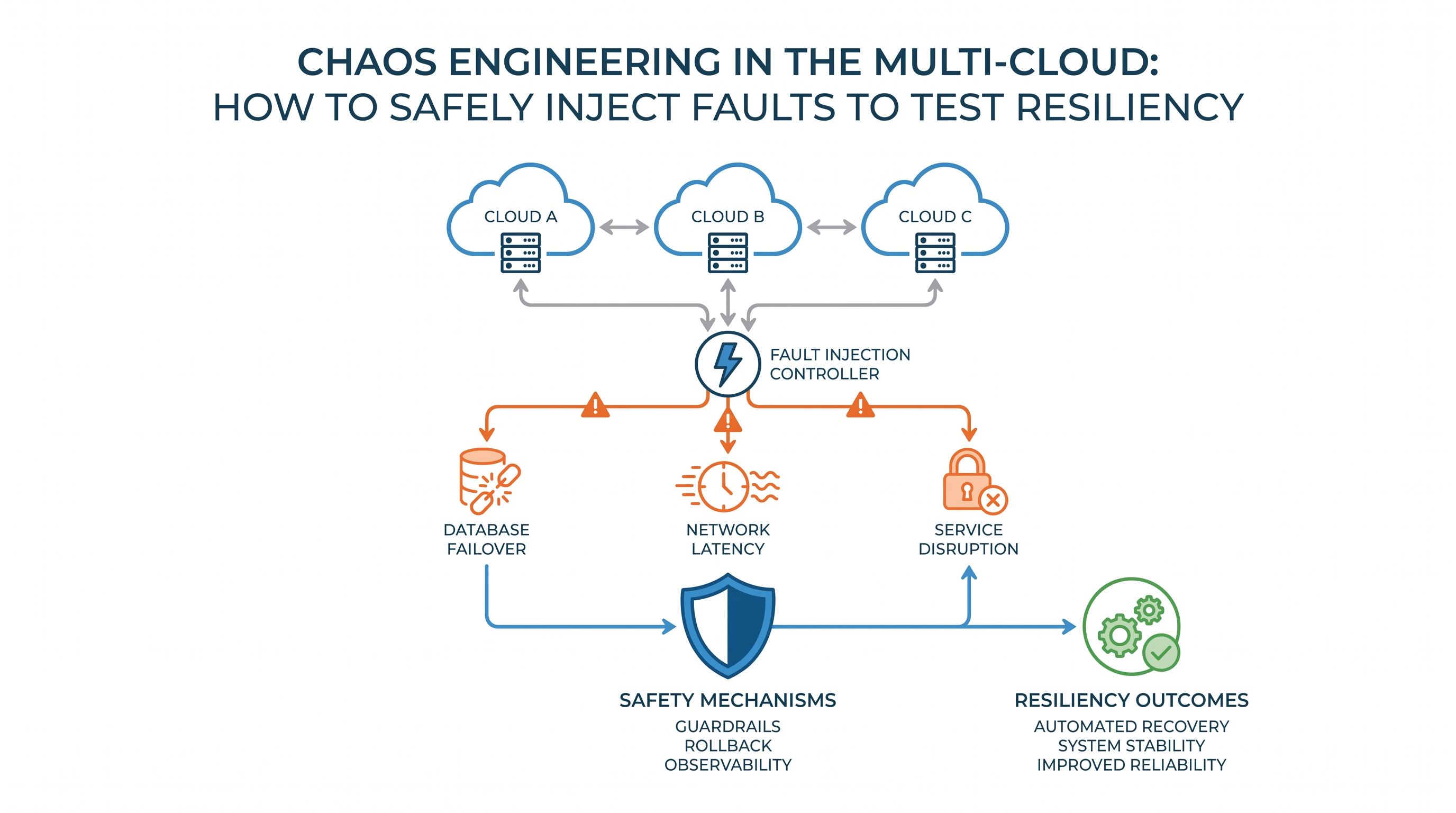
The Multi-Cloud Resiliency Paradox
Modern enterprise architectures leverage multi-cloud strategies to mitigate vendor lock-in, meet regional data residency requirements, and optimize cost-performance ratios across AWS, Azure, Google Cloud Platform (GCP), and Oracle Cloud Infrastructure (OCI). However, this architectural diversity introduces unprecedented operational complexity. When your application's control plane resides in AWS, its transactional database runs on Azure SQL, and its analytics engine processes data in GCP, the surface area for failure expands exponentially.
Traditional disaster recovery (DR) testing—typically characterized by scheduled, semi-annual failover drills—fails to capture the dynamic, non-linear failures inherent in highly distributed systems. A routing table misconfiguration in an Equinix Cloud Exchange, an unexpected API rate limit on Azure's Resource Manager, or a silent packet drop in GCP's Virtual Private Cloud (VPC) can trigger cascading outages that monitoring tools struggle to isolate. To survive these inevitable failure modes, organizations must transition from reactive recovery to proactive experimentation through multi-cloud chaos engineering.
For infrastructure SRE solutions, the goal of chaos engineering is not to break systems in production arbitrarily, but to uncover hidden systemic vulnerabilities under controlled conditions. This requires a rigorous, systematic approach to fault injection that spans heterogeneous cloud platforms, respects strict security postures, and accounts for the financial implications of simulated degradation.
Designing a Safe Chaos Experimentation Framework
Injecting faults across multiple cloud providers requires a unified framework that guarantees safety, repeatability, and immediate containment. The fundamental process of any chaos experiment involves four distinct phases: establishing a steady state, formulating a hypothesis, injecting the fault, and verifying the outcome. However, in a multi-cloud context, each phase must account for cloud-specific behaviors and APIs.
1. Defining the Steady State
The steady state is the baseline behavior of your system under normal operating conditions. In a multi-cloud environment, this baseline cannot be measured by a single metric like CPU utilization. It must encompass cross-cloud telemetry, including:
Inter-cloud network latency: Round-trip time (RTT) between AWS us-east-1 and Azure East US.
API transaction success rates: The ratio of successful to failed calls across AWS STS, Azure Active Directory (Entra ID), and GCP IAM.
Database replication lag: The delta between primary databases on one cloud and read replicas on another.
Financial run-rate: The baseline hourly spend across all involved resources, ensuring that autoscaling policies triggered during experiments do not violate budget thresholds.
2. Formulating the Hypothesis
A well-structured hypothesis defines the expected system response to a specific failure. For example: "If we inject 150ms of network latency between the AWS-hosted frontend microservices and the Azure-hosted database cluster, the frontend's circuit breakers will trip within 500ms, fallback to a local Redis cache, and user-facing transaction success rates will remain above 99%."
3. Blast Radius Containment and Automated Rollbacks
The "blast radius" is the subset of users, services, and infrastructure impacted by a chaos experiment. In a multi-cloud environment, containing this radius requires strict isolation. You must ensure that a fault injected in a staging environment in AWS does not cascade through shared ExpressRoute or Direct Connect circuits to impact production databases in Azure.
To safely manage this, SRE teams must implement automated "kill switches." If any key performance indicator (KPI) deviates beyond a predefined threshold during an experiment, the chaos orchestration tool must instantly terminate the injection and trigger operational intelligence workflows to restore the steady state. Below is an architectural diagram concept of a multi-cloud chaos control loop:
+-------------------------------------------------------------------------+
|                           Multi-Cloud Control Plane                     |
|                                                                         |
|   +------------------+     Inject Fault     +-----------------------+   |
|   | Chaos Orchestror | -------------------> | Target Cloud (AWS/AZ) |   |
|   +------------------+                      +-----------------------+   |
|            ^                                            |               |
|            | Trigger Rollback                           | Telemetry     |
|            | (If Threshold Exceeded)                    v               |
|   +------------------+                      +-----------------------+   |
|   |  Kill Switch Engine| <------------------ | Monitoring/Observability| |
|   +------------------+                      +-----------------------+   |
+-------------------------------------------------------------------------+
Multi-Cloud Chaos Scenarios: Architectural Blueprints
To effectively test resiliency, you must simulate failures that specifically exploit the integration points between cloud providers. Below are three detailed architectural scenarios and the corresponding configurations required to execute them safely.
Scenario A: Cross-Cloud Database Failover Latency
In this scenario, an application's primary transactional database is hosted on Azure SQL Database, while its web tier runs on AWS Elastic Kubernetes Service (EKS). Connectivity is established via redundant IPSec VPN tunnels over the internet. The goal is to test how the AWS application layer handles a sudden degradation in cross-cloud network performance.
To inject this fault, we use Chaos Mesh deployed on the EKS cluster to target the egress traffic destined for the Azure SQL CIDR block. The following Custom Resource Definition (CRD) injects 200ms of latency with a jitter of 10ms only on traffic targeting the Azure database IP range:
apiVersion: chaos-mesh.org/v1alpha1
kind: NetworkChaos
metadata:
  name: azure-db-latency
  namespace: production-validation
spec:
  action: delay
  mode: all
  selector:
    namespaces:
      - app-tier
    labelSelectors:
      app: "web-frontend"
  delay:
    latency: '200ms'
    jitter: '10ms'
    correlation: '50'
  direction: to
  target:
    selector:
      namespaces:
        - app-tier
    mode: all
  externalTargets:
    - '20.62.0.0/16' # Azure SQL Subnet Range
  duration: '5m'
  scheduler:
    cron: '@every 1h'
What to monitor: Monitor the connection pool size on the AWS EKS pods. If connection pooling is misconfigured, the 200ms latency will quickly exhaust the pool, causing the web servers to reject new user requests. The experiment proves whether your database timeout values and retry policies with exponential backoff are correctly tuned.
Scenario B: DNS/Traffic Management Partitioning
Many multi-cloud architectures rely on global server load balancing (GSLB) solutions like Cloudflare, AWS Route 53 Application Recovery Controller, or Azure Traffic Manager to route user traffic to the healthy cloud provider. What happens if one cloud provider suffers a complete regional outage, but the DNS routing layer fails to update, sending 50% of your users into a black hole?
To simulate this, you must inject a fault at the DNS level. By utilizing API-driven fault injection, you can modify the health check endpoints of your GSLB to return a false positive or a false negative. For instance, you can block outgoing traffic from GCP-hosted health check agents to your AWS workloads, forcing the GSLB to trigger an unneeded failover. This tests:
The speed of DNS propagation across global recursive resolvers.
The behavior of client-side caching (TTL compliance).
Whether the secondary cloud environment can handle a sudden 100% surge in traffic (autoscaling responsiveness).
Scenario C: Inter-Cloud IAM and Security Token Expiry
Cross-cloud authentication often relies on OpenID Connect (OIDC) federation. For example, a service running in GCP Google Kubernetes Engine (GKE) assumes an AWS IAM Role via OIDC to write logs directly to an Amazon S3 bucket. If the token exchange service experiences latency or credential expiration issues, how does the application handle the authorization failure?
To test this, you can inject API errors using a local proxy or service mesh (like Istio) configured on the GKE cluster. By intercepting calls to sts.amazonaws.com and returning a 403 Forbidden or 504 Gateway Timeout, you can observe if the application gracefully queues the logs locally or crashes due to unhandled security exceptions.
The FinOps of Chaos: Balancing Experimentation Costs and Downtime Savings
Chaos engineering is an active operational cost. When you inject faults that simulate high CPU load, network latency, or pod evictions, you inevitably trigger cloud provider auto-scaling groups (ASGs), scale up database read replicas, and generate massive amounts of inter-region and inter-cloud data transfer fees. If left unmanaged, a single chaos experiment can result in thousands of dollars of unplanned cloud spend.
To maintain financial control, organizations must integrate FinOps metrics into their chaos engineering pipelines. This requires calculating the cost-benefit ratio of running experiments. The formula for the ROI of a chaos experiment can be defined as:
ROI = (Estimated Cost of Unplanned Outage prevented - Cost of Running Chaos Experiment) / Cost of Running Chaos Experiment
To accurately calculate the "Cost of Running Chaos Experiment," you must track the delta in infrastructure costs during the test window. This is where a sophisticated cost impact calculation engine becomes essential. It allows SREs to correlate the exact timeframe of a chaos injection with the corresponding spikes in compute, network egress, and API call costs across AWS, Azure, and GCP.
For example, if a network delay experiment triggers an autoscaling event in AWS that spins up 50 additional c5.2xlarge instances, and simultaneously triggers database scaling in Azure, the total cost of that 30-minute experiment must be quantified. If the experiment uncovers a bug that would have caused a 4-hour production outage (costing an estimated $100,000 in lost revenue), the financial justification for the experiment is clear. However, if the experiment runs continuously in a non-production environment without guardrails, it represents a significant source of cloud waste.
FinOps Best Practices for Multi-Cloud Chaos Engineering:
Auto-Takedown Policies: Ensure all chaos resources (such as temporary VM instances used to generate stress load) have a strict Time-To-Live (TTL) tag. If the orchestrator fails to clean up, automated cloud policies must reap these resources.
Egress Cost Awareness: Inter-cloud data transfer is one of the most expensive components of multi-cloud architectures. Avoid generating massive synthetic network traffic across cloud boundaries. Instead, simulate network latency using packet manipulation tools (such as
tc/netem in Linux) directly on the host or container, which achieves the same experimental result without sending actual data across the WAN.Sized-Down Staging Environments: Run initial chaos experiments in scaled-down staging environments that mirror production topology but use smaller instance sizes (e.g., using
t3.mediuminstead ofm5.2xlarge). Scale up the experiment to production-grade environments only after the hypothesis has been validated at a lower cost.
Security & Compliance Guardrails During Chaos Injection
Injecting faults into production or staging systems is inherently risky from a security perspective. A chaos tool requires elevated privileges to terminate instances, modify routing tables, block network ports, and stop database processes. If these privileges are not strictly governed, the chaos engineering platform itself becomes a primary target for malicious actors.
To secure multi-cloud chaos testing, organizations must implement robust cloud security management practices that enforce the principle of least privilege (PoLP) across all cloud boundaries.
1. Securing Chaos Tool Credentials
Do not use static, long-lived access keys (such as AWS IAM User Access Keys or Azure Service Principal client secrets) to authenticate your chaos tools. Instead, utilize short-lived, federated credentials. For example, run your chaos orchestrator in a Kubernetes cluster using IAM Roles for Service Accounts (IRSA) in AWS, or Workload Identity in GCP. This ensures that the credentials used to inject faults expire automatically and are never stored in plaintext code repositories.
2. Policy-as-Code Guardrails
Before executing any chaos experiment, the proposed actions must be validated against security policies. Using tools like Open Policy Agent (OPA), you can define rules that prevent chaos experiments from targeting critical, non-negotiable security infrastructure. For example, you can write an OPA policy that blocks any experiment trying to modify security groups, disable CloudTrail logging, or touch production active directory servers.
# OPA Policy Example: Block Security Group Modifications during Chaos Tests
package playbooks.security

default allow = true

allow = false {
    input.action == "ModifySecurityGroupRules"
    input.environment == "production"
}
3. Preventing Compliance Drift
Simulating failures can temporarily degrade security controls, which might trigger compliance alerts (e.g., SOC2, PCI-DSS, or ISO 27001). For instance, if an experiment stops a logging agent on a host to test log-forwarder resiliency, the system is temporarily non-compliant. SRE and security teams must coordinate to ensure that:
All chaos experiments are pre-registered with the security operations center (SOC) to prevent false positives and "alert fatigue."
Security agents are automatically restarted if they fail to recover post-experiment.
Audit logs clearly distinguish between a real security incident and a authorized chaos simulation.
Unifying Chaos, Security, and FinOps with CloudAtler
Executing chaos engineering across multiple clouds without a centralized management plane is a recipe for operational silos, security vulnerabilities, and runaway costs. SREs need a single pane of glass that not only orchestrates experiments but also correlates their impact on security posture and cloud budgets in real time.
This is where the CloudAtler platform transforms how enterprises approach resiliency. By unifying FinOps, cloud security, and automated operations across AWS, Azure, GCP, and Oracle environments, CloudAtler provides the necessary guardrails to make chaos engineering safe, predictable, and highly effective.
Leveraging Atler AI, our platform automatically maps your multi-cloud dependencies, identifies single points of failure, and suggests safe chaos experiments to run. During execution, CloudAtler monitors your financial run-rate and security configurations, acting as an automated, intelligent kill switch. If an experiment triggers unexpected cross-cloud data transfer costs or exposes a security vulnerability, CloudAtler halts the experiment and rolls back the infrastructure to its last known safe state instantly.
All in One Place
Atler Pilot decodes your cloud spend story by bringing monitoring, automation, and intelligent insights together for faster and better cloud operations.