
The Cost Accountability Crisis
In traditional on-premises IT, cost accountability was relatively straightforward. A department requested a physical server, IT procured it, and the capital expenditure (CapEx) was explicitly approved and allocated to that department's budget. The friction of procurement served as a natural barrier to overspending.
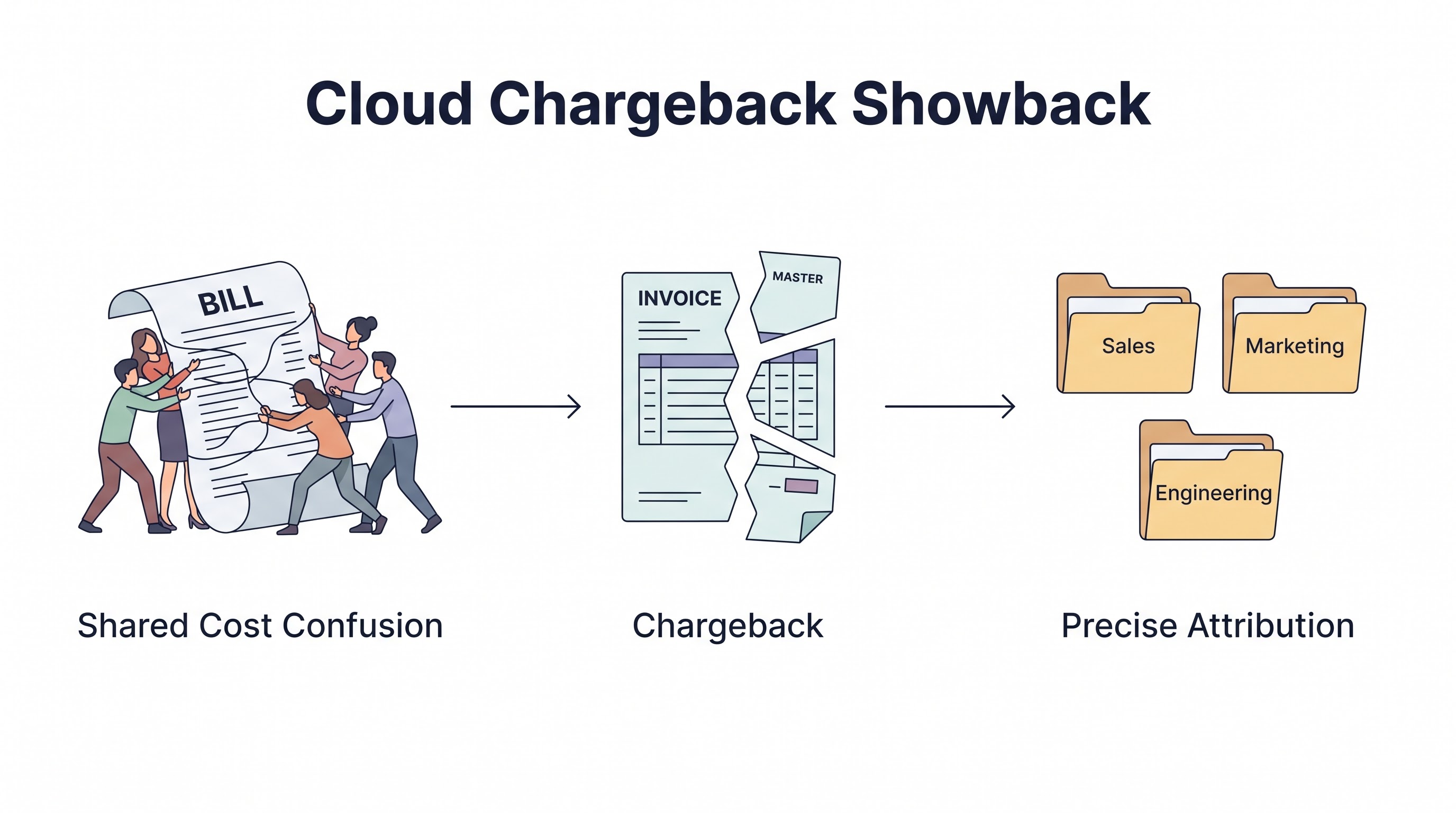
The cloud destroyed that barrier. With Infrastructure as Code (IaC) and APIs, developers can provision massive compute resources in seconds. The resulting operational expenditure (OpEx) arrives a month later as a single, massive invoice from AWS, Azure, or GCP. When IT attempts to pay the bill, a crisis ensues: Finance demands to know who spent the money, but the centralized bill obscures individual team usage. Without accountability, cloud spend becomes a "tragedy of the commons"—everyone utilizes the resource, but no one feels responsible for its cost.
Solving this crisis is the core mandate of the FinOps 'Inform' phase. Organizations must implement a system to distribute cloud costs back to the business units that generated them. The two primary models for achieving this are Showback and Chargeback. Choosing the right model, and implementing it correctly, dictates whether your FinOps practice will be embraced by engineering or rejected as bureaucratic overhead.
Defining Showback and Chargeback
While often used interchangeably, showback and chargeback represent fundamentally different approaches to driving cost-conscious behavior.
Cloud Showback
Showback is an informational model. The central IT or FinOps team allocates cloud costs to specific departments, projects, or applications and shows them the data. The crucial distinction is that no actual money changes hands internally. The central IT budget still pays the cloud provider. Showback relies on visibility, transparency, and peer pressure to drive optimization. It answers the question: "Here is what you spent this month; are you comfortable with that?"
Cloud Chargeback
Chargeback is a financial model. The central IT team acts as an internal cloud broker. They allocate the costs and then formally bill the individual business units. The cloud spend is deducted directly from each department's Profit & Loss (P&L) statement. Chargeback relies on financial consequence to drive optimization. It states: "Here is what you spent; we have deducted it from your budget."
Showback: The Carrot Approach
Showback is the recommended starting point for almost all organizations embarking on a FinOps journey.
Advantages of Showback
Lower Friction Implementation: Because no actual budgets are impacted, the demand for 100% allocation accuracy is lower. If an untagged resource is incorrectly attributed to a shared bucket in month one, nobody's bonus is affected. This allows the FinOps team to iterate and improve the tagging strategy without causing political battles.
Cultural Alignment: Showback fosters collaboration. When cost visibility dashboards are made public to all engineering teams, natural gamification occurs. Teams compare their efficiency metrics (e.g., cost per transaction) against their peers, driving organic optimization efforts.
Executive Awareness: It provides leadership with the necessary data to understand which products or services are driving infrastructure costs, without requiring a massive overhaul of corporate accounting practices.
The Limitation
The primary weakness of showback is that it lacks teeth. If a team consistently overspends and ignores the reports, the central IT budget still absorbs the impact. Showback relies on engineering leaders caring about efficiency; if they only care about shipping features, showback will fail to control costs.
Chargeback: The Stick Approach
Chargeback is the hallmark of a highly mature FinOps organization, typically implemented years into the cloud journey.
Advantages of Chargeback
Absolute Accountability: When cloud costs hit a general manager's P&L, cloud efficiency immediately becomes a priority. Engineering leaders are forced to balance the speed of delivery against the cost of infrastructure.
Accurate Product Margins: Chargeback enables true cloud unit economics. A company cannot accurately price its SaaS product if it does not know the exact infrastructure cost required to serve a single customer.
The Risks and Challenges
The Accuracy Mandate: If you are charging a department's budget, the data must be unassailable. A 90% tagging compliance rate is acceptable for showback; it is disastrous for chargeback. Disputes over misallocated costs can consume immense amounts of FinOps and Finance time.
The Behavioral Backlash: Aggressive chargeback can stifle innovation. If developers are afraid of the financial consequences of spinning up resources for experimentation, agility suffers—negating the primary benefit of the cloud.
The Prerequisites: Tagging and Allocation
Neither model works without a rigorous foundation of cost allocation data. The AWS or Azure bill is a monolith; you must fracture it into logical pieces.
The absolute prerequisite is a comprehensive Cloud Tagging Strategy enforced via policy-as-code (e.g., AWS SCPs or Azure Policy). At a minimum, every resource must possess tags for CostCenter, Application, and Environment. Without these, the FinOps team is reduced to guessing who owns an EC2 instance based on its naming convention—a strategy that invariably fails at scale.
The Nightmare of Shared Costs
The most complex aspect of both models is handling shared resources. How do you allocate the cost of a centralized transit gateway, an enterprise-wide logging platform, or a multi-tenant Kubernetes cluster?
There are several approaches:
Proportional Allocation: Distribute the cost based on usage metrics. For a shared database, allocate costs based on the percentage of queries executed by each application. (This is accurate but technically difficult to implement).
Fixed Percentage: Distribute costs evenly across all business units or based on a predetermined, negotiated percentage (e.g., Product A pays 60%, Product B pays 40%).
The "IT Tax": Central IT absorbs the shared costs, funding them through a flat overhead tax applied to the entire organization.
Mature FinOps platforms like CloudAtler provide sophisticated cost allocation engines that automate the distribution of shared costs based on customizable, rule-based logic, saving FinOps teams hundreds of hours of manual spreadsheet manipulation.
A Phased Implementation Strategy
Attempting to move from zero visibility straight to strict chargeback is a recipe for organizational revolt. Implement accountability in phases:
Phase 1: Visibility (Months 1-3). Establish the tagging taxonomy. Build basic dashboards. Focus purely on data accuracy. Do not present the data to business units yet.
Phase 2: Private Showback (Months 4-6). Share the cost data privately with engineering directors. Use this phase to identify tagging gaps and refine allocation rules without public embarrassment.
Phase 3: Public Showback (Months 7-12). Make team-level cost data visible to the entire engineering organization. Institute monthly FinOps review meetings. Focus on FinOps ROI and efficiency metrics rather than absolute spend.
Phase 4: Chargeback (Year 2+). Only transition to formal chargeback when tagging compliance is consistently >95%, shared cost allocation rules are agreed upon by Finance, and engineering leadership has fully embraced their responsibility for cloud costs.
Key Takeaway
Cost accountability is a cultural challenge masquerading as a technical problem. Start with Showback to build trust, establish visibility, and foster a culture of optimization through transparency. Only graduate to Chargeback when your allocation data is flawless and the organization is ready to tie infrastructure efficiency directly to departmental P&L statements.
All in One Place
Atler Pilot decodes your cloud spend story by bringing monitoring, automation, and intelligent insights together for faster and better cloud operations.