
The Rise of GreenOps in 2026
In 2026, the conversation surrounding cloud computing has expanded beyond performance, security, and cost. Environmental, Social, and Governance (ESG) reporting is now a strict regulatory requirement across many global jurisdictions, particularly in the EU and North America. Organizations are legally mandated to measure and disclose their Scope 3 emissions, which explicitly includes the carbon footprint generated by their outsourced cloud infrastructure.
This regulatory pressure has birthed a new operational discipline: GreenOps. By merging the financial accountability frameworks of FinOps with precise environmental metrics, organizations are learning to optimize their cloud architectures not just to save money, but to significantly reduce their carbon intensity. This guide details the methodologies and tools required to accurately measure and actively manage your cloud carbon footprint.
The Challenge of Accurate Measurement
The foundational rule of GreenOps is that you cannot manage what you cannot accurately measure. Initially, organizations relied on the native carbon accounting tools provided by the hyperscalers (e.g., AWS Customer Carbon Footprint Tool, Google Cloud Carbon Footprint, Azure Emissions Impact Dashboard). While useful for high-level executive summaries, these native tools often suffer from massive data lag (sometimes trailing by months) and lack the granular, resource-level detail required by engineering teams to make immediate architectural decisions.
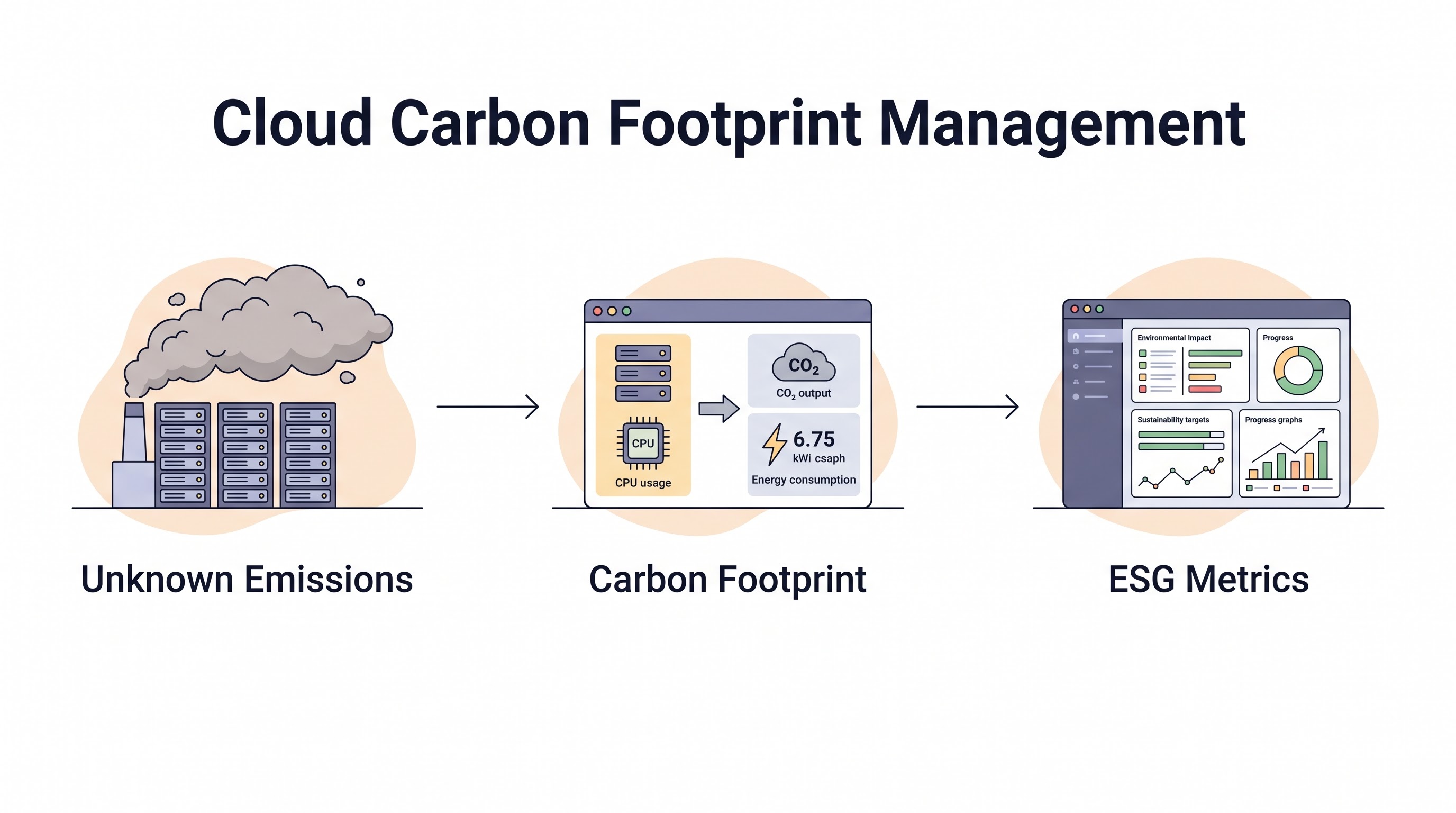
To solve this, leading enterprises have adopted open-source calculation engines like Cloud Carbon Footprint (CCF). These platforms ingest daily cloud billing data and granular compute usage metrics, applying sophisticated conversion factors to estimate emissions. These calculations take into account the specific energy mix of the data center region (e.g., the ratio of coal vs. wind power on the local grid) and the historical Power Usage Effectiveness (PUE) of the facility.
Furthermore, organizations must differentiate between location-based and market-based emissions. Location-based metrics reflect the actual physical reality of the local power grid powering the data center. Market-based metrics account for the Renewable Energy Certificates (RECs) or Power Purchase Agreements (PPAs) that the cloud provider buys to offset their usage. Accurate ESG reporting typically requires disclosing both.
Architectural Strategies for Carbon Reduction
Fortunately for engineering teams, there is a massive overlap between FinOps (cost optimization) and GreenOps. The most effective strategies for reducing cloud carbon footprints are fundamentally rooted in reducing waste:
Aggressive Resource Right-Sizing: Overprovisioned VMs that hover at 5% CPU utilization are constantly drawing baseline power. Aggressively right-sizing these instances, or better yet, transitioning to serverless architectures (like AWS Fargate or Azure Container Apps) allows the cloud provider to bin-pack workloads more densely, drastically improving the overall energy efficiency of the physical hardware.
Strategic Region Selection: The carbon intensity of cloud regions varies wildly. Deploying a workload in a region powered predominantly by hydroelectric or wind power (e.g., AWS eu-north-1 in Sweden, or Google Cloud europe-north1 in Finland) can reduce that workload's physical carbon footprint by over 80% compared to deploying it in a region reliant on fossil fuels.
Eliminating Orphaned Resources: Unattached EBS volumes, obsolete snapshots, and idle load balancers consume power while providing zero business value. Automated scripts that continuously reap these orphaned resources provide immediate environmental and financial benefits.
Carbon-Aware Computing: The Next Frontier
The most advanced GreenOps practices in 2026 are moving beyond static optimization into Carbon-Aware Computing. This involves dynamically shifting compute workloads in response to the real-time carbon intensity of the power grid.
By integrating with APIs from organizations like WattTime or Electricity Maps, Kubernetes clusters can be programmed to make environmentally conscious scheduling decisions. For example, a massive, latency-insensitive machine learning training job can be automatically paused and rescheduled to run at 2:00 AM when the local grid is flooded with excess, low-carbon wind energy. Alternatively, the workload can be dynamically routed to a completely different geographic region where the sun is currently shining and solar power is abundant.
Conclusion
Cloud carbon footprint management is no longer an optional PR exercise; it is a core operational requirement. By integrating real-time carbon metrics into developer dashboards and CI/CD pipelines, organizations can empower their engineers to make sustainable architectural choices every day, driving down both emissions and infrastructure costs.
Key Takeaway
GreenOps is rapidly becoming a regulatory necessity, requiring organizations to accurately measure and manage their cloud infrastructure's carbon footprint. By combining aggressive resource right-sizing, strategic region selection based on renewable energy availability, and advanced Carbon-Aware Computing scheduling, engineering teams can significantly reduce both their Scope 3 emissions and their cloud spend.
All in One Place
Atler Pilot decodes your cloud spend story by bringing monitoring, automation, and intelligent insights together for faster and better cloud operations.