
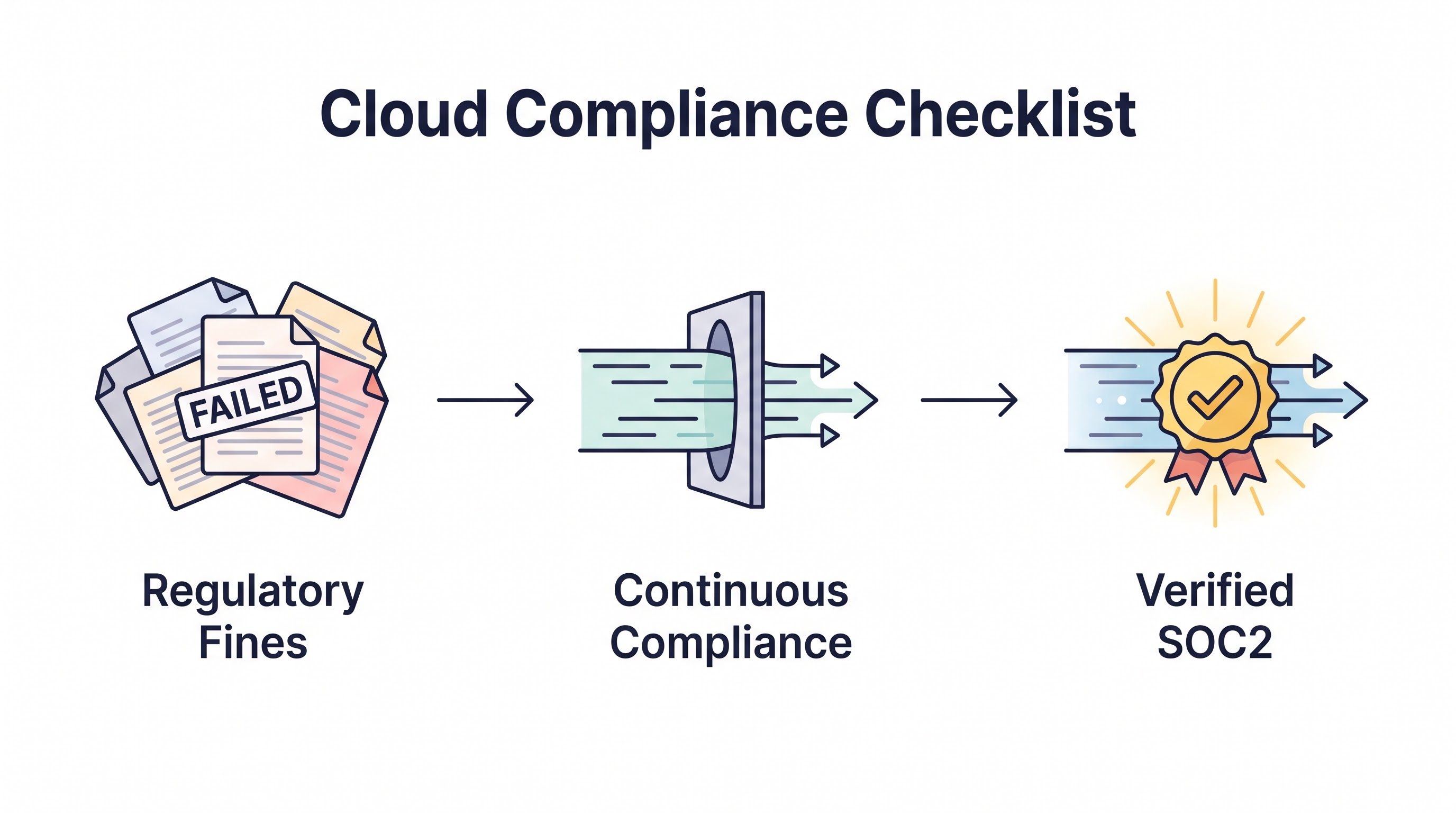
The Audit Fatigue Problem
For B2B SaaS companies and enterprises operating in regulated industries, compliance is no longer optional; it is a fundamental prerequisite for revenue. Customers will not sign contracts without a SOC 2 Type II report. European operations demand GDPR compliance. Healthcare clients require HIPAA adherence.
The traditional approach to achieving these certifications is agonizing. A company spends six months preparing for a SOC 2 audit, gathering screenshots and logs manually. Three months later, the ISO 27001 auditors arrive, asking for 80% of the exact same evidence, forcing the engineering team to repeat the entire manual data-gathering exercise. This phenomenon is known as "audit fatigue," and it crushes engineering productivity.
This guide presents a unified approach to cloud compliance. Rather than treating each framework as a distinct silo, organizations must recognize the massive technical overlap between them, implement a single set of rigorous cloud controls, and automate the evidence collection process.
The Secret of Compliance: The Massive Overlap
While the language and specific legal requirements differ (GDPR focuses on privacy rights, HIPAA on protected health information, SOC 2 on trust principles), the underlying technical controls required to secure a cloud environment are remarkably similar.
If you implement strict multi-factor authentication (MFA), encrypt all data at rest, and centrally aggregate unalterable logs, you have simultaneously satisfied major requirements across SOC 2, ISO 27001, HIPAA, and PCI-DSS.
Instead of mapping cloud configurations to individual frameworks, mature organizations implement a unified Cloud Security Framework and map those technical controls to the various compliance standards. We will break these down into four core pillars.
Control Pillar 1: Access Control (IAM)
Proving that only authorized individuals can access sensitive systems is the cornerstone of every audit.
The Unified Controls:
Enforce MFA: Required across the board. If an auditor finds a cloud console login without MFA, you will likely fail the audit. Use SSO (Okta, Entra ID) to enforce this globally.
Principle of Least Privilege (PoLP): Cloud IAM permissions must be strictly scoped. You must prove that developers do not have standing administrative access to production databases.
Access Reviews: (Critical for SOC 2 and ISO). You must provide evidence that management reviews user access rights at least quarterly, and that terminated employees are offboarded immediately.
Separation of Duties: Ensure that the person who writes the code cannot single-handedly deploy it to production without a peer review (enforced via branch protection rules in GitHub/GitLab).
Control Pillar 2: Data Protection and Encryption
Data must be protected from unauthorized access, both internally and externally.
The Unified Controls:
Encryption at Rest: Enable default encryption (KMS) on all S3 buckets, EBS volumes, and RDS databases. This is a non-negotiable requirement for HIPAA (ePHI) and highly scrutinized in SOC 2.
Encryption in Transit: Enforce TLS 1.2+ for all external and internal communications. Disable insecure protocols (HTTP, FTP).
Data Classification: (Crucial for GDPR and ISO 27001). You must know where sensitive data resides. Implement a tagging strategy that labels resources holding PII or ePHI. You cannot protect data if you don't know where it is.
Data Retention and Deletion: GDPR enforces the "Right to be Forgotten." You must have mechanisms (e.g., S3 Lifecycle policies) to securely delete data when it is no longer required or upon user request.
Control Pillar 3: Logging and Auditing
Auditors operate on a simple premise: "If it isn't logged, it didn't happen."
The Unified Controls:
Centralized Audit Trails: CloudTrail (AWS) or Activity Log (Azure) must be enabled across all regions and accounts.
Immutable Storage: These logs must be stored in a centralized, locked-down repository (like an S3 bucket with Object Lock) where they cannot be tampered with or deleted, even by administrators.
Incident Response Alerting: Logging is insufficient; you must prove you monitor those logs. Implementing anomaly detection and GuardDuty alerts, and having a documented Incident Response plan, satisfies major components of ISO 27001 and SOC 2.
Control Pillar 4: Vulnerability Management
You must prove that your infrastructure is actively defended against known threats.
The Unified Controls:
Automated Patching: Establish a formalized cloud patch management process. You must provide evidence that critical vulnerabilities are patched within defined SLAs (e.g., 14 days).
Vulnerability Scanning: Regularly scan infrastructure (EC2 instances) and container images for CVEs.
Penetration Testing: Conduct at least annual third-party penetration tests and document the remediation of the findings.
Automating Evidence Collection
The historical pain of compliance is the evidence collection phase—engineers manually taking screenshots of AWS configurations to prove encryption is enabled. In a cloud environment, this is obsolete.
Cloud infrastructure is defined by APIs. Therefore, compliance evidence can be automatically extracted via APIs. Using Cloud Security Posture Management (CSPM) tools, organizations can continuously map their live cloud configuration against compliance frameworks.
If an auditor asks, "Are all databases encrypted?", the CSPM immediately generates a report confirming that 100% of RDS instances have KMS encryption enabled, eliminating the need for manual screenshots.
Moving to Continuous Compliance
Compliance is not a point-in-time state; it is continuous. If you pass an audit on Monday, but a developer provisions an unencrypted, public S3 bucket on Tuesday, you are no longer compliant.
Advanced organizations utilize tools like CloudAtler to enforce "Continuous Compliance." By integrating CSPM checks into the DevSecOps pipeline and utilizing auto-remediation for critical misconfigurations, they ensure that the infrastructure never drifts out of compliance, transforming the annual audit from a three-month nightmare into a routine, automated check.
Key Takeaway
Stop chasing individual compliance certifications in silos. Recognize the massive technical overlap between SOC 2, ISO 27001, GDPR, and HIPAA. Implement a unified set of rigorous cloud controls focused on IAM, encryption, logging, and patching. Finally, leverage CSPM platforms to automate evidence collection and enforce continuous compliance, freeing your engineering teams from the burden of manual audit preparation.
All in One Place
Atler Pilot decodes your cloud spend story by bringing monitoring, automation, and intelligent insights together for faster and better cloud operations.