
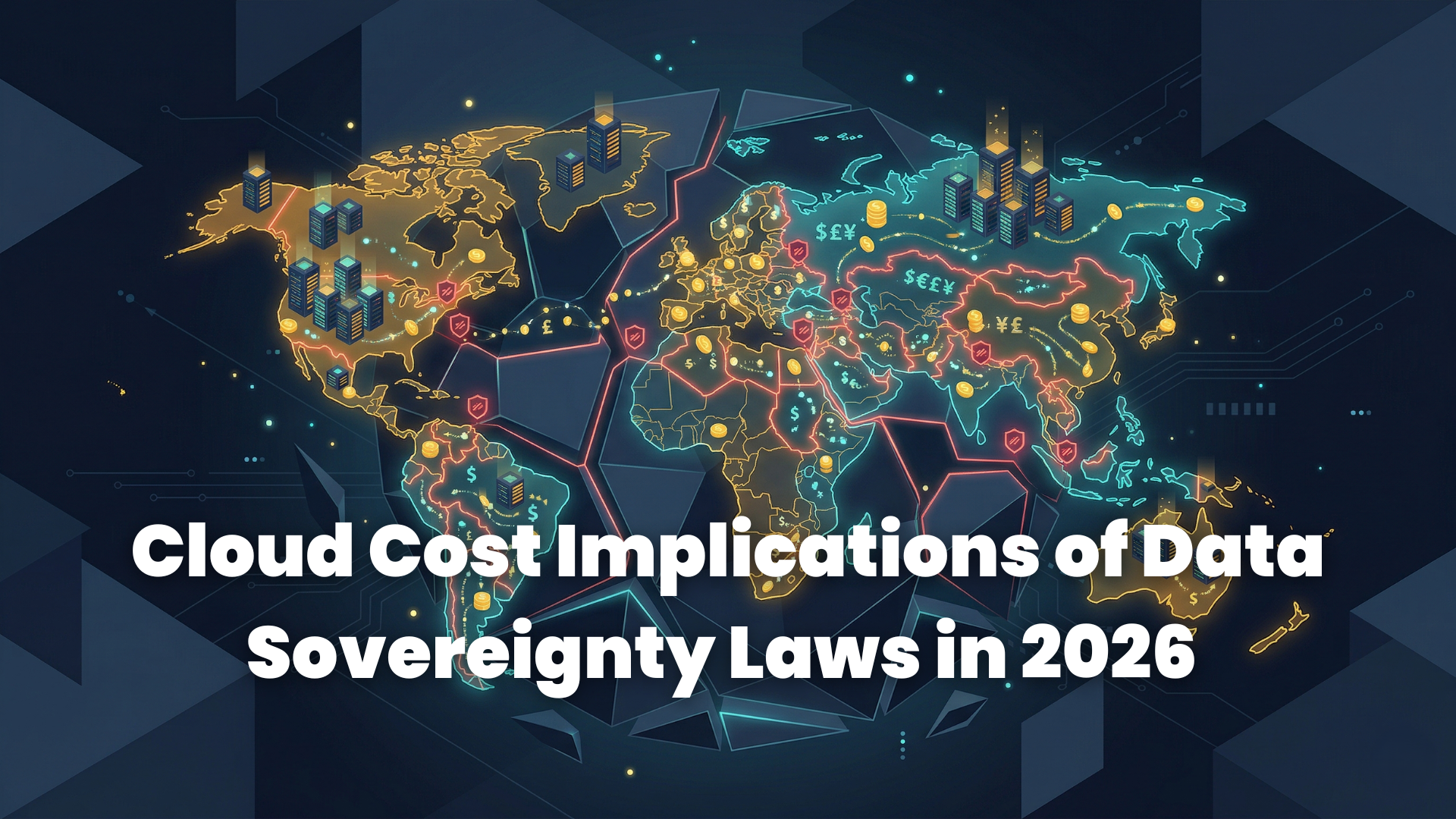
In 2026, cloud strategy is not just about performance, scalability, or even cost optimization. Across the world, governments are tightening regulations around how data is stored, processed, and transferred. What was once a flexible, globally distributed cloud model is now being reshaped by national boundaries, legal jurisdictions, and compliance frameworks. Data is now treated as a strategic national resource.
For businesses, especially those operating across multiple regions, this shift introduces a new layer of complexity. It’s not just about where your data lives, but which laws apply to it, who can access it, and how it moves across borders.
And while most discussions around data sovereignty focus on compliance and security, cost is another equally critical dimension that often gets overlooked.
Data sovereignty laws are fundamentally changing the economics of cloud computing. They introduce new infrastructure requirements, restrict architectural flexibility, and create operational inefficiencies that directly impact cloud spending.
This blog explores the real cloud cost implications of data sovereignty laws in 2026, helping engineering, cloud, and FinOps teams understand what’s changing and how to adapt.
The Shift from Global Cloud to Regional Cloud
Cloud computing was originally designed around the idea of global efficiency.
Organizations could deploy workloads anywhere, replicate data across regions, and leverage economies of scale offered by hyperscalers. This allowed businesses to optimize for performance and cost simultaneously.
However, data sovereignty laws are challenging this model.
Countries are increasingly requiring that certain types of data, especially personal, financial, and government-related data, remain within national or regional boundaries. In some cases, this results in de facto data localization, even if laws are technically risk-based rather than absolute.
As a result, organizations can no longer freely move data across regions to optimize costs. Instead, they must build region-specific infrastructure, often duplicating resources that were previously centralized.
This shift from a global cloud model to a regionally constrained cloud architecture is one of the biggest drivers of increased costs.
Infrastructure Duplication: The First Cost Multiplier
One of the most immediate impacts of data sovereignty laws is the need for infrastructure duplication. In a traditional cloud setup, a company might run a centralized system serving users globally. Data could be processed in one region and distributed efficiently across geographies.
With data sovereignty requirements, this approach becomes risky or non-compliant. Organizations now need to:
Deploy separate infrastructure in each region
Maintain isolated data storage environments
Build region-specific processing pipelines
This means that instead of running one system, companies may need to run multiple parallel systems. The cost implications are significant.
Compute resources, storage systems, networking components, and monitoring tools must all be replicated. Even shared services such as authentication, logging, and analytics often need to be duplicated to ensure compliance.
Over time, this leads to exponential infrastructure growth, especially for companies operating in multiple jurisdictions.
Increased Storage and Data Replication Costs
Data sovereignty laws also impact how data is stored and replicated. Modern cloud architectures rely heavily on data replication for redundancy, performance, and disaster recovery. However, when regulations restrict cross-border data movement, replication strategies become more complex.
Organizations must ensure that:
Data backups remain within compliant regions
Disaster recovery systems do not violate localization rules
Cross-region replication is carefully controlled or restricted
This often results in localized backup systems, which increases storage costs.
In addition, companies may need to maintain multiple copies of the same dataset across different regions to meet compliance requirements. This leads to data fragmentation and redundancy, both of which increase overall storage expenses.
Network and Data Transfer Cost Implications
Another hidden cost driver is network traffic. In multi-region architectures shaped by sovereignty laws, data flows become more constrained and less efficient. Instead of optimizing for the shortest or cheapest network path, organizations must route data in ways that comply with legal requirements.
This can lead to:
Increased intra-region data transfer costs
Higher latency due to restricted routing
Additional API calls between region-specific services
Even more importantly, certain cross-border data transfers may require additional compliance mechanisms, such as encryption, auditing, or legal safeguards, which introduce both technical and financial overhead. At scale, these network inefficiencies can significantly increase cloud spending.
Vendor Lock-In and Limited Optimization Flexibility
Data sovereignty laws also impact vendor flexibility. In theory, multi-cloud strategies allow organizations to choose the most cost-effective provider for each workload. However, in practice, sovereignty requirements can limit these choices.
For example, some regions may only support certain cloud providers or require the use of locally controlled infrastructure. This reduces competition and limits the ability to optimize costs. In addition, reliance on region-specific services can increase the risk of vendor lock-in, making it harder to migrate workloads or adopt alternative solutions.
When organizations lose flexibility, they often lose their ability to negotiate pricing or optimize infrastructure efficiently.
Compliance Overhead: The Invisible Cost Layer
Beyond infrastructure, data sovereignty introduces a significant amount of operational and compliance overhead.
Organizations must invest in:
Legal and regulatory expertise
Compliance audits and reporting
Data governance frameworks
Monitoring and tracking of data flows
These are not one-time costs. They are ongoing operational expenses that grow with the complexity of the system. For example, companies must continuously track where data is stored, how it moves, and which jurisdictions apply. This becomes particularly challenging in cloud environments where data can be dynamically replicated across multiple locations.
In many cases, compliance costs rival or even exceed infrastructure costs.
The Rise of Sovereign Cloud and Its Cost Trade-offs
In response to data sovereignty requirements, cloud providers are introducing sovereign cloud solutions. These are specialized environments designed to ensure that data remains within specific jurisdictions and is governed by local laws. They often include features such as:
Localized data centers
Restricted administrative access
Enhanced compliance controls
While these solutions address regulatory concerns, they often come at a premium. Sovereign cloud offerings may:
Costs more than standard cloud services
Offer fewer features or integrations
Limit access to global infrastructure capabilities
This creates a trade-off between compliance and cost efficiency. Organizations must decide whether to prioritize regulatory alignment or leverage the full capabilities of global cloud platforms.
The Complexity of Extraterritorial Laws
One of the most challenging aspects of data sovereignty is the impact of extraterritorial laws. For example, laws like the US CLOUD Act allow authorities to access data held by US-based providers, even if that data is stored in another country. This creates a conflict between jurisdictions.
A company may store data in a specific region to comply with local laws, yet still be subject to foreign legal access requirements due to the cloud provider’s origin. To address this, organizations may need to:
Choose region-specific or local cloud providers
Implement additional encryption and access controls
Redesign architectures to reduce exposure
Each of these decisions adds complexity and cost.
Multi-Cloud Becomes a Necessity
As data sovereignty laws evolve, many organizations are turning to multi-cloud architectures. Instead of relying on a single provider, they distribute workloads across multiple cloud platforms to meet regional compliance requirements. While this approach improves flexibility, it also introduces new challenges:
Increased operational complexity
Higher management overhead
Difficulty in maintaining consistent performance and security
Multi-cloud environments require additional tooling, integration layers, and expertise, all of which contribute to higher costs.
Bring Cost Visibility into Sovereignty-Driven Architectures
As cloud architectures become more complex due to data sovereignty laws, one of the biggest challenges organizations face is understanding the true cost impact of their decisions.
Infrastructure is no longer centralized. Costs are distributed across regions, providers, and services. Without clear visibility, it becomes difficult to identify inefficiencies or optimize spending.
This is where our intelligent cloud management platform, Atler Pilot, plays a critical role.
At Atler Pilot, we help organizations gain a unified view of cloud spending across complex, multi-region, and multi-cloud environments. As businesses adapt to data sovereignty requirements, Atler Pilot provides insights into how infrastructure choices, regional deployments, and data management strategies impact overall costs.
Instead of reacting to rising cloud bills, teams can proactively identify inefficiencies, optimize resource allocation, and make informed decisions that balance compliance with cost efficiency.
Conclusion
Data sovereignty laws are fundamentally reshaping cloud computing in 2026. What was once a borderless, globally optimized infrastructure model is now constrained by legal, political, and regulatory boundaries. While these changes are necessary for privacy, security, and national interests, they introduce significant cost implications for businesses.
From infrastructure duplication and increased storage costs to compliance overhead and reduced flexibility, the financial impact of data sovereignty is both real and growing. However, organizations that understand these dynamics can turn them into an advantage.
By designing region-aware architectures, adopting multi-cloud strategies carefully, and maintaining strong visibility into cloud spending, businesses can navigate this new landscape effectively. Because in the future of cloud computing, success will not just depend on how well you scale, but on how intelligently you balance compliance, performance, and cost in a world where data is no longer free to move.
All in One Place
Atler Pilot decodes your cloud spend story by bringing monitoring, automation, and intelligent insights together for faster and better cloud operations.