
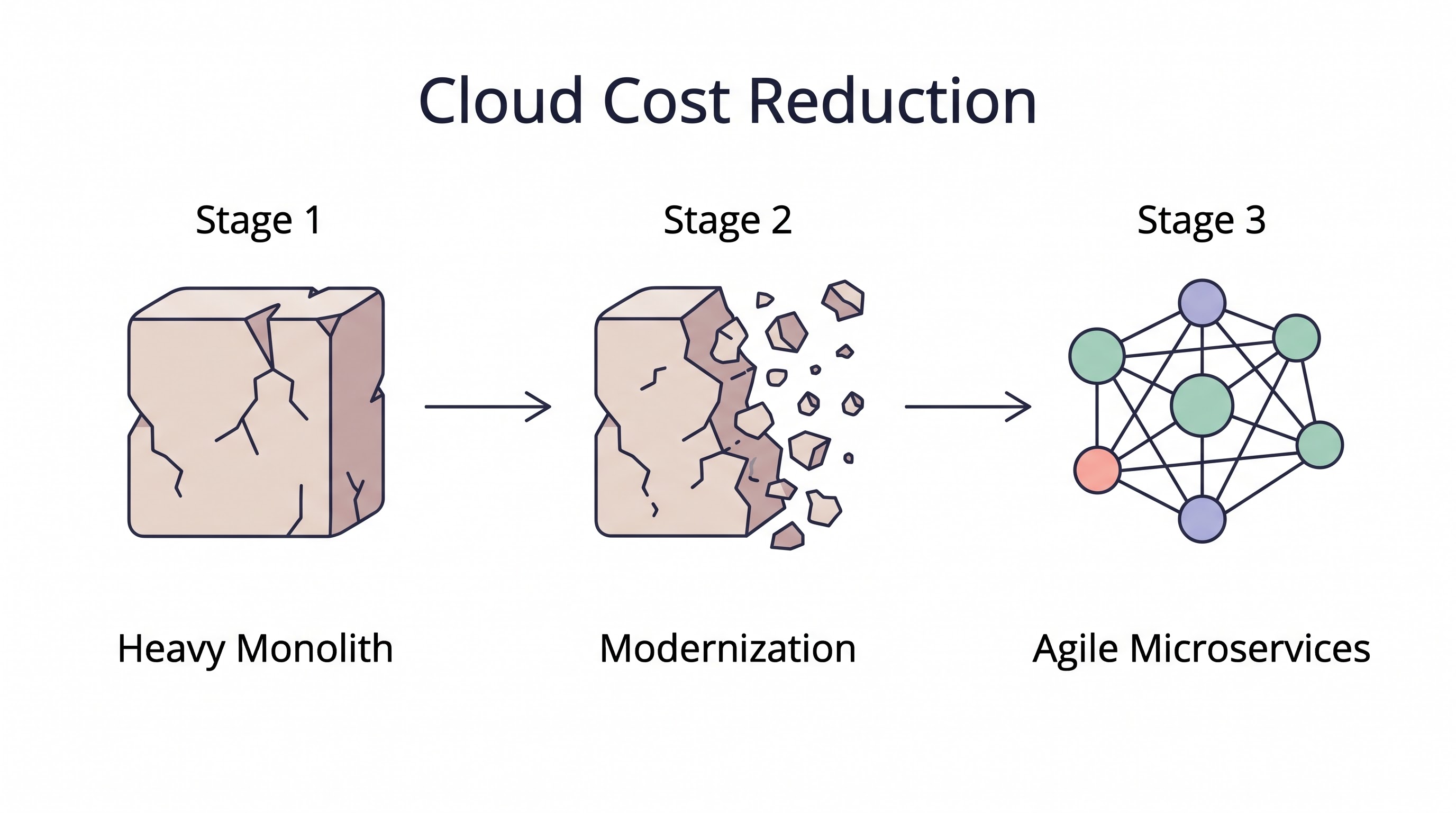
Beyond Theory: FinOps in the Wild
Frameworks and best practices are essential, but the reality of cloud cost reduction is messy. It involves battling legacy architectural decisions, navigating organizational politics, and implementing technical changes while the engines are running. Theory dictates that rightsizing is easy; reality proves that convincing an engineering team to downsize a production database they believe is "mission-critical" is an exercise in high-stakes diplomacy.
This article analyzes three anonymized, real-world case studies of organizations that successfully executed massive cloud cost reductions. By examining their specific challenges, the technical solutions they deployed, and the cultural shifts they engineered, we can extract practical lessons applicable to any enterprise struggling with cloud spend.
Case Study 1: Taming the Multi-Cloud Data Monster
The Company: A global AdTech firm processing terabytes of bidding data daily.
The Environment: Multi-cloud (AWS and GCP) with an annual cloud spend approaching $18M.
The Problem: The company's cloud bill was growing at twice the rate of its revenue. The primary culprit was storage and data transfer. Bidding logs were stored in AWS S3 Standard indefinitely, and massive datasets were frequently queried across regions and even across cloud providers for analytics, incurring catastrophic egress fees.
The Challenge
The data engineering team resisted deleting any logs, citing potential future machine learning training needs. Furthermore, the lack of a cloud tagging strategy meant that the FinOps team could not attribute the exploding storage costs to specific products or regional teams, making accountability impossible.
The Strategy: Tiering, Governance, and Negotiation
The FinOps team initiated a three-pronged attack to rein in the data costs:
Aggressive Lifecycle Management: They implemented S3 Lifecycle policies and GCP Object Lifecycle Management. Data older than 30 days was moved to Infrequent Access; data older than 90 days transitioned to Glacier/Archive. This satisfied the engineers' desire to keep data while slashing storage costs by 65%.
Architectural Redesign for Egress: They mapped the data flows causing the massive egress charges. They discovered a daily job pulling 5TB of data from AWS to GCP for processing. By replicating the processing service in AWS, they eliminated the cross-cloud transfer, saving $12,000 a month in egress fees alone. See the Networking Cost Reduction Guide for similar strategies.
Enterprise Discount Program (EDP) Negotiation: Armed with accurate usage forecasts, the FinOps team negotiated a new AWS Enterprise Discount Program, trading a committed baseline spend for a significant blanket discount across all services.
The Result: A 35% reduction in total cloud spend within 6 months, saving roughly $6.3M annually, while establishing a tag-based showback model that held engineering teams accountable for future data growth.
Case Study 2: Rightsizing a Kubernetes Monolith
The Company: A mid-sized SaaS provider in the fintech sector.
The Environment: A massive, monolithic application running on Google Kubernetes Engine (GKE).
The Problem: To ensure high availability during traffic spikes, the engineering team had heavily over-provisioned the GKE clusters. Node CPU utilization hovered around 12%. The company was effectively paying for a fleet of idling servers to wait for traffic that only arrived twice a day.
The Challenge
The engineering culture prioritized uptime above all else (a common and valid concern in fintech). Any suggestion of reducing cluster capacity was met with resistance due to fears of latency spikes or dropped transactions during peak trading hours.
The Strategy: Autoscaling and Spot Adoption
The FinOps team realized they could not win an argument based solely on cost; they had to prove the changes were technically safe.
Tuning the Horizontal Pod Autoscaler (HPA): The application was not scaling efficiently because Pod resource requests were set too high. Using tools detailed in the Kubernetes Cost Management Guide, the team analyzed actual container utilization and reduced the requested CPU and memory by 40%. This allowed the HPA to pack Pods much more efficiently onto the nodes.
Cluster Autoscaler Optimization: With Pods correctly sized, the Cluster Autoscaler was tuned to aggressively spin down underutilized nodes during off-peak hours.
Strategic Spot Instance Implementation: The most significant win came from segregating workloads. The core transactional services remained on standard On-Demand nodes (covered by Committed Use Discounts). However, the massive background processing jobs (report generation, data ingestion) were moved to separate node pools utilizing Preemptible VMs (Spot VMs). These jobs were stateless and could handle interruptions.
The Result: By shifting 40% of the compute workload to Spot instances and properly tuning autoscaling, the company reduced its GKE compute costs by 55%, maintaining five-nines of availability throughout the transition.
Case Study 3: The Serverless Spend Explosion
The Company: A rapidly growing media streaming startup.
The Environment: 100% serverless architecture on AWS (Lambda, API Gateway, DynamoDB).
The Problem: Serverless architectures scale beautifully—both in performance and cost. Following a viral marketing campaign, user traffic skyrocketed. The architecture handled the load flawlessly, but the subsequent AWS bill was staggering. The "pay-for-what-you-use" model had become a liability because the code was highly inefficient, resulting in millions of unnecessary executions and massive API Gateway throughput.
The Challenge
Traditional cloud rightsizing techniques do not apply to serverless. You cannot shut down an idle Lambda function to save money. The only way to reduce costs was to refactor the application code, requiring significant developer effort.
The Strategy: Observability and Architecture Refactoring
The FinOps team partnered closely with the lead architects to identify the inefficiencies.
Granular Observability: They implemented advanced tracing using AWS X-Ray and Datadog to map execution paths. They discovered a severe N+1 query problem where a single user request triggered dozens of redundant DynamoDB reads via Lambda.
Caching and API Consolidation: The engineering team introduced ElastiCache (Redis) to cache frequent read requests, drastically reducing DynamoDB read capacity unit (RCU) consumption and Lambda execution times. They also consolidated chatty API calls to reduce API Gateway billing.
Memory Tuning: Using AWS Lambda Power Tuning, they systematically tested the functions. They found that several functions were over-allocated on memory. By reducing memory allocation, the cost per invocation dropped, though they had to carefully balance this against execution duration (since Lambda charges by GB-second).
The Result: The refactoring effort took two sprints, but it reduced the serverless spend by 45%. More importantly, the company established a unit economics baseline (cost per 1,000 streams) to monitor future code efficiency.
Universal Lessons from Successful Reductions
Across these disparate case studies, several universal truths emerge about successful cloud cost reduction:
Visibility Precedes Action: In every case, the first step was gaining granular visibility into the data. You cannot optimize a black box.
Engineering Alignment is Mandatory: FinOps teams do not optimize infrastructure; engineers do. The most successful FinOps practitioners act as consultants, providing data and tooling that empower engineers to make cost-aware architectural decisions.
Automation Sustains Savings: One-off rightsizing events are temporary. Sustained savings require automation—whether that is S3 lifecycle policies, Kubernetes autoscalers, or automated tagging enforcement.
Use the Right Pricing Model: Leveraging Spot instances for batch jobs, RIs for steady-state workloads, and negotiating Enterprise Agreements are powerful levers that require zero code changes.
Key Takeaway
Real-world cloud cost reduction requires a combination of financial engineering (commitments, tiering), technical optimization (autoscaling, refactoring), and cultural alignment. As these case studies demonstrate, organizations that approach cloud costs as an architectural constraint rather than a fixed utility bill can achieve savings of 30% to 50%, transforming their cloud infrastructure into a highly efficient engine for business growth.
All in One Place
Atler Pilot decodes your cloud spend story by bringing monitoring, automation, and intelligent insights together for faster and better cloud operations.