
The Last Line of Defense
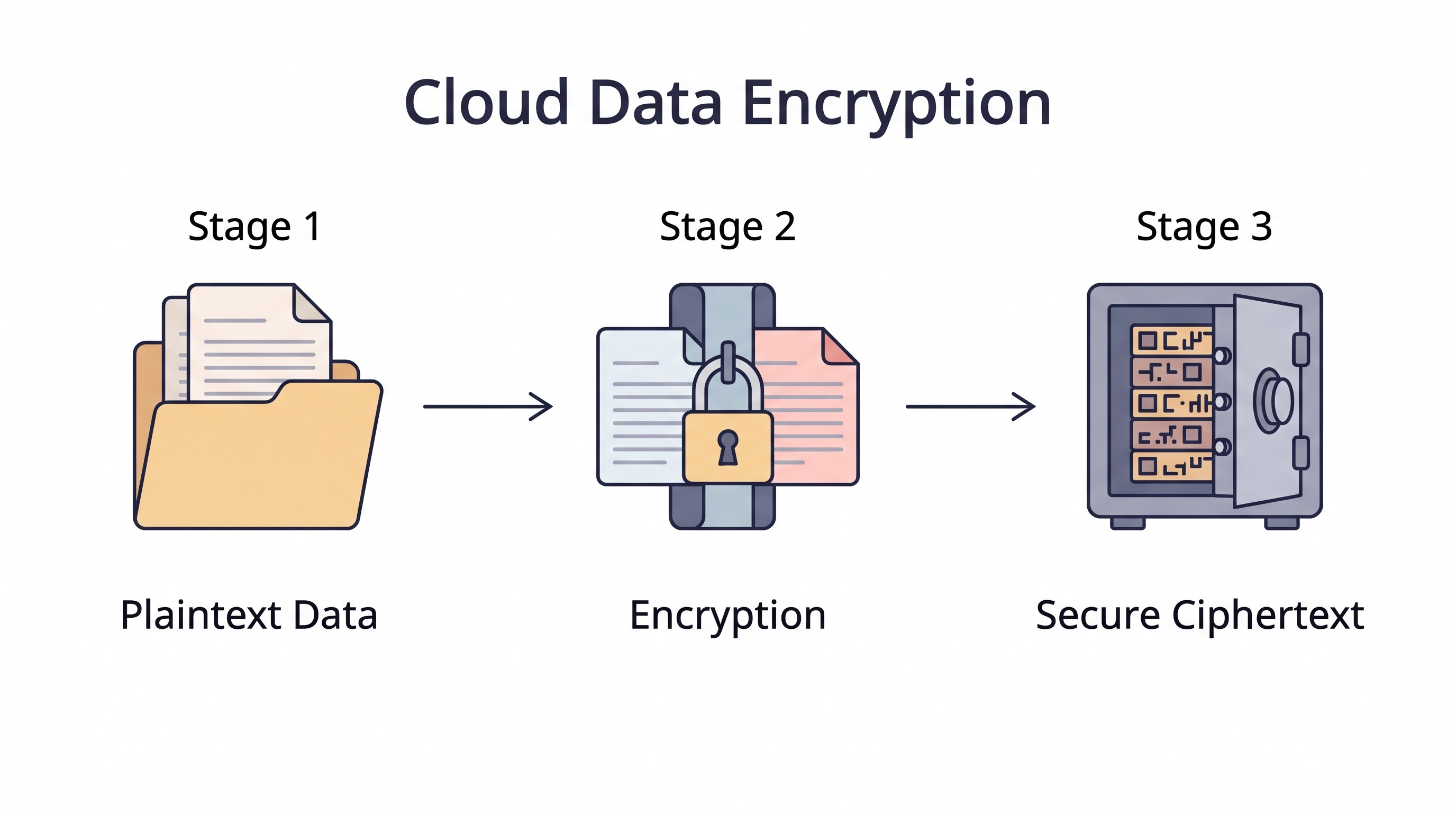
If firewalls fail, if IAM policies are misconfigured, and if a threat actor successfully breaches the perimeter and accesses your storage volumes, data encryption is the absolute last line of defense. If the exfiltrated database is encrypted with a strong cryptographic key that the attacker does not possess, the breach transforms from a catastrophic regulatory disaster into a highly stressful, but manageable, incident.
Historically, encryption was computationally expensive and complex to implement, requiring dedicated hardware security modules (HSMs) and specialized cryptographic engineers. In the modern cloud, encryption at rest and in transit has been commoditized. It is often as simple as checking a box or adding a single line to a Terraform module.
However, simple implementation can lead to a false sense of security. Misunderstanding key management, failing to encrypt internal network traffic, or ignoring the emerging requirements for encryption "in use" can leave massive blind spots. This guide provides a comprehensive framework for protecting data across its entire lifecycle in the cloud.
Encryption at Rest: The Absolute Minimum
Encryption at rest protects data stored on physical disks. It mitigates the risk of someone physically stealing a hard drive from an AWS datacenter, or, more realistically, prevents unauthorized access from other tenants sharing the underlying hardware.
The 2026 Standard: Default Encryption Must Be Enabled Everywhere.
There is zero acceptable reason for unencrypted data at rest in a modern cloud environment.
Object Storage: Amazon S3, Azure Blob, and Google Cloud Storage all support default encryption at the bucket level. Any object uploaded is automatically encrypted before being written to disk.
Block Storage: EBS volumes and Azure Managed Disks must be encrypted. Crucially, encrypting an EBS volume also ensures that all subsequent snapshots of that volume are encrypted.
Databases: Managed databases (RDS, Cloud SQL, DynamoDB) offer seamless encryption at rest with negligible performance impact.
Enforce this requirement using Policy-as-Code. A CSPM or an AWS Service Control Policy (SCP) should mathematically prevent the creation of any unencrypted storage resource.
Mastering Key Management (KMS)
Encryption algorithms are standardized (AES-256 is the default). The security of encryption lies entirely in the protection of the encryption keys. Cloud Key Management Services (AWS KMS, Azure Key Vault, GCP Cloud KMS) are the critical infrastructure for this protection.
Cloud providers offer three tiers of key management:
Provider-Managed Keys: The easiest option. The cloud provider creates, manages, and rotates the keys. It requires zero operational effort and meets basic compliance needs, but provides the lowest level of control.
Customer-Managed Keys (CMK): The recommended standard for enterprise data. The customer creates the key within the KMS, defines the IAM policies detailing exactly which users and services can use the key, and controls the key rotation schedule. The provider still secures the underlying hardware.
CloudHSM: Dedicated Hardware Security Modules in the cloud for organizations with extreme regulatory requirements (e.g., FIPS 140-2 Level 3) where they must control the actual hardware boundary.
The KMS Advantage: Cryptographic Erase. If you need to permanently destroy a multi-terabyte dataset (e.g., for GDPR compliance), deleting the data takes time. Instead, you simply delete the Customer-Managed Key used to encrypt that data. The data is instantly and irrevocably cryptographically shredded.
The BYOK Debate: Do You Really Need It?
"Bring Your Own Key" (BYOK) allows organizations to generate encryption keys in their own on-premises HSMs and import them into the cloud provider's KMS. While frequently demanded by compliance teams, BYOK introduces massive operational fragility.
If your on-premises key material is lost, or the connection to the cloud KMS severs during a key rotation, every cloud database encrypted with that key becomes permanently unreadable. For 99% of organizations, using Customer-Managed Keys generated natively within the cloud provider's highly available KMS is vastly more secure and resilient than attempting to manage BYOK.
Encryption in Transit: Beyond the Browser
Encryption in transit protects data as it moves across networks, preventing man-in-the-middle attacks and packet sniffing.
Terminating TLS (HTTPS) at the public-facing Load Balancer or API Gateway is standard practice. However, Zero Trust Architecture mandates that encryption must not stop at the perimeter.
Internal TLS: Traffic moving between microservices inside a VPC must also be encrypted. Attackers who breach a front-end server routinely sniff internal network traffic to steal database credentials or unencrypted payloads.
Service Meshes: Implementing internal TLS manually is an operational nightmare of certificate rotation. Modern environments utilize a Service Mesh (like Istio or Linkerd) to automatically handle mutual TLS (mTLS) between Kubernetes pods, ensuring all internal communication is encrypted and authenticated without altering the application code.
Encryption in Use: Confidential Computing
The final frontier of data protection is encryption "in use." Traditionally, even if data is encrypted at rest and in transit, it must be decrypted in the server's RAM/CPU in order to be processed. A highly sophisticated attacker with access to the hypervisor or a memory-dump vulnerability could theoretically extract this unencrypted data.
Confidential Computing solves this. Technologies like AWS Nitro Enclaves, Intel SGX, and AMD SEV create highly isolated, hardware-encrypted compute environments (enclaves). Data is decrypted and processed only within the enclave. Even the cloud provider's administrators, or a user with root access to the underlying OS, cannot see the data being processed. This is critical for highly regulated industries processing highly sensitive PII, cryptographic operations, or collaborative machine learning models where data privacy is paramount.
Secrets are Not Just Data
API keys, database passwords, and OAuth tokens require a specialized form of encryption and access control. Hardcoding these secrets in source code or storing them in plain text configuration files is a primary cause of cloud breaches.
All secrets must be stored in a dedicated Secrets Manager (AWS Secrets Manager, HashiCorp Vault). Applications should authenticate via an IAM role to retrieve the secret dynamically into memory at runtime. Furthermore, advanced implementations utilize dynamic secrets, where the Vault generates a unique, temporary database password for the application that automatically expires after 30 minutes, drastically limiting the utility of a stolen credential.
Key Takeaway
Cloud data encryption is highly accessible but must be applied comprehensively. Default encryption at rest using Customer-Managed Keys is the baseline. Zero Trust mandates that all internal network traffic be encrypted via mTLS. Protect your encryption keys through rigorous IAM policies, utilize Secrets Managers to eliminate hardcoded credentials, and explore Confidential Computing for the most sensitive processing workloads. In the cloud, if the data isn't encrypted across all three states—at rest, in transit, and in use—it isn't fully secured.
All in One Place
Atler Pilot decodes your cloud spend story by bringing monitoring, automation, and intelligent insights together for faster and better cloud operations.