
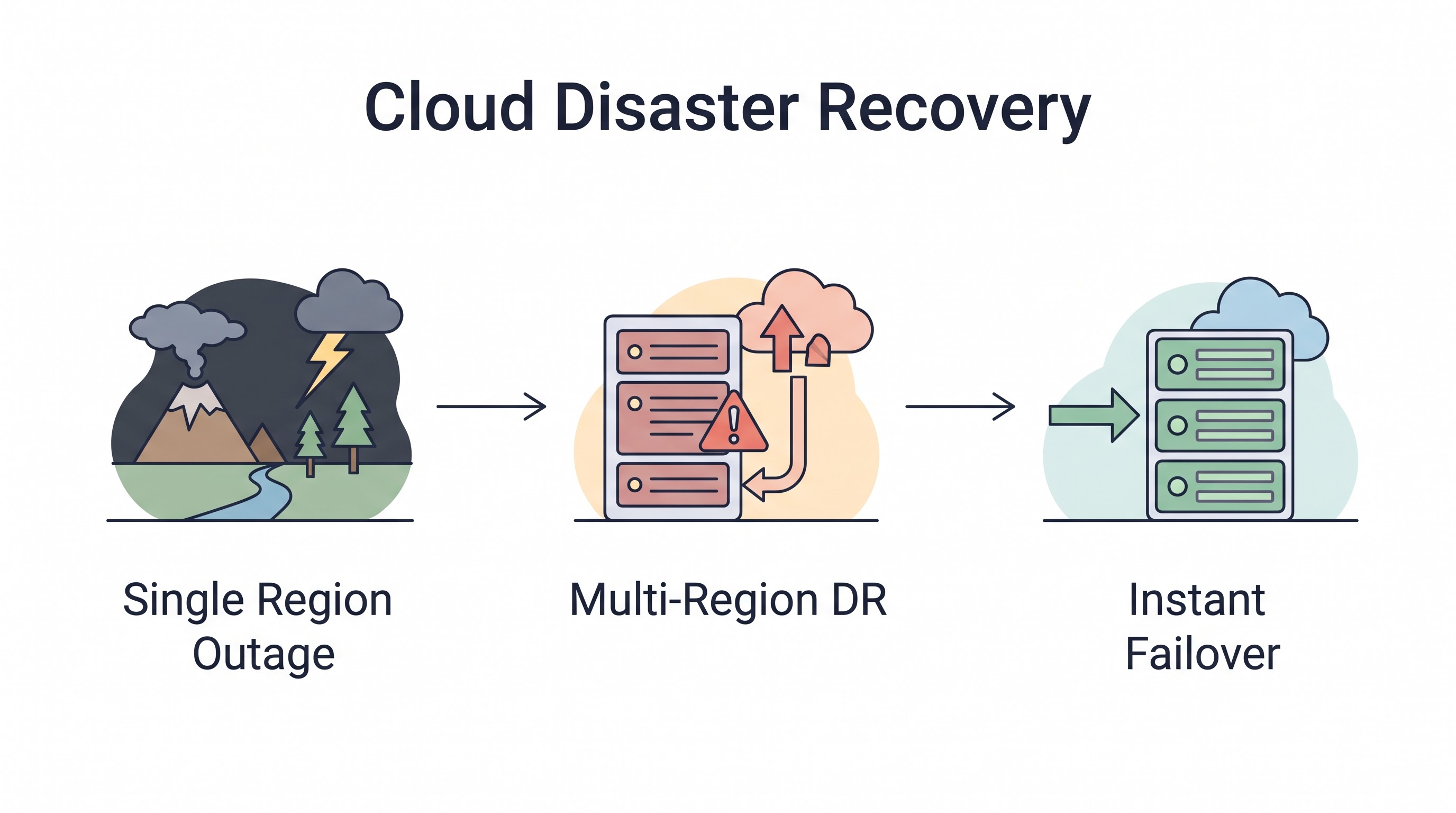
Why the Cloud Still Goes Down
A persistent myth surrounding cloud computing is that migrating to AWS, Azure, or GCP automatically guarantees high availability and disaster resilience. It does not. While the cloud providers guarantee the availability of their infrastructure, the availability of your application remains your responsibility (The Shared Responsibility Model).
Cloud regions experience major outages due to weather, power failures, or provider-level software bugs. More commonly, organizations inflict disasters upon themselves: a developer accidentally drops a production database, a botched Terraform deployment deletes critical network routing, or a ransomware attack encrypts the primary data stores.
Designing a Cloud Disaster Recovery (DR) plan requires balancing business continuity requirements against significant infrastructure costs. This guide outlines the architectures required to survive both physical outages and catastrophic cyberattacks.
The Physics of DR: RTO and RPO
Every DR discussion must begin with two business metrics, not technology choices.
Recovery Time Objective (RTO): How long can the business survive the application being offline? If the RTO is 4 hours, the DR architecture must allow you to spin up replacement infrastructure and route traffic within 240 minutes.
Recovery Point Objective (RPO): How much data can the business afford to lose? If the RPO is 1 hour, backups or data replication must occur at least every 60 minutes. An outage means you lose up to 59 minutes of transactions.
As RTO and RPO approach zero (zero downtime, zero data loss), the cost of the DR architecture increases exponentially.
The 4 Cloud DR Architectures
Cloud DR typically involves utilizing a secondary geographic region (e.g., failing over from us-east-1 to us-west-2). The architecture you choose dictates your RTO and RPO.
Strategy 1: Backup and Restore
RTO: Hours to Days | RPO: Hours | Cost: Low
Data (databases, file systems) is backed up regularly and copied to a secondary region (e.g., using S3 Cross-Region Replication). No compute resources are running in the secondary region. In a disaster, the operations team must manually provision the VPCs, spin up EC2 instances, install applications, and restore the database from the backup.
Use Case: Non-critical internal applications where multi-day downtime is acceptable.
Strategy 2: Pilot Light
RTO: Tens of Minutes to Hours | RPO: Minutes | Cost: Moderate
The critical core of the environment (the database) is continuously replicated to the secondary region. The application servers are configured via Infrastructure as Code (Terraform), but the instances are not running, saving compute costs. In a disaster, the database in the secondary region is promoted to primary, the IaC pipeline spins up the application servers, and DNS is updated to route traffic.
Use Case: Standard enterprise applications balancing cost and recovery speed.
Strategy 3: Warm Standby
RTO: Minutes | RPO: Seconds to Minutes | Cost: High
A scaled-down, fully functional version of the production environment is always running in the secondary region. The database is continuously replicated, and a minimum number of application servers are active, handling internal testing or minimal traffic. In a disaster, the Auto Scaling Groups in the secondary region are triggered to scale out to handle full production load, and DNS is flipped.
Use Case: Business-critical applications like e-commerce sites or core banking systems.
Strategy 4: Multi-Site Active/Active
RTO: Near Zero | RPO: Near Zero | Cost: Extreme
The application is deployed across two or more regions simultaneously, actively serving traffic from both. Global load balancers (like AWS Route 53 or Azure Traffic Manager) route users to the closest healthy region. If Region A goes down, traffic is seamlessly routed to Region B. This requires highly complex, globally distributed databases (like DynamoDB Global Tables or Google Spanner) to handle multi-region write conflicts.
Use Case: Tier-0 applications (Netflix, global payment processors) where downtime costs millions per minute.
The New DR: Surviving Ransomware
Traditional DR architectures were designed for regional physical outages. If a hurricane takes down AWS us-east-1, your Warm Standby in us-west-2 saves you. However, if a ransomware attack encrypts your primary database, the replication engine will instantly replicate that encrypted, useless data to your Warm Standby database in the secondary region. Traditional DR fails against ransomware.
The Mitigation: Immutable Backups.
Your DR strategy must include backups that are mathematically impossible to modify or delete, even by an administrator whose credentials have been compromised.
S3 Object Lock: Configure backups to be written to an S3 bucket with Object Lock enabled in Compliance Mode for a defined retention period (e.g., 30 days). Not even the AWS Root user can delete those backups before the 30 days expire.
Air-Gapped Accounts: Store critical backups in a completely separate, highly restricted AWS account that is isolated from the primary production organization, utilizing a distinct identity provider.
The Illusion of the Untested Plan
A DR plan that has not been tested is merely a theoretical document. The most critical aspect of Cloud DR is regular, automated testing.
Utilize Game Days or Chaos Engineering to simulate regional failures. Can your team actually execute the Terraform scripts to spin up the Pilot Light environment under pressure? If a failover occurs, does the application successfully connect to the newly promoted database? If you cannot prove your RTO and RPO through successful testing, your organization is not resilient.
Key Takeaway
Cloud Disaster Recovery is an exercise in risk management and economics. Select the architecture (Pilot Light, Warm Standby, Multi-Site) that aligns with your business's specific RTO and RPO requirements. Crucially, recognize that multi-region replication does not protect against data corruption or ransomware. You must supplement geographical redundancy with mathematically immutable backups to ensure survivability against modern cyber threats.
All in One Place
Atler Pilot decodes your cloud spend story by bringing monitoring, automation, and intelligent insights together for faster and better cloud operations.