
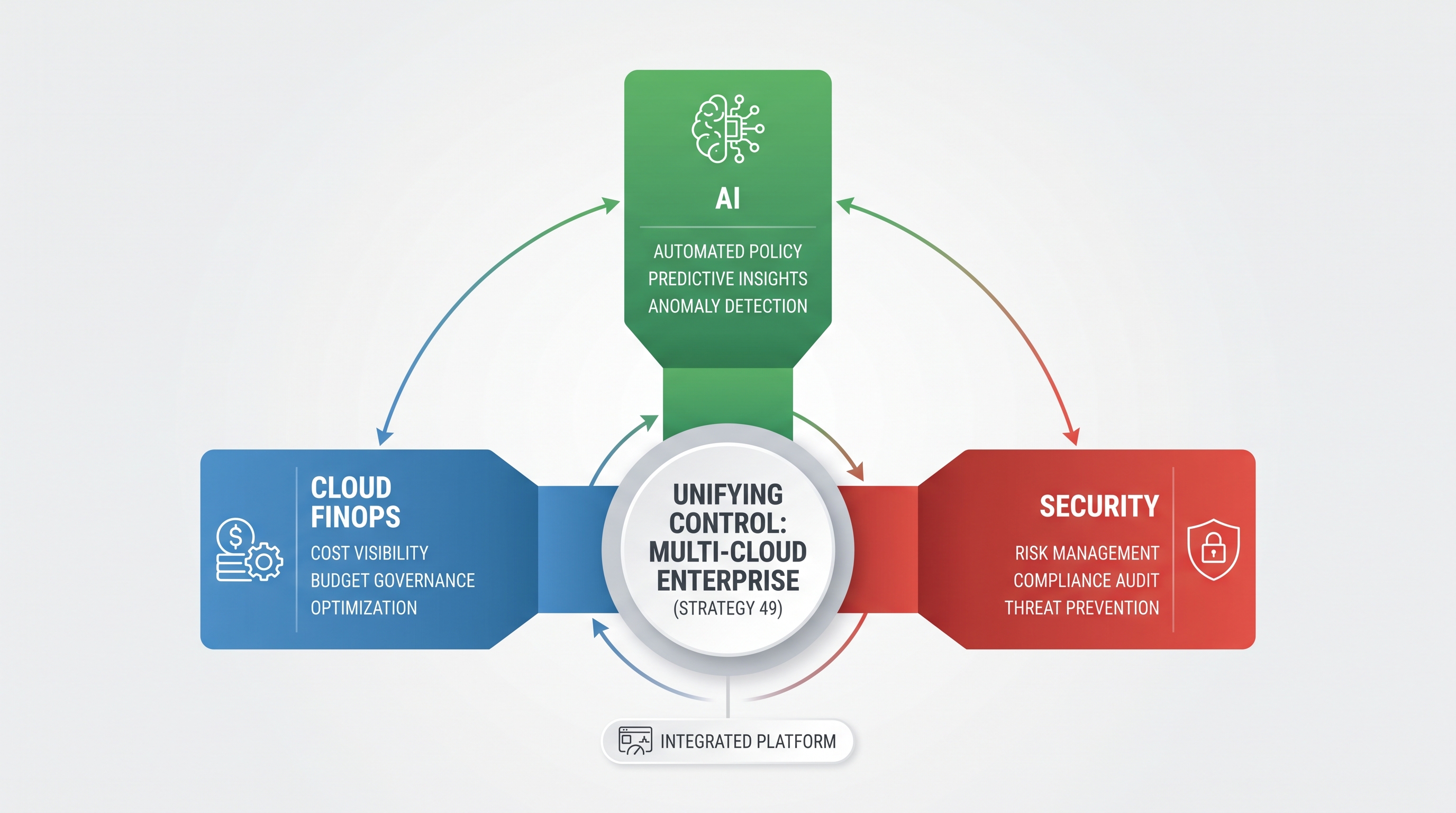
The relentless pace of digital transformation has propelled enterprises into increasingly complex multi-cloud ecosystems. AWS, Azure, GCP, and Oracle environments often coexist, each with its unique billing models, security paradigms, and operational nuances. This fragmentation presents a formidable challenge: how to simultaneously optimize cloud spend, maintain an impenetrable security posture, and ensure operational excellence without drowning in complexity. The answer lies not in more isolated tools, but in an integrated, intelligent approach we term "Strategy 49."
Strategy 49 represents the convergence of three critical pillars: FinOps, Artificial Intelligence (AI), and a robust security strategy. It’s a holistic framework designed to break down the traditional silos between finance, engineering, and security teams, leveraging AI as the connective tissue to drive predictive insights, automated actions, and continuous optimization across all dimensions. For enterprises grappling with scale, cost overruns, and persistent security threats, Strategy 49 is not merely an aspiration but an operational imperative.
Understanding Strategy 49: The Nexus of FinOps, AI, and Security
Strategy 49 is fundamentally about intelligent governance. It acknowledges that in a dynamic cloud environment, cost, security, and performance are inextricably linked. A security misconfiguration can lead to exorbitant egress charges; an under-optimized resource can become a vulnerable attack surface; and a lack of financial accountability can mask critical operational risks. Strategy 49 posits that true cloud mastery emerges when these domains are managed as a unified, data-driven entity, powered by AI.
At its core, Strategy 49 involves:
Unified Data Plane: Ingesting and normalizing operational, financial, and security data from all cloud providers into a single, comprehensive data lake.
AI-Powered Analytics: Applying machine learning models to this aggregated data for anomaly detection, predictive forecasting, root cause analysis, and actionable insights across cost, security, and performance.
Automated Remediation & Governance: Implementing intelligent automation to act on these insights, enforcing policies, rightsizing resources, patching vulnerabilities, and ensuring continuous compliance, all within defined guardrails.
Cross-Functional Collaboration: Fostering a culture where FinOps, Security, and Engineering teams share common metrics, responsibilities, and a unified platform for decision-making.
Moving beyond theoretical constructs, let's delve into the practical application of Strategy 49, illustrating how AI serves as the catalyst for transformation in both FinOps and security domains.
FinOps in the Age of AI: Predictive Cost Optimization and Governance
Traditional FinOps practices, while valuable, often struggle to keep pace with the velocity and complexity of modern cloud deployments. AI elevates FinOps from reactive reporting to proactive, predictive management, enabling enterprises to gain unparalleled control over their cloud spend.
Dynamic Cost Allocation and Showback/Chargeback
Accurate cost attribution is the bedrock of FinOps. In multi-cloud environments, resource tagging inconsistencies and shared service costs (e.g., transit gateways, central logging, shared databases) make precise showback/chargeback a significant challenge. AI-powered platforms can transcend manual tagging limitations:
Automated Tagging & Classification: Machine learning models can analyze resource metadata, usage patterns, and naming conventions to automatically tag untagged resources or correct inconsistent tags. For instance, an AI model can infer that an EC2 instance with a specific naming convention and attached volumes belongs to the "Marketing" department and "Campaign X" project, even if manually untagged. CloudAtler leverages automated tagging to ensure granular cost visibility across your multi-cloud estate.
Shared Resource Cost Disaggregation: AI can analyze usage metrics (e.g., network traffic, API calls, storage consumption) of shared services and intelligently distribute costs to consuming departments or applications based on actual consumption patterns, providing a far more equitable and accurate chargeback model than heuristic rules.
AI-Powered Anomaly Detection and Budget Forecasting
Unexpected cost spikes are a common pain point. AI algorithms are adept at identifying these anomalies in real-time by establishing baselines from historical data and flagging deviations that exceed statistical thresholds. This isn't just about alerting; it's about context:
Root Cause Analysis: When an anomaly is detected, AI can correlate it with recent operational changes (e.g., new deployments, increased traffic, misconfigurations) to quickly pinpoint the root cause, accelerating investigation and remediation.
Predictive Budgeting: Leveraging historical spend, seasonal trends, business forecasts, and projected growth, AI models can generate highly accurate budget forecasts. This moves budgeting from an annual guessing game to a continuous, data-driven process, allowing for proactive adjustments and preventing budget overruns before they occur. Furthermore, AI can provide uncertainty planning capabilities, modeling various scenarios to prepare for fluctuating demands.
Resource Optimization and Rightsizing with ML
One of the most immediate FinOps wins comes from optimizing resource utilization. AI takes this a step further:
Continuous Rightsizing: AI continuously analyzes CPU, memory, disk I/O, and network utilization metrics across compute instances (EC2, Azure VMs, GCP Compute Engine), databases (RDS, Azure SQL, Cloud SQL), and other services. It identifies over-provisioned resources and recommends optimal instance types or sizes, often with a calculated cost saving and performance impact. This goes beyond simple thresholds, considering workload patterns, burstability, and application-specific requirements.
Idle Resource Identification: AI can detect resources that are consistently idle or underutilized, such as unattached EBS volumes, unused snapshots, or development environments left running after hours, and recommend their termination or scheduling for shutdown.
Compute Lifecycle Analysis: Advanced AI models can perform compute lifecycle analysis, predicting when instances might be better suited for different pricing models (e.g., moving from On-Demand to Spot or Reserved Instances) based on long-term usage patterns and architectural stability.
Commitment Intelligence and Reserved Savings Optimization
Managing Reserved Instances (RIs) and Savings Plans (SPs) across multiple cloud providers is notoriously complex. AI can transform this into a strategic advantage:
Intelligent Recommendation Engine: AI analyzes historical and projected usage patterns, existing commitments, and current market rates to recommend the optimal mix of RIs and SPs across AWS, Azure, and GCP. It considers factors like instance family flexibility, regional commitments, and payment options to maximize savings. CloudAtler's commitment intelligence features provide these recommendations, ensuring you always have the most cost-effective commitment strategy.
Utilization Monitoring & Exchange Automation: AI continuously monitors RI/SP utilization, flagging underutilized commitments and recommending exchanges or modifications to prevent waste. For instance, if an AWS EC2 instance type covered by an RI is deprecated, AI can proactively suggest an exchange to a more suitable, covered type. Our reserved savings optimization capabilities ensure maximum value from your commitments.
Elevating Cloud Security with AI: Proactive Defense and Compliance
The sheer volume of security events, logs, and potential vulnerabilities in a multi-cloud environment overwhelms human analysts. AI is no longer a luxury but a necessity for robust cloud security, enabling proactive threat hunting, intelligent vulnerability management, and automated compliance.
Threat Detection and Vulnerability Prioritization
AI's ability to process massive datasets makes it invaluable for identifying subtle indicators of compromise (IoCs) and prioritizing remediation efforts:
Behavioral Anomaly Detection: ML models establish baselines for normal user and resource behavior (e.g., login patterns, API calls, network traffic). Any deviation – an unusual login location, excessive API calls from a service account, or data exfiltration attempts – is immediately flagged, often before traditional rule-based systems react.
Intelligent Vulnerability Prioritization: Not all vulnerabilities are created equal. AI-powered patch intelligence and vulnerability prioritization systems analyze CVE scores, exploit availability, asset criticality, network reachability, and existing compensating controls to assign a true risk score. This allows security teams to focus on the vulnerabilities that pose the greatest actual threat to the business, rather than being overwhelmed by a flood of low-impact alerts.
Multi-Resource Detection: AI can correlate events across different cloud resources and services (e.g., a suspicious login to an Azure VM followed by unusual S3 bucket access in AWS) to detect sophisticated, multi-stage attacks that might evade single-cloud detection systems. CloudAtler's multi-resource detection capabilities are crucial for hybrid and multi-cloud environments.
Automated Policy Enforcement and Compliance Guardrails
Maintaining continuous compliance with regulatory standards (e.g., GDPR, HIPAA, PCI-DSS) and internal security policies is a non-stop battle. AI automates this enforcement:
Continuous Configuration Drift Detection: AI constantly monitors cloud resource configurations against predefined security baselines and compliance policies. If a S3 bucket policy is inadvertently changed to public, or an Azure Network Security Group rule exposes a critical port, AI immediately detects the drift.
Automated Remediation & Guardrails: Beyond detection, AI can trigger automated remediation actions, such as reverting non-compliant configurations to their secure state, blocking suspicious network traffic, or isolating compromised resources. These automated actions operate within pre-approved guardrails, preventing unintended operational disruptions.
Audit Readiness: AI maintains an immutable audit trail of all security events, policy checks, and remediation actions, significantly simplifying compliance reporting and demonstrating adherence to regulatory requirements.
Identity and Access Management (IAM) Optimization
IAM is a primary attack vector. AI brings intelligence to this critical area:
Least Privilege Enforcement: AI analyzes actual user and service role activity to identify over-privileged permissions, recommending precise least-privilege policies. It can detect roles with permissions that are never used and suggest their removal.
Anomalous Access Pattern Detection: AI can flag unusual access attempts, such as a user trying to access resources outside their typical working hours or from an unknown IP address, or a service account performing actions it has never performed before.
Patch Management and Remediation with AI-Driven Intelligence
Patching is often a resource-intensive, high-risk operation. AI transforms it:
Impact-Aware Patching: AI analyzes the dependencies and criticality of systems to be patched, predicting potential service disruptions. It can model the financial impact of patching (e.g., cost of downtime, resource consumption during rollout) to inform scheduling and strategy. CloudAtler's patch-aware intelligence provides this crucial context.
Automated, Safe Rollouts: AI can orchestrate phased patch rollouts, monitoring system health and performance metrics in real-time. If any degradation is detected, it can trigger automated safe rollbacks to the previous stable state, minimizing risk and ensuring business continuity. This is a core component of patch remediation.
Patch Governance Automation: AI facilitates patch governance by automating the change advisory board (CAB) process, generating necessary documentation, and tracking compliance with patching policies across diverse operating systems and applications. This is critical for robust patch governance.
The Symbiotic Relationship: FinOps and Security in Strategy 49
Strategy 49 thrives on the inherent synergy between FinOps and Security. When these domains collaborate, powered by AI, the whole is greater than the sum of its parts.
Quantifying the Cost of Insecurity
A major challenge for security teams is demonstrating the ROI of security investments. FinOps, augmented by AI, provides the tools to quantify the financial impact of security risks and breaches:
Direct Costs: AI can help calculate the direct costs of a security incident, including increased egress charges from data exfiltration, compute costs for incident response tools, and potential fines from compliance violations.
Opportunity Costs: FinOps metrics can highlight the opportunity costs of insecure architectures, such as the inability to pursue certain business initiatives due to compliance gaps or the higher operational costs associated with manual security processes.
ROI of Security Investments: By tying security enhancements (e.g., implementing WAFs, adopting least-privilege IAM) to reduced risk exposure and avoided costs, FinOps can clearly articulate the financial benefits of proactive security measures.
Security-Aware Cost Optimization
FinOps recommendations must always consider security implications. Strategy 49 ensures that cost optimization doesn't inadvertently introduce new vulnerabilities:
Cost of Compliance: Certain security requirements, such as using dedicated instances for sensitive workloads, specific data residency regions, or enhanced encryption services, inherently carry higher costs. AI-driven FinOps intelligently factors these "security premiums" into optimization recommendations, ensuring that cost savings don't compromise security.
Risk-Adjusted Rightsizing: An AI might recommend rightsizing a database, but if that database hosts critical PII and is subject to strict performance SLAs, the AI will factor in the risk of performance degradation and potential compliance penalties, suggesting a more conservative optimization or flagging it for manual review.
Operationalizing Shared Responsibility with Unified Visibility
The cloud shared responsibility model often creates ambiguity. Strategy 49, through AI and a unified platform, provides clarity:
Single Pane of Glass: A common platform that presents both financial and security posture side-by-side allows FinOps, security, and engineering teams to see the complete picture. An engineer optimizing a resource can immediately see its security profile, and a security analyst investigating an alert can understand its cost implications. This is precisely where a unified dashboard becomes indispensable, providing a holistic view across all cloud providers.
Collaborative Workflows: AI-generated insights and automated actions are integrated into existing ITSM and CI/CD pipelines, fostering seamless collaboration. For example, a budget alert (FinOps) triggered by unusual network activity (Security) can automatically create a ticket for the SRE team, complete with correlated data from both domains. This shared intelligence fosters a culture of culture transparency and accountability.
Architectural Considerations for Implementing Strategy 49
Implementing Strategy 49 requires a thoughtful architectural approach that can handle the scale and diversity of multi-cloud environments.
Data Ingestion and Normalization
The foundation of Strategy 49 is robust data. This involves:
Multi-Cloud Connectors: Secure, API-driven connectors to ingest billing data (Cost and Usage Reports, Azure Cost Management APIs), configuration data (CloudTrail, Azure Activity Logs, GCP Logging), security logs (GuardDuty, Security Hub, Azure Security Center, GCP Security Command Center), and performance metrics (CloudWatch, Azure Monitor, GCP Monitoring) from AWS, Azure, GCP, and Oracle.
Schema Normalization: Raw data from different providers has disparate schemas. A critical architectural component is a data pipeline that normalizes this data into a unified schema, enabling consistent analysis across all clouds. This often involves ETL/ELT processes using tools like Apache Kafka, Spark, or cloud-native data services.
Data Lake Foundation: Storing this normalized data in a scalable, queryable data lake (e.g., S3, Azure Data Lake Storage, Google Cloud Storage) is essential for historical analysis, AI model training, and ad-hoc querying.
AI/ML Model Training and Deployment
The intelligence layer requires a robust MLOps framework:
Model Lifecycle Management: A system for developing, training, deploying, and monitoring ML models. This includes version control for models, automated retraining pipelines, and performance monitoring to detect model drift.
Explainable AI (XAI): For critical FinOps and security decisions, the ability to understand why an AI made a particular recommendation is crucial for trust and auditability. Architectural components should support XAI techniques like SHAP or LIME.
Real-time Inference: Many FinOps and security use cases (e.g., anomaly detection, policy enforcement) require real-time or near real-time AI inference, necessitating low-latency deployment options like edge computing or optimized cloud functions.
Integration with Existing Workflows
Insights are only valuable if they lead to action. Strategy 49's architecture must integrate seamlessly:
API-First Design: The platform should expose comprehensive APIs for programmatic access to insights and for triggering automated actions, allowing integration with ITSM (ServiceNow, Jira), CI/CD pipelines (Jenkins, GitLab CI), and SIEM/SOAR systems (Splunk, Cortex XSOAR).
Event-Driven Architecture: Leveraging cloud-native event services (e.g., AWS EventBridge, Azure Event Grid, GCP Pub/Sub) to publish and subscribe to FinOps and security events, enabling reactive automation across the enterprise.
Culture and Team Collaboration
Technology alone is insufficient. Strategy 49 demands a cultural shift:
Cross-Functional Teams: Establishing "Cloud Centers of Excellence" or similar groups that include representatives from FinOps, Security, and Engineering.
Shared Goals & Metrics: Aligning KPIs across teams. For example, security teams might have a metric for "reduction in critical vulnerabilities," while FinOps tracks "cost savings from vulnerability remediation."
Education & Enablement: Providing training and resources to ensure all stakeholders understand their role in the integrated strategy. CloudAtler's focus on team intelligence is designed to facilitate this cross-functional understanding and collaboration.
Real-World Examples & Use Cases
Scenario 1: Identifying and Remediating a Costly Security Misconfiguration
An AWS S3 bucket containing sensitive customer data is inadvertently made public due to a developer error. This misconfiguration leads to unauthorized access and a sudden spike in data egress charges as attackers exfiltrate data.
Strategy 49 in Action:
AI-Powered Security Detection: CloudAtler's AI, continuously monitoring S3 bucket policies across all accounts, immediately detects the public bucket policy change (Security). Simultaneously, its behavioral anomaly detection flags the unusual surge in egress traffic from that bucket (FinOps/Operational).
Correlated Alerting: The platform correlates these events, recognizing a high-severity incident: a security misconfiguration leading to potential data breach and high costs. An alert is triggered to both the security operations center (SOC) and the FinOps team.
Automated Remediation & Cost Impact: Based on pre-defined guardrails, CloudAtler's automation engine automatically reverts the S3 bucket policy to private, stopping further data exfiltration. The cost impact calculation feature immediately quantifies the financial loss incurred during the brief exposure period and estimates the savings from the swift remediation.
Post-Incident Analysis: The AI provides a detailed timeline of events, root cause analysis (linking to the developer's recent deployment), and recommendations for preventing similar incidents (e.g., stricter CI/CD checks, enhanced guardrails for S3 public access).
Scenario 2: Optimizing a Microservices Architecture for Cost and Compliance
A rapidly scaling e-commerce application built on Kubernetes across Azure and GCP experiences fluctuating costs and occasional compliance audit findings related to container image vulnerabilities.
Strategy 49 in Action:
AI-Driven FinOps Optimization: CloudAtler's AI analyzes the application's historical usage patterns, seasonal demand, and container resource requests. It identifies optimal node pool configurations (instance types, scaling policies) for both Azure Kubernetes Service (AKS) and Google Kubernetes Engine (GKE), recommending a blend of Spot Instances where appropriate and calculating the projected savings. Our performance management features ensure that these optimizations do not degrade application responsiveness.
Continuous Security & Compliance: Concurrently, CloudAtler's security posture management continuously scans container images in registries and running pods for known vulnerabilities. When new vulnerabilities are detected, the AI prioritizes them based on exploitability, asset criticality, and compliance requirements.
Integrated Remediation Workflow: For high-priority vulnerabilities, the platform can automatically trigger a pipeline to rebuild and redeploy affected container images with patched versions. For cost optimizations, it can generate pull requests with updated infrastructure-as-code (IaC) templates for node pool configurations, allowing engineering teams to review and apply changes with confidence, knowing the financial and security implications are already calculated.
Scenario 3: Patch Management with Financial Impact Analysis
A critical zero-day vulnerability is announced affecting a widely used operating system present across hundreds of production servers in AWS and Oracle Cloud Infrastructure (OCI).
Strategy 49 in Action:
AI-Powered Vulnerability Assessment: CloudAtler's patch intelligence immediately identifies all affected instances across both AWS and OCI, correlating them with their associated applications, criticality, and owner teams.
Financial Impact Calculation: The AI then performs a financial impact calculation, estimating the potential downtime cost if these servers are taken offline for patching during business hours, or the cost of temporary scaling up resources to maintain availability during rolling updates. It also calculates the potential cost of inaction (e.g., fines, data breach remediation) if the vulnerability is exploited.
Intelligent Patch Remediation: Based on the combined security risk and financial impact, CloudAtler recommends the optimal patching strategy: a phased rollout during off-peak hours, leveraging automated safe rollbacks and real-time performance monitoring. It can even suggest temporarily shifting traffic to unaffected regions or scaling up standby environments to minimize disruption.
Automated Governance & Reporting: The platform automates the creation of change requests (CAB automation), tracks the progress of the patch rollout across both cloud environments, and provides real-time compliance reporting on the vulnerability remediation status, ensuring patch governance is maintained.
Conclusion
The journey to cloud maturity is paved with the integration of previously disparate functions. Strategy 49 is not just a theoretical construct; it is a practical, AI-driven framework for enterprises to unify their FinOps, security, and operational strategies across the multi-cloud landscape. By breaking down silos and leveraging the power of machine learning, organizations can achieve unprecedented levels of cost efficiency, proactive security, and agile operations.
Embracing Strategy 49 means moving beyond reactive firefighting to a state of predictive control and continuous optimization. It means fostering a culture where finance, security, and engineering teams operate with shared visibility and accountability, all powered by intelligent automation.
CloudAtler is purpose-built to empower enterprises in implementing Strategy 49. Our AI-powered platform unifies FinOps, cloud security, and automated operations across AWS, Azure, GCP, and Oracle environments. From granular cost attribution and predictive budgeting to proactive threat detection and automated patch remediation, CloudAtler provides the single pane of glass and the intelligent automation required to master your multi-cloud destiny. Stop managing cloud complexity in silos. Start unifying your cloud operations, security, and financial control with CloudAtler.
Ready to transform your cloud strategy? Discover how CloudAtler can unify your multi-cloud FinOps, security, and operations today.
All in One Place
Atler Pilot decodes your cloud spend story by bringing monitoring, automation, and intelligent insights together for faster and better cloud operations.