
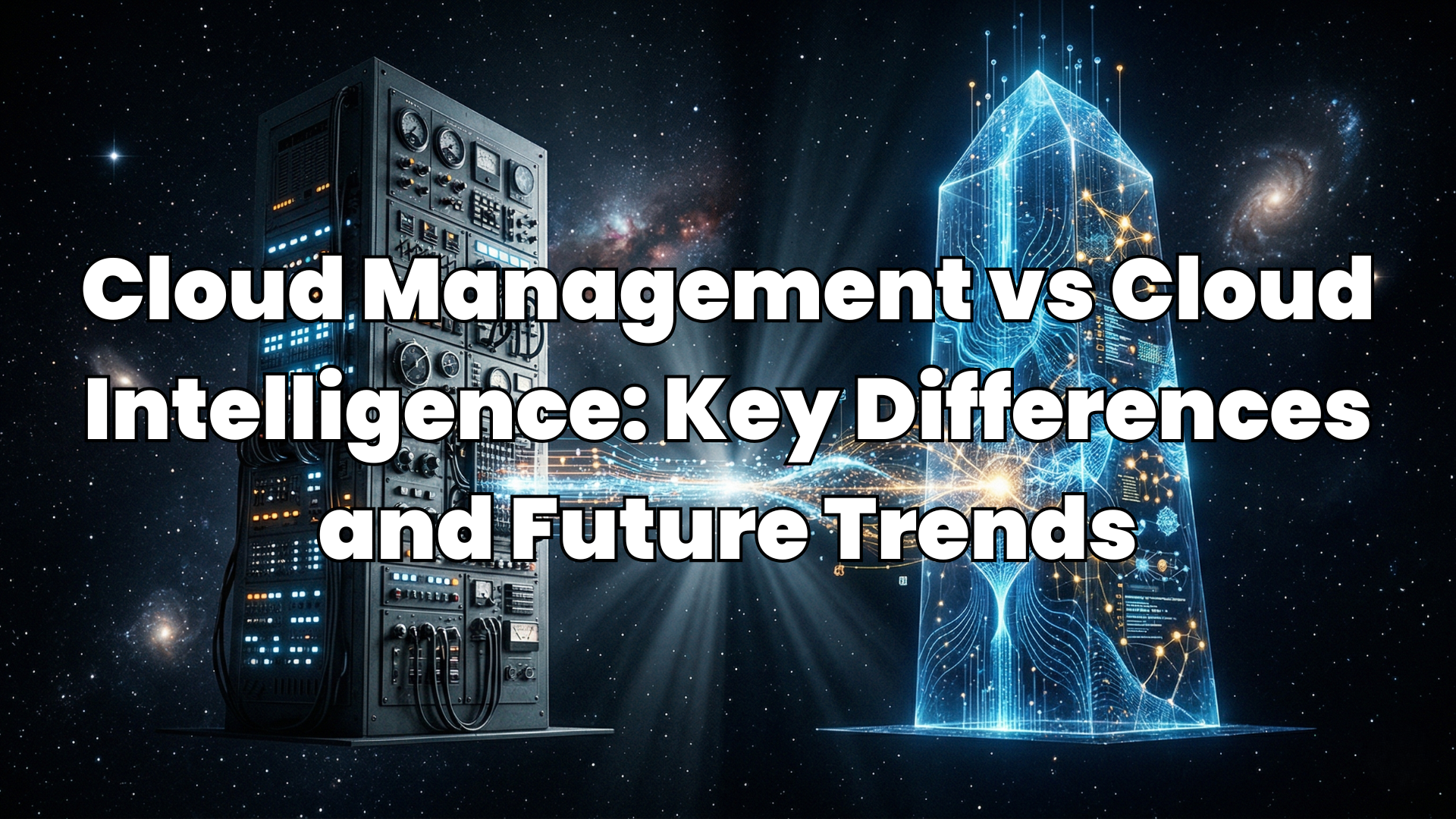
For years, organizations have focused on managing the cloud. They built dashboards to track usage, deployed tools to monitor infrastructure, and implemented processes to control costs and maintain performance. This phase was necessary. As cloud adoption grew, so did the need for visibility and control.
However, something interesting has started to happen. Despite having more tools, more data, and more dashboards than ever before, many organizations still struggle with the same problems: rising costs, inefficient resource usage, delayed decision-making, and reactive operations. This signals a deeper shift.
We are moving from an era of cloud management to an era of cloud intelligence.
While these two concepts may sound similar, they represent fundamentally different approaches to how organizations interact with cloud environments. One focuses on control and visibility. The other focuses on understanding, prediction, and action.
In this blog, we’ll explore the key differences between cloud management and cloud intelligence, why this shift is happening, and what it means for the future of cloud operations.
Understanding Cloud Management
Cloud management refers to the set of tools, processes, and practices used to monitor, control, and maintain cloud infrastructure. It is the foundation of modern cloud operations. Organizations use cloud management platforms to:
Track resource usage
Monitor system performance
Manage deployments
Control access and permissions
Analyze cost reports
At its core, cloud management is about visibility and control. It answers questions like:
What resources are running?
How much are we spending?
Is the system performing as expected?
This approach works well for maintaining stability and ensuring that systems operate within defined boundaries. However, cloud management is largely reactive. It tells you what has already happened, but it does not always explain why it happened or what should be done next.
The Limitations of Cloud Management
As cloud environments become more complex, the limitations of traditional cloud management become more apparent. One of the biggest challenges is the sheer volume of data.
Modern systems generate vast amounts of information across metrics, logs, traces, and billing reports. While management tools collect and display this data, they often leave the user's interpretation. This creates a gap.
Teams have access to information, but they lack insight.
Another limitation is the disconnect between different layers of the system. Cost data lives in one place, performance metrics in another, and application behavior somewhere else. Without a unified view, it becomes difficult to understand how these elements interact. As a result, decision-making is becoming slower and less effective. Teams spend more time analyzing data and less time acting on it.
What is Cloud Intelligence?
Cloud intelligence represents the next evolution. Instead of simply managing resources, it focuses on understanding how cloud systems behave and how they can be optimized continuously. It combines data from multiple sources and uses advanced analytics, automation, and often AI to provide contextual insights and actionable recommendations.
While cloud management answers “what is happening,” cloud intelligence answers:
Why is it happening?
What will happen next?
What should we do about it?
This shift changes the role of cloud tools from passive observers to active decision enablers.
Key Differences Between Cloud Management and Cloud Intelligence
The difference between these two approaches becomes clearer when you look at how they operate in practice. Cloud management is primarily focused on monitoring and reporting. It provides dashboards, alerts, and logs that help teams track system behavior. However, it relies heavily on human interpretation.
Cloud intelligence, on the other hand, focuses on analysis and action. It connects data across systems, identifies patterns, and highlights insights that are directly relevant to decision-making. Another key difference lies in how each approach handles complexity.
Cloud management often reflects the complexity of the system, presenting large volumes of data that users must navigate. Cloud intelligence reduces complexity by surfacing only what matters, helping teams focus on high-impact areas. Perhaps the most important difference is timing.
Cloud management is reactive. It tells you what has already happened. Cloud intelligence is proactive. It identifies trends, predicts issues, and enables teams to act before problems escalate.
Why is the Shift Happening Now?
Several factors are driving the transition from cloud management to cloud intelligence. First is the rise of distributed architecture.
Microservices, containers, and multi-cloud environments have made systems more dynamic and interconnected. Traditional management tools struggle to keep up with this level of complexity. Second is the increasing importance of cost efficiency.
As cloud spending grows, organizations can no longer rely on manual optimization. They need systems that can continuously analyze usage and identify inefficiencies in real time. Third is the demand for faster decision-making.
In competitive markets, the ability to act quickly is critical. Teams cannot afford to spend hours analyzing dashboards before making decisions. Cloud intelligence addresses all of these challenges by providing real-time, contextual insights.
The Role of AI and Automation
A major driver of cloud intelligence is the integration of AI and automation. AI enables systems to analyze large volumes of data and identify patterns that would be difficult for humans to detect. It can highlight anomalies, predict trends, and recommend optimizations.
Automation takes this a step further by enabling systems to act on these insights. For example, instead of simply alerting a team about underutilized resources, an intelligent system can recommend or even execute adjustments automatically.
This reduces manual effort and ensures that optimization is continuous rather than periodic.
From Cost Visibility to Cost Understanding
One of the most significant impacts of cloud intelligence is in the area of cost management. Traditional tools provide visibility into spending, but they often fail to explain the underlying causes. Cloud intelligence connects cost data with system behavior. It helps teams understand:
Which workloads are driving costs
How architectural decisions impact spending
Where inefficiencies exist
This deeper understanding enables more effective optimization. Instead of reacting to high bills, organizations can proactively manage costs as part of their overall strategy.
Breaking Down Silos Between Teams
Cloud intelligence also plays a critical role in improving collaboration. In many organizations, engineering, finance, and operations teams work with different data and perspectives. This can lead to misalignment and inefficiencies. By providing a unified view of cloud environments, cloud intelligence helps bridge these gaps.
Engineering teams gain visibility into cost implications, while finance teams gain insight into technical decisions. This alignment enables more informed and balanced decision-making.
Future Trends in Cloud Intelligence
As cloud intelligence continues to evolve, several trends are shaping its future. One of the most important trends is the move toward real-time optimization.
Instead of periodic reviews, systems will continuously monitor and adjust resources based on current conditions. This will make optimization an ongoing process rather than a one-time activity. Another trend is the rise of predictive operations.
By analyzing historical data and usage patterns, intelligent systems will be able to anticipate future needs and potential issues. This will enable teams to act proactively rather than reactively. We are also seeing the emergence of context-aware platforms.
These systems do not just analyze data, but they also understand the context in which that data exists. This allows them to provide more relevant and actionable insights. Finally, the integration of FinOps with engineering workflows will become more seamless.
Cost awareness will be embedded directly into development and deployment processes, making optimization a natural part of everyday work.
Bring Intelligence into Cloud Operations
As organizations move toward cloud intelligence, the need for the right tools becomes critical. This is where our intelligent cloud management platform, Atler Pilot, fits into the evolving landscape.
At Atler Pilot, we focus on transforming cloud cost visibility into actionable intelligence. By connecting infrastructure usage with spending patterns, the platform helps teams understand not just what they are spending, but why.
With real-time insights, anomaly detection, and intelligent recommendations, Atler Pilot enables organizations to move beyond reactive management and adopt a more proactive approach to cloud optimization.
This shift allows teams to make faster, more informed decisions and maintain control over both performance and cost.
Conclusion
The transition from cloud management to cloud intelligence represents a fundamental shift in how organizations operate in the cloud. Cloud management provided the foundation by delivering visibility and control. However, as systems become more complex, this is no longer enough. Organizations need tools and practices that go beyond monitoring and reporting. They need systems that provide insight, context, and action.
Cloud intelligence meets this need by transforming data into understanding and enabling proactive decision-making. As this shift continues, the organizations that succeed will be the ones that embrace intelligence as a core part of their cloud strategy. Because in the future, it will not be enough to simply manage the cloud. You will need to understand it, predict it, and continuously optimize it
All in One Place
Atler Pilot decodes your cloud spend story by bringing monitoring, automation, and intelligent insights together for faster and better cloud operations.