
The Persistence of the Unpatched Server
When a critical zero-day vulnerability (like Log4Shell or a severe Linux kernel exploit) is announced, the security team's reaction speed dictates whether the organization makes the evening news. In theory, cloud elasticity should make patching trivial. In reality, patching remains one of the most stressful, manual, and error-prone activities in enterprise IT.
Breach after breach confirms a painful truth: adversaries are not executing complex cyber-heists; they are simply scanning the internet for servers missing a patch that was released six months ago. The failure to patch is rarely due to ignorance; it is due to operational friction. Engineers fear that applying a patch will break the application, so they delay.
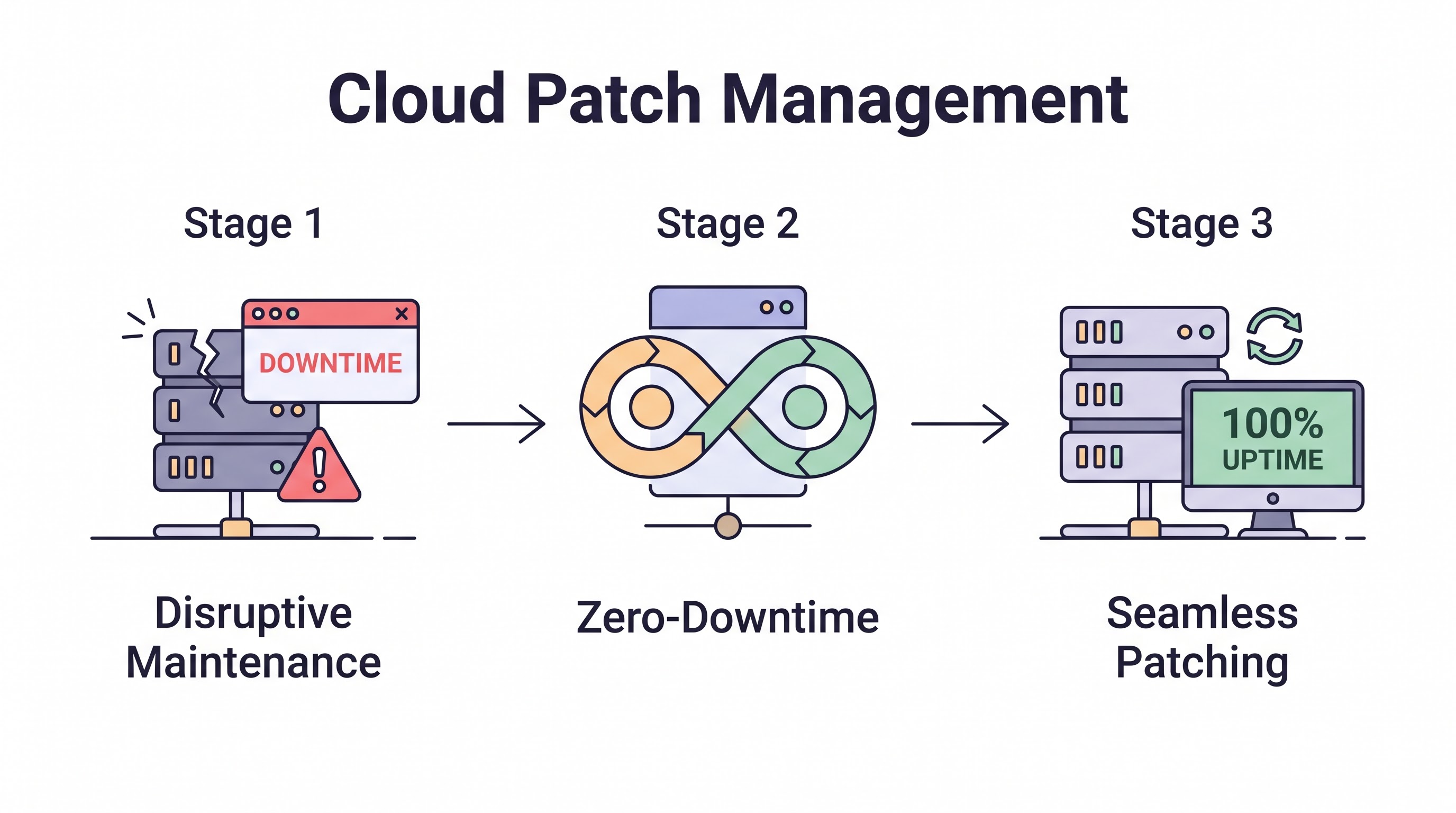
Modern cloud patch management requires removing human hesitation from the equation. This guide explores how to transition from brittle, manual patching processes to automated systems that secure your infrastructure without compromising uptime.
Why Traditional Patching Fails in the Cloud
In the on-premises era, patching involved a sysadmin logging into a server over SSH, running yum update or apt-get upgrade, and hoping the server rebooted successfully. Applying this methodology to an auto-scaling cloud environment is disastrous.
If you manually patch an EC2 instance, and then the Auto Scaling Group scales up due to traffic, the new instance will be spun up using the old, unpatched base image (AMI). Your environment is now inconsistent, and the vulnerability has returned. Cloud environments are highly dynamic; patching strategies must be built for ephemerality.
The Gold Standard: Immutable Infrastructure
The most secure, reliable way to patch cloud infrastructure is not to patch it at all. This is the concept of Immutable Infrastructure.
In an immutable paradigm, servers are never modified after they are deployed. When an OS vulnerability is discovered, you do not log in and update packages. Instead, the process is:
The CI/CD pipeline takes a fresh, fully patched base OS image provided by the cloud vendor.
The pipeline installs your application code and dependencies onto this new image, creating a new "Golden AMI" (or container image).
The deployment system (e.g., Terraform) updates the Auto Scaling Group to use the new image.
New, secure instances are spun up. Traffic is routed to them via the load balancer.
The old, vulnerable instances are terminated and destroyed.
This completely eliminates configuration drift. You are guaranteed that every running instance is identical and fully patched. If a patch breaks the application, rolling back is as simple as routing traffic back to the previous image.
Automated In-Place Patching (When You Must)
While immutable infrastructure is the goal, reality often intervenes. Stateful database servers, legacy monolithic applications, and third-party appliances often cannot be casually destroyed and rebuilt. For these workloads, automated in-place patching is required.
Never do this manually via SSH. Utilize native cloud orchestrators like AWS Systems Manager (SSM) Patch Manager or Azure Update Management.
Best Practices for Orchestrated Patching:
Define Patch Baselines: Create rules that auto-approve security patches within 3 days of release, but delay non-critical updates.
Maintenance Windows: Schedule automated patching to occur during low-traffic periods.
Phased Rollouts: Never patch the entire fleet at once. Configure the orchestrator to patch 10% of the fleet, run health checks, and proceed only if the application remains stable. This contains the "blast radius" of a bad patch.
Patching in the Container Era
Containers (Docker/Kubernetes) enforce immutability by design, but they introduce a new challenge: patching the software supply chain. A running container should never be patched via docker exec.
Container patching relies on aggressive vulnerability scanning during the build phase. When a vulnerability is found in a base image (e.g., alpine or node:latest), the remediation is to update the Dockerfile to reference a newer, patched base image, rebuild the container, and redeploy the pod to the Kubernetes cluster.
The operational burden here shifts from the infrastructure team to the developers, requiring DevSecOps integration to ensure developers are notified immediately when their container images inherit newly discovered vulnerabilities.
The Rise of Patch Intelligence
A massive enterprise generates thousands of patch notifications weekly. Determining which patches actually matter is a critical bottleneck. A vulnerability might have a CVSS score of 9.8 (Critical), but if the vulnerable component is deployed on an internal server with no internet access, it is less urgent than a 7.5 vulnerability on an internet-facing API gateway.
Advanced platforms like CloudAtler's Patch Intelligence utilize context to prioritize patching efforts. They correlate threat intelligence feeds with your specific cloud architecture to highlight "exploitable" vulnerabilities—focusing the engineering team's attention on the patches that actually prevent breaches, rather than blindly patching based on raw CVSS scores.
Integration with Vulnerability Scanning
Patch management cannot exist in a vacuum; it is the remediation arm of vulnerability management. Your environment must be continuously scanned by tools like Amazon Inspector, Tenable, or Qualys.
The workflow must be tightly coupled: The scanner detects a CVE → The vulnerability management system contextualizes the risk → The orchestrator (e.g., SSM Patch Manager) automatically schedules the remediation for the next maintenance window.
Measuring Patching Success
You cannot secure what you do not measure. Effective patch management tracks strict SLAs.
Time to Patch (TTP): How many days elapse between the release of a critical CVE and its remediation across 100% of the fleet? (Target: < 7 days for critical internet-facing vulnerabilities).
Patch Compliance Rate: What percentage of the fleet is currently running the approved patch baseline? (Target: > 95%).
Key Takeaway
Manual patching in a cloud environment is both a security risk and an operational failure. Organizations must transition to automated solutions. The gold standard is immutable infrastructure, where vulnerable servers are replaced rather than repaired. For legacy systems, leverage native orchestrators for phased, automated updates. Couple execution with Patch Intelligence to prioritize remediation based on actual environmental risk, drastically reducing the window of exposure to threat actors.
All in One Place
Atler Pilot decodes your cloud spend story by bringing monitoring, automation, and intelligent insights together for faster and better cloud operations.