
The Cost of Retrospective Security
The most expensive time to find a security flaw is after the application is deployed to production. The second most expensive time is during a penetration test right before launch. In both scenarios, fixing a fundamental architectural flaw—such as realizing an S3 bucket cannot be isolated from the internet because of how the application handles uploads—requires tearing down the infrastructure and rewriting code.
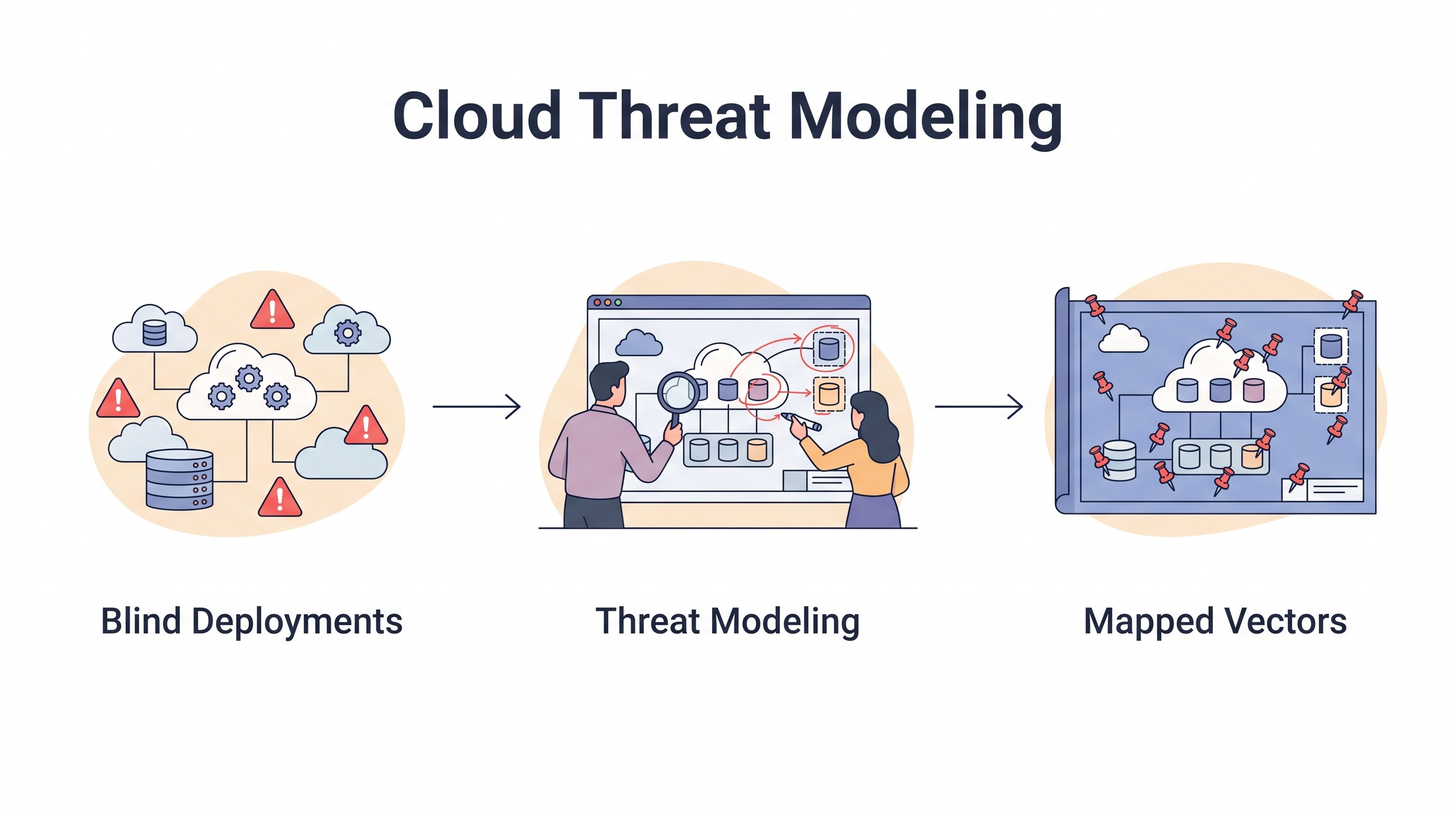
To break this cycle, security must shift to the architectural design phase. This is the purpose of Cloud Threat Modeling. It is the structured process of identifying potential security threats and architectural vulnerabilities before a single line of Infrastructure as Code (IaC) is written. By thinking like an attacker during the design phase, organizations can design systems that are inherently resilient, drastically reducing the cost and friction of security.
What is Cloud Threat Modeling?
Threat modeling is a brainstorming exercise governed by a framework. It asks four fundamental questions about an architecture:
What are we building? (Architecture diagrams, data flows).
What can go wrong? (Identifying threats).
What are we going to do about it? (Designing mitigations).
Did we do a good enough job? (Validation and review).
In the on-premises world, threat modeling focused heavily on network perimeters and physical servers. In the cloud, the focus shifts entirely to Identity and Access Management (IAM), data flow between managed services, and the trust boundaries between microservices.
Adapting STRIDE for the Cloud
The most common framework for identifying threats is STRIDE (developed by Microsoft). When applying STRIDE to the cloud, the context changes:
S - Spoofing Identity: Can an attacker assume the identity of a legitimate user or microservice? Cloud Context: Leaked AWS access keys, weak IAM roles attached to EC2 instances, or compromised JWT tokens in an API Gateway.
T - Tampering with Data: Can an attacker modify data in transit or at rest? Cloud Context: Intercepting unencrypted traffic between VPCs, or modifying data in an S3 bucket lacking KMS encryption and versioning.
R - Repudiation: Can an attacker perform an action and deny they did it? Cloud Context: A developer disabling CloudTrail logging, or an application failing to log administrative actions to a central, immutable SIEM.
I - Information Disclosure: Can an attacker access sensitive data? Cloud Context: The classic public S3 bucket, unencrypted RDS snapshots, or overly permissive cross-account IAM roles.
D - Denial of Service: Can an attacker disrupt the system? Cloud Context: "Denial of Wallet" attacks against serverless functions (triggering Lambda millions of times to exhaust budgets), or exploiting misconfigured Auto Scaling Groups.
E - Elevation of Privilege: Can an unprivileged user gain admin rights? Cloud Context: A compromised container exploiting a misconfigured Kubernetes RBAC policy, or a developer assuming an overly broad IAM role.
The 4-Step Threat Modeling Process
Step 1: Deconstruct the Architecture (Data Flow Diagrams)
You cannot secure what you don't understand. Create a Data Flow Diagram (DFD). Map out the users, the entry points (API Gateway, Load Balancers), the compute elements (Lambda, EC2, EKS), the data stores (RDS, S3), and crucially, the Trust Boundaries (e.g., the boundary between the public internet and the VPC, or the boundary between a web tier subnet and a database tier subnet).
Step 2: Threat Identification (Applying STRIDE)
Walk through every element and data flow on the diagram. For the API Gateway: Can a user spoof a token? Can they launch a DoS attack? For the DynamoDB connection: Are we encrypting the data in transit? Can the Lambda function elevate privileges to delete the table?
Step 3: Mitigation Design
For every identified threat, design a mitigation. If the threat is "Information Disclosure from S3," the mitigation is "Enforce S3 Block Public Access and enable KMS encryption via Terraform." These mitigations become the security requirements for the engineering team.
Step 4: Validation
Once the system is built, the security team verifies that the mitigations were actually implemented (e.g., using CSPM tools or penetration testing).
Example: Threat Modeling a Serverless API
Consider a simple architecture: A user uploads a profile picture to an API Gateway, which triggers a Lambda function, which saves the image to S3.
Threat (Tampering/Spoofing): An attacker uploads a malicious executable instead of a JPG, or uploads an image named
../../../etc/shadowto attempt a path traversal attack on the Lambda execution environment.Mitigation: The Lambda function must implement strict input validation, verify the MIME type of the file, and randomize the filename before saving it to S3, as detailed in the Serverless Security Guide.
Threat (Information Disclosure): The S3 bucket is accidentally made public, exposing all user profile pictures.
Mitigation: Implement a Service Control Policy (SCP) enforcing "Block Public Access" at the account level.
Integrating Threat Modeling into Agile
Traditional threat modeling took weeks. In Agile/DevOps environments, this is unacceptable. Threat modeling must be continuous and iterative.
Instead of modeling the entire application at once, threat model the specific feature being developed during the sprint planning phase. If a sprint involves adding a new payment API, spend 30 minutes applying STRIDE to just that data flow. The output (the mitigations) become security acceptance criteria (Jira tickets) for that specific sprint.
Automating Threat Modeling (Threat-Modeling-as-Code)
The industry is moving toward "Threat-Modeling-as-Code." Developers define the architecture using code (e.g., Python scripts or YAML files in tools like Threatspec or IriusRisk). The tool automatically generates the DFD, applies standard threat libraries based on the identified components (e.g., automatically flagging the risk of public exposure when an S3 bucket is defined), and outputs the required mitigations.
This approach allows threat models to live in version control alongside the application code, updating dynamically as the architecture evolves.
Key Takeaway
Cloud Threat Modeling is the ultimate "shift-left" security practice. By applying frameworks like STRIDE to architectural diagrams before code is written, teams can identify fundamental flaws in IAM, network design, and data handling. Integrating lightweight, iterative threat modeling into Agile sprints ensures that applications are designed securely from inception, drastically reducing the friction and cost of late-stage security testing.
All in One Place
Atler Pilot decodes your cloud spend story by bringing monitoring, automation, and intelligent insights together for faster and better cloud operations.