
The Flaw in the Monthly Bill
If a company's AWS bill increases from $100,000 in January to $120,000 in February, is that a failure of engineering efficiency or a massive business success? Looking solely at the invoice provides no answer. If the user base remained flat, the 20% increase indicates unchecked infrastructure bloat. However, if the business launched a wildly successful marketing campaign and doubled its active users, a 20% increase in infrastructure cost represents phenomenal scalability and efficiency.
Traditional cloud cost management focuses obsessively on the absolute dollar amount: lowering the total bill through commitments and rightsizing. While necessary, this approach is fundamentally limited. It treats cloud infrastructure as a utility cost to be minimized, rather than an engine of revenue to be optimized.
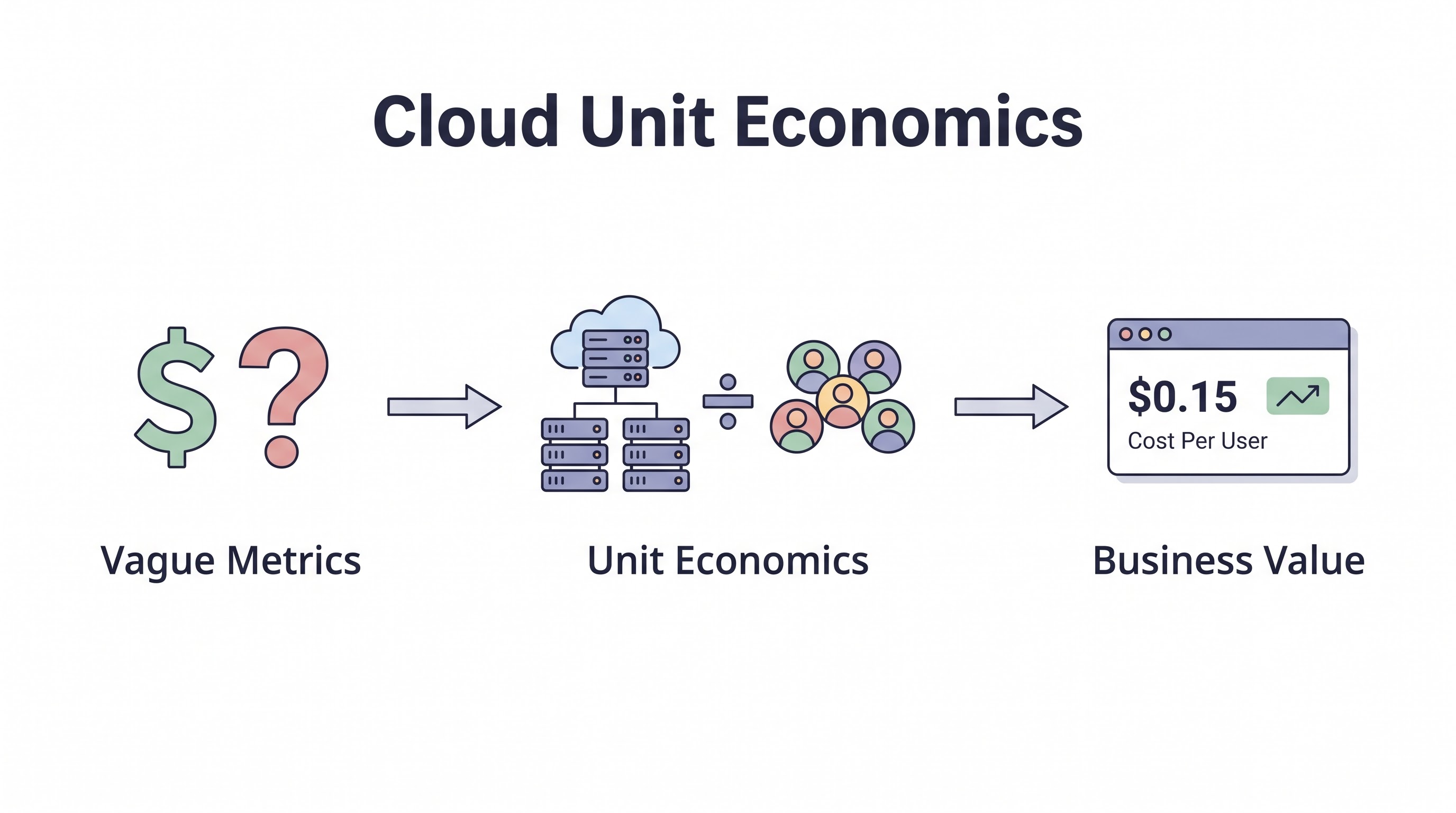
The pinnacle of FinOps maturity is the adoption of Cloud Unit Economics. By tying infrastructure spend directly to business outcomes, organizations stop asking "How much did we spend?" and start asking "How efficiently did we deliver value?"
What Are Cloud Unit Economics?
Cloud Unit Economics is the practice of measuring the cloud cost required to deliver a single, quantifiable unit of business value. It creates a ratio: the numerator is the allocated cloud cost, and the denominator is a relevant business metric.
Instead of reporting that "the database costs $50,000 a month," a team reports that "the infrastructure cost to process a single e-commerce transaction is $0.015."
This shift transforms cloud spend from a technical overhead metric into a critical business KPI. It aligns the engineering team, the finance team, and the product team around a shared understanding of profitability.
Finding the Right "Unit" for Your Business
The hardest part of unit economics is defining the denominator. The ideal unit metric must be easily measurable, directly tied to revenue (or core business value), and understandable by non-technical executives.
Examples across different industries:
B2B SaaS: Cloud cost per Monthly Active User (MAU), cost per tenant, cost per API request.
E-commerce: Cloud cost per transaction, cost per checkout, cost per page view.
Media & Streaming: Cloud cost per hour of streamed video, cost per subscriber.
AdTech: Cloud cost per million ad impressions, cost per bid processed.
Ride-Sharing: Cloud cost per completed ride.
Organizations often need multiple unit metrics. A macro-metric (Cost per Tenant) is useful for the C-suite, while micro-metrics (Cost per Search Query) are useful for specific engineering squads.
How to Calculate Your Unit Cost
Calculating accurate unit costs requires mature FinOps capabilities, specifically in cost allocation.
Step 1: Isolate the Cost Numerator
You cannot use the total monthly cloud bill as the numerator. You must isolate the specific costs associated with delivering the unit. This requires a rigorous tagging strategy. If calculating "Cost per API Request" for a specific microservice, you must use tags to isolate the EC2, DynamoDB, and data transfer costs generated only by that microservice.
Step 2: Allocate Shared Costs
Handling shared resources (like a central Kubernetes cluster or shared logging pipeline) is the primary challenge. If a logging platform costs $10,000/month and serves five applications, you must establish an allocation rule (e.g., proportional based on log volume generated) to distribute that cost to the respective applications before calculating their individual unit costs.
Step 3: Integrate Business Telemetry
The denominator data (e.g., number of transactions) rarely lives in the cloud billing console. It lives in application databases, Google Analytics, or Datadog. FinOps teams must extract this telemetry and merge it with the billing data to calculate the ratio.
Understanding Marginal Cost vs. Fixed Cost
A static unit cost is a good start, but understanding the trajectory of your unit cost is the ultimate goal. As a business scales, the unit cost should decrease due to economies of scale.
Cloud infrastructure consists of:
Fixed/Step Costs: Resources like NAT Gateways, control planes, or baseline databases that cost money regardless of whether you have 10 users or 10,000 users.
Variable/Marginal Costs: Resources that scale linearly with usage, like Lambda invocations or egress bandwidth.
When launching a new product, the unit cost will initially be astronomically high because the fixed costs are divided by a tiny number of users. As user adoption grows, the unit cost should plummet and eventually flatten out, representing the true marginal cost of serving one additional user. If the unit cost remains flat or increases as the business scales, the architecture is fundamentally inefficient and requires refactoring.
Driving Engineering Behavior with Unit Metrics
Engineers are natural optimizers, but they optimize for the metrics they are given. If told to "cut costs," they will begrudgingly turn off idle development servers. If given a unit metric target—"Reduce the cost per search query by 15%"—they treat it as an architectural challenge.
Unit economics enables decentralized decision-making. When a product manager requests a new feature, the engineering team can estimate its impact on the unit cost. If adding a real-time recommendation engine increases the "Cost per Checkout" from $0.05 to $0.08, the business can make an informed decision: Does this new feature increase our conversion rate enough to justify a 60% increase in our infrastructure cost per transaction?
Changing the Executive Conversation
Unit economics bridges the communication gap between engineering and finance.
When presenting to the board, a FinOps leader armed with unit economics doesn't apologize for a rising cloud bill. They present a chart showing that while total cloud spend increased by $500,000, the cost per subscriber decreased by 8%, significantly improving the company's gross margins. This narrative transforms the cloud from a runaway expense into a predictable, highly leveraged asset.
This is the essence of proving FinOps ROI.
Automating Unit Metric Tracking
Manually exporting AWS CUR data, pulling transaction counts from a database, and mashing them together in Excel is unsustainable. Mature organizations leverage platforms that automate this integration.
A FinOps platform like CloudAtler can ingest business telemetry (via API) alongside multi-cloud billing data. It automatically applies shared cost allocation rules and generates real-time dashboards showing the trendline of your specific unit metrics, alerting teams instantly if an architectural deployment causes a spike in the marginal cost of a transaction.
Key Takeaway
Stop managing the total cloud bill and start managing Cloud Unit Economics. Define a business metric that represents value (e.g., cost per transaction). Enforce strict tagging to isolate costs, allocate shared resources proportionally, and track the trajectory of your unit cost as you scale. This practice transforms cloud spend from a technical liability into a measurable driver of business profitability.
All in One Place
Atler Pilot decodes your cloud spend story by bringing monitoring, automation, and intelligent insights together for faster and better cloud operations.