
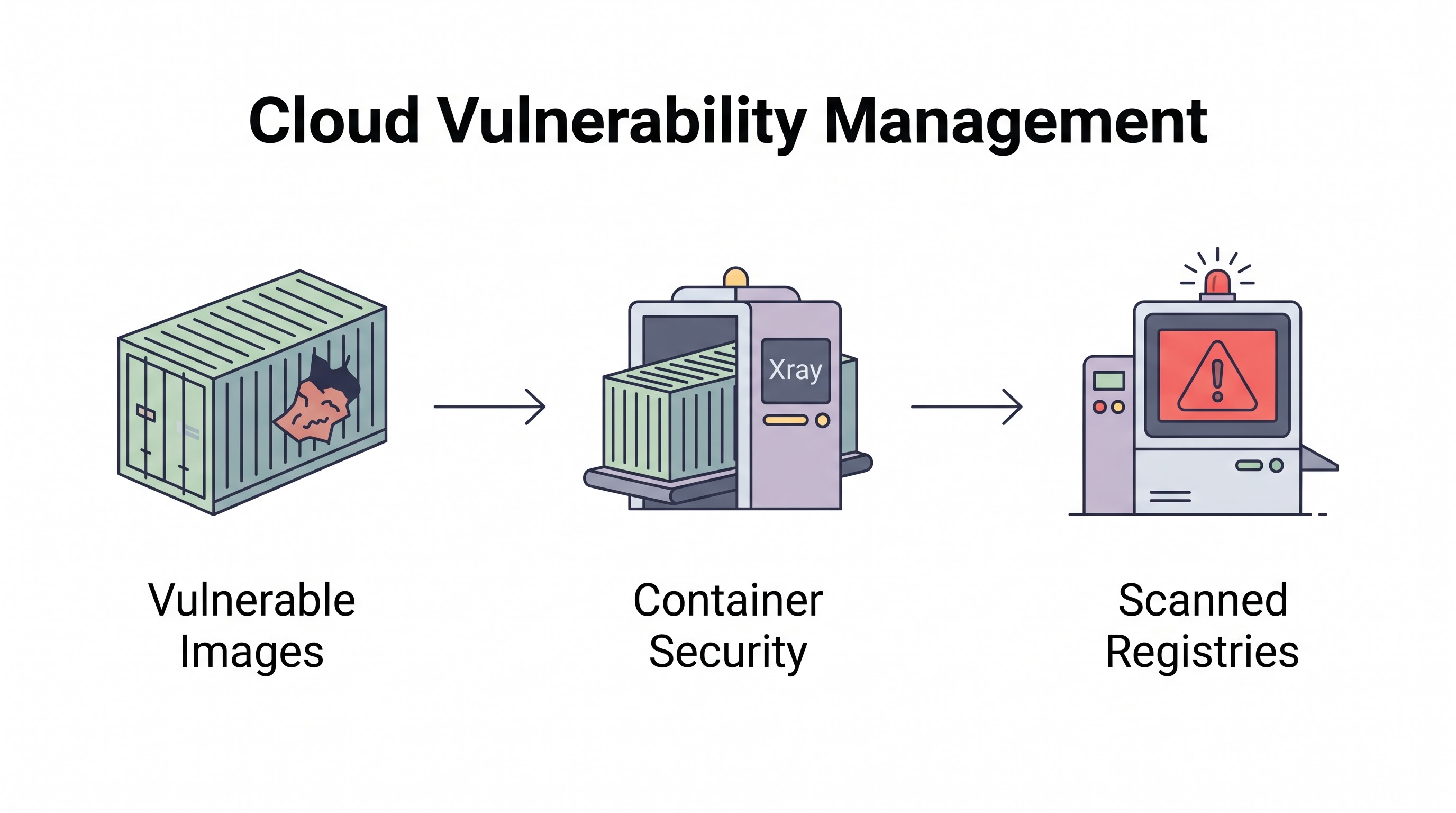
Understanding Cloud Vulnerability Management
Cloud vulnerability management represents a fundamental departure from traditional on-premises security patching. In a legacy datacenter, IT teams maintained a static inventory of servers, scanned them weekly or monthly, and deployed patches during scheduled weekend maintenance windows. The cloud destroys this paradigm completely.
When infrastructure is codified and ephemeral, a server might exist for only three hours to process a batch job before terminating. Scanning that server on a Tuesday when it ran on a Sunday is impossible. Furthermore, cloud vulnerabilities are not limited to operating system flaws or outdated Apache struts libraries. They extend into the control plane itself—an overly permissive IAM role, a publicly accessible S3 bucket, or a misconfigured Security Group are all critical vulnerabilities that traditional network scanners will completely ignore.
Modern cloud vulnerability management requires continuous visibility across three distinct layers: the infrastructure layer (virtual machines, containers), the platform layer (managed databases, serverless functions), and the control plane layer (identity, networking, configuration). Without unified visibility across all three, security teams are operating with massive, exploitable blind spots.
The core challenge organizations face in 2026 is no longer discovering vulnerabilities; the challenge is prioritization. A standard enterprise cloud environment might generate tens of thousands of vulnerability alerts daily. Attempting to remediate all of them is a mathematical impossibility that inevitably leads to alert fatigue and engineering burnout. Effective vulnerability management hinges on contextualizing these alerts—understanding which vulnerable package is actually loaded into memory, running on an internet-facing workload, and attached to an identity with data access permissions.
CSPM vs CWPP vs CNAPP: The Acronym Soup
To effectively manage vulnerabilities, security teams must deploy the right tooling. The industry has converged on several key acronyms that define cloud security capabilities.
Cloud Security Posture Management (CSPM) focuses on the control plane. It evaluates your cloud environment against compliance frameworks (like CIS benchmarks, SOC2, or HIPAA) and identifies misconfigurations. CSPM will tell you if an S3 bucket is public, if encryption is disabled on an EBS volume, or if MFA is missing for root accounts. It does not look inside the virtual machines.
Cloud Workload Protection Platforms (CWPP) focus on the runtime environment. They evaluate the operating systems, containers, and applications running on top of the cloud infrastructure. CWPP will tell you if your EC2 instance is running an outdated version of OpenSSL susceptible to a known CVE, or if a container is executing a suspicious binary.
Cloud-Native Application Protection Platforms (CNAPP) represent the convergence of CSPM, CWPP, and CI/CD security into a unified platform. In 2026, standalone CSPM or CWPP tools are largely considered legacy approaches. A true CNAPP correlates data across domains. For example, it doesn't just flag a high-severity CVE (CWPP capability); it correlates that CVE with an open Security Group port 443 (CSPM capability) to elevate the priority of the alert, proving that the vulnerability is actually exploitable from the internet.
Implementing a CNAPP strategy reduces the "security tax" on engineering teams by consolidating agents and providing a single source of truth for vulnerability prioritization. However, purchasing a CNAPP does not automatically solve vulnerability management—the tool must be integrated deeply into developer workflows to be effective.
Why Standard CVSS Scores Fail in the Cloud
The Common Vulnerability Scoring System (CVSS) has been the industry standard for rating the severity of software vulnerabilities for decades. A score of 9.8 out of 10 indicates a critical, network-exploitable flaw that requires immediate patching. However, applying raw CVSS scores directly to cloud environments often results in massive resource misallocation.
Consider a CVSS 9.8 Remote Code Execution (RCE) vulnerability found in a specific Python library. In a traditional environment, this is an all-hands-on-deck emergency. But what if this library is deployed within an AWS Lambda function that has no internet ingress, is triggered only by internal SQS messages, runs for maximum of 3 seconds, and has an IAM role that only permits writing to a single, tightly controlled DynamoDB table?
In that specific context, the actual risk approaches zero. The vulnerability cannot be reached by attackers, and even if it could, the blast radius is severely constrained by IAM boundaries and ephemeral execution. Forcing an engineering team to drop feature work to patch this "Critical" vulnerability degrades business velocity without meaningfully improving security.
Modern cloud vulnerability management platforms calculate an Environmental Risk Score. This takes the base CVSS and modifies it heavily based on cloud context:
Reachability: Is there a network path from the internet to the vulnerable resource?
Execution Context: Is the vulnerable package actually loaded into memory and utilized by the application, or is it dormant on the disk?
Blast Radius: What permissions does the underlying compute resource hold? Can it assume roles to escalate privileges?
Data Sensitivity: Does the resource have access to PII, PCI, or proprietary source code?
By filtering vulnerabilities through this contextual lens, organizations typically reduce their "Critical" alert volume by 80% to 90%, allowing security teams to focus on the flaws that actually represent existential threats to the business.
Shifting Left: Infrastructure as Code Security
Attempting to fix vulnerabilities after they are deployed into production is the most expensive and risky approach to cloud security. The concept of "shifting left" means moving vulnerability identification to the earliest possible point in the software development lifecycle (SDLC).
In cloud environments, this primarily involves scanning Infrastructure as Code (IaC). Terraform, AWS CloudFormation, and Pulumi define exactly how infrastructure will be provisioned. By scanning these templates in the CI/CD pipeline or directly in the developer's IDE, organizations can prevent misconfigurations from ever reaching the cloud.
A comprehensive Shift Left strategy includes several gates:
IDE Scanning: Plugins that provide developers with real-time feedback as they write Terraform, highlighting overly permissive IAM policies or missing encryption flags.
Pre-Commit Hooks: Automated checks that run locally before code can be committed to the repository, blocking blatant security violations.
CI/CD Pipeline Scanning: Mandatory automated security scans executed during the build process. If critical vulnerabilities or misconfigurations are detected, the build fails.
Container Registry Scanning: Scanning Docker images for vulnerable packages immediately after they are built, before they are tagged for deployment.
The psychological benefit of shifting left is immense. When a security tool blocks a deployment and provides exactly the line of code that needs fixing, developers perceive it as a helpful guardrail. When a security team opens a Jira ticket three weeks after deployment demanding a configuration change, developers perceive it as friction and bureaucracy.
Automated Patching Strategies at Scale
Even with perfect IaC scanning, zero-day vulnerabilities will emerge in production systems. When a critical flaw like Log4Shell or a major kernel vulnerability drops, organizations must be able to remediate across thousands of cloud instances rapidly.
Manual patching is not a strategy; it is a liability. Cloud environments require automated remediation. The approach depends heavily on the compute architecture:
Immutable Infrastructure
In mature cloud-native environments, infrastructure is immutable. Servers are never patched in place. When a vulnerability is discovered, the base image (AMI or Docker image) is updated with the patch, a new build is triggered, and the old instances are systematically replaced by the new, secure instances via rolling deployments.
This approach eliminates configuration drift and ensures that the production environment exactly matches the defined infrastructure as code. It requires highly automated CI/CD pipelines and stateless application architectures, but it provides the most robust and predictable patching mechanism.
Mutable Infrastructure Patching
For organizations still migrating legacy workloads to the cloud, immutable infrastructure may not yet be feasible. In these scenarios, automated patch management tools must be deployed. Native cloud tools like AWS Systems Manager Patch Manager or Azure Update Management allow administrators to define patch baselines, schedule maintenance windows, and automatically apply critical OS and application patches across fleets of VMs without manual intervention.
The key to success with mutable patching is automated testing. Patches must be automatically deployed to staging environments, subjected to integration tests, and only promoted to production if no regressions are detected.
Zero Trust Vulnerability Management
Zero Trust is often discussed in the context of networking and identity, but it is deeply relevant to vulnerability management. A core tenet of Zero Trust is "Assume Breach." The architecture must be designed with the assumption that a vulnerability will eventually be exploited.
If an attacker successfully exploits a vulnerable web application, what happens next? In a flat, implicitly trusted network, the attacker can move laterally, access databases, and exfiltrate data. In a Zero Trust architecture, the blast radius is severely constrained.
Vulnerability management in a Zero Trust environment focuses heavily on Micro-segmentation and Least Privilege IAM. Even if a critical vulnerability exists on an EC2 instance, if that instance's Security Group only permits outbound traffic to a specific API endpoint, and its IAM role only permits reading from a specific SQS queue, the attacker's ability to pivot and cause damage is drastically reduced.
Security teams must prioritize remediating vulnerabilities on resources that violate Zero Trust principles—resources with broad network access, administrative IAM privileges, or direct access to sensitive datastores. A vulnerability on an isolated, tightly scoped resource is inherently lower risk.
Measuring Vulnerability Management Success
You cannot improve what you cannot measure. Traditional security metrics like "Total Vulnerabilities Found" or "Number of Patches Applied" are vanity metrics that do not reflect actual security posture. Modern cloud security teams track operational metrics that demonstrate velocity and risk reduction:
Mean Time to Remediation (MTTR): The average time it takes to patch or mitigate a vulnerability after it is discovered. This should be tracked separately for Critical, High, and Medium severity flaws.
SLA Adherence Rate: The percentage of vulnerabilities remediated within the organization's defined Service Level Agreements (e.g., 95% of Criticals patched within 48 hours).
Scan Coverage: The percentage of cloud compute resources actively monitored by vulnerability scanning tools. A low number here indicates dangerous blind spots.
False Positive Rate: The percentage of vulnerability alerts that are dismissed as not applicable or acceptable risk. A high false positive rate indicates poorly tuned tooling and leads directly to alert fatigue.
Developer Fix Rate: The percentage of vulnerabilities identified in the CI/CD pipeline (Shift Left) that are fixed by developers before reaching production.
Future Trends in Cloud Security
As we look toward the remainder of 2026 and beyond, several trends are reshaping vulnerability management:
AI-Assisted Remediation: LLMs are being integrated into CNAPP platforms not just to explain vulnerabilities, but to generate the exact Terraform or Pulumi code required to fix them. Developers can review and merge the AI-generated pull requests, drastically reducing remediation time.
eBPF-Based Security: Extended Berkeley Packet Filter (eBPF) technology allows security tools to monitor kernel-level activity without requiring heavy, invasive agents. This provides unprecedented visibility into runtime vulnerabilities and malicious behavior with near-zero performance overhead, making it the standard for Kubernetes and container security.
Supply Chain Security Consolidation: Following high-profile software supply chain attacks, vulnerability management is expanding to include deep analysis of third-party dependencies, open-source libraries, and the CI/CD pipeline infrastructure itself. Software Bill of Materials (SBOM) generation and continuous verification are becoming mandatory compliance requirements.
Key Takeaway
Cloud vulnerability management is no longer a localized IT operation; it is a continuous, context-driven discipline that bridges security, operations, and development. By abandoning raw CVSS scores in favor of environmental risk context, shifting security checks into the CI/CD pipeline, and embracing automated remediation, organizations can drastically reduce their attack surface without slowing down business velocity.
All in One Place
Atler Pilot decodes your cloud spend story by bringing monitoring, automation, and intelligent insights together for faster and better cloud operations.