
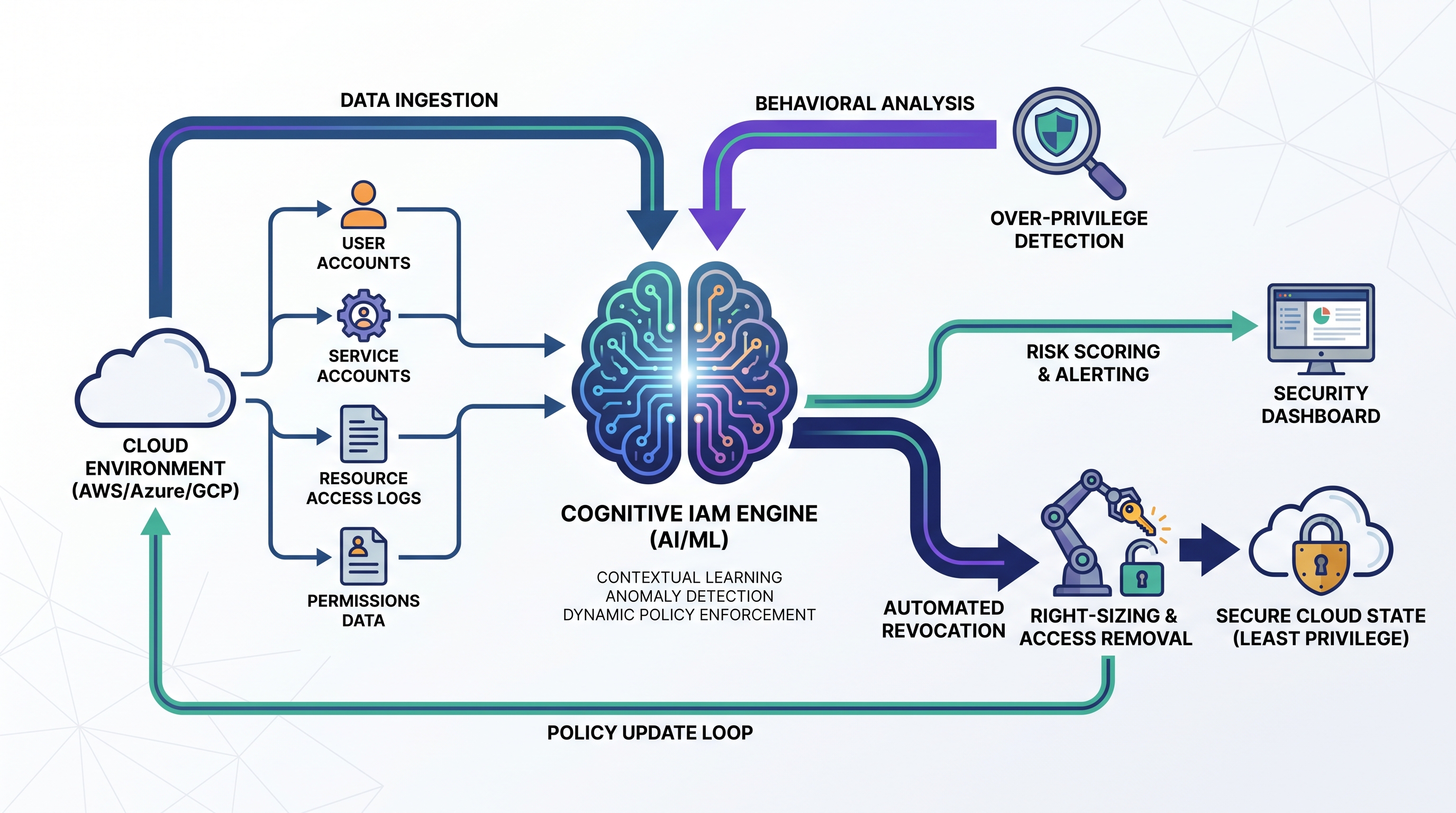
The Crisis of Static IAM in Multi-Cloud Environments
In modern enterprise cloud architectures, Identity and Access Management (IAM) has evolved from a basic administration boundary into the primary security perimeter. However, the rapid expansion of cloud-native infrastructure—characterized by thousands of microservices, serverless execution environments, CI/CD pipelines, and ephemeral resources—has rendered traditional, static Role-Based Access Control (RBAC) obsolete. The core issue lies in the operational friction of defining precise permissions: security teams, under pressure to accelerate deployment cycles, frequently grant overly broad permissions (such as wildcard * admin policies) to developers and machine identities to avoid deployment roadblocks.
This practice creates a massive, silent vulnerability known as the Privilege Gap—the delta between the permissions an identity is granted and the permissions it actually executes to perform its function. According to industry telemetry, over 95% of cloud identities utilize less than 5% of their granted permissions. This leaves a vast surface area of unused, high-privilege access open to exploitation. If an attacker compromises a developer's credential or exploits a vulnerability in a public-facing service account, they instantly inherit these dormant, over-privileged permissions, enabling rapid lateral movement, data exfiltration, and resource hijacking.
Managing this risk manually at enterprise scale is mathematically impossible. Cloud environments generate billions of API access events daily across heterogeneous platforms (AWS, Azure, GCP, and Oracle). Traditional Cloud Infrastructure Entitlement Management (CIEM) tools flag these violations but leave the remediation to manual intervention, resulting in alert fatigue and delayed response times. To solve this crisis, enterprises must shift from static, reactive access control to Cognitive IAM—an automated, self-healing framework powered by machine learning that continuously monitors identity behavior, calculates risk in real-time, and dynamically rightsizes permissions. Implementing such automated frameworks is a core pillar of modern cloud security management, allowing organizations to bridge the gap between agility and robust defense.
What is Cognitive IAM?
Cognitive IAM is an advanced identity governance paradigm that replaces static security policies with a dynamic, closed-loop system driven by artificial intelligence. Instead of relying on human administrators to define and review access policies, Cognitive IAM treats identity access as a fluid, state-based variable. It continuously ingests system telemetry, models the behavioral baseline of every human and machine identity, detects anomalies, and automatically updates access configurations in real-time.
This approach relies on three fundamental operational phases:
Continuous Observation: Real-time ingestion and normalization of multi-cloud audit logs, API call histories, network flow logs, and identity provider context.
Cognitive Synthesis: Leveraging machine learning models (such as clustering, isolation forests, and sequence-to-sequence models) to analyze historical usage patterns, distinguish normal operations from anomalies, and map out the exact permissions required for an identity to function. This level of intelligence is precisely what the Atler AI engine delivers by analyzing complex system behaviors across cloud boundaries.
Autonomous Remediation: Automatically generating and deploying rightsized, least-privilege Infrastructure-as-Code (IaC) policies to replace over-privileged configurations, coupled with rollback mechanisms to prevent operational disruptions.
Architectural Blueprint for Cognitive IAM
Implementing a Cognitive IAM framework requires a highly scalable, decoupled architecture capable of processing massive streams of semi-structured log data, running machine learning inference, and executing policy changes via secure APIs. Below is the technical blueprint of a multi-cloud Cognitive IAM pipeline:
+---------------------------------------------------------------------------------+
|                               TELEMETRY INGESTION                               |
|  [AWS CloudTrail]      [Azure Activity Logs]     [GCP Cloud Logging]           |
+------------------------------------+--------------------------------------------+
                                     |
                                     v (Streaming via Kafka / Kinesis)
+---------------------------------------------------------------------------------+
|                            DATA NORMALIZATION & STORAGE                         |
|  - Schema Mapping (Actor, Action, Resource, Context)                            |
|  - Hot Storage (Elasticsearch/ClickHouse) & Cold Storage (S3/GCS)               |
+------------------------------------+--------------------------------------------+
                                     |
                                     v
+---------------------------------------------------------------------------------+
|                           COGNITIVE ANALYSIS ENGINE                             |
|  - Behavioral Baselining (Markov Chains / LSTM)                                 |
|  - Privilege Gap Calculation Engine                                             |
|  - Anomaly Detection (Isolation Forest)                                         |
+------------------------------------+--------------------------------------------+
                                     |
                                     v (Policy Synthesis)
+---------------------------------------------------------------------------------+
|                          AUTONOMOUS REMEDIATION PIPELINE                        |
|  - Dynamic Policy Generator (JSON/YAML)                                         |
|  - Policy Validation Engine (Dry-Run / Shadow Mode)                             |
|  - Orchestrated Deployment (Terraform / Cloud APIs)                             |
+---------------------------------------------------------------------------------+
1. Telemetry Ingestion and Normalization
The foundation of Cognitive IAM is telemetry. The system must ingest audit logs from all cloud providers in real-time. This includes AWS CloudTrail, Azure Activity Logs, GCP Cloud Audit Logs, and OCI Audit Logs. Because each cloud provider formats its event logs differently, the ingestion pipeline must normalize these logs into a unified schema containing the following key fields:
Principal ID: The unique identifier of the identity (IAM User, Role, Service Account, or Federated Identity).
Action: The specific API call executed (e.g.,
s3:GetObject,Microsoft.Compute/virtualMachines/write).Resource: The Amazon Resource Name (ARN) or fully qualified resource ID targeted by the action.
Contextual Metadata: IP address, geographic location, user-agent, authentication mechanism (MFA vs. API key), and timestamp.
2. State and Entitlement Extraction
Simultaneously, the system must pull the "desired state" of entitlements. This involves querying the cloud providers' IAM APIs to map out the current active permissions assigned to each principal. This includes direct policy attachments, group memberships, inherited roles, and resource-based policies (such as S3 Bucket Policies or Key Vault Access Policies). By comparing the granted entitlements with the utilized actions extracted from the telemetry stream, the system constructs a real-time matrix of the privilege gap.
The Mathematics of Privilege Gap Analysis
To automate policy rightsizing, the system must mathematically define and quantify the privilege gap. We can model this using set theory and vector spaces. Let $G_i$ represent the set of all granted permissions for a specific cloud identity $i$:
Gi = { p1, p2, ..., pn }
Let $U_i(t)$ represent the set of unique permissions actually utilized by identity $i$ over an observation window $t$ (typically 30, 90, or 180 days):
Ui(t) = { p | p ∈ Gi and p was successfully executed at least once during time window t }
The Privilege Gap Coefficient (PGC) for identity $i$ can be expressed as:
PGCi = 1 - (|Ui(t)| / |Gi|)
A $PGC_i$ value of 0 indicates that the identity is perfectly rightsized (all granted permissions are utilized). A $PGC_i$ value approaching 1 indicates an extremely over-privileged identity that poses a severe security risk. For example, if a machine identity is granted 500 permissions via an administrative role but only executes 5 unique API actions over 90 days, its $PGC$ is $1 - (5 / 500) = 0.99$. This indicates that 99% of its access surface is dormant and should be pruned.
Role Mining and Clustering
To prevent policy fragmentation (where every single identity has a unique, custom-tailored policy that becomes unmanageable), Cognitive IAM uses clustering algorithms to perform automated Role Mining. By applying algorithms like K-Means or Density-Based Spatial Clustering of Applications with Noise (DBSCAN) to the utilization vectors of various identities, the system groups similar identities together.
For instance, if thirty different developer accounts exhibit a Jaccard similarity coefficient of over 0.90 in their API usage patterns, the system clusters them and defines a single, optimized "Developer Role" that matches their collective utilization profile, rather than maintaining thirty separate policies.
Code Implementation: Detecting and Rightsizing AWS IAM Policies with Python
To illustrate how a Cognitive IAM system processes log telemetry and generates rightsized policies, let us look at a functional Python implementation. This script parses normalized CloudTrail events, compares them against an existing over-privileged IAM policy, identifies unused permissions, and outputs a refined, least-privilege JSON policy document.
import json
from datetime import datetime, timedelta

# Mock Database of CloudTrail Events parsed over a 90-day window
MOCK_CLOUDTRAIL_EVENTS = [
    {"principal": "arn:aws:iam::123456789012:role/AppServerRole", "action": "s3:GetObject", "resource": "arn:aws:s3:::production-assets/*"},
    {"principal": "arn:aws:iam::123456789012:role/AppServerRole", "action": "s3:PutObject", "resource": "arn:aws:s3:::production-assets/*"},
    {"principal": "arn:aws:iam::123456789012:role/AppServerRole", "action": "dynamodb:GetItem", "resource": "arn:aws:dynamodb:us-east-1:123456789012:table/Orders"},
    {"principal": "arn:aws:iam::123456789012:role/AppServerRole", "action": "dynamodb:PutItem", "resource": "arn:aws:dynamodb:us-east-1:123456789012:table/Orders"}
]

# Current Over-Privileged IAM Policy assigned to the Role
CURRENT_IAM_POLICY = {
    "Version": "2012-10-17",
    "Statement": [
        {
            "Sid": "AllowAllS3Operations",
            "Effect": "Allow",
            "Action": "s3:*",
            "Resource": "*"
        },
        {
            "Sid": "AllowAllDynamoDBOperations",
            "Effect": "Allow",
            "Action": "dynamodb:*",
            "Resource": "*"
        },
        {
            "Sid": "UnusedAdminPrivileges",
            "Effect": "Allow",
            "Action": [
                "iam:CreateUser",
                "iam:AttachUserPolicy",
                "ec2:TerminateInstances"
            ],
            "Resource": "*"
        }
    ]
}

def analyze_privilege_gap(events, current_policy, principal_arn):
    # Extract unique actions utilized by the target principal from logs
    utilized_actions = set()
    utilized_resources = set()

    for event in events:
        if event["principal"] == principal_arn:
            utilized_actions.add(event["action"])
            utilized_resources.add(event["resource"])

    print(f"[INFO] Analyzed Logs for {principal_arn}")
    print(f"[INFO] Utilized Actions: {utilized_actions}")

    # Generate a rightsized policy based strictly on utilized actions and resources
    rightsized_statements = []

    # Group utilized actions by service for cleaner policy generation
    services_map = {}
    for action in utilized_actions:
        service, method = action.split(":")
        if service not in services_map:
            services_map[service] = []
        services_map[service].append(action)

    for index, (service, actions) in enumerate(services_map.items()):
        # Map resources targeted by this service
        target_resources = [res for res in utilized_resources if res.startswith(f"arn:aws:{service}") or f":{service}:" in res or service == "s3"]
        if not target_resources:
            target_resources = ["*"]

        statement = {
            "Sid": f"CognitiveAutoGenerated{service.capitalize()}{index}",
            "Effect": "Allow",
            "Action": sorted(list(actions)),
            "Resource": target_resources
        }
        rightsized_statements.append(statement)

    rightsized_policy = {
        "Version": "2012-10-17",
        "Statement": rightsized_statements
    }

    return rightsized_policy

# Execute the rightsizing analysis
target_role = "arn:aws:iam::123456789012:role/AppServerRole"
new_policy = analyze_privilege_gap(MOCK_CLOUDTRAIL_EVENTS, CURRENT_IAM_POLICY, target_role)

print("\n--- RIGHTSIGHTED COGNITIVE IAM POLICY ---")
print(json.dumps(new_policy, indent=4))
Explanation of Code Output
The Python implementation reads the CloudTrail log stream and identifies that the AppServerRole has only executed four distinct API calls: two S3 actions (GetObject and PutObject) and two DynamoDB actions (GetItem and PutItem). The original policy granted wildcard admin access to S3 and DynamoDB, as well as highly sensitive IAM user creation and EC2 termination privileges which were never used.
The Cognitive IAM engine automatically discards the unused IAM and EC2 privileges, strips away the wildcard permissions, and constructs a highly targeted, least-privilege policy restricting the identity to only the exact actions and resources it has historically utilized. This closes the Privilege Gap completely, reducing the identity's blast radius to zero for unneeded services.
Multi-Cloud Considerations and Silo Elimination
One of the greatest challenges in implementing Cognitive IAM is the structural difference in how cloud providers handle identities and permissions. A unified, enterprise-grade cognitive security posture cannot exist in a vacuum; it must operate seamlessly across multiple cloud ecosystems:
Amazon Web Services (AWS): Uses a policy-centric model based on IAM Policies, Roles, and Service Control Policies (SCPs). AWS IAM Access Analyzer provides basic tracking of unused access, but lacks native, cross-account automated remediation capabilities.
Microsoft Azure: Relies on Role-Based Access Control (RBAC) mapped to Azure Active Directory (Microsoft Entra ID) security principals. Azure's Privileged Identity Management (PIM) allows for just-in-time access, but requires manual configuration of eligibility windows and lacks self-learning, behavior-based rightsizing engines.
Google Cloud Platform (GCP): Utilizes a binding-centric model where IAM policies bind members to specific roles on resources. GCP's IAM Recommender provides machine-learning-based suggestions to reduce permissions, but implementing these recommendations automatically across thousands of projects requires custom, complex orchestration pipelines.
Operating separate, native security tools for each cloud provider creates fragmented visibility, operational overhead, and inconsistent policy enforcement. To solve this, enterprises must adopt unified platforms that abstract these differences into a single control plane. Organizations looking to secure their multi-cloud footprint should leverage comprehensive CISO security solutions that consolidate telemetry from all providers, run unified machine learning models, and present a single, actionable pane of glass. This cross-cloud visibility is best realized through an enterprise-grade unified dashboard, which allows security and operations teams to monitor and remediate privilege gaps in real-time across AWS, Azure, GCP, and Oracle environments simultaneously.
FinOps & Security Convergence: The Financial Impact of Over-Privileged Accounts
While IAM is traditionally viewed as a security domain, over-privileged accounts have a direct, massive impact on Cloud Financial Operations (FinOps). The convergence of security and FinOps is a critical area of optimization for modern enterprises. Unchecked, over-privileged accounts frequently lead to unexpected, runaway cloud spend due to several distinct vectors:
1. Cryptojacking and Rogue Resource Provisioning
When an attacker compromises an over-privileged developer credential or service account that possesses permissions to provision compute resources (e.g., ec2:RunInstances in AWS or compute.instances.insert in GCP), they rarely limit their activities to data theft. In the vast majority of cases, attackers immediately spin up high-performance, GPU-enabled instances or Kubernetes clusters to mine cryptocurrency. These "cryptojacking" campaigns can rack up tens of thousands of dollars in compute costs within a matter of hours before security teams even detect the intrusion.
2. Shadow IT and Orphaned Resources
Developers granted broad administrative permissions frequently spin up experimental environments, large database clusters, or high-capacity storage volumes for temporary testing. Because they have the permissions to do so without oversight, these resources are often forgotten and left running indefinitely. A Cognitive IAM system, by automatically revoking unused provisioning privileges, prevents engineers from spinning up unapproved, non-compliant infrastructure, enforcing financial discipline at the API level.
3. Data Exfiltration Surcharges
Over-privileged service accounts that have unrestricted access to massive data repositories (such as S3 buckets or BigQuery datasets) can be leveraged by malicious actors to exfiltrate terabytes of data. Beyond the catastrophic compliance and reputational costs, the raw data egress fees charged by cloud providers for moving massive datasets out of the cloud network can result in immediate, devastating financial shocks.
By enforcing strict, automated guardrails on provisioning and data access, Cognitive IAM acts as an automated cost-containment mechanism. Restricting identities to only the specific resources they need to run production workloads eliminates the financial risk of accidental or malicious over-provisioning.
Operationalizing Autonomous Remediation Without Breaking Production
The primary barrier to adopting automated IAM remediation is the fear of breaking production applications. If an AI model automatically revokes a permission that a critical application server only utilizes once a year (for instance, during an annual disaster recovery drill or a quarterly billing consolidation process), the application will fail, resulting in costly downtime.
To safely operationalize Cognitive IAM, organizations must implement a multi-tiered safety framework that incorporates intelligent guardrails and progressive automation levels:
1. Multi-Tiered Lookback Windows
Rather than applying a uniform 30-day analysis window to all identities, the system should categorize accounts based on risk and operational frequency. Critical system infrastructure components should have a 180-day or 365-day observation window to capture semi-annual and annual administrative tasks, while ephemeral developer sandboxes can operate on a tight 14-day window.
2. Shadow (Dry-Run) Mode
Before a newly synthesized, rightsized policy is pushed to production, the Cognitive IAM engine should run the policy in "Shadow Mode". In this state, the system does not actually modify the active IAM policy. Instead, it continues to monitor the principal's API calls. If the principal executes an action that would have been blocked by the proposed rightsized policy, the system flags a "false positive" anomaly, aborts the deployment, and updates its learning model to include the newly observed action.
3. Automated Rollback Mechanisms
If an automated policy change does result in an unexpected application error, the remediation engine must support instant, single-click or automated rollbacks. The system should maintain a versioned history of all IAM configurations (ideally backed by GitOps workflows). If an application triggers a series of AccessDenied exceptions immediately following an automated policy update, the system must detect this and immediately revert to the previous known-good state within seconds, preventing prolonged outages.
Conclusion
The transition from static, manually managed IAM policies to a dynamic, machine-learning-driven Cognitive IAM framework is no longer an optional security enhancement—it is an operational necessity. As cloud environments continue to scale in complexity, the privilege gap will only widen, creating massive vulnerabilities and uncontrollable financial risks.
By implementing a system that continuously observes behavior, mathematically synthesizes least-privilege policies, and autonomously remediates over-privileged accounts through intelligent guardrails, organizations can finally align security with DevOps agility. A robust platform like CloudAtler enables enterprises to eliminate the operational friction of access management, ensuring that identities possess exactly the permissions they need—no more, no less. Embracing Cognitive IAM is the definitive step toward realizing a truly secure, zero-trust cloud architecture.
All in One Place
Atler Pilot decodes your cloud spend story by bringing monitoring, automation, and intelligent insights together for faster and better cloud operations.