
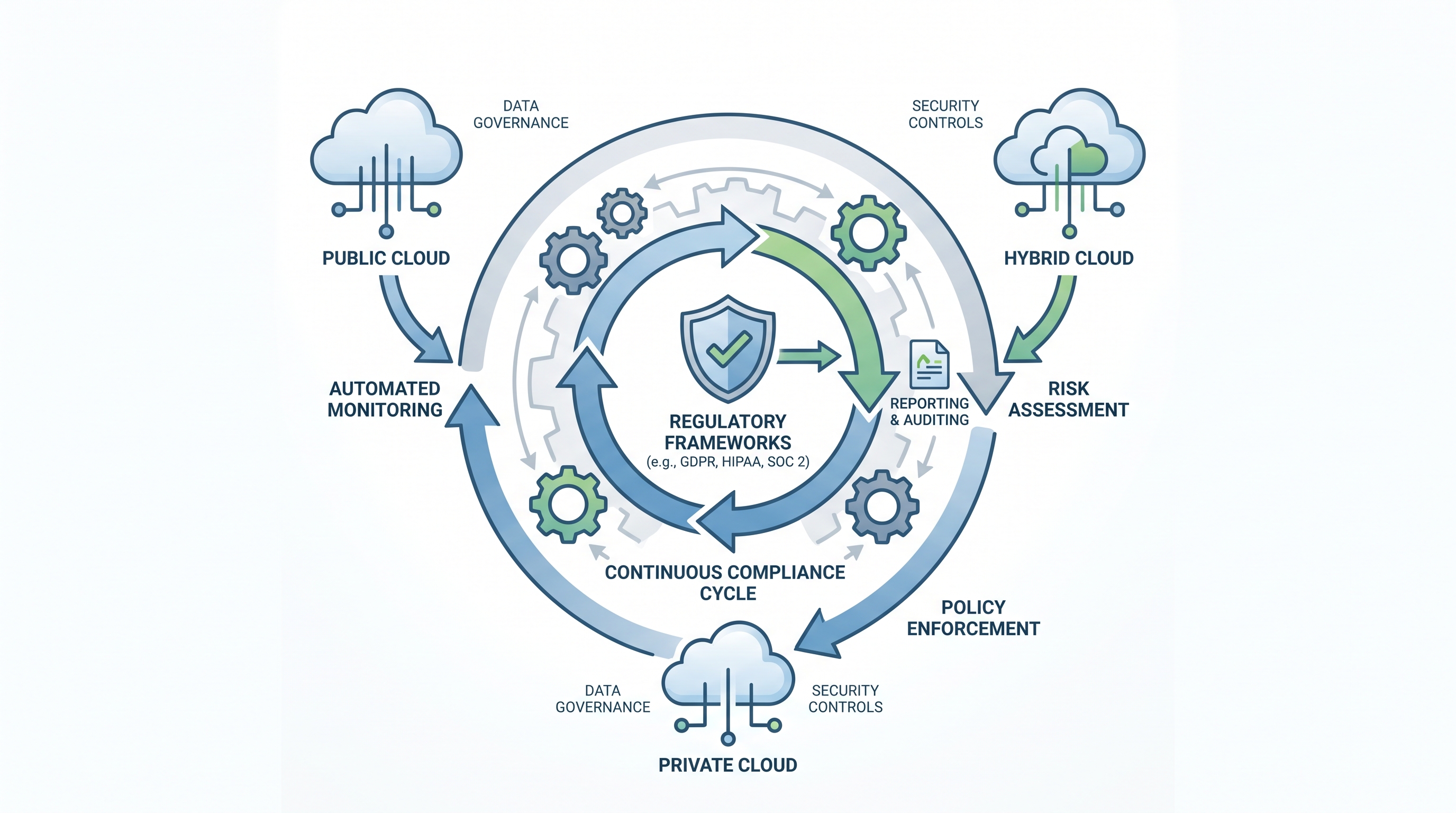
In the modern enterprise landscape, cloud adoption is not a matter of if, but how many. Organizations increasingly leverage multiple public cloud providers—AWS, Azure, Google Cloud Platform (GCP), and Oracle Cloud Infrastructure (OCI)—to capitalize on specialized services, mitigate vendor lock-in, and optimize geographical reach. While this multi-cloud strategy offers significant advantages, it simultaneously introduces a formidable challenge: maintaining continuous compliance with a growing array of regulatory frameworks across disparate, dynamic environments.
Regulatory mandates such as GDPR, HIPAA, PCI DSS, SOC 2, ISO 27001, and countless industry-specific requirements are not static. They evolve, demanding constant vigilance, proactive control implementation, and irrefutable audit trails. The traditional, episodic approach to compliance—often a reactive scramble before an audit—is fundamentally incompatible with the agile, ephemeral nature of cloud infrastructure. Enterprises require a paradigm shift towards continuous compliance: an automated, integrated, and always-on methodology that embeds regulatory adherence into every stage of the cloud lifecycle, from provisioning to decommissioning.
This is not merely a security problem; it's an operational and financial one. Non-compliance carries severe financial penalties, reputational damage, and operational disruptions. Conversely, a well-orchestrated compliance strategy, integrated with FinOps principles, can lead to optimized resource utilization, reduced waste, and enhanced security posture. This blog post will dissect the complexities of continuous compliance in a multi-cloud world, offering technical architectures, FinOps optimization tactics, and security best practices to navigate this critical domain.
The Multi-Cloud Compliance Labyrinth: Understanding the Landscape
Navigating the compliance landscape across multiple cloud providers is akin to solving a complex puzzle where each piece has its own unique shape and rules. The fundamental challenge stems from the inherent differences in cloud provider services, APIs, security models, and compliance reporting mechanisms. What works seamlessly in AWS might require a completely different approach in Azure or GCP.
Divergent Regulatory Frameworks and Their Cloud Implications
Enterprises operate under a mosaic of regulatory frameworks, each with specific requirements concerning data privacy, security, and operational integrity:
GDPR (General Data Protection Regulation): Focuses on data protection and privacy for EU citizens. Requires strict controls over data residency, access, encryption, and breach notification. Cloud providers offer regions within the EU, but the enterprise is responsible for ensuring data is processed and stored in compliance with GDPR principles, including cross-border data transfer mechanisms.
HIPAA (Health Insurance Portability and Accountability Act): Protects sensitive patient health information (PHI) in the United States. Demands stringent security controls for PHI storage, transmission, and processing. Cloud environments must support HIPAA-eligible services, and Business Associate Agreements (BAAs) are crucial.
PCI DSS (Payment Card Industry Data Security Standard): Mandates security controls for organizations handling credit card data. This involves network segmentation, strong access controls, encryption of cardholder data, and regular vulnerability scanning. Achieving PCI DSS in the cloud requires meticulous configuration of virtual networks, firewalls, and data storage.
SOC 2 (Service Organization Control 2): Reports on an organization's controls relevant to security, availability, processing integrity, confidentiality, and privacy. Cloud providers offer SOC 2 reports for their infrastructure, but the enterprise must extend these controls to their applications and data.
ISO 27001 (Information Security Management System): An international standard for managing information security. Provides a framework for establishing, implementing, operating, monitoring, reviewing, maintaining, and improving an ISMS. Cloud implementations must align with ISO 27001 principles, often requiring detailed documentation of controls.
Each of these frameworks translates into specific technical controls and processes that must be consistently applied and validated across AWS EC2 instances, Azure Virtual Machines, GCP Compute Engine, and OCI Compute instances; across S3 buckets, Azure Blobs, GCP Cloud Storage, and OCI Object Storage; and across various database services, networking components, and identity providers.
The Shared Responsibility Model: A Compliance Crucible
A cornerstone of cloud security, the Shared Responsibility Model, defines who is accountable for what. While cloud providers are responsible for the security of the cloud (e.g., physical infrastructure, hypervisor, core network), the customer is responsible for security in the cloud (e.g., virtual machines, operating systems, applications, data, network configurations, identity and access management). In a multi-cloud environment, understanding where each provider's responsibility ends and yours begins becomes incredibly complex, especially when integrating services across different clouds or with on-premises infrastructure.
The Challenge of "Compliance Drift"
Cloud environments are inherently dynamic. Developers deploy new resources, configurations change, and applications evolve at a rapid pace. This constant flux makes it incredibly difficult to maintain a consistent compliance posture. "Compliance drift" occurs when configurations deviate from their approved, compliant state due to manual changes, misconfigurations, or unapproved deployments. Without continuous monitoring and automated enforcement, drift can quickly lead to compliance gaps and security vulnerabilities, making audit preparation a nightmare.
Architectural Pillars of Continuous Compliance
To overcome the multi-cloud compliance labyrinth, enterprises must establish a robust architectural foundation built upon automation, real-time visibility, and integrated governance. These pillars are critical for transforming compliance from a periodic burden into an intrinsic, automated function of cloud operations.
1. Automated Policy Enforcement through Infrastructure as Code (IaC)
Manual configuration is the enemy of compliance. IaC tools like Terraform, CloudFormation (AWS), Azure Resource Manager (ARM) templates, and GCP Deployment Manager allow infrastructure to be defined, provisioned, and managed through code. This approach ensures consistency, repeatability, and version control, which are all vital for compliance.
Policy-as-Code (PaC): Beyond infrastructure, compliance policies themselves must be codified. Tools like Open Policy Agent (OPA), Sentinel (HashiCorp), and native cloud policy engines (AWS Config Rules, Azure Policy, GCP Organization Policies) enable organizations to define compliance requirements as code. These policies can then be enforced pre-deployment (e.g., CI/CD pipeline checks) and post-deployment (e.g., continuous auditing). For example, a PaC rule might mandate that all S3 buckets or Azure Blob containers storing sensitive data must have encryption at rest enabled and public access blocked, irrespective of the cloud provider.
Guardrails and Preventative Controls: Implementing preventative guardrails at the cloud account/subscription level ensures that non-compliant resources cannot even be provisioned. This is far more effective than detecting non-compliance after the fact. For instance, an AWS Service Control Policy (SCP) or Azure Management Group Policy can restrict the creation of resources in non-approved regions or enforce specific tagging requirements for cost attribution and compliance context.
2. Real-time Monitoring and Detection
Continuous compliance demands continuous awareness. Organizations need capabilities to monitor cloud environments in real-time for security threats, misconfigurations, and policy violations.
Cloud Security Posture Management (CSPM): CSPM tools continuously assess cloud configurations against security benchmarks (e.g., CIS Benchmarks) and regulatory frameworks. They identify misconfigurations, over-privileged IAM roles, and publicly exposed resources across all connected cloud accounts. For example, a CSPM solution would flag an unencrypted database in AWS RDS, an Azure Storage Account with anonymous public read access, or a GCP Cloud Storage bucket without appropriate retention policies.
Cloud Workload Protection Platforms (CWPP): CWPPs focus on protecting workloads (VMs, containers, serverless functions) at runtime. They offer vulnerability management, anti-malware, host intrusion detection, and application control. This is crucial for detecting threats that bypass perimeter defenses or arise from compromised applications.
Event-Driven Security and SIEM Integration: Centralizing cloud logs (CloudTrail, Azure Activity Logs, GCP Audit Logs, OCI Audit Logs) into a Security Information and Event Management (SIEM) system or data lake provides a unified view of security events. Automated alerts triggered by suspicious activity (e.g., unauthorized access attempts, configuration changes to critical resources) enable rapid response.
3. Integrated Remediation and Governance
Detection without remediation is insufficient. Continuous compliance requires automated, governed processes to correct identified non-compliance issues swiftly and safely.
Automated Remediation Workflows: For many common compliance violations (e.g., unencrypted storage, missing tags, overly permissive security groups), remediation can be automated. This might involve triggering serverless functions (AWS Lambda, Azure Functions, GCP Cloud Functions) to apply encryption, add required tags, or tighten network rules. The key is to ensure these automations are tested, reversible, and integrated into change management processes.
Change Management and Approval Workflows: While automation is paramount, not all changes can or should be fully automated. Critical changes, especially those impacting sensitive data or production systems, require human review and approval. Integration with ITSM tools ensures that remediation actions are tracked, approved, and documented, providing an auditable trail. This extends to patch management, where patch CAB automation streamlines the approval and deployment process for security updates.
Version Control for Policies and Configurations: All IaC templates, PaC rules, and automated remediation scripts must be stored in version control systems (e.g., Git). This allows for tracking changes, rollbacks, and collaborative development, ensuring that compliance definitions themselves are governed.
4. Unified Visibility and Reporting
Auditors and stakeholders require clear, consistent evidence of compliance. A fragmented view across multiple cloud consoles makes this nearly impossible.
Centralized Unified Dashboard: A single pane of glass that aggregates compliance status, security posture, and operational metrics from all cloud providers is essential. This dashboard should display real-time compliance scores, highlight critical violations, and track remediation progress across AWS, Azure, GCP, and Oracle.
Automated Evidence Generation: Compliance audits typically demand extensive documentation. Solutions should automate the collection of configuration snapshots, audit logs, policy enforcement reports, and remediation records. This significantly reduces the manual effort and time spent preparing for audits.
Customizable Reporting: Different stakeholders require different views. CISOs need security posture, FinOps teams need cost-aware compliance reports, and legal teams need regulatory specific attestations. The system must support customizable reporting tailored to various audiences and compliance frameworks.
FinOps and Security Synergy in Compliance
Compliance is often perceived as a cost center, but when integrated with FinOps principles, it can become an enabler for optimized cloud spend and enhanced operational efficiency. The synergy between financial accountability and security posture is undeniable.
The Cost Implications of Non-Compliance
The financial consequences of non-compliance extend far beyond direct fines. They include:
Regulatory Fines: Direct penalties from regulatory bodies (e.g., GDPR fines can be up to 4% of annual global turnover).
Reputational Damage: Loss of customer trust, negative brand perception, and potential long-term business impact.
Legal Costs: Litigation, investigations, and settlements arising from data breaches or compliance failures.
Operational Disruptions: Forced remediation efforts, system downtime, and diversion of engineering resources.
Increased Insurance Premiums: Higher cybersecurity insurance costs after incidents.
These costs underscore the imperative for proactive, continuous compliance, viewed not as an overhead but as a critical risk mitigation strategy with a measurable ROI.
Optimizing Compliance Spend with FinOps Principles
FinOps, the practice of bringing financial accountability to the variable spend model of cloud, offers several levers for optimizing compliance costs:
Right-Sizing Security Controls: Implementing overly aggressive or redundant security controls can lead to unnecessary cloud spend. FinOps encourages analyzing the cost-effectiveness of each control. For instance, using cheaper, native cloud encryption keys where appropriate, rather than always opting for more expensive hardware security modules (HSMs) when not explicitly required by compliance.
Cost-Aware Security Tooling: Evaluating the TCO of security tools, including their licensing, operational overhead, and integration costs across multiple clouds. Consolidating tools where possible and leveraging native cloud security services can yield significant savings.
Automated Tagging for Cost and Compliance Context: Implementing consistent, automated tagging strategies across all cloud resources is fundamental for both FinOps and compliance. Tags can denote ownership, cost center, environment (prod/dev), and importantly, compliance criticality or the regulatory framework it falls under (e.g.,
compliance:PCI-DSS). This enables accurate cost allocation and provides crucial context for compliance audits. CloudAtler's automated tagging capabilities are designed to streamline this process, ensuring consistency across disparate cloud environments.Budgeting for Compliance-Related Investments: Integrating compliance tooling, training, and personnel costs into the overall cloud budget. FinOps teams work with security and engineering to forecast these expenditures, ensuring adequate resources are allocated without overspending. This includes budgeting for continuous monitoring tools, security assessments, and compliance-specific training.
Technical Deep Dive: Implementing Continuous Compliance Across Clouds
Achieving continuous compliance requires a granular approach to technical controls, consistently applied across diverse cloud infrastructures. This section explores key technical domains and their multi-cloud implementation challenges and solutions.
Identity and Access Management (IAM) Unification
IAM is the bedrock of cloud security and compliance. In a multi-cloud environment, managing identities and permissions across AWS IAM, Azure Active Directory (AD), GCP IAM, and OCI IAM is complex.
Centralized Identity Provider: Implement a single source of truth for identities, typically an enterprise identity provider (IdP) like Okta, Ping Identity, or Azure AD (even if not using Azure as primary cloud). This IdP federates identities to each cloud provider, ensuring consistent user management and authentication policies.
Least Privilege Principle: Enforce the principle of least privilege rigorously. Users and services should only have the minimum permissions necessary to perform their functions. This requires continuous monitoring of IAM policies and roles for excessive permissions.
Multi-Factor Authentication (MFA): Mandate MFA for all administrative access and privileged operations across all cloud environments to significantly reduce the risk of unauthorized access.
Access Reviews: Regularly review IAM policies, roles, and user assignments to ensure they remain appropriate and remove stale permissions.
Network Security and Segmentation
Network security is paramount for protecting data in transit and segmenting workloads according to their sensitivity and compliance requirements.
VPC/VNet/VCN Configuration: Design virtual networks (AWS VPC, Azure VNet, GCP VPC, OCI VCN) with clear segmentation. Isolate production environments from development, and critical systems from less sensitive ones.
Firewall Rules and Security Groups: Implement strict inbound and outbound firewall rules (AWS Security Groups, Azure Network Security Groups, GCP Firewall Rules, OCI Security Lists/Network Security Groups) to allow only necessary traffic. Automate the management of these rules via IaC.
Web Application Firewalls (WAFs) and DDoS Protection: Deploy WAFs (AWS WAF, Azure Application Gateway WAF, GCP Cloud Armor, OCI WAF) to protect web applications from common attacks. Utilize native DDoS protection services provided by each cloud provider.
Private Connectivity: For hybrid cloud deployments, establish secure, private connections (AWS Direct Connect, Azure ExpressRoute, GCP Cloud Interconnect, OCI FastConnect) between on-premises data centers and cloud environments to avoid public internet exposure for sensitive traffic.
Data Protection: Encryption, Residency, and DLP
Protecting data at rest and in transit, managing data residency, and preventing data loss are critical compliance requirements.
Encryption Everywhere: Mandate encryption for all data at rest (e.g., S3 bucket encryption, Azure Storage encryption, GCP Cloud Storage encryption, OCI Object Storage encryption) and in transit (e.g., TLS for all network communications, VPNs). Utilize customer-managed keys (CMKs) for critical data when required by compliance.
Data Residency: Understand and enforce data residency requirements. Ensure sensitive data is stored and processed within specific geographic boundaries as dictated by regulations (e.g., GDPR for EU data). This dictates cloud region selection.
Data Loss Prevention (DLP): Implement DLP solutions to identify, monitor, and protect sensitive data across cloud storage and applications. This can involve scanning data for PII, PHI, or cardholder data patterns.
Backup and Disaster Recovery: Establish robust backup and disaster recovery strategies, ensuring that backups are encrypted, regularly tested, and stored in accordance with compliance retention policies.
Vulnerability and Patch Management
Unpatched systems are a leading cause of breaches. Continuous vulnerability management and patch application are non-negotiable for compliance.
Automated Vulnerability Scanning: Implement continuous vulnerability scanning (e.g., AWS Inspector, Azure Security Center, GCP Security Command Center, OCI Vulnerability Scanning Service) across all cloud workloads (VMs, containers). Integrate third-party vulnerability scanners for deeper insights.
Prioritization and Context: Not all vulnerabilities are equal. Prioritize remediation based on severity, exploitability, and the criticality of the affected asset. AI-powered patch intelligence can analyze CVEs, asset criticality, and historical patch success rates to recommend the most impactful patches, reducing noise and focusing efforts.
Automated Patch Remediation: Automate the patching process as much as possible, especially for non-production environments. For production, integrate patching with change management workflows, leveraging tools that support phased rollouts and automated rollbacks in case of issues. CloudAtler's capabilities in patch remediation and safe rollbacks are designed to minimize risk during critical updates.
Configuration Management: Use configuration management tools (e.g., Ansible, Chef, Puppet, AWS Systems Manager State Manager, Azure Automation State Configuration) to ensure desired state configurations, including patch levels, are maintained across all instances, detecting and correcting any drift.
Leveraging AI and Automation for Proactive Compliance
The sheer scale and complexity of multi-cloud environments make manual compliance efforts unsustainable. Artificial intelligence and advanced automation are no longer optional but essential for achieving proactive and continuous compliance.
Predictive Analytics for Compliance Risks
AI can analyze historical data from audit logs, configuration changes, and security incidents to identify patterns and predict potential compliance risks before they materialize. For example, AI might detect a growing trend of misconfigured storage buckets in a particular development team, allowing for proactive intervention and training before a major incident occurs. This shift from reactive detection to proactive prediction is a game-changer for compliance.
AI-Driven Anomaly Detection
Traditional rule-based monitoring struggles with the dynamic nature of cloud. AI-powered anomaly detection can establish baselines of normal behavior for cloud resources, user activity, and network traffic. Any significant deviation from these baselines can trigger alerts, indicating potential security threats or compliance violations that might otherwise go unnoticed. This is particularly effective in identifying insider threats or sophisticated attacks that mimic legitimate activity.
Automated Guardrails and Preventative Controls
AI can enhance automated policy enforcement by learning from past compliance failures and automatically suggesting or implementing stronger guardrails. For instance, if a specific type of resource repeatedly causes compliance issues, AI could recommend a preventative policy to block its deployment or enforce specific security configurations at creation time. CloudAtler's guardrails leverage AI to provide intelligent, preventative controls.
AI for Optimizing Security Spend
AI can analyze security control effectiveness against their cost. It can identify redundant security tools, recommend right-sizing security services based on actual usage and risk profiles, and even optimize incident response workflows to reduce the operational cost of compliance. By understanding the financial impact of security decisions, Atler AI helps organizations achieve robust security without overspending.
The CloudAtler Approach to Unifying Compliance
CloudAtler is purpose-built to address the intricate challenges of multi-cloud continuous compliance by unifying FinOps, cloud security, and automated operations. Our AI-powered platform provides the comprehensive visibility, proactive controls, and intelligent automation necessary for enterprises to meet regulatory frameworks across AWS, Azure, GCP, and Oracle environments.
Unified Visibility for Multi-Cloud Compliance
Our unified dashboard aggregates compliance status, security posture, and financial insights from all your cloud providers into a single, intuitive view. This eliminates the swivel-chair effect, providing a holistic understanding of your compliance landscape and enabling rapid identification of critical issues.
Automated Policy Enforcement and Remediation
CloudAtler leverages policy-as-code principles and intelligent automation to enforce compliance policies across your entire multi-cloud footprint. From ensuring encryption at rest to mandating consistent tagging, our platform automatically detects and remediates non-compliant configurations. Our robust comprehensive security management capabilities streamline the implementation and governance of security policies.
AI-Driven Insights for Proactive Compliance and Cost Optimization
At the heart of CloudAtler is Atler AI, which continuously analyzes your cloud environment for security vulnerabilities, compliance drift, and cost inefficiencies. It provides predictive insights into potential compliance risks, recommends optimal security configurations, and identifies opportunities for FinOps optimization. For example, our AI-powered patch intelligence prioritizes vulnerabilities based on real-world exploitability and asset criticality, ensuring that your teams focus on what matters most for compliance and security.
Seamless Integration of FinOps and Security
CloudAtler bridges the gap between security and finance. By providing a unified financial operations platform, we ensure that compliance efforts are not only effective but also cost-efficient. Our platform helps you understand the cost impact of security controls, optimize resource allocation for compliance, and generate budget-aware compliance reports. This integration fosters a culture of transparency and shared responsibility across security, operations, and finance teams.
Conclusion
Continuous compliance in a multi-cloud enterprise is no longer an aspiration but an imperative. The complexities of diverse regulatory frameworks, disparate cloud architectures, and the relentless pace of change demand a sophisticated, automated, and intelligent approach. By establishing robust architectural pillars, integrating FinOps principles, and leveraging the power of AI and automation, organizations can transform compliance from a reactive burden into a proactive, strategic advantage.
The journey to continuous compliance requires a unified platform that can see across all clouds, understand the intricate relationships between security, operations, and finance, and act intelligently to maintain regulatory adherence. CloudAtler provides this unified intelligence, empowering enterprises to navigate the multi-cloud compliance landscape with confidence and efficiency.
Ready to unify your cloud operations, enhance security, and achieve continuous compliance across AWS, Azure, GCP, and Oracle? Discover how CloudAtler can transform your enterprise.
All in One Place
Atler Pilot decodes your cloud spend story by bringing monitoring, automation, and intelligent insights together for faster and better cloud operations.