
In most organizations, patching is not something people talk about until they have to. It sits quietly in the background, often scheduled, sometimes delayed, and occasionally rushed when something goes wrong. Although teams have embraced automation in almost every part of software delivery, patch management still tends to follow an older rhythm, one that doesn’t quite match the speed of modern systems.
The irony is hard to ignore. We deploy code multiple times a day, scale infrastructure automatically, and monitor systems in real time. Yet, when it comes to patching, many teams still rely on periodic updates, maintenance windows, and manual interventions. It’s not that teams don’t understand its importance. It’s that patching has never been fully integrated into the way modern engineering actually works.
However, the environment has changed. Infrastructure is no longer static. Dependencies evolve constantly. Security threats emerge faster than ever. And in this landscape, delayed patching is not just inefficient, it’s risky.
This is where Continuous Patch Management begins to take shape, not as a new tool or a one-time upgrade, but as a shift in how we think about maintaining systems. It aligns patching with the same principles that shaped DevOps in the first place: automation, speed, and continuous improvement.
But what does this shift actually look like in practice? How do you move from scheduled patching to a truly continuous approach without introducing risk or complexity? And more importantly, how do you make it work in real-world systems that are already running at scale?
Let’s break it down and explore how continuous patch management is quietly becoming the next evolution of DevOps and why it matters more than it seems.
Why Traditional Patching Feels Increasingly Outdated?
There was a time when patching schedules made perfect sense. Systems were relatively stable, releases were less frequent, and downtime could be planned without major consequences. In such environments, a monthly or quarterly patch cycle was not only sufficient but practical.
Yet, that context no longer exists.
Modern applications are built on layers of dependencies like libraries, containers, operating systems, and managed services, and evolve independently. A single application might rely on dozens of external components, all of which can introduce vulnerabilities over time. Waiting for a scheduled patch cycle in such a scenario feels less like a strategy and more like a compromise.
What complicates things further is the fear of disruption. Teams hesitate to apply patches quickly because they worry about breaking functionality. This hesitation, although understandable, creates a paradox. The longer the patches are delayed, the greater the risk becomes. And when patches are finally applied, they often come in larger batches, increasing the chances of something going wrong. In trying to avoid instability, teams sometimes end up amplifying it.
Continuous Patch Management: A Natural Extension of DevOps
DevOps transformed how we build and deliver software by introducing continuous integration and continuous delivery. It reduced the gap between development and operations, making systems more responsive and adaptable. However, patching remained somewhat outside this loop, treated as a separate concern rather than an integral part of the lifecycle.
Continuous patching closes that gap.
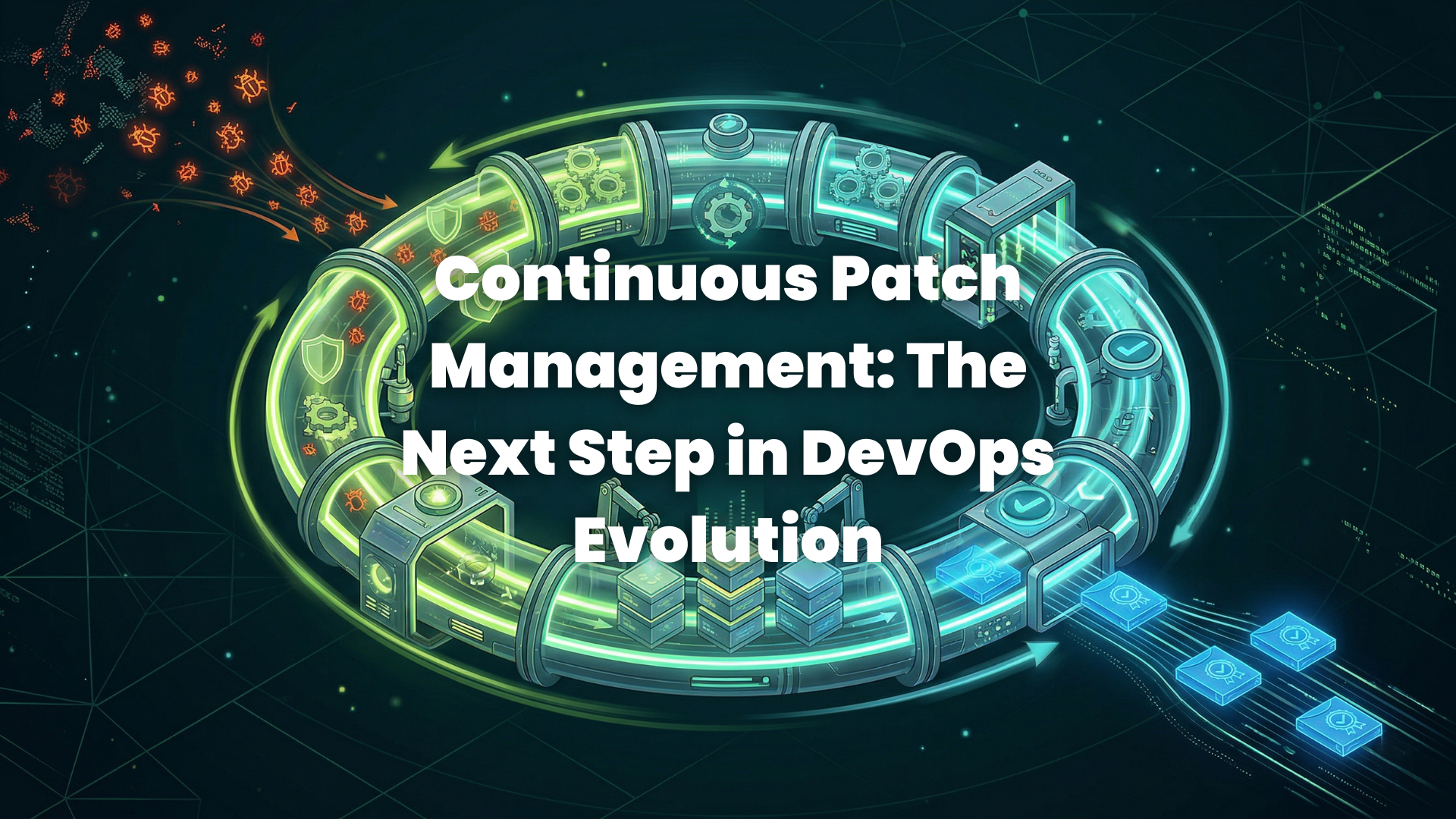
Instead of waiting for predefined intervals, patches are identified, tested, and applied as part of ongoing workflows. The emphasis shifts from large, infrequent updates to smaller, incremental changes. This not only reduces risk but also aligns patching with the natural cadence of modern systems.
There is also a subtle but important psychological shift here. When patching becomes continuous, it stops being a disruptive event. It becomes routine, almost invisible in its execution, yet critical in its impact.
What Changes When Patching Becomes Continuous?
The most noticeable change is in timing. Vulnerabilities are addressed sooner, often before they become critical. The window of exposure shrinks, sometimes dramatically. Instead of reacting to issues, teams begin to anticipate them. But the change goes deeper than that.
Continuous patching introduces a feedback loop. Systems are monitored continuously, updates are applied incrementally, and outcomes are observed in near real time. If something doesn’t behave as expected, it can be rolled back quickly. This creates a level of agility that traditional patching simply cannot match.
It also changes ownership. Patching is no longer just an operational responsibility. It becomes a shared concern across development, security, and operations teams. Everyone has visibility, and more importantly, everyone has context.
The Transformative Role of Automation
At the heart of continuous patch management lies automation. Without it, the process would be too complex and too time-consuming to sustain.
Automation does not just speed things up, but it also changes what is possible.
Vulnerability scanning tools continuously analyze systems and dependencies, identifying issues as they emerge. These findings are then fed into automated pipelines, where patches can be tested against existing workloads. If everything checks out, updates are deployed with minimal human intervention.
What’s interesting, however, is that automation does not eliminate the need for judgment. Policies still need to be defined. Not every patch should be applied immediately. Some updates may require additional validation, especially in sensitive environments.
The goal is not blind automation, but intelligent automation and systems that act quickly, yet thoughtfully.
Why Modern Architectures Make This Feasible?
If continuous patching feels achievable today, it is largely because of how infrastructure itself has evolved.
Containers, for instance, have changed the way we think about updates. Instead of modifying running systems, teams can rebuild container images with updated dependencies and redeploy them. This approach ensures consistency and reduces the risk of configuration drift.
Cloud-native environments further support this model. Managed services handle many underlying updates automatically, reducing the burden on engineering teams. Infrastructure as code allows environments to be recreated quickly, making it easier to apply changes without introducing inconsistencies.
Although these technologies do not remove the need for careful planning, they provide the foundation on which continuous patching can operate effectively.
The Subtle Connection Between Patching and Cost
It’s easy to view patching purely through the lens of security. For most teams, it sits in the same mental bucket as vulnerability scans and compliance checks that are important yet somewhat detached from day-to-day operational decisions. However, if you look closely, patching has a far deeper and often overlooked connection to cost.
There is also a second layer to this. Unpatched vulnerabilities don’t just pose security risks, but they also introduce operational uncertainty. Incidents triggered by these vulnerabilities can lead to downtime, emergency fixes, and unplanned scaling, all of which carry both financial and reputational costs. In that sense, patching is more about stability.
Continuous patching begins to address this in a subtle but meaningful way. Ensuring systems remain up to date, it helps maintain performance consistency. Workloads run on optimized environments, inefficiencies are gradually eliminated, and the likelihood of sudden disruptions is reduced. Although the impact may not always be immediately visible, it creates a more predictable and controlled cost structure over time.
This is why we built Atler Pilot, an intelligent cloud management platform. While traditionally positioned around cloud cost visibility and optimization, Atler Pilot extends this perspective further with its patch intelligence capabilities. Instead of treating patching as an isolated activity, it provides contextual insights to highlight how outdated components, inefficient workloads, or delayed updates may be influencing both system performance and cost.
What makes this particularly valuable is the shift in perspective it enables. Teams are no longer just reacting to vulnerabilities or chasing cost anomalies in isolation. They begin to see the connection between the two. Similarly, a performance bottleneck may have implications not just for latency, but for cost efficiency as well.
In this way, patching and cost management stop being parallel tracks. They become part of the same narrative, so one can focus on building systems that are not only secure, but also efficient, stable, and predictable. And perhaps that is the real insight here. Patching is not just about fixing what is broken. It is about preventing inefficiencies before they become expenses.
The Reality of Implementation
For all its advantages, continuous patch management is not without complexity.
There is always the risk of unintended consequences. A patch that resolves one issue may introduce another. Dependencies may behave differently after an update. Legacy systems may not support frequent changes.
These challenges are real, yet they are not new. They exist in traditional patching as well, often magnified by the scale of updates.
What continuous patching offers is a different way of dealing with them. Smaller, incremental changes are easier to test, easier to monitor, and easier to roll back. Over time, this reduces the overall risk, even if individual updates still require attention.
Conclusion
Perhaps the most interesting thing about continuous patch management is how it reframes maintenance. Traditionally, maintenance has been seen as a necessary interruption, a task that must be performed to keep systems running. It is reactive by nature, often triggered by issues or schedules. Continuous patching, however, turns maintenance into momentum.
Instead of pausing to fix systems, teams continuously refine them. Updates become part of the natural flow of work, not a disruption to it. Security improves not through occasional efforts, but through ongoing attention. Systems evolve steadily, rather than in bursts. And in that steady evolution lies a quiet advantage. Because in modern infrastructure, the goal is not just to build systems that work today. It is to build systems that remain reliable, secure, and efficient tomorrow without constant intervention. Continuous patch management does not eliminate complexity. But it changes how we live with it. Not by stopping change, but by keeping pace with it.
All in One Place
Atler Pilot decodes your cloud spend story by bringing monitoring, automation, and intelligent insights together for faster and better cloud operations.