
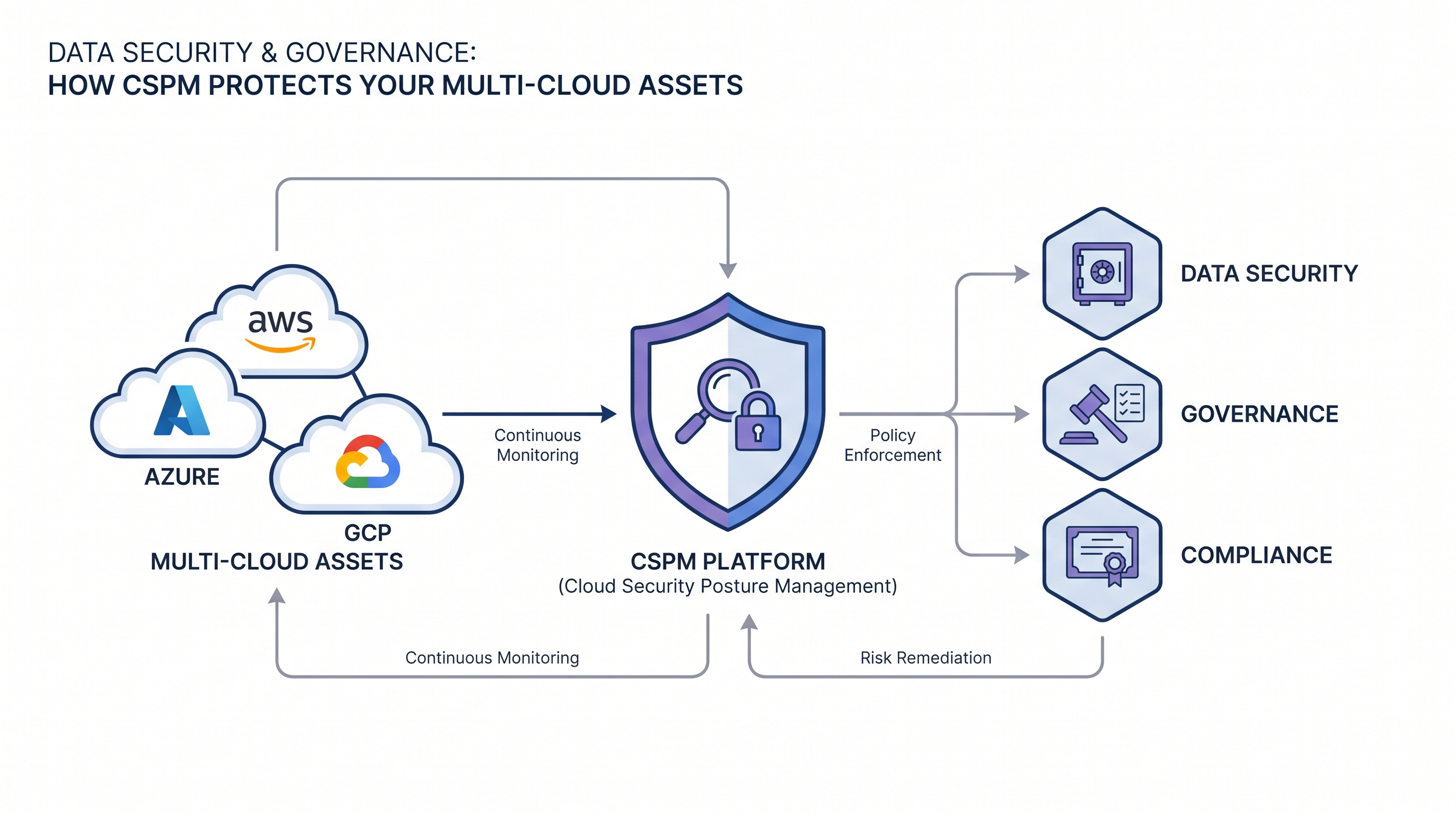
In the relentless pursuit of agility, scalability, and cost optimization, enterprises have enthusiastically embraced multi-cloud architectures. However, this strategic diversification introduces a formidable challenge: securing and governing sensitive data across disparate cloud providers like AWS, Azure, Google Cloud Platform (GCP), and Oracle Cloud Infrastructure (OCI). The sheer volume of data, the varying security models of each provider, and the dynamic nature of cloud environments create an intricate web of potential vulnerabilities and compliance complexities. Without a unified, proactive approach, data breaches, regulatory non-compliance, and significant financial penalties become an almost inevitable risk.
Enter Cloud Security Posture Management (CSPM). More than just a tool, CSPM represents a fundamental shift in how organizations approach cloud security and governance. It provides the continuous visibility, automated detection, and policy enforcement necessary to maintain a hardened security posture across an expansive multi-cloud footprint. At CloudAtler, we understand that true cloud mastery lies in the seamless integration of security, governance, and financial operations (FinOps). Our AI-powered platform is engineered to unify these critical domains, transforming the daunting task of multi-cloud data protection into an actionable, intelligent, and cost-efficient process.
The Escalating Challenge of Multi-Cloud Data Security & Governance
The allure of multi-cloud is undeniable, offering resilience, vendor lock-in avoidance, and the ability to leverage best-of-breed services. Yet, this distributed landscape presents unique and often underestimated security and governance challenges for enterprise architects and security teams:
Data Sprawl and Silos: Data can reside in various storage types (object, block, file, database) across multiple cloud providers, often without a centralized inventory or classification. This sprawl makes it incredibly difficult to understand where sensitive data resides and to apply consistent security controls.
Inconsistent Security Configurations: Each cloud provider has its own set of security services, APIs, and configuration paradigms. What's secure by default in AWS S3 might require explicit configuration in Azure Blob Storage or GCP Cloud Storage. Manually managing these discrepancies across environments is prone to human error.
Shared Responsibility Model Misinterpretation: While cloud providers secure the "cloud itself," customers are responsible for security "in the cloud." This often leads to misconfigurations in identity and access management (IAM), network security groups (NSGs), storage bucket policies, and encryption settings, directly impacting data security.
Compliance Complexities: Enterprises operate under a myriad of regulatory frameworks (GDPR, HIPAA, PCI-DSS, SOC 2, ISO 27001). Demonstrating continuous compliance across a multi-cloud environment, each with its own regional data residency laws and security certifications, is a monumental task.
Shadow IT and Developer Autonomy: The ease of provisioning resources in the cloud can lead to "shadow IT" instances where unmonitored resources or applications store sensitive data outside central governance, creating unknown vulnerabilities.
Attack Surface Expansion: Every new cloud account, every new service, every new data store adds to the potential attack surface. Without comprehensive visibility, organizations are essentially operating blind to critical risks.
These challenges underscore the need for a sophisticated, automated solution that can cut through the complexity and provide a holistic view of the security posture across all cloud environments.
Understanding Cloud Security Posture Management (CSPM)
Beyond Basic Configuration Checks: The Core Pillars of CSPM
Cloud Security Posture Management (CSPM) is a class of security tools designed to identify and remediate misconfigurations and compliance violations in cloud environments. Unlike traditional security tools that focus on network traffic or endpoint protection, CSPM focuses on the configuration state of cloud resources themselves. It's about proactively ensuring that your cloud environment is configured securely from the ground up, aligning with best practices and regulatory mandates.
The core pillars of a robust CSPM solution include:
Continuous Configuration Monitoring: CSPM solutions continuously scan your cloud environments for misconfigurations. This isn't a one-time audit but an ongoing process, crucial for dynamic cloud environments where configurations can change rapidly.
Compliance Validation and Reporting: A key function is to map cloud configurations against various regulatory frameworks and industry benchmarks (e.g., CIS Benchmarks, NIST, PCI-DSS). It automates the process of demonstrating compliance, generating reports for auditors, and highlighting areas of non-conformance.
Misconfiguration Detection and Prioritization: CSPM identifies common misconfigurations such as publicly exposed storage buckets, overly permissive IAM roles, unencrypted data stores, weak network security group rules, and disabled logging. Advanced CSPM solutions use context and risk scoring to prioritize findings, helping teams focus on the most critical vulnerabilities.
Vulnerability Assessment Integration: While not a vulnerability scanner itself, CSPM often integrates with vulnerability management tools to provide a more complete picture of risk. It ensures that not only are configurations secure, but the underlying software and services are also free from known vulnerabilities.
Policy Enforcement (Policy-as-Code): CSPM allows organizations to define security and governance policies as code, which can then be automatically enforced across all cloud accounts. This ensures consistency and reduces manual effort.
Risk Visualization and Reporting: A critical aspect is providing clear, actionable insights into the overall security posture through dashboards and reports, enabling security teams, FinOps practitioners, and leadership to understand risk trends and remediation progress.
In essence, CSPM acts as your cloud environment's vigilant guardian, continuously assessing its health and flagging deviations from your defined security and governance policies. This proactive stance is invaluable in preventing breaches before they occur.
CSPM in Action: Protecting Data Across AWS, Azure, GCP, and Oracle
Architectural Deep Dive: How CSPM Integrates and Operates
A truly effective CSPM solution must operate seamlessly across diverse cloud ecosystems, understanding the nuances of each provider while presenting a unified security posture. CloudAtler achieves this through an agentless approach, leveraging native cloud APIs and service integrations to collect configuration data without impacting performance or requiring complex deployments. Let's explore specific examples across major cloud providers:
AWS Environment Protection
In AWS, data security often revolves around S3 bucket policies, IAM roles, Security Groups, and KMS key policies. A CSPM solution like CloudAtler will continuously:
Monitor S3 Bucket Policies: Detect public S3 buckets, buckets without encryption at rest (SSE-S3, SSE-KMS), buckets without versioning enabled (for ransomware protection), and buckets with overly permissive access control lists (ACLs) or bucket policies (e.g.,
"Principal": "*").Audit IAM Configurations: Identify IAM users with excessive privileges, unused IAM roles, roles with trust policies that allow cross-account access without proper constraints, or the absence of Multi-Factor Authentication (MFA) on root accounts and privileged users.
Evaluate Security Groups: Flag security groups with ingress rules allowing "0.0.0.0/0" (anywhere) access to critical ports (e.g., 22, 3389, 443, 80) for databases, application servers, or management interfaces, which could expose sensitive data or control planes.
Validate KMS Key Policies: Ensure that KMS keys used for encrypting sensitive data are properly protected, with restricted key usage and administration access, preventing unauthorized decryption.
For instance, if an engineer accidentally deploys an S3 bucket containing customer PII without encryption and with a public read policy, CloudAtler's CSPM would immediately flag this critical misconfiguration, detailing the risk, the affected resource, and suggesting remediation steps, potentially even automating the fix based on pre-defined policies.
Azure Environment Protection
Azure's ecosystem presents similar challenges with Storage Accounts, Azure Key Vault, Network Security Groups (NSGs), and Azure AD roles. CloudAtler's CSPM capabilities for Azure include:
Storage Account Configuration: Detecting Azure Storage Accounts that allow public blob access, lack encryption at rest (default in new accounts but configurable), or have overly broad firewall rules exposing them to the internet.
Azure Key Vault Security: Ensuring Key Vaults storing secrets, keys, and certificates have appropriate access policies, are protected by network access controls, and are not publicly exposed.
Network Security Group (NSG) Analysis: Identifying NSGs with inbound rules that permit unrestricted access to virtual machines or subnets hosting sensitive applications or data.
Azure AD Role-Based Access Control (RBAC): Auditing custom roles for excessive permissions, detecting users with elevated privileges who shouldn't have them, and monitoring for stale or unused service principals.
A common scenario is an Azure Storage Account configured with anonymous public read access for a container holding proprietary application logs, inadvertently exposing sensitive operational data. CloudAtler would detect this exposure, categorize it by severity, and guide the team to restrict access immediately.
Google Cloud Platform (GCP) Protection
GCP's security model, centered around Cloud Storage, IAM policies, and VPC Firewall rules, also benefits immensely from CSPM:
Cloud Storage Bucket Policies: Identifying Cloud Storage buckets configured for public access, lacking encryption keys (customer-managed or customer-supplied), or with overly permissive IAM policies (e.g.,
allUsersorallAuthenticatedUsersroles on sensitive data).IAM Policy Enforcement: Detecting service accounts with excessive permissions, monitoring for unconstrained custom roles, or identifying users with broad project-level access who only need resource-specific permissions.
VPC Firewall Rule Auditing: Flagging firewall rules that allow ingress from "0.0.0.0/0" to critical internal resources or databases, bypassing network segmentation principles.
Secret Manager Configuration: Ensuring secrets stored in Secret Manager are properly versioned, rotated, and accessed only by authorized service accounts or users.
Imagine a GCP Cloud Storage bucket intended for internal analytics containing anonymized customer data, but due to a misconfiguration, it's exposed to allUsers. CloudAtler would pinpoint this exposure, providing the necessary context to revoke public access and ensure data confidentiality.
Oracle Cloud Infrastructure (OCI) Protection
OCI, with its unique IAM structure, Object Storage, and Virtual Cloud Network (VCN) Security Lists, also requires dedicated CSPM oversight:
Object Storage Configuration: Identifying OCI Object Storage buckets that are publicly accessible, lack encryption, or have overly broad pre-authenticated requests (PARs).
OCI IAM Policies: Auditing IAM policies for overly permissive statements, detecting users or groups with unnecessary administrative privileges, and ensuring proper tenancy and compartment isolation.
VCN Security Lists and Network Security Groups (NSGs): Flagging Security List or NSG rules that allow unrestricted inbound access to critical compute instances, databases, or load balancers within a VCN.
Database Security: Monitoring OCI Autonomous Database configurations for adherence to security best practices, such as strong password policies, audit logging, and network access controls.
For example, an OCI Object Storage bucket containing backup data might be inadvertently configured with public read access. CloudAtler's CSPM would detect this, allowing immediate remediation to prevent unauthorized data exfiltration. The ability to manage and visualize these diverse security postures from a single unified dashboard is paramount for enterprises operating at scale.
The Synergistic Relationship: CSPM, Data Governance, and Compliance
Translating Security Posture into Governance Frameworks
Data security and data governance are inextricably linked. While security focuses on protecting data from unauthorized access and breaches, governance establishes the policies and processes for managing data throughout its lifecycle, including its use, storage, and retention. CSPM serves as the critical bridge, translating abstract governance policies into concrete, enforceable security controls.
Here’s how CSPM facilitates robust data governance and compliance:
Automated Compliance Mapping: CSPM solutions come pre-loaded with controls mapped to major regulatory frameworks (PCI-DSS, HIPAA, GDPR, SOC 2, ISO 27001). When a misconfiguration is detected (e.g., unencrypted PII in an S3 bucket), CSPM not only flags the security issue but also indicates which compliance mandates it violates. This significantly reduces the manual effort and complexity of compliance audits.
Continuous Compliance Monitoring: Instead of periodic audits, CSPM provides real-time, continuous monitoring of compliance posture. Any deviation from a compliance standard is immediately identified, allowing for prompt remediation and maintaining an "always-on" compliant state. This proactive approach minimizes the risk of non-compliance fines and reputational damage.
Enforcing Data Classification Policies: Organizations classify data based on sensitivity (e.g., PII, PHI, confidential, public). CSPM can enforce policies that dictate where certain data types can be stored (e.g., PII only in encrypted storage in specific regions), how it's accessed, and its encryption status. For instance, a policy might state that all data tagged "Confidential-PII" must reside in a cloud storage service with server-side encryption enabled and restricted network access. CSPM validates adherence to this policy across all cloud providers.
Policy-as-Code for Governance: With CSPM, governance policies can be codified and applied programmatically across the multi-cloud environment. This ensures consistency and prevents configuration drift. For example, a policy could mandate that all new storage buckets across AWS, Azure, and GCP must have public access disabled by default and encryption enabled. CSPM actively monitors for any violations of these codified governance rules.
Audit Trails and Reporting: CSPM solutions maintain detailed audit trails of configuration changes, security findings, and remediation actions. This historical data is invaluable for forensic analysis in case of a breach and provides irrefutable evidence for compliance auditors, demonstrating due diligence and accountability.
Consider a multinational financial institution operating under GDPR. They have a strict policy that all customer data (PII) must be encrypted at rest and stored within EU data centers. CloudAtler's CSPM would continuously scan all AWS S3 buckets, Azure Blob Storage containers, and GCP Cloud Storage buckets across all regions. If a new bucket containing PII is provisioned in a non-EU region or without encryption, the CSPM solution would immediately alert the security team and flag it as a GDPR violation, allowing for rapid corrective action. This capability is central to effective security management in a regulated industry.
FinOps and Security Convergence: Optimizing Cost and Risk with CSPM
The Financial Impact of Poor Security Posture and How CSPM Mitigates It
Security and FinOps, traditionally viewed as separate disciplines, are increasingly converging. A strong security posture isn't just about preventing breaches; it's also about optimizing cloud spend and ensuring operational efficiency. Conversely, poor security can lead to significant, often hidden, financial costs. CSPM plays a pivotal role in this convergence.
The financial implications of inadequate security posture include:
Cost of Data Breaches: This is the most obvious and often devastating cost, encompassing regulatory fines (e.g., GDPR fines can be up to 4% of global annual revenue), legal fees, incident response costs, credit monitoring for affected customers, public relations damage, and lost business.
Unnecessary Resource Consumption: Misconfigurations can lead to inefficient resource utilization. For instance, publicly exposed S3 buckets or Azure Blob containers can incur significant data transfer costs from malicious downloads or bot activity. CSPM can identify these exposures, preventing both security breaches and unexpected egress charges.
Manual Remediation Costs: Without automated CSPM, security teams spend countless hours manually identifying, investigating, and remediating misconfigurations across vast cloud estates. This labor cost is substantial and diverts highly skilled personnel from more strategic initiatives.
Compliance Penalties: Failure to meet regulatory compliance standards can result in hefty fines, loss of certifications, and exclusion from certain markets or partnerships.
Reputational Damage: A security breach can severely damage an organization's brand reputation, leading to a loss of customer trust and market share, which translates directly into long-term financial losses.
CSPM directly mitigates these financial risks by:
Proactive Risk Reduction: By identifying and remediating misconfigurations before they are exploited, CSPM prevents costly breaches and compliance violations. This proactive approach is far more cost-effective than reactive incident response.
Optimizing Resource Security and Cost: CSPM can highlight resources that are both insecure and inefficient. For example, an overly provisioned EC2 instance with an exposed port is both a security risk and a cost drain. By identifying such instances, CSPM enables teams to right-size resources while simultaneously enhancing security.
Automating Remediation: CloudAtler’s advanced CSPM capabilities, powered by AI, can automate the remediation of many common misconfigurations. This drastically reduces the manual effort and associated labor costs, allowing security and operations teams to focus on higher-value tasks. For example, automatically applying encryption to an unencrypted S3 bucket or tightening an overly permissive IAM policy.
Informing Budgeting and Forecasting: By providing clear visibility into security risks and their potential financial impact, CSPM data can be integrated into FinOps practices. This allows for more accurate budget forecasting and risk-aware planning, ensuring that security investments are prioritized effectively. CloudAtler's platform is designed as a Financial Operations Platform, unifying these insights.
Enhancing Operational Efficiency: A secure and compliant environment reduces operational overhead related to audits, investigations, and emergency fixes. This frees up engineering and security teams, allowing them to innovate and drive business value.
The synergy between FinOps and security, facilitated by a comprehensive CSPM solution, ensures that cloud investments are not only secure but also deliver maximum business value without undue financial risk.
Advanced CSPM Capabilities with AI and Automation (CloudAtler's Edge)
Predictive Intelligence and Automated Remediation for Proactive Defense
While foundational CSPM provides crucial visibility, the sheer scale and complexity of multi-cloud environments demand more than just static rule checks. This is where advanced, AI-powered CSPM solutions like CloudAtler truly differentiate themselves, moving beyond reactive detection to proactive, intelligent defense.
AI-Powered Anomaly Detection: Traditional CSPM relies on predefined rules and benchmarks. CloudAtler's Atler AI goes further by learning the "normal" behavior and configuration patterns of your multi-cloud environment. It can then detect subtle anomalies or configuration drifts that don't violate a specific rule but might indicate an emerging threat or an insider risk. For example, an unusual change in an IAM role’s permissions that bypasses standard change management, or a sudden modification to a database security group that deviates from historical patterns, would be flagged immediately. This adds a layer of predictive intelligence to your security posture.
Contextual Risk Prioritization: Not all misconfigurations carry the same level of risk. A publicly exposed S3 bucket containing development logs is less critical than one holding customer credit card numbers. CloudAtler's AI contextualizes findings by correlating them with data sensitivity (identified through automated tagging and discovery), blast radius (how many other resources are affected), and potential business impact. This enables security teams to focus their efforts on the most critical vulnerabilities first, optimizing remediation efforts and reducing mean time to repair (MTTR).
Automated, Policy-Driven Remediation: Identifying misconfigurations is only half the battle; fixing them efficiently is the other. CloudAtler provides robust capabilities for automated remediation. Based on pre-approved policies and playbooks, the platform can automatically correct common misconfigurations (e.g., enabling encryption on an unencrypted storage bucket, tightening an overly permissive network rule, or revoking excessive IAM permissions). This "security-as-code" approach ensures consistent enforcement, reduces human error, and accelerates the time to a secure state. These automated actions are often accompanied by safe rollbacks to ensure operational stability.
Integration with Vulnerability and Patch Management: A secure posture isn't just about configuration; it's also about the underlying software. CloudAtler integrates CSPM findings with patch governance and vulnerability management. It provides a holistic view, ensuring that not only are your cloud resources configured correctly, but that the operating systems, databases, and application components running on them are also patched, up-to-date, and free from known CVEs. This unified approach prevents vulnerabilities from being exploited, even if the surrounding cloud infrastructure is perfectly configured.
Unified Operations and Intelligence: The true power of CloudAtler lies in its ability to unify FinOps, security, and automated operations. Through a single unified dashboard, organizations gain complete visibility into their multi-cloud environment – from cost performance and resource utilization to security posture and compliance adherence. This operational intelligence allows for informed decision-making, enabling teams to balance security requirements with budget constraints and operational efficiency.
By leveraging AI and automation, CloudAtler transforms CSPM from a detection tool into a proactive defense mechanism that continuously hardens your multi-cloud environment, anticipates threats, and ensures continuous compliance and cost efficiency.
Conclusion
The journey to secure and govern data across a sprawling multi-cloud landscape is fraught with complexity, but it is not insurmountable. Cloud Security Posture Management (CSPM) stands as the indispensable foundation for maintaining a robust security posture, enforcing critical governance policies, and ensuring continuous compliance across AWS, Azure, GCP, and Oracle environments. By moving beyond reactive security measures to a proactive, continuous assessment of cloud configurations, enterprises can significantly reduce their attack surface and mitigate the financial and reputational risks associated with data breaches.
However, in today's dynamic threat landscape, foundational CSPM is merely the starting point. The true competitive advantage lies in leveraging advanced capabilities: AI-powered anomaly detection, contextual risk prioritization, and automated, policy-driven remediation. These intelligent features not only enhance security efficacy but also drive significant operational efficiencies and enable a seamless convergence of security and FinOps, ensuring that your cloud investments are both secure and cost-optimized.
Don't let the complexity of multi-cloud dilute your security and governance efforts. Empower your teams with the intelligence and automation needed to thrive securely. It's time to unify your cloud operations, strengthen your data security, and achieve unparalleled governance across all your cloud assets.
Take control of your multi-cloud destiny. Explore how CloudAtler's AI-powered platform can unify your FinOps, cloud security, and automated operations today.
All in One Place
Atler Pilot decodes your cloud spend story by bringing monitoring, automation, and intelligent insights together for faster and better cloud operations.