
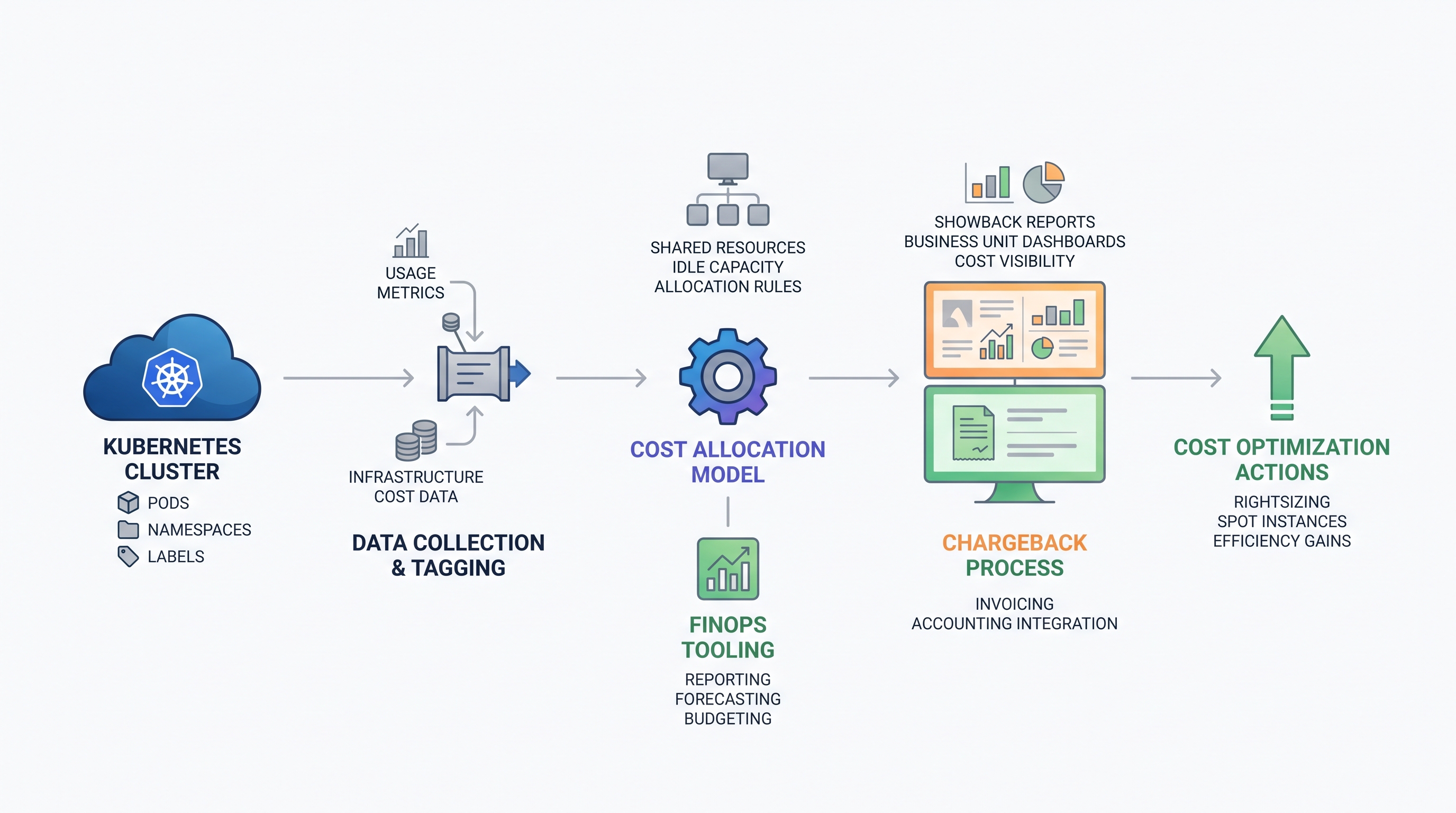
The Kubernetes Cost Visibility Conundrum for Enterprises
In the rapidly evolving landscape of cloud-native infrastructure, Kubernetes has emerged as the de facto standard for orchestrating containerized applications. Its dynamic, elastic, and highly abstracted nature offers unparalleled agility and scalability for development teams. However, for enterprise FinOps teams, this same agility often translates into a significant challenge: gaining granular visibility and control over costs. Traditional cloud cost management tools, designed for virtual machines and managed services, frequently fall short when attempting to dissect the shared, multi-tenant resources inherent in a Kubernetes cluster.
The core of the problem lies in Kubernetes' resource pooling model. Multiple applications, microservices, and teams often share the same underlying compute nodes, network infrastructure, and storage volumes. A single EC2 instance, Azure VM, or GCP Compute Engine instance might host dozens or hundreds of pods belonging to different services, departments, or environments. Directly attributing the cost of that instance or its associated network egress to a specific application or business unit becomes a complex task, often obscured by layers of abstraction.
This lack of clear attribution can lead to several critical issues: inflated cloud bills due to inefficient resource utilization, difficulty in identifying cost owners, hindered budget forecasting, and a general inability to correlate infrastructure spend with business value. For FinOps teams, the imperative is clear: develop robust mechanisms for Kubernetes cost allocation and showback to empower engineering teams with financial accountability and drive intelligent optimization decisions. This deep dive will explore the technical underpinnings and practical strategies required to achieve this.
Foundational Principles for Granular Kubernetes Cost Attribution
Achieving accurate Kubernetes cost allocation begins with establishing a strong foundation built on intelligent resource management and metadata. Without these core elements, any attempt at cost attribution will be, at best, an educated guess.
1. Resource Requests and Limits: The Bedrock of Allocation
One of the most critical, yet often overlooked, aspects of Kubernetes cost management is the proper configuration of resource requests and resource limits for pods. These parameters directly influence how the Kubernetes scheduler places pods and how much CPU and memory they are guaranteed (requests) or allowed to consume (limits).
Requests (Guaranteed Resources): When a pod specifies a CPU request (e.g.,
500mfor 0.5 CPU core) and a memory request (e.g.,256Mi), the Kubernetes scheduler ensures that a node has at least this much available capacity before scheduling the pod. These requests are critical because they represent the minimum resources "reserved" for your application, even if it's not actively using them. For cost allocation, the request values are often a more stable and predictable metric than actual usage, especially in environments where applications burst.Limits (Maximum Consumption): Limits define the upper bound of resources a container can consume. If a container tries to exceed its CPU limit, it will be throttled. If it exceeds its memory limit, it will be OOMKilled (Out Of Memory killed). While limits are crucial for cluster stability, they don't directly factor into "reserved" cost allocation in the same way requests do, but they do indicate potential for over-provisioning if consistently set too high.
FinOps Impact: Properly set requests are vital for accurate cost allocation. If a team requests 2 CPU cores and 4GB of memory for an application, they should be "charged" for that reserved capacity, even if the application only uses 0.5 CPU and 1GB. This incentivizes developers to right-size their requests, preventing resource waste and "ghost costs" from over-provisioned pods. Continuous monitoring of actual usage against requests is essential for identifying optimization opportunities.
2. Kubernetes Labels and Annotations: The Tagging Imperative
Just as tagging is fundamental for cost allocation in traditional cloud resources, Kubernetes labels and annotations are the cornerstone for attributing costs within clusters. They provide the metadata necessary to group and filter resources by owner, project, environment, application, or cost center.
Labels: Key-value pairs intended for identifying attributes that are meaningful to users and can be used for selecting groups of objects (e.g., for scheduling, service discovery, or policy enforcement). Examples:
app: my-service,team: finance,environment: production,cost_center: 12345. Labels are indexed and can be queried efficiently.Annotations: Key-value pairs for attaching arbitrary non-identifying metadata to objects. They are not used for selection but can store richer, more detailed information. Examples: Git commit hashes, build information, contact details for the service owner, or even specific billing codes not suitable for labels.
Strategy for Consistent Tagging:
Standardized Taxonomy: Define a clear, consistent set of labels (e.g.,
cloudatler.com/team,cloudatler.com/project,cloudatler.com/environment,cloudatler.com/owner) and enforce their usage across all deployments.Mandatory Labels: Implement admission controllers or policy engines (like OPA Gatekeeper) to ensure that all new deployments include the required cost-related labels.
Automated Tagging: For large-scale environments, manual tagging is unsustainable. Leverage tools that can automatically apply labels based on namespaces, deployment patterns, or even integrate with CI/CD pipelines. CloudAtler offers advanced automated tagging capabilities that extend across your multi-cloud and Kubernetes environments, ensuring consistent metadata for cost and security attribution.
FinOps Impact: Consistent and comprehensive labeling is non-negotiable. It allows FinOps teams to slice and dice Kubernetes costs by any relevant business dimension, enabling accurate showback reports and identifying which teams or applications are consuming what resources.
3. Namespaces as Cost Boundaries
Kubernetes namespaces provide a mechanism for isolating groups of resources within a single cluster. While their primary purpose is logical separation and access control, they can also serve as a natural boundary for initial cost grouping.
FinOps Impact: If each team or application has its own dedicated namespace(s), attributing costs at the namespace level becomes a straightforward first step. However, challenges arise in multi-tenant namespaces where shared services reside, or when a single application spans multiple namespaces. In such cases, labels become even more critical for finer-grained allocation within or across namespaces.
Architectural Approaches to Kubernetes Cost Allocation
Once the foundational principles are in place, FinOps teams can implement various architectural approaches to aggregate and attribute costs. These methods range in complexity and accuracy, depending on the enterprise's specific needs and the granularity required.
1. Method 1: Node-Based Allocation
This is the simplest approach, often serving as an initial step. It involves allocating the cost of an entire node (VM instance, network, storage attached directly to the node) to the pods running on it. The cost is then distributed among the pods based on a weighting factor, typically their CPU and memory requests.
Mechanism:
Identify the hourly cost of each underlying cloud VM (e.g., EC2, Azure VM, GCP Compute Engine).
Sum the resource requests (CPU and memory) of all pods running on that node.
Calculate each pod's share of the node's total requested resources.
Attribute a proportional share of the node's cost to each pod.
Pros: Relatively easy to implement, directly correlates to IaaS billing, provides a high-level view.
Cons:
Inaccuracy: Does not account for actual usage vs. requested, leading to "idle cost" on the node being distributed, potentially unfairly.
Shared Services: Difficult to accurately allocate costs for cluster-level services (e.g., Ingress controllers, monitoring agents) that consume resources on many nodes but serve the entire cluster.
Varied Workloads: A node might host low-utilization development pods alongside high-utilization production pods, leading to skewed allocation if only requests are considered.
Best for: Smaller clusters, environments with dedicated nodes for specific workloads, or as a starting point before more advanced methods.
2. Method 2: Pod-Based Allocation (Resource Usage Tracking)
This method provides a far more accurate picture by tracking the actual CPU and memory consumption of each pod and attributing costs based on that usage. This requires a robust monitoring infrastructure.
Mechanism:
Data Collection: Utilize Kubernetes Metrics Server, cAdvisor (built into Kubelet), Prometheus, and Grafana to collect granular, real-time CPU and memory usage data for each container within each pod.
Cost Calculation:
Actual Usage: Calculate the hourly average (or P90, P95) CPU and memory usage for each pod.
Node Cost Attribution: Instead of simple requests, attribute node costs based on each pod's actual consumption relative to the node's total consumption.
Idle Cost: Explicitly identify and track "idle cost" – the difference between the node's total capacity and the sum of all pods' actual usage. This idle cost can then be allocated as "cluster overhead" or amortized across all tenants.
Oversubscription Cost: Account for situations where the sum of pod requests exceeds the node's physical capacity (if configured for oversubscription).
Label Integration: Use pod labels (
team,project,app) to roll up these usage-based costs to the desired business dimensions.
Pros: Highly accurate, reflects true resource consumption, incentivizes right-sizing and efficiency, clearly identifies idle resources.
Cons: More complex to implement, requires robust monitoring and data processing, can be volatile with ephemeral pods.
Tools & Technology: Open-source solutions like OpenCost (built on Kubecost principles) or commercial platforms offer sophisticated engines for this. CloudAtler's operational intelligence capabilities are designed to ingest and process this granular data, providing actionable insights for FinOps and SRE teams.
3. Method 3: Advanced Cost Models (Shared Resources & Amortization)
Real-world Kubernetes environments involve more than just pod compute costs. This advanced approach tackles the complexities of shared services, cluster overhead, and persistent storage.
Handling Shared Services:
Examples: Ingress controllers (Nginx, Envoy), service meshes (Istio, Linkerd), logging agents (Fluentd), monitoring agents (Prometheus node exporters), DNS services, API gateways.
Allocation Strategy: These services consume resources (CPU, memory, network) but serve the entire cluster or multiple tenants. Their costs can be amortized across all namespaces/teams based on various factors:
Equal Share: Simplest, but least accurate.
Weighted by Pod Count: Allocate based on the number of pods each team runs.
Weighted by Resource Usage: Allocate based on each team's total requested or actual CPU/memory usage.
Custom Business Metrics: For specific services, e.g., allocating Ingress controller costs based on the number of ingresses owned by a team or the volume of traffic routed.
Cluster-Level Costs:
Control Plane: For managed Kubernetes services (EKS, AKS, GKE), the control plane has a direct cost. For self-managed, the cost of master nodes.
Shared Storage: Persistent Volumes (PVs) and Persistent Volume Claims (PVCs) often map to underlying cloud storage services (EBS, Azure Disks, GCP Persistent Disks, S3 buckets). Their costs must be attributed to the owning PVC/pod/namespace.
Network Egress: Often a significant cost, challenging to attribute precisely within Kubernetes. Tools can analyze network flow logs or use proxy-level metrics.
Reserved Instances (RIs) and Savings Plans (SPs) Amortization:
If the underlying cloud VMs are covered by RIs or SPs, the effective hourly cost is lower. The cost allocation engine must be able to apply these savings proportionally to the pods running on those instances. CloudAtler's commitment intelligence helps optimize and allocate these savings across your Kubernetes infrastructure.
Mechanism: Requires a sophisticated cost engine that can ingest data from multiple sources (Kubernetes API, cloud provider billing APIs, monitoring systems) and apply complex rules for direct and indirect cost attribution.
FinOps Impact: This comprehensive approach provides the most accurate and defensible cost attribution, essential for chargeback models and fostering deep financial accountability across engineering teams.
Implementing Showback and Chargeback Mechanisms
With accurate cost data collected and allocated, the next step is to present this information to stakeholders in a meaningful way, enabling informed decision-making and fostering a culture of cost awareness.
Defining Showback vs. Chargeback
Showback: An informational model where teams receive reports detailing their infrastructure consumption and associated costs. They are "shown" their spend but not directly billed. This promotes accountability and encourages optimization without the administrative overhead and potential political friction of direct billing. It's an excellent starting point for most enterprises.
Chargeback: A direct billing model where internal teams or departments are actually charged for their cloud resource consumption. This requires extremely high accuracy, transparency, and often formal agreements on allocation methodologies. While it creates strong financial incentives, it demands a robust and trusted cost allocation system.
Data Collection and Aggregation Pipeline
A robust pipeline is crucial for consolidating data from disparate sources:
Kubernetes API: Provides metadata about pods, deployments, namespaces, nodes, PVs, and associated labels/annotations.
Cloud Provider APIs: Crucial for node instance costs, network egress, managed services (e.g., managed databases, load balancers), and specific storage costs. This data must be correlated with Kubernetes resources.
Metrics Systems: Prometheus, Metrics Server, cAdvisor provide actual CPU/memory usage, network I/O, storage I/O, and other performance metrics.
ETL/Data Lake: All this raw data needs to be ingested, transformed, and stored in a central repository (e.g., data lake, time-series database) where it can be processed by the cost engine.
Cost Engine Development or Selection
The core of your showback/chargeback system is the cost engine, which applies the allocation rules to the aggregated data:
Open-Source Options: Solutions like OpenCost provide a good starting point for calculating Kubernetes costs. They typically integrate with Prometheus and Grafana.
Commercial Platforms: For enterprise-grade requirements, commercial platforms like CloudAtler offer comprehensive, multi-cloud, and multi-Kubernetes cost allocation capabilities. These platforms often include:
Pre-built integrations with major cloud providers and Kubernetes clusters.
Sophisticated rules engines for direct and shared cost attribution.
Automated amortization of RIs/SPs.
Ability to ingest custom metrics and business logic.
Integration with financial systems.
The rules for cost attribution within the engine must be clearly defined and transparent:
Direct Costs: Pods, specific PVs, dedicated Load Balancers.
Shared Costs: Cluster overhead, control plane, shared ingress, monitoring infrastructure.
Amortized Costs: Reserved Instances, Savings Plans.
Reporting and Visualization
Presenting complex cost data in an understandable and actionable format is key to FinOps success. Reporting should cater to different audiences:
FinOps Teams: Granular breakdowns, cost trends, anomaly detection, optimization opportunities, budget vs. actuals.
Engineering Teams/DevOps: Dashboards showing their specific application/namespace costs, resource utilization, idle resources, and potential savings from right-sizing. This empowers them to own their cloud spend.
Business Units/Leadership: High-level summaries, cost per business metric (e.g., cost per transaction, cost per user), budget adherence, and overall cloud spend trajectory.
CloudAtler provides a unified dashboard and a financial command center that consolidates all these views, offering real-time visibility across your entire cloud estate, including detailed Kubernetes cost attribution, budget forecasting, and performance management.
FinOps Optimization Tactics for Kubernetes
Visibility is the first step; action is the ultimate goal. With robust cost allocation in place, FinOps teams can work collaboratively with engineering to implement significant optimizations.
Continuous Right-Sizing of Requests and Limits:
Based on actual usage data, continuously adjust pod resource requests and limits. If an application consistently uses 200m CPU but requests 1000m, reduce the request. Tools like Vertical Pod Autoscaler (VPA) can automate recommendations or even direct adjustments. This directly impacts the "reserved" cost attributed to the application.
Leveraging Auto-Scaling:
Horizontal Pod Autoscaler (HPA): Scales the number of pod replicas based on CPU utilization or custom metrics. Ensures you only run the necessary number of pods.
Cluster Autoscaler (CA): Adjusts the number of nodes in your cluster based on pending pods. Prevents over-provisioning of underlying compute infrastructure.
Vertical Pod Autoscaler (VPA): Adjusts the CPU and memory requests/limits of individual containers based on their historical usage. This is crucial for dynamic right-sizing.
Strategic Use of Spot Instances/Preemptible VMs:
For fault-tolerant, stateless, or batch workloads, leverage cloud provider spot instances (AWS EC2 Spot, Azure Spot VMs, GCP Preemptible VMs) for significant cost savings. Kubernetes can gracefully handle preemption, making it an ideal environment for these instance types. Ensure your cluster autoscaler is configured to prioritize them.
Commitment Management Optimization:
Ensure that the underlying compute nodes are covered by the optimal mix of Reserved Instances (RIs) or Savings Plans (SPs). Analyze your compute lifecycle and usage patterns to make informed purchasing decisions. CloudAtler's reserved savings optimization feature provides AI-driven recommendations to maximize your commitment discounts across your entire cloud footprint, including Kubernetes nodes.
Garbage Collection and Resource Cleanup:
Identify and remove idle or unused Kubernetes resources:
Unused Persistent Volume Claims (PVCs) and Persistent Volumes (PVs): These continue to incur storage costs.
Stale Deployments, ReplicaSets, Services: Clean up old or failed deployments that might still be consuming resources or IP addresses.
Unused Images: Regularly prune container images from node disk space.
Policy Enforcement with Admission Controllers:
Implement Kubernetes Admission Controllers (e.g., OPA Gatekeeper, Kyverno) to enforce FinOps best practices at deployment time. This includes:
Mandating resource requests and limits for all pods.
Ensuring required labels (team, project, cost center) are present.
Preventing the deployment of oversized images or insecure configurations.
CloudAtler provides robust guardrails and security management features that can integrate with and enhance these policy enforcement mechanisms, ensuring both cost efficiency and security compliance.
Integrating Kubernetes Cost with Broader Cloud FinOps
While Kubernetes cost allocation is a specialized domain, it must not exist in a silo. For true enterprise FinOps, Kubernetes costs need to be integrated into a holistic view that encompasses all cloud resources—virtual machines, serverless functions, databases, storage, and network services—across multi-cloud and hybrid environments.
The challenge of correlating Kubernetes costs with non-Kubernetes resources (e.g., a database service external to the cluster that a Kubernetes application depends on) is significant. A unified platform is essential to break down these silos.
CloudAtler's value proposition is precisely this unification. Our AI-powered platform unifies FinOps, cloud security, and automated operations across AWS, Azure, GCP, and Oracle environments. This means FinOps teams can:
See the total cost of an application, regardless of whether its components run on Kubernetes, serverless, or traditional VMs.
Correlate Kubernetes resource consumption with broader cloud spend trends and business metrics.
Leverage AI-driven insights for optimization opportunities that span both containerized and non-containerized workloads.
Automate cost allocation, budget forecasting (budget forecasting), and anomaly detection across their entire cloud estate, including the granular details of Kubernetes clusters.
By providing a single source of truth, CloudAtler empowers FinOps teams to move beyond mere cost reporting to strategic financial management, enabling proactive optimization and aligning cloud spend with business objectives.
Conclusion
The dynamic and abstracted nature of Kubernetes presents unique challenges for FinOps teams striving for comprehensive cost visibility and control. However, by establishing strong foundational principles—meticulous resource requests, consistent labeling, and strategic namespace utilization—and implementing advanced architectural approaches for cost allocation, enterprises can unlock unparalleled insights into their containerized infrastructure spend.
Implementing effective showback and chargeback mechanisms, backed by robust data pipelines and sophisticated cost engines, transforms cost data into actionable intelligence. This empowers engineering teams to take ownership of their cloud consumption, driving a culture of continuous optimization through right-sizing, intelligent auto-scaling, and strategic commitment management.
Ultimately, true FinOps maturity in a Kubernetes-driven world means integrating these granular insights into a broader, unified cloud financial management strategy. A platform that consolidates FinOps, security, and automated operations, like CloudAtler, is not just beneficial—it's essential for navigating the complexities of modern cloud environments. By doing so, organizations can move beyond reactive cost cutting to proactive, intelligent cloud spend management that fuels innovation and business growth.
Ready to gain unparalleled visibility and control over your Kubernetes and multi-cloud costs? Discover how CloudAtler’s AI-powered platform can unify your FinOps, cloud security, and automated operations, transforming your cloud spend into a strategic advantage. Explore CloudAtler today and unify your cloud operations.
All in One Place
Atler Pilot decodes your cloud spend story by bringing monitoring, automation, and intelligent insights together for faster and better cloud operations.