
In 2025, the "reasoning model" has become the new gold standard for complex AI tasks. Unlike standard LLMs that simply predict the next token, reasoning models like OpenAI's o1 and the disruptive DeepSeek-R1 generate internal "Chain of Thought" (CoT) tokens to "think" before they speak. This capability unlocks incredible power for coding, math, and architecture, but it introduces a new cost vector: the Reasoning Tax.
For engineering teams, the question is no longer just "which model is smarter?" but "which model yields the best ROI?". This article breaks down the economics of the two market leaders.
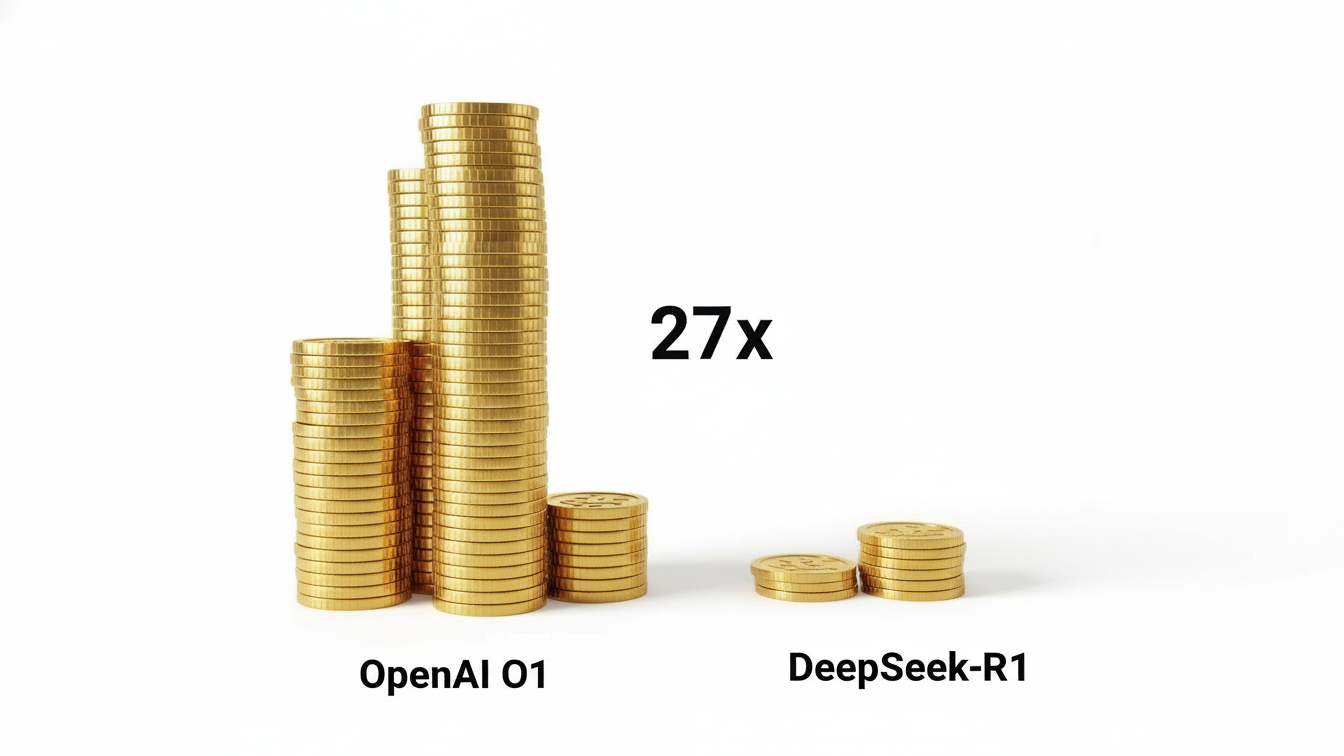
The Pricing Chasm: A 27x Difference
The disparity in pricing between these two models is nothing short of staggering. As of late 2025, the API pricing stands as follows:
Metric | DeepSeek-R1 (API) | OpenAI o1 (API) | Cost Multiplier |
Input Cost (per 1M tokens) | $0.55 | $15.00 | ~27x |
Output Cost (per 1M tokens) | $2.19 | $60.00 | ~27x |
Note: Output costs include the invisible reasoning tokens generated during the Chain of Thought process.
The "Reasoning Tax" in Practice
Let's look at a real-world scenario: An autonomous coding agent tasked with refactoring a complex Python class.
Prompt: 1,000 tokens.
Reasoning: The model "thinks" for 8,000 tokens (invisible to the user but billed).
Final Answer: 1,000 tokens.
Total Output: 9,000 tokens.
Cost Calculation:
OpenAI o1:
(1k x $0.015) + (9k x $0.060)= $0.555 per taskDeepSeek-R1:
(1k x $0.00055) + (9k x $0.00219)= $0.020 per task
The Impact: If your engineering team runs this agent 10,000 times a day in a CI/CD pipeline:
OpenAI Bill: $5,550 / day
DeepSeek Bill: $200 / day
Performance Benchmarks: Do You Get What You Pay For?
Is DeepSeek-R1 just "cheap," or is it "good"? Independent benchmarks from late 2025 suggest it is surprisingly competitive, though o1 retains the edge in nuance.
Math (AIME): DeepSeek-R1 scores 79.8%, actually edging out OpenAI o1's 79.2% in some runs.
Coding (Codeforces): DeepSeek trails slightly (96.3% vs 96.6%), a negligible difference for most enterprise CRUD applications.
General Knowledge (MMLU): OpenAI retains a lead (91.8% vs 90.8%), showing it is less prone to hallucinations in broad, non-technical topics.
The Verdict: A Bifurcated Strategy
For DevOps and AI Architects, the recommendation is a split strategy:
Use DeepSeek-R1 for High-Volume Logic: For automated testing, data extraction loops, and internal coding agents where volume is high and human review is possible, DeepSeek offers a 96% cost reduction. The price elasticity allows you to deploy "swarms" of agents where you previously could only afford one.
Use OpenAI o1 for "Zero-Fail" Tasks: For client-facing chatbots or critical architectural decisions where the highest possible reasoning fidelity and safety guardrails are required, the premium for o1 is justified.
Conclusion
In 2025, cost efficiency is an architectural requirement. Ignoring the 27x price differential is no longer an option for scalable AI systems. Teams that master semantic routing—sending easy tasks to DeepSeek and hard tasks to o1—will win on margin
All in One Place
Atler Pilot decodes your cloud spend story by bringing monitoring, automation, and intelligent insights together for faster and better cloud operations.