
Introduction: The Hidden Tax of Multi-Cloud Architectures
As enterprises increasingly adopt multi-cloud and hybrid-cloud topologies to avoid vendor lock-in, maximize resilience, and leverage best-of-breed services, they inevitably encounter a silent budget killer: cloud egress fees. While cloud service providers (CSPs) make it frictionless and free to ingest data (ingress), extracting that same data (egress) to the public internet, on-premises data centers, or other cloud environments incurs a compounding, complex, and often unpredictable tax.
For a modern enterprise processing petabytes of data across Amazon Web Services (AWS), Microsoft Azure, Google Cloud Platform (GCP), and Oracle Cloud Infrastructure (OCI), unoptimized data transfer paths can easily account for 15% to 30% of the total monthly cloud bill. Compounding this challenge is the sheer opacity of cloud billing systems. Egress charges are rarely consolidated under a single line item; instead, they are fragmented across virtual private clouds (VPCs), NAT gateways, load balancers, and content delivery networks (CDNs).
To reclaim control over your infrastructure spend, you must treat data gravity and network topology as first-class architectural concerns. This deep dive demystifies the mechanics of cloud egress pricing, identifies common architectural anti-patterns that inflate costs, and provides production-ready, highly technical strategies to optimize your data transfer footprints. By leveraging a robust unified financial operations platform, organizations can gain the visibility needed to execute these strategies effectively.
The Physics and Economics of Cloud Data Transfer
Before designing a cost-optimized network architecture, you must understand how cloud hyperscalers categorize and charge for data movement. Network transfer costs are generally determined by three variables: the source of the data, the destination of the data, and the transit mechanism utilized.
1. Intra-Region, Inter-Availability Zone (AZ) Transfer
Even within a single cloud region, moving data across isolated Availability Zones incurs fees. Hyperscalers charge for inter-AZ transfer because data must traverse the provider's physical regional fiber backbone. For instance, in AWS, data transferred between EC2 instances in different AZs within the same region costs $0.01 per GB in each direction (totaling $0.02/GB for a round trip). In Azure, availability zone data transfer is typically billed at $0.01 per GB for inbound/outbound transfers across zones.
2. Inter-Region Transfer
Moving data from one geographical region to another within the same cloud provider's global network is significantly more expensive than inter-AZ transfer. For example, transferring data from AWS US East (N. Virginia) to US West (Oregon) costs $0.02 per GB. These costs scale rapidly when replicating large databases, maintaining disaster recovery (DR) environments, or distributing container images across global registries.
3. Internet Egress (The Hyperscaler Premium)
This is where costs escalate exponentially. When data leaves a cloud provider's network to go to the public internet, an on-premises data center, or another cloud provider over public routes, it is subject to standard internet egress rates. These rates are typically tiered, meaning the unit cost decreases as volume increases, but the starting rates are exceptionally high:
AWS: Starts at $0.09 per GB (for the first 10 TB after the 100 GB free tier).
Azure: Starts at $0.087 per GB (for the first 10 TB after the 100 GB free tier).
GCP: Starts at $0.12 per GB (for worldwide destination egress, excluding China and Australia).
OCI: Notably disruptively priced, offering the first 10 TB per month free, with subsequent egress billed at approximately $0.0085 per GB.
The table below highlights the vast disparity in egress pricing across major hyperscalers for standard internet data transfer:
Cloud Provider | Free Tier (Per Month) | Base Egress Rate (Per GB) | Inter-Region Rate (Per GB) |
|---|---|---|---|
AWS | 100 GB | $0.090 | $0.020 |
Azure | 100 GB | $0.087 | $0.020 - $0.080 |
GCP | 100 GB | $0.120 | $0.010 - $0.080 |
OCI | 10 TB (10,000 GB) | $0.0085 | $0.000 (Same-region ADs) |
Architectural Anti-Patterns that Inflate Egress Costs
Before implementing optimizations, architects must recognize and remediate the design flaws that lead to bloated egress invoices. In our architectural consulting, we frequently observe four primary anti-patterns:
Anti-Pattern 1: The NAT Gateway Black Hole
In secure cloud environments, private instances (e.g., database servers, microservices in private subnets) route outbound traffic to the internet through a Network Address Translation (NAT) Gateway. While necessary for security, NAT Gateways are a major cost driver. For instance, AWS charges $0.045 per hour for the NAT Gateway itself, plus a $0.045 per GB data processing fee.
If an application in a private subnet downloads a 100 GB dataset from an external API or another cloud bucket via a NAT Gateway, you pay $4.50 in processing fees plus the standard $9.00 in internet egress fees. If that same data is routed internally to an S3 bucket in the same region without a VPC endpoint, you are billed double-processing fees for no structural benefit.
Anti-Pattern 2: Multi-AZ Databases without Local Routing
Highly available database deployments (such as Amazon RDS Multi-AZ or self-managed PostgreSQL clusters on Kubernetes) constantly replicate state across AZs. If application servers in AZ-A query database read-replicas located in AZ-B, every single query and response incurs inter-AZ transfer fees. This cross-AZ chatter can quickly accumulate millions of gigabytes of billed traffic annually.
Anti-Pattern 3: Public IP Routing for Internal Services
When services in different VPCs or virtual networks (VNets) communicate using public IP addresses, traffic is routed out to the public internet and back in. This means you pay egress fees on the sending side and, in some cases, ingress or processing fees on the receiving side, even though both resources reside within the same cloud provider's physical data centers.
Anti-Pattern 4: Uncompressed and Unoptimized Payload Delivery
Sending verbose, uncompressed JSON or XML payloads over inter-cloud connections is highly inefficient. Many legacy enterprise applications fail to utilize modern serialization formats or compression algorithms, resulting in payloads that are up to 10 times larger than necessary.
Strategic Architectures to Mitigate Egress Fees
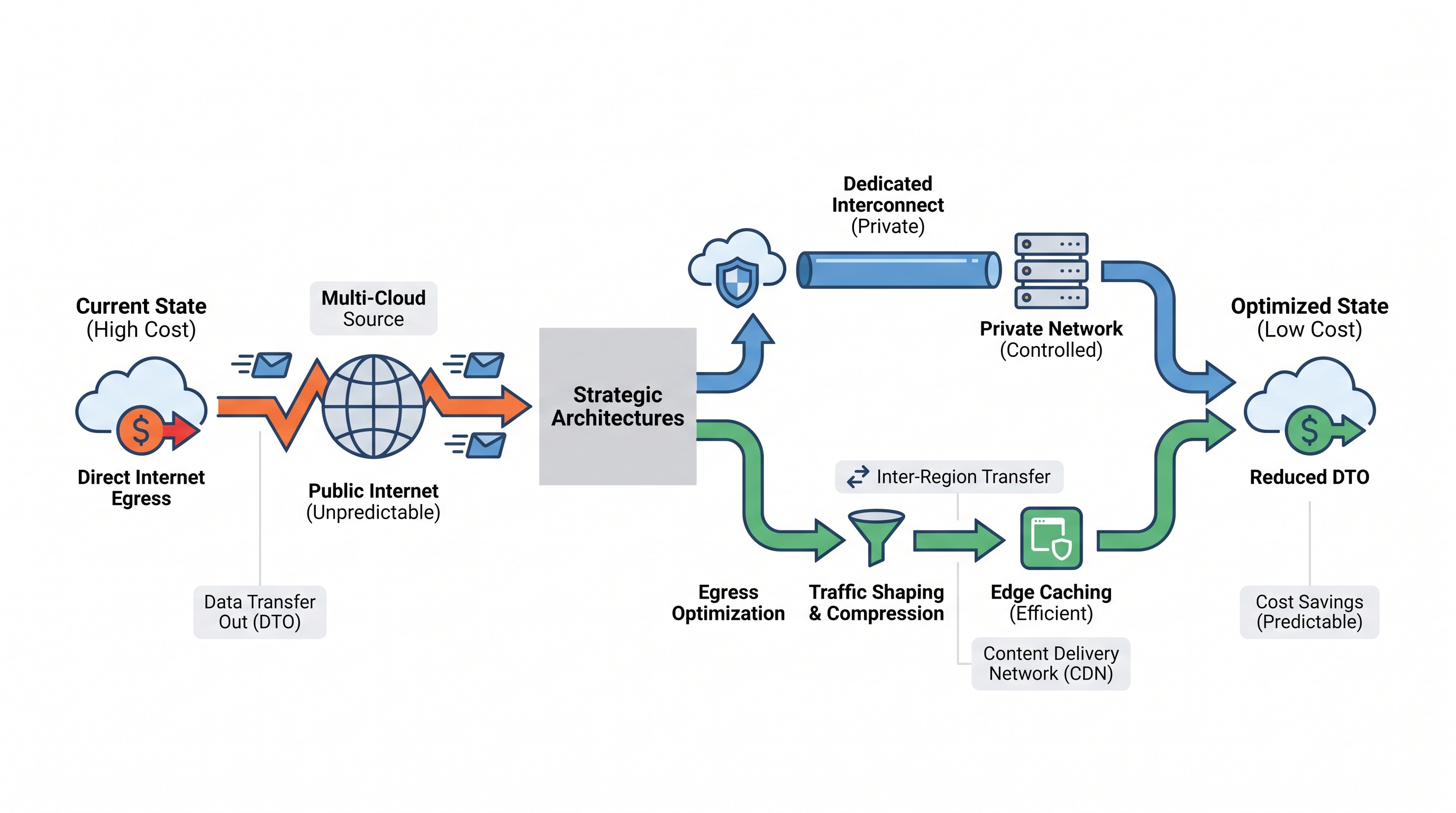
To systematically slash data transfer costs, cloud architects must transition from naive routing models to cost-aware, highly structured network topologies. Below are three production-proven architectural frameworks designed to minimize egress overhead.
Architecture A: Zero-Egress VPC Endpoints and Private Links
To eliminate NAT Gateway processing fees and public internet routing for cloud-native services, you must leverage private endpoints. In AWS, this is achieved via Gateway VPC Endpoints and Interface VPC Endpoints (powered by AWS PrivateLink). Azure offers Private Endpoints, and GCP utilizes Private Google Access.
Gateway Endpoints (available for S3 and DynamoDB in AWS) are entirely free and route traffic directly through the internal cloud network, bypassing NAT Gateways. Interface Endpoints use private IP addresses from your VPC subnet to route traffic to services like KMS, Secrets Manager, or SQS. While Interface Endpoints have a small hourly and processing cost ($0.01/GB), they are significantly cheaper than routing that same traffic through a NAT Gateway ($0.045/GB) and out to the internet.
Technical Implementation: Configuring AWS S3 Gateway Endpoints via Terraform
To ensure all S3 traffic bypasses your NAT Gateways, declare a Gateway VPC Endpoint in your Terraform infrastructure-as-code:
resource "aws_vpc_endpoint" "s3" {
  vpc_id       = var.vpc_id
  service_name = "com.amazonaws.${var.region}.s3"
  vpc_endpoint_type = "Gateway"

  route_table_ids = var.private_route_table_ids

  tags = {
    Name        = "s3-gateway-endpoint"
    Environment = var.environment
  }
}
By applying this configuration, any request originating from your private subnets directed at an S3 bucket will be routed directly via the AWS internal network, dropping your data transfer cost for S3 access to $0.00/GB.
Architecture B: Multi-Cloud Dedicated Interconnects
If your enterprise runs a split-stack architecture—such as running analytical workloads in Google BigQuery while maintaining your transactional core in AWS Aurora—relying on the public internet for data synchronization is financially unsustainable. The solution is to establish dedicated, private physical network connections between the clouds.
By provisioning AWS Direct Connect, Azure ExpressRoute, GCP Partner Interconnect, or OCI FastConnect, you bypass the public internet entirely. Hyperscalers heavily discount egress fees over these dedicated connections. For example:
AWS Direct Connect: Egress rates drop from $0.09/GB to $0.02/GB (a 77% reduction).
Azure ExpressRoute: Outbound data transfer rates drop to approximately $0.025/GB, or you can opt for an Unlimited Data plan where all egress is covered under a flat monthly port fee.
GCP Interconnect: Egress rates drop to $0.01 - $0.04 per GB depending on the region.
To implement this without managing physical telco cross-connects yourself, utilize Megaport, Equinix Cloud Exchange, or PacketFabric. These Software-Defined Network (SDN) providers allow you to provision virtual cross-connects between AWS, Azure, and GCP in minutes, establishing a high-throughput, low-latency, and cost-optimized multi-cloud mesh.
Architecture C: Smart Edge Routing and CDN Origin Shielding
For workloads distributing static assets, media, or API responses to global users, direct egress from object storage (like S3 or Azure Blob) is a massive financial liability. Instead, you must route traffic through a Content Delivery Network (CDN) like Amazon CloudFront, Cloudflare, or Fastly.
CDNs cache content close to the end-user, reducing the need to fetch data from the origin. Furthermore, cloud providers offer deep egress discounts when transferring data to their native CDNs. For instance, data transfer from AWS S3 to Amazon CloudFront is $0.00/GB. CloudFront then charges its own egress fees to the internet, which are lower than S3's direct internet egress rates and can be negotiated down with custom enterprise agreements.
If you use a third-party CDN like Cloudflare, you can leverage the Bandwidth Alliance. If your origin is in a participating cloud provider (such as OCI, Google Cloud, or Backblaze B2), egress fees from the cloud provider to Cloudflare are either entirely waived or heavily discounted, bringing your origin-to-CDN transfer costs down to zero.
Advanced FinOps Tactics for Egress Control
While architectural changes lay the foundation, continuous optimization requires deep observability and operational discipline. CFOs and engineering leaders need FinOps solutions for CIOs that bridge the gap between architectural decisions and real-time cost visibility.
1. Payload Optimization and Serialization Protocols
The less data you send, the less you pay. Modernizing your application's serialization protocols can yield immediate, dramatic reductions in network payload sizes:
Transition from JSON to Protocol Buffers (gRPC) or Apache Avro: JSON is highly verbose due to repeating key names in every object. gRPC and Avro serialize data into a highly compressed binary format. In typical production environments, migrating microservice communication to gRPC reduces payload sizes by 60% to 80%.
Enforce Compression: Ensure all HTTP communication utilizes modern compression algorithms. While Gzip is standard, Brotli offers up to 20% better compression ratios for text-based payloads (HTML, JSON, JS) with minimal CPU overhead.
Columnar Data Formats for Analytics: When transferring large analytical datasets between cloud data lakes, never use CSV or JSON. Use columnar formats like Apache Parquet or ORC. Parquet natively compresses data and allows query engines to perform "projection pushdown," reading only the specific columns required for a query rather than transferring the entire dataset over the wire.
2. Topology-Aware Routing in Kubernetes
If you run microservices on Kubernetes (EKS, AKS, or GKE) across multiple availability zones, Kubernetes' default load-balancing behavior is cost-blind. By default, a service in AZ-A will distribute traffic round-robin to pods in AZ-A, AZ-B, and AZ-C, constantly generating inter-AZ egress fees.
To solve this, enable Topology-Aware Routing (formerly Topology-Aware Hints). This mechanism instructs the Kubernetes control plane to bias traffic routing to endpoints that reside within the same zone as the originating client pod. Traffic only crosses zone boundaries if local endpoints are overloaded or unavailable.
To enable this in your Kubernetes Service manifest, apply the following annotation:
apiVersion: v1
kind: Service
metadata:
  name: billing-service
  annotations:
    service.kubernetes.io/topology-mode: Auto
spec:
  selector:
    app: billing
  ports:
    - protocol: TCP
      port: 80
      targetPort: 8080
Implementing topology-aware routing across high-throughput microservices can reduce inter-AZ data transfer costs by up to 70% while simultaneously reducing network latency by eliminating unnecessary physical hops.
3. Continuous Egress Auditing and Anomaly Detection
Egress spikes are often caused by operational anomalies: a runaway batch job, a misconfigured database replication loop, or a security breach. To catch these before they manifest as catastrophic bills, you must implement automated cost impact calculations. Utilizing CloudAtler's automated cost impact calculation engine allows teams to immediately map traffic anomalies to their direct financial consequences, preventing runaway network spend.
Security & Compliance Implications of Egress Optimization
Optimizing egress is not merely a financial exercise; it is deeply intertwined with your organization's security posture. Attackers exfiltrating sensitive data rely on the same outbound network paths as your applications. Consequently, securing your egress paths serves a dual purpose: reducing costs and preventing data breaches.
1. Egress Filtering and Zero-Trust Network Access (ZTNA)
By default, many VPCs allow unrestricted outbound access to the internet (0.0.0.0/0). This is both a security hazard and a cost risk. Implement strict egress filtering using firewalls or security groups to ensure that private resources can only communicate with approved external domains. This prevents compromised instances from participating in DDoS botnets, mining cryptocurrency, or exfiltrating massive databases to attacker-controlled servers.
Integrating cost tracking with a unified cloud security management dashboard ensures that any unusual spike in outbound network traffic is instantly triaged for both potential security threats (data exfiltration) and financial impact.
2. Encrypting Private Interconnects
When routing sensitive data over private interconnects (like Direct Connect or ExpressRoute), remember that these physical lines are rarely encrypted by default. To maintain compliance (e.g., PCI-DSS, HIPAA, GDPR), you must layer encryption over these links:
IPsec VPN over Private Interconnect: Run an IPsec VPN tunnel inside your Direct Connect or ExpressRoute. This encrypts all payload data but adds packet overhead and can limit maximum throughput to the VPN gateway's processing capacity.
MACsec (Media Access Control Security): For high-performance workloads, implement MACsec (IEEE 802.1AE). MACsec provides line-rate encryption at Layer 2, securing the physical link between your routers and the cloud provider's edge routers without introducing the latency or packet overhead associated with IPsec.
How CloudAtler Automates Egress Governance
Manually tracking network topologies, identifying unoptimized NAT gateways, and calculating the cost impact of cross-cloud data transfers across AWS, Azure, GCP, and OCI is an overwhelming task for enterprise platform teams. This is where CloudAtler's unified operational intelligence platform becomes invaluable.
CloudAtler provides a comprehensive suite of tools designed to automate FinOps, security, and cloud operations:
Intelligent Network Mapping: CloudAtler scans your multi-cloud environment to construct an interactive topology map, highlighting high-cost data transfer paths, misconfigured NAT Gateways, and public IP routing anomalies.
Predictive Cost Analysis: Driven by the advanced Atler AI engine, CloudAtler continuously analyzes network traffic patterns to predict future egress costs and recommend optimal commitments or architectural shifts (such as provisioning a dedicated interconnect when traffic volumes cross cost-effectiveness thresholds).
Automated Remediation Guardrails: Prevent costly architectural regressions. CloudAtler can automatically flag or block the creation of public-facing endpoints or uncompressed replication pipelines that violate your organization's FinOps policies.
Conclusion: Take Control of Your Multi-Cloud Network Spend
Cloud egress fees do not have to be an inevitable cost of doing business in a multi-cloud world. By moving away from costly public internet routing, eliminating NAT Gateway bottlenecks, optimizing payload delivery, and implementing topology-aware routing, enterprises can reclaim control over their network architecture and slash their data transfer bills by up to 80%.
However, achieving sustainable, long-term optimization requires unified visibility and automated governance. Stop letting fragmented billing consoles and hidden network charges erode your cloud ROI. Partner with CloudAtler to unify your FinOps, security, and cloud operations under a single, intelligent platform.
All in One Place
Atler Pilot decodes your cloud spend story by bringing monitoring, automation, and intelligent insights together for faster and better cloud operations.