
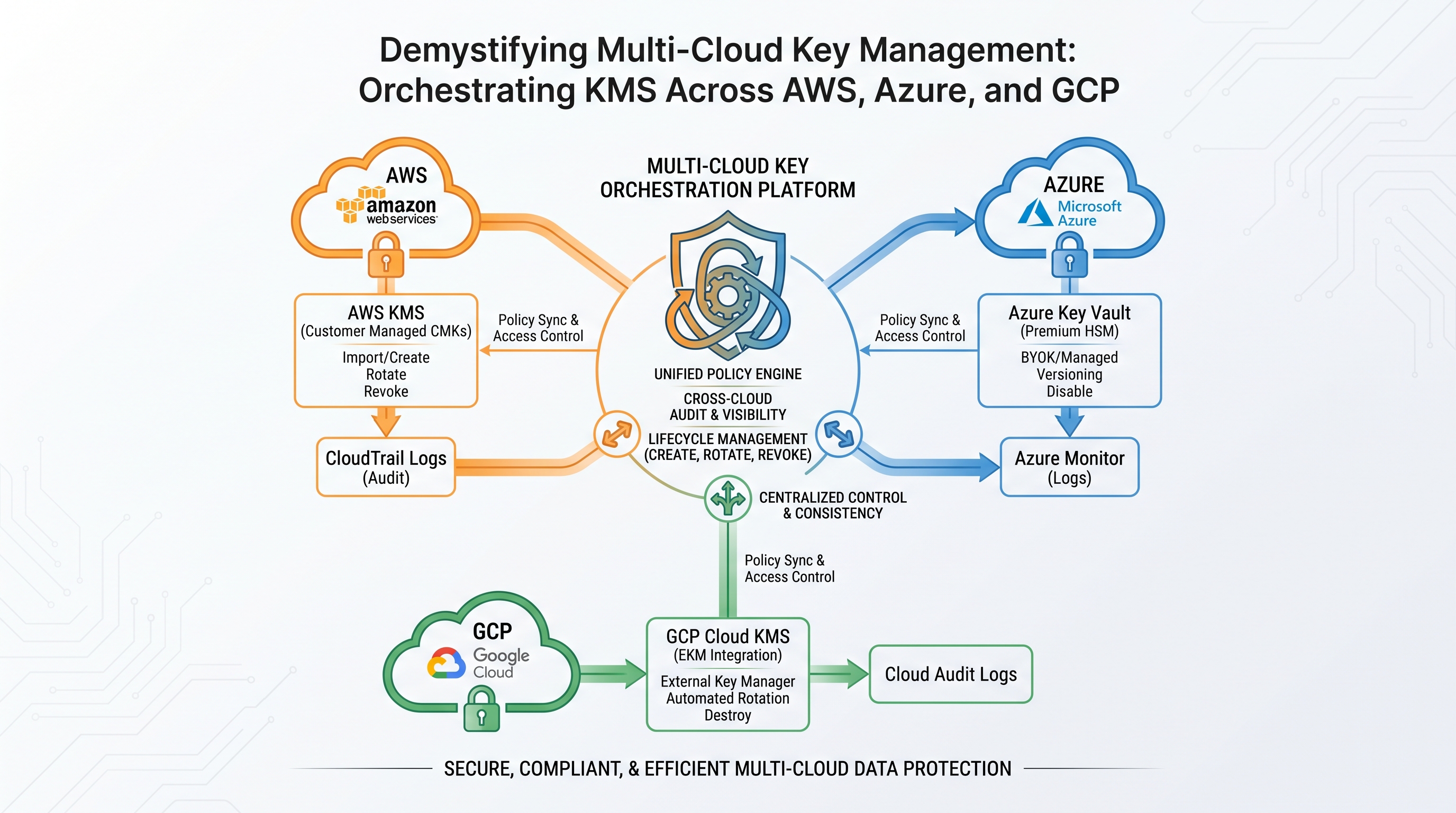
Introduction: The Multi-Cloud Cryptographic Dilemma
In the modern enterprise landscape, multi-cloud is no longer a strategic choice—it is the operational reality. As organizations deploy workloads across Amazon Web Services (AWS), Microsoft Azure, and Google Cloud Platform (GCP), security architects face a daunting challenge: securing sensitive data at rest and in transit across fragmented infrastructure. Cryptographic keys are the bedrock of this security paradigm, yet each cloud provider has engineered its own proprietary Key Management Service (KMS), complete with distinct APIs, IAM paradigms, pricing structures, and compliance certifications.
Without a unified approach, multi-cloud key management rapidly devolves into operational chaos. Security teams struggle with configuration drift, compliance officers face visibility gaps, and platform engineers grapple with latency and cross-cloud dependency issues. Furthermore, unoptimized KMS usage can lead to ballooning API transaction costs, complicating FinOps initiatives. To address these challenges, organizations must implement robust cloud security management frameworks that unify cryptographic operations without compromising on the native performance and security benefits of each platform.
1. Architectural Anatomy of Native KMS: AWS vs. Azure vs. GCP
To orchestrate keys across multiple clouds, we must first understand the fundamental architectural differences between the native key management systems of the "Big Three" cloud providers. Each provider approaches key storage, identity integration, and hardware security modules (HSMs) differently.
Amazon Web Services (AWS) KMS
AWS KMS is a fully managed service integrated deeply with the broader AWS ecosystem. It utilizes Customer Master Keys (CMKs)—now termed AWS KMS keys—which can be symmetric or asymmetric. AWS KMS keys never leave AWS KMS unencrypted; instead, cryptographic operations are performed within the KMS boundary.
Hardware Security: AWS KMS uses FIPS 140-2 Level 2 validated HSMs (and Level 3 for cryptographic operations in certain regions). For dedicated, single-tenant hardware, AWS offers CloudHSM, which can back a Custom Key Store (CKS).
Access Control: Access is governed via a combination of IAM policies and resource-based Key Policies. Key Policies are mandatory; even an administrator with full IAM permissions cannot access a key unless the Key Policy explicitly grants it.
Key Types: Supports symmetric (AES-256-GCM) and asymmetric (RSA, Elliptic Curve) keys.
Microsoft Azure Key Vault & Managed HSM
Azure splits its key management offering into two distinct tiers: standard multi-tenant Azure Key Vault (AKV) and single-tenant Azure Key Vault Managed HSM.
Hardware Security: Standard Azure Key Vault uses FIPS 140-2 Level 2 (software-protected) or Level 3 (HSM-protected) keys. Managed HSM provides fully isolated, single-tenant HSM pools validated at FIPS 140-2 Level 3.
Access Control: Historically managed via Vault Access Policies, Azure now heavily promotes Azure Role-Based Access Control (Azure RBAC) integrated with Microsoft Entra ID (formerly Azure AD) for granular, control-plane and data-plane isolation.
Key Types: Supports RSA and Elliptic Curve (EC) keys. Symmetric keys are not directly supported for cryptographic operations inside standard Key Vault; they must be managed as secrets or handled via Managed HSM.
Google Cloud Platform (GCP) Cloud KMS
GCP Cloud KMS is built on a highly scalable, global architecture. Unlike AWS and Azure, which organize keys inside vaults or account-level services, GCP organizes keys hierarchically: Organization -> Folder -> Project -> Location -> Key Ring -> Key -> Key Version.
Hardware Security: Cloud KMS supports software keys, HSM-protected keys (FIPS 140-2 Level 3), and External Key Management (Cloud EKM) which allows keys to reside in third-party, on-premises HSMs.
Access Control: Governed entirely by Cloud IAM. Permissions are granted at any level of the resource hierarchy, providing massive scalability for large enterprises.
Key Types: Supports symmetric (AES-256), asymmetric signing (RSA, ECDSA), and asymmetric encryption (RSA).
At-a-Glance Comparison
Feature / Dimension | AWS KMS | Azure Key Vault / Managed HSM | GCP Cloud KMS |
|---|---|---|---|
Primary Identity Provider | AWS IAM | Microsoft Entra ID | Google Cloud IAM |
Access Policy Model | Key Policies + IAM Policies | Azure RBAC or Vault Access Policies | Resource-Hierarchical Cloud IAM |
Symmetric Encryption | Native (AES-256-GCM) | Supported in Managed HSM only | Native (AES-256) |
Hardware Validation | FIPS 140-2 Level 2 (Level 3 Custom Key Store) | FIPS 140-2 Level 2 (KV) / Level 3 (Managed HSM) | FIPS 140-2 Level 3 (Cloud HSM) |
External Key Support | AWS KMS Custom Key Store (CloudHSM / External HSM) | BYOK (Bring Your Own Key) via HSM import | Cloud EKM (External Key Manager) |
2. The Multi-Cloud Key Orchestration Problem
When operating across multiple cloud providers, security and infrastructure teams face a critical integration problem: How do we securely decrypt data residing in Cloud A using a key managed in Cloud B, or encrypt data spanning multiple environments without violating security boundaries?
Consider a practical enterprise architecture: An application running on an AWS EKS (Elastic Kubernetes Service) cluster needs to ingest and process sensitive customer data stored in Google Cloud Storage (GCS), while the analytical processing engine resides in Azure Synapse. To maintain a strict zero-trust posture, the data must remain encrypted end-to-end. If AWS, Azure, and GCP each use their own isolated KMS, the application is forced to manage three sets of APIs, handle cross-cloud authentication, manage key rotation schedules independently, and handle the latency overhead of cross-cloud cryptographic calls.
Envelope Encryption and the DEK/KEK Pattern
To mitigate the latency and cost of transmitting large payloads across clouds for cryptographic operations, modern cloud architectures rely on Envelope Encryption. In this design:
A Data Encryption Key (DEK) is generated locally to encrypt the actual payload (e.g., using fast symmetric AES-256-GCM).
The DEK is then encrypted (wrapped) using a Key Encryption Key (KEK) stored securely inside a KMS.
The encrypted payload and the encrypted DEK are stored together.
To decrypt, the application sends the encrypted DEK to the KMS, which decrypts it using the KEK and returns the plaintext DEK. The application then decrypts the payload locally and immediately purges the plaintext DEK from memory.
While envelope encryption solves the payload transit problem, orchestrating the KEK across multiple clouds remains highly complex. If the KEK resides in AWS KMS, Azure workloads must authenticate securely to AWS to decrypt the DEK. This cross-cloud trust establishment requires robust federated identity configuration and careful policy management.
3. Designing a Unified Multi-Cloud KMS Architecture
Enterprises can adopt three primary architectural patterns to orchestrate keys across AWS, Azure, and GCP. Each pattern balances security, operational overhead, latency, and compliance differently.
Pattern A: Cross-Cloud IAM Federation (Native-to-Native)
In this pattern, keys remain strictly native to the cloud provider where the data resides, but identity federation is used to allow cross-cloud workloads to access the respective KMS. For example, an application running on AWS EC2 can assume an IAM role in GCP via Workload Identity Federation to access GCP Cloud KMS.
This approach minimizes latency because data-plane services use local keys, but it increases configuration complexity because security teams must manage trust relationships across OIDC (OpenID Connect) providers, AWS IAM, Azure Entra ID, and GCP IAM.
Example: AWS Key Policy Allowing Federated GCP Workload Access
Below is a JSON representation of an AWS KMS Key Policy that grants decrypt permissions to a federated role assumed by a GCP service account via OIDC:
{
    "Version": "2012-10-17",
    "Statement": [
        {
            "Sid": "AllowLocalAdminFullAccess",
            "Effect": "Allow",
            "Principal": {
                "AWS": "arn:aws:iam::111122223333:root"
            },
            "Action": "kms:*",
            "Resource": "*"
        },
        {
            "Sid": "AllowGCPWorkloadFederatedDecrypt",
            "Effect": "Allow",
            "Principal": {
                "AWS": "arn:aws:iam::111122223333:role/gcp-federated-kms-reader-role"
            },
            "Action": [
                "kms:Decrypt",
                "kms:DescribeKey"
            ],
            "Resource": "*",
            "Condition": {
                "StringEquals": {
                    "kms:ViaService": "ec2.us-east-1.amazonaws.com"
                }
            }
        }
    ]
}
Pattern B: Bring Your Own Key (BYOK) with a Centralized HSM
For organizations requiring strict control over key generation, the BYOK pattern is highly effective. Keys are generated in a highly secure, on-premises physical HSM (or a cloud-neutral HSM like HashiCorp Vault or Fortanix) and then securely imported into AWS KMS, Azure Key Vault, and GCP Cloud KMS.
This allows the enterprise to use the same cryptographic key material across all three clouds, simplifying cross-cloud data mobility. However, managing the lifecycle, rotation, and secure transport of imported keys introduces substantial operational overhead. Furthermore, if a key is rotated, it must be manually or programmatically re-imported into all cloud providers simultaneously to prevent decryption failures.
Pattern C: External Key Management (HYOK / EKM)
Hold Your Own Key (HYOK) or External Key Management (EKM) represents the ultimate level of cryptographic control. In this model, the cloud providers do not hold the key material at all. Instead, when AWS, Azure, or GCP needs to perform a cryptographic operation, they make a secure gRPC or REST API call to an external, third-party HSM controlled entirely by the customer.
While this satisfies the most stringent sovereign data requirements, it introduces a dangerous single point of failure: if the external HSM goes offline or suffers from latency spikes, all dependent cloud services (databases, storage buckets, compute instances) will instantly fail to read or write data. This architecture is generally reserved for highly regulated industries like banking, healthcare, and defense.
4. FinOps of Key Management: Optimizing KMS Costs
While security is the primary driver of KMS architecture, cost optimization is a frequently overlooked aspect of multi-cloud key management. Unoptimized cryptographic operations can lead to astronomical bills, particularly in high-throughput transactional systems.
Understanding KMS Pricing Models
Each cloud provider structures its KMS pricing differently, making direct comparisons difficult without careful analysis:
AWS KMS: Charges $1.00 per month per KMS key. Cryptographic operations (symmetric) cost $0.03 per 10,000 API requests. Asymmetric operations cost $0.03 to $0.15 per 10,000 requests depending on the algorithm.
Azure Key Vault: Software-protected keys cost $0.03 per 10,000 operations. HSM-protected keys cost $1.00 per 10,000 operations. Managed HSM instances cost approximately $1.62 per hour (~$1,180 per month) regardless of transaction volume.
GCP Cloud KMS: Charges $0.06 per active key version per month (software-protected) or $1.00 per active key version per month (HSM-protected). Cryptographic operations cost $0.03 per 10,000 operations.
FinOps Math: The Cost of Scale
Consider an enterprise running a high-volume microservices architecture across AWS and GCP that processes 500 million transactions per month. If every transaction makes a direct call to KMS to decrypt a payload:
AWS KMS Cost Projection:
Base Keys: 50 keys * $1.00/month = $50.00
API Operations: (500,000,000 / 10,000) * $0.03 = $1,500.00
Total Monthly AWS KMS Cost: $1,550.00
If the architecture is duplicated in GCP with 5 versions per key maintained for historical data:
GCP Cloud KMS Cost Projection:
Base Keys: 50 keys * 5 active versions * $0.06/month = $15.00
API Operations: (500,000,000 / 10,000) * $0.03 = $1,500.00
Total Monthly GCP Cloud KMS Cost: $1,515.00
While $1,500 per month may seem manageable, scale this to thousands of microservices, multiple environments (dev, test, staging, prod), and database-level encryption, and KMS transaction costs can quickly exceed tens of thousands of dollars. To manage and forecast these costs effectively, organizations leverage CloudAtler's financial operations platform to identify waste, trace API call spikes, and optimize resource allocation.
FinOps Optimization Strategies for KMS
Implement DEK Caching: Instead of calling KMS for every single database read/write or API payload, applications should cache the decrypted Data Encryption Key (DEK) in secure memory for a limited duration (e.g., 5 to 15 minutes). This reduces KMS API calls by up to 99%, dropping transaction costs to near zero.
Prune Unused Keys and Versions: In GCP, you are billed for every active key version. If you rotate keys monthly, a single key will have 12 active versions after a year, multiplying your base cost. Disable or destroy old, unused key versions that are no longer needed to decrypt legacy data.
Leverage Local Cryptography for Low-Risk Data: Reserve KMS HSM-backed keys for highly sensitive data (PII, PCI, financial records). For transient, low-risk application data, use local, ephemeral software-based keys.
5. Automated Governance, Compliance, and Rotation
Security compliance frameworks (such as PCI-DSS, SOC 2, ISO 27001, and HIPAA) mandate strict guidelines for cryptographic key management. Specifically, keys must be rotated regularly, access must be audited, and separation of duties must be enforced.
Automating Key Rotation Across Clouds
Manual key rotation is highly error-prone and a frequent cause of production outages. Each cloud provider offers automation mechanisms, but orchestrating them globally requires a unified control plane.
AWS KMS Rotation: AWS offers automatic annual rotation for customer-managed keys. When enabled, AWS KMS automatically generates new key material every year while keeping older key material active to decrypt previously encrypted data.
Azure Key Vault Rotation: Azure supports setting a key rotation policy directly on the key itself. You can define a rotation lifetime (e.g., every 90 days) and an expiration time, triggering automatic rotation and notifying downstream applications via Event Grid.
GCP Cloud KMS Rotation: GCP allows you to set a rotation schedule (e.g., every 30 days) on a key. Cloud KMS automatically creates a new key version on the schedule and sets it as the primary version for new encryption operations.
Achieving Unified Visibility
The primary risk in a multi-cloud KMS architecture is "blind spots." If an administrator accidentally exposes an AWS Key Policy or fails to rotate an Azure Key Vault key, the security posture of the entire enterprise is compromised. To prevent this, CISOs and security directors must establish unified visibility.
Using CloudAtler's unified dashboard, security teams can monitor key states, rotation compliance, and IAM policies across AWS, Azure, and GCP from a single pane of glass. This central oversight ensures that security policies are enforced consistently, regardless of the underlying cloud provider's native quirks.
Furthermore, cloud security leaders can leverage CloudAtler's dedicated CISO security solutions to map cryptographic compliance directly to regulatory frameworks, accelerating audit cycles and eliminating configuration drift automatically.
6. Implementing Cross-Cloud Key Management: A Step-by-Step Guide
Let us walk through a robust, highly secure architecture for sharing cryptographic keys between AWS and GCP using HashiCorp Vault as an intermediary transit engine. This approach avoids direct cross-cloud provider dependencies and provides a centralized control plane.
Step 1: Deploy HashiCorp Vault in a Multi-Region, Multi-Cloud Cluster
Deploy Vault in a highly available configuration across AWS and GCP. Use native cloud KMS (AWS KMS and GCP Cloud KMS) to handle the auto-unseal process of the Vault cluster in their respective environments. This ensures that the root of trust remains hardware-backed.
Step 2: Enable the Transit Secrets Engine
The Transit Secrets Engine in Vault handles cryptographic operations on data in transit. It does not store the data; it simply encrypts or decrypts it and returns the result. Enable the engine via the Vault CLI:
vault secrets enable transitStep 3: Create a Unified Encryption Key
Create a named encryption key inside the transit engine. This key will act as our cross-cloud KEK:
vault write -f transit/keys/multi-cloud-kek type=aes256-gcm96Step 4: Configure Cross-Cloud Authentication
Configure Vault to accept authentication from both AWS IAM roles and GCP Service Accounts. This allows applications in both clouds to authenticate securely without hardcoded credentials.
# Enable AWS Auth Method
vault auth enable aws

# Enable GCP Auth Method
vault auth enable gcp
Step 5: Define a Unified Access Policy
Create a Vault policy that allows applications to encrypt and decrypt data using the unified KEK:
path "transit/encrypt/multi-cloud-kek" {
    capabilities = ["update"]
}
path "transit/decrypt/multi-cloud-kek" {
    capabilities = ["update"]
}
Step 6: Execute Envelope Encryption in Code
Applications running in AWS or GCP can now consume this service via standard REST APIs or SDKs. Below is a conceptual Python implementation using the hvac library to encrypt a local payload:
import hvac
import base64

def encrypt_payload_cross_cloud(plaintext_data, vault_url, client_token):
    # Initialize Vault Client
    client = hvac.Client(url=vault_url, token=client_token)

    # Encode data to base64 as required by Vault Transit Engine
    encoded_data = base64.b64encode(plaintext_data.encode('utf-8')).decode('utf-8')

    # Perform encryption operation via Transit KEK
    encrypt_response = client.secrets.transit.encrypt_data(
        name='multi-cloud-kek',
        plaintext=encoded_data
    )

    ciphertext = encrypt_response['data']['ciphertext']
    return ciphertext

# Example Usage
encrypted_data = encrypt_payload_cross_cloud("Sensitive Multi-Cloud Data", "https://vault.internal.net", "s.xxxxxx")
print(f"Ciphertext: {encrypted_data}")
Conclusion: Unify Your Multi-Cloud Security and Operations
Orchestrating Key Management Services across AWS, Azure, and GCP requires a delicate balance of cryptographic rigor, architectural planning, and active cost management. By understanding the unique design paradigms of each cloud provider, implementing federated identity models, and adopting envelope encryption patterns, enterprises can successfully mitigate security risks and prevent operational bottlenecks.
However, managing security policies, tracking key rotations, and keeping KMS transaction costs under control across multiple clouds remains a massive operational burden. Security and operations teams cannot afford to operate in silos, wasting valuable engineering hours manually auditing keys or chasing down FinOps anomalies.
This is where CloudAtler's Atler AI engine steps in. By unifying cloud security, financial operations, and automated infrastructure management into a single, cohesive platform, CloudAtler empowers organizations to maintain a flawless security posture while continuously optimizing cloud spend. Don't let cryptographic complexity slow down your engineering velocity.
Ready to simplify your multi-cloud operations? Discover how CloudAtler can revolutionize your cloud governance, security, and FinOps. Explore the CloudAtler Platform today or schedule a personalized demo with our cloud architecture experts.
All in One Place
Atler Pilot decodes your cloud spend story by bringing monitoring, automation, and intelligent insights together for faster and better cloud operations.