
The Friction of Modern Cloud Operations: Velocity vs. Control
For years, enterprise IT operations operated under a ticket-driven paradigm. If a software engineering team needed a new database, a virtual private cloud (VPC), or an IAM role, they submitted a ticket to a centralized infrastructure team. This model ensured strict governance, but it created massive operational bottlenecks, dragging down developer velocity and delaying time-to-market.
The advent of public cloud and Infrastructure-as-Code (IaC) promised to solve this. By giving developers direct access to cloud APIs via Terraform, CloudFormation, or Pulumi, organizations unlocked unprecedented speed. However, this decentralized freedom introduced severe unintended consequences: runaway cloud spend, fragmented architectural patterns, shadow IT, and critical security vulnerabilities. Without centralized control, developers routinely provisioned over-provisioned compute instances, left storage buckets exposed to the public internet, and ignored resource tagging requirements.
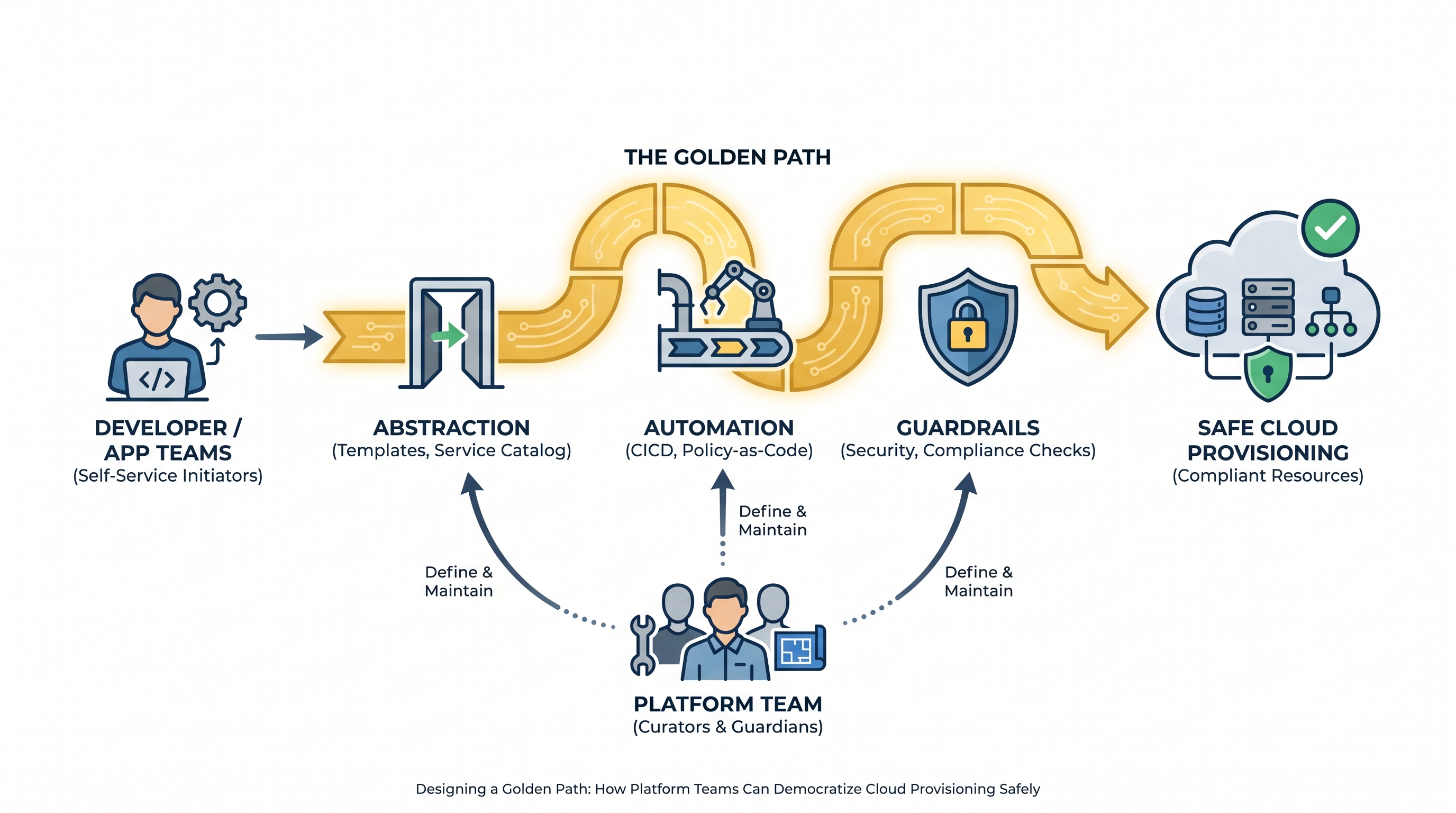
To resolve this tension, modern enterprises are turning to Platform Engineering. Instead of acting as gatekeepers, platform teams function as product teams, building internal developer platforms (IDPs) that offer self-service capabilities. At the core of this strategy is the concept of the "Golden Path" (sometimes called the Paved Road). A Golden Path is a defined, supported, and highly automated task-oriented workflow that guides developers through a safe, compliant journey to deploy software and infrastructure.
Democratizing cloud provisioning safely requires more than just publishing a repository of Terraform templates. It demands a highly orchestrated ecosystem that integrates Policy-as-Code, shift-left cost estimation, continuous drift detection, and automated operations. By leveraging robust infrastructure and SRE solutions, platform teams can transition from manual gatekeepers to architects of scalable self-service ecosystems.
Architecting the Golden Path: The Platform Engineering Blueprint
A successful Golden Path abstract away cloud complexity while preserving the underlying flexibility that developers need. If the abstraction is too restrictive, developers will bypass it, creating a "shadow path." If it is too loose, the organization is exposed to security and financial risks. Striking the right balance requires a modular, layered platform architecture.
Figure 1: The layered architecture of a modern multi-cloud Golden Path, balancing developer autonomy with centralized governance.
1. The Abstraction Layer (The Developer Interface)
Developers should not have to write 500 lines of raw HCL (HashiCorp Configuration Language) to deploy a standard microservice. The Golden Path provides simplified interfaces, which can take several forms:
Internal Developer Portals (IDPs): Platforms like Backstage (originally open-sourced by Spotify) allow developers to trigger templates via a graphical interface. With a few clicks, a developer can provision a "Secure Spring Boot Service on AWS EKS."
Custom CLI Tools: Internal CLI tools that wrap IaC execution, allowing developers to scaffold and deploy resources directly from their terminals.
High-Level IaC Modules: Opinionated, version-controlled Terraform or Pulumi modules maintained by the platform team that enforce corporate defaults (e.g., automated backups, private network routing, and mandatory monitoring agents).
2. The Orchestration and GitOps CI/CD Pipeline
Direct apply commands from a developer’s local machine should be strictly prohibited. All provisioning must flow through a structured CI/CD pipeline. Using a GitOps model (via tools like ArgoCD for Kubernetes or Terraform Cloud/Spacelift for general infrastructure) ensures that the Git repository remains the single source of truth. The pipeline acts as the automated gatekeeper, executing security scans, linting, cost projections, and policy checks before any resource is modified in the cloud provider.
3. Multi-Cloud Consistency (AWS, Azure, GCP, and Oracle)
Enterprise environments are rarely single-cloud. A robust Golden Path must provide a consistent developer experience whether the underlying target is AWS, Azure, GCP, or Oracle Cloud Infrastructure (OCI). This requires platform teams to build abstract resource definitions. While the underlying Terraform modules will differ per provider, the developer-facing inputs should remain standardized, ensuring that multi-cloud complexity is managed by the platform, not the individual application teams.
Security Integration: Shift-Left Vulnerability Management and Guardrails
Securing the Golden Path requires moving security from a post-deployment audit phase to an active, pre-deployment prevention phase—a practice known as "shifting left." Instead of discovering an exposed S3 bucket via a security scan weeks after deployment, the infrastructure pipeline should block the deployment entirely.
Policy-as-Code (PaC)
Policy-as-Code allows platform teams to write, version, and execute compliance rules using programming logic. The industry standards for PaC are Open Policy Agent (OPA) using the Rego language, and HashiCorp Sentinel. By integrating PaC into the GitOps pipeline, you can programmatically inspect the execution plan of any infrastructure change before it is applied.
Consider the following OPA Rego policy, which analyzes a Terraform plan JSON file to ensure that all AWS S3 buckets have public access blocks enabled and are encrypted with customer-managed KMS keys:
package terraform.validation

default allow = false

# Helper to capture all resource changes in the plan
resource_changes[rc] {
    rc := input.resource_changes[_]
}

# Rule: Allow only if there are no violations
allow {
    count(violations) == 0
}

# Violation: S3 bucket without public access block
violations[msg] {
    some i
    rc := resource_changes[i]
    rc.type == "aws_s3_bucket"
    # Check if a corresponding public access block exists in the configuration
    not has_public_access_block(rc.address)
    msg := sprintf("Security Violation: S3 bucket '%v' is missing a secure public access block configuration.", [rc.address])
}

# Violation: S3 bucket not encrypted with KMS
violations[msg] {
    some i
    rc := resource_changes[i]
    rc.type == "aws_s3_bucket"
    enc := rc.change.after.server_side_encryption_configuration[_].rule[_].apply_server_side_encryption_by_default[_]
    enc.sse_algorithm != "aws:kms"
    msg := sprintf("Security Violation: S3 bucket '%v' must use KMS encryption (sse_algorithm: 'aws:kms').", [rc.address])
}

has_public_access_block(bucket_address) {
    some j
    rc := resource_changes[j]
    rc.type == "aws_s3_bucket_public_access_block"
    rc.change.after.bucket == bucket_address
    rc.change.after.block_public_acls == true
    rc.change.after.block_public_policy == true
    rc.change.after.ignore_public_acls == true
    rc.change.after.restrict_public_buckets == true
}
By enforcing this policy within the pull request workflow, developers receive instant feedback. If they attempt to merge code that violates these security mandates, the build fails, and the pipeline prevents provisioning. This continuous enforcement is bolstered when paired with enterprise-grade automated security guardrails, ensuring that drift or manual out-of-band overrides are immediately flagged and remediated.
Least Privilege IAM and Boundary Policies
Another pillar of safe provisioning is limiting the "blast radius" of developer credentials. Platform teams should implement dynamic, ephemeral credentialing (e.g., via HashiCorp Vault or AWS IAM Roles Anywhere) rather than long-lived static API keys. When a developer triggers a Golden Path pipeline, the pipeline assumes a highly scoped IAM role designed specifically for that application's context. Furthermore, AWS IAM Permission Boundaries or GCP Organization Policies should be applied to ensure that even if a developer has access to configure IAM, they cannot escalate their privileges beyond pre-defined limits.
FinOps by Design: Embedding Cost Controls into Provisioning
Historically, FinOps (Cloud Financial Operations) has been a reactive practice. Finance departments receive a massive cloud bill at the end of the month, identify anomalies, and ask engineering teams to downsize resources. This approach is highly inefficient. A true Golden Path embeds FinOps directly into the provisioning lifecycle, turning cost management into a proactive engineering discipline.
1. Pre-Deployment Cost Estimation
Just as security policies run during the Pull Request phase, cost estimation tools (such as Infracost) should analyze the proposed infrastructure changes and calculate the exact financial impact. For example, if a developer changes an AWS RDS instance type from a db.t3.medium to a db.r5.4xlarge, the pipeline should comment directly on the PR, showing the monthly cost delta:
## 💰 CloudAtler FinOps Guardrail: Cost Estimate Update

| Resource | Action | Unit | Qty | Monthly Cost Delta |
| :--- | :--- | :--- | :--- | :--- |
| **aws_db_instance.primary** | Modified | db.r5.4xlarge | 730 hrs | +$1,024.80 |
| **aws_ebs_volume.db_storage** | Unchanged | GP3 | 500 GB | $0.00 |

**Total Monthly Change:** +$1,024.80 USD
⚠️ This change exceeds the team's monthly budget threshold of $500.00 USD. Approval from the FinOps Lead is required before merging.
This transparent feedback loop forces developers to consider the financial impact of their architectural decisions before the resources are ever provisioned in the cloud.
2. Metadata and Automated Tagging
Without accurate resource tagging, cloud cost allocation is impossible. The Golden Path must enforce tagging standards programmatically. Rather than relying on developers to manually type tags (which leads to typos like Env: Production vs environment: prod), the platform's underlying IaC modules should automatically inject standardized tags. These tags should include key dimensions such as Cost Center, Owner, Environment, Application ID, and Business Unit. Implementing robust automated tagging solutions ensures that every single resource provisioned through the platform is instantly discoverable and fully traceable back to its respective budget owner.
3. Architectural Right-Sizing Defaults
The easiest way to save money on cloud infrastructure is to avoid provisioning unnecessary capacity in the first place. The Golden Path should ship with cost-optimized defaults. For example, compute resources should default to utilizing ARM64-based instances (such as AWS Graviton or Azure Ampere Altra), which offer significantly better price-to-performance ratios than traditional x86 instances. Storage resources should default to auto-tiering options, and non-production environments should be configured with auto-shutdown schedules to eliminate idle compute spend over weekends and holidays.
By shifting FinOps left, companies can leverage a comprehensive cloud financial operations platform to monitor and enforce these parameters continuously, creating a highly efficient cloud operating model.
Technical Implementation: A Step-by-Step Multi-Cloud Terraform Module Example
To illustrate how these concepts come together, let's look at a concrete, production-grade Terraform module that represents a "Golden Path" asset. This module provisions a secure, cost-optimized, and fully tagged virtual machine instance on AWS, enforcing security best practices (IMDSv2, EBS encryption, disabled public IP) and integrating automated tagging.
# Golden Path Module: Secure & Cost-Optimized Compute Instance
# File: modules/golden_compute/main.tf

terraform {
  required_version = ">= 1.5.0"
  required_providers {
    aws = {
      source  = "hashicorp/aws"
      version = "~> 5.0"
    }
  }
}

variable "environment" {
  type        = string
  description = "Target deployment environment (dev, staging, prod)"
  validation {
    condition     = contains(["dev", "staging", "prod"], var.environment)
    error_message = "The environment variable must be one of: dev, staging, prod."
  }
}

variable "application_id" {
  type        = string
  description = "The unique identifier of the application."
}

variable "owner_email" {
  type        = string
  description = "The contact email of the resource owner."
}

variable "subnet_id" {
  type        = string
  description = "The private subnet ID where the compute instance will reside."
}

variable "vpc_security_group_ids" {
  type        = list(string)
  description = "A list of security group IDs to associate with the instance."
}

# Local variables to enforce corporate tagging standards and cost optimization
locals {
  # Enforce ARM64 (Graviton) for cost efficiency based on environment
  instance_type = var.environment == "prod" ? "m7g.large" : "t4g.medium"

  # Standardized metadata tags
  mandatory_tags = {
    Environment     = var.environment
    ApplicationID   = var.application_id
    Owner           = var.owner_email
    ProvisionedBy   = "Platform-Golden-Path-v2.1"
    FinOpsManaged   = "true"
    SecurityLevel   = "High"
  }
}

# Fetch the latest secure Amazon Linux 2023 AMI for ARM64 architecture
data "aws_ami" "secure_al2023" {
  most_recent = true
  owners      = ["amazon"]

  filter {
    name   = "name"
    values = ["al2023-ami-2023.*-kernel-6.1-arm64"]
  }
}

# Fetch or define a Customer Managed Key (CMK) for EBS Encryption
data "aws_kms_key" "ebs_key" {
  key_id = "alias/corporate-ebs-key"
}

resource "aws_instance" "golden_compute" {
  ami           = data.aws_ami.secure_al2023.id
  instance_type = local.instance_type
  subnet_id     = var.subnet_id

  # Security: Enforce association of scoped security groups
  vpc_security_group_ids = var.vpc_security_group_ids

  # Security: Prevent public IP assignment to ensure private-only routing
  associate_public_ip_address = false

  # Security: Enforce Instance Metadata Service Version 2 (IMDSv2)
  metadata_options {
    http_endpoint               = "enabled"
    http_tokens                 = "required" # Enforces IMDSv2
    http_put_response_hop_limit = 1
    instance_metadata_tags      = "enabled"
  }

  # Security & Compliance: Enforce EBS Encryption at rest using Customer Managed Keys
  root_block_device {
    encrypted             = true
    kms_key_id            = data.aws_kms_key.ebs_key.arn
    volume_type           = "gp3" # Cost-optimized storage type
    volume_size           = 50
    delete_on_termination = true
  }

  # FinOps: Automatically inject corporate tagging standards
  tags = local.mandatory_tags
}

output "instance_id" {
  value       = aws_instance.golden_compute.id
  description = "The ID of the secure compute instance."
}

output "private_ip" {
  value       = aws_instance.golden_compute.private_ip
  description = "The private IP address of the secure compute instance."
}
This module demonstrates how platform teams can hardcode compliance. A developer utilizing this module does not need to know what IMDSv2 is, nor do they need to remember to specify EBS encryption or select the cheaper Graviton instance type. The Golden Path handles these decisions automatically, guaranteeing compliance by design.
Operational Feedback Loops: Monitoring, Drift Detection, and Self-Healing
The lifecycle of a provisioned resource does not end once the CI/CD pipeline completes. Over time, cloud environments are subject to "configuration drift." A user might manually log into the AWS Console and open a port in a security group to debug an issue, or an automated script might inadvertently alter a tag.
To maintain the integrity of the Golden Path, platform teams must establish continuous operational feedback loops. This involves three key pillars:
1. Continuous Drift Detection
A GitOps engine or a dedicated cloud governance platform should continuously compare the actual state of resources in the cloud provider against the desired state defined in the Git repository. If any discrepancy is discovered, the system should instantly raise an alert. For critical security resources, the platform should go beyond alerting and automatically reconcile the drift, overwriting the manual change and restoring the compliant configuration.
2. Post-Deployment Vulnerability Scanning
Even if an infrastructure asset was secure at the time of provisioning, new zero-day vulnerabilities emerge constantly. Platform teams must integrate continuous container image scanning, operating system patch intelligence, and network vulnerability assessments. If a security vulnerability is discovered in an active compute instance, the platform should flag it, prioritize it based on risk, and trigger automated remediation workflows.
3. Dynamic Performance and Cost Optimization
A resource that was correctly sized at deployment may become idle or over-provisioned over time. Platform teams should implement continuous performance monitoring that tracks CPU, memory, network, and disk utilization. By cross-referencing performance metrics with pricing data, the platform can automatically identify optimization opportunities—such as downgrading an idle database or converting an underutilized instance to a spot instance.
How CloudAtler Unifies and Automates the Golden Path
Building and maintaining a custom platform engineering ecosystem from scratch requires an enormous amount of engineering overhead. Teams must stitch together disparate tools for IaC, policy enforcement, cost tracking, patching, and vulnerability management. This is where CloudAtler excels.
CloudAtler is an AI-powered platform designed to unify FinOps, cloud security, and automated operations across AWS, Azure, GCP, and Oracle environments. Instead of managing fragmented tools, CloudAtler acts as the operational overlay for your Golden Paths, ensuring that your self-service provisioning remains secure, compliant, and cost-optimized at scale.
Intelligent Guardrails: CloudAtler’s advanced policy engine continuously scans your multi-cloud environment, enforcing real-time security and compliance guardrails. It automatically detects configuration drift, public resource exposure, and non-compliant IAM configurations, allowing platform teams to delegate provisioning with absolute confidence.
Proactive FinOps Command Center: With CloudAtler, cost optimization is built directly into your operations. The platform provides deep, multi-cloud visibility, predictive budget forecasting, and cost impact calculations, helping you prevent cost anomalies before they hit your monthly bill.
AI-Driven Operations: Powered by the Atler AI engine, the platform automates complex operational tasks, from intelligent patch remediation to automated tagging and self-healing workflows. It bridges the gap between SRE, Security, and Finance teams, fostering a culture of transparency and shared accountability.
Conclusion: Empowering Developers Safely
The ultimate goal of platform engineering is not to restrict developers, but to empower them. By designing a secure, automated Golden Path, platform teams eliminate the friction of provisioning, allowing software engineers to focus on what they do best: shipping business value.
However, democratization cannot come at the expense of enterprise security or financial health. By combining modular Infrastructure-as-Code, strict Policy-as-Code guardrails, shift-left cost estimation, and robust operational feedback loops, you can build a self-service cloud ecosystem that scales safely and efficiently.
Ready to supercharge your platform engineering and secure your cloud operations? Discover how CloudAtler can unify your FinOps and security today. Schedule a demo to see our AI-powered platform in action and start building your ultimate Golden Path.
All in One Place
Atler Pilot decodes your cloud spend story by bringing monitoring, automation, and intelligent insights together for faster and better cloud operations.