
Introduction: The Multi-Cloud Imperative and the Latency Challenge
Modern enterprise IT has moved past the question of whether to adopt a multi-cloud strategy. Today, the focus is on execution. Organizations choose AWS for its vast ecosystem and mature compute services, GCP for its cutting-edge data analytics and Kubernetes leadership, Azure for its deep enterprise integration, and Oracle Cloud Infrastructure (OCI) for its high-performance bare metal and cost-effective database licensing. However, distributing workloads across these distinct cloud providers introduces a major physical constraint: network latency.
When an application running in AWS us-east-1 needs to query a database hosted in GCP us-east4, or when an Azure-based web tier communicates with an Oracle Autonomous Database in OCI Ashburn, every millisecond of round-trip time (RTT) directly impacts user experience, throughput, and system reliability. Minimizing this latency requires deep architectural alignment across physical fiber routing, Layer 2 and Layer 3 networking, routing protocols, security controls, and financial operations.
Without a unified operational framework, managing these complex cross-cloud environments can lead to fragmented visibility, runaway egress costs, and critical security vulnerabilities. By utilizing a centralized unified dashboard, enterprise teams can gain the end-to-end visibility necessary to monitor performance, optimize costs, and enforce security policies across all cloud environments.
The Physics of Inter-Cloud Latency
To design a low-latency multi-cloud network, architects must first understand the physical and geographic realities that govern network performance. Latency is primarily a function of distance, fiber quality, and the number of network hops (routing and switching overhead). The speed of light in a vacuum is approximately 300,000 km/s, but inside a single-mode fiber-optic cable, it propagates at roughly 200,000 km/s. This translates to approximately 1 millisecond of RTT for every 100 kilometers (62 miles) of physical distance.
Geographic co-location is the single most critical factor in reducing multi-cloud latency. If your AWS workloads are in Ireland (eu-west-1) and your GCP resources are in Frankfurt (europe-west3), you will face a baseline physical latency of 15 to 25 milliseconds, regardless of how optimized your network stack is. Conversely, selecting regions that share close physical proximity—such as Northern Virginia for AWS (us-east-1), GCP (us-east4), Azure (East US), and OCI (Ashburn)—reduces the baseline physical RTT to sub-2 milliseconds.
Baseline Multi-Cloud Latency Matrix (Co-located Regions)
The following table outlines the expected baseline latencies when utilizing dedicated private interconnects between co-located cloud regions in the Northern Virginia area:
Source Region | Destination Region | Connection Type | Expected Latency (RTT) |
|---|---|---|---|
AWS (us-east-1) | GCP (us-east4) | Equinix Cloud Exchange (Direct Connect <> Interconnect) | 1.8 ms – 2.5 ms |
Azure (East US) | OCI (us-ashburn-1) | Azure-OCI Interconnect (ExpressRoute <> FastConnect) | 1.2 ms – 1.8 ms |
AWS (us-east-1) | Azure (East US) | Megaport Cloud Exchange | 2.0 ms – 3.0 ms |
GCP (us-east4) | OCI (us-ashburn-1) | Equinix Fabric | 2.2 ms – 3.2 ms |
AWS to GCP Low-Latency Architecture
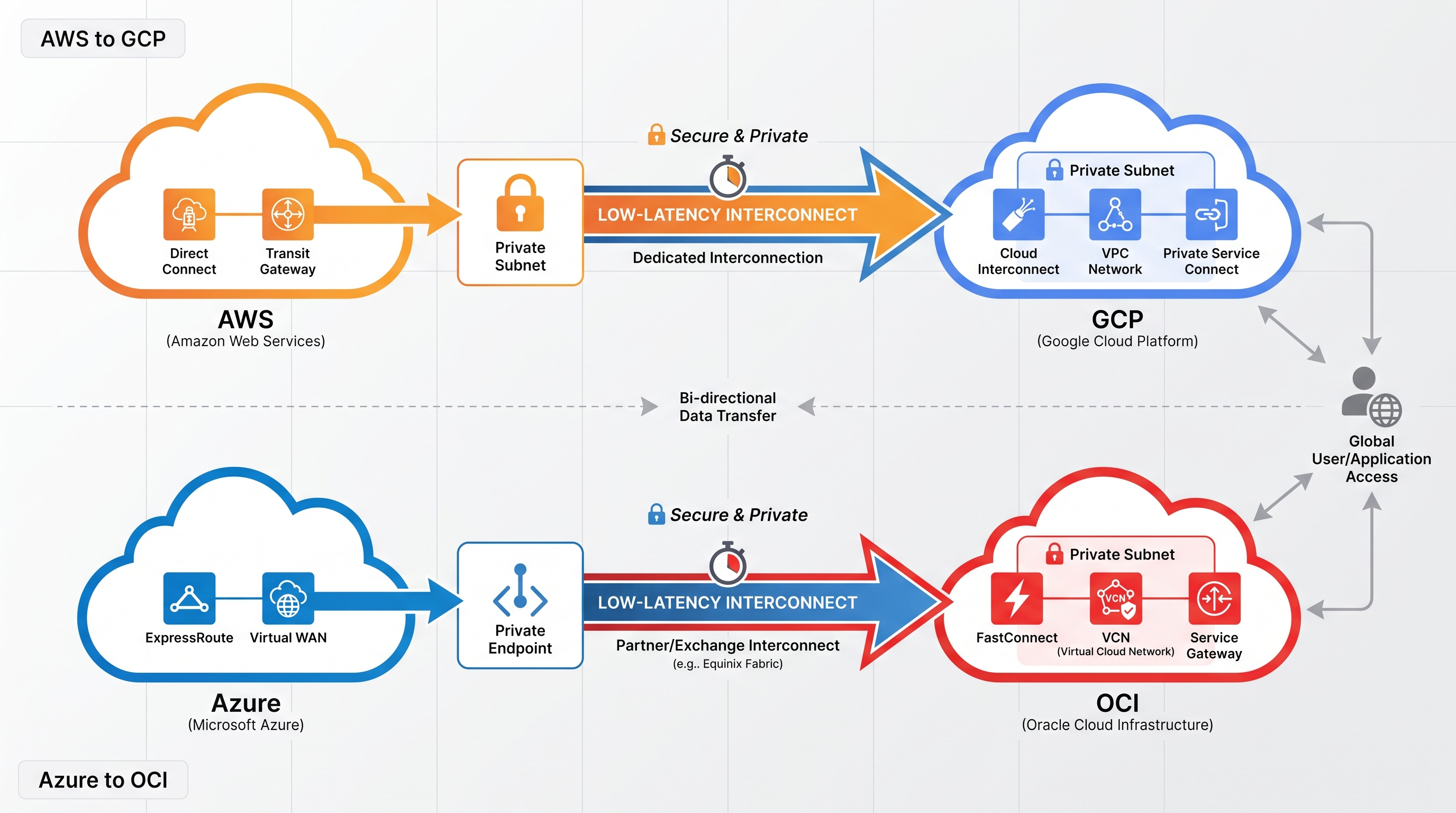
Connecting AWS and GCP with minimal latency requires bypassing the public internet entirely. Relying on IPsec VPNs over the public internet introduces unpredictable routing, packet loss, and jitter due to the volatile nature of public BGP routing. Instead, architects must implement a private, dedicated Layer 2 or Layer 3 connection using AWS Direct Connect and GCP Dedicated Interconnect, bridged via a third-party Cloud Exchange Provider (CXP) such as Equinix, Megaport, or PacketFabric.
Physical Connectivity and Cloud Exchange Integration
In a standard AWS-to-GCP private architecture, the CXP hosts a physical routing fabric within a shared colocation facility (e.g., Equinix Ashburn DC1-DC11). The architecture is established as follows:
AWS Direct Connect (DX): A dedicated physical connection (or hosted connection) is provisioned from the AWS region to the CXP's meet-me room (MMR). This connection terminates on an AWS Direct Connect Gateway (DXGW).
GCP Partner or Dedicated Interconnect: Similarly, a high-speed link is provisioned from GCP's edge network to the same CXP fabric, terminating on a GCP Cloud Router.
Software-Defined Cloud Router (SDCR): The CXP provisions a virtual router (e.g., Megaport Cloud Router or Equinix Fabric Virtual Router) to bridge the two circuits. This virtual router handles the Layer 3 BGP peering between AWS and GCP.
BGP Configuration and Routing Optimization
To ensure optimal routing and prevent sub-optimal routing paths (asymmetric routing), BGP must be configured precisely. The virtual router in the CXP acts as the intermediary Autonomous System (AS). Below is an example of the BGP peering configuration logic:
+------------------+                 +---------------------+                 +------------------+
|   AWS VPC        |                 | Cloud Exchange      |                 |   GCP VPC        |
|   ASN: 64512     | <-- BGP Peer -->| Virtual Router      | <-- BGP Peer -->|   ASN: 16550     |
|   Subnet:        |                 | ASN: 133937         |                 |   Subnet:        |
|   10.100.0.0/16  |                 |                     |                 |   10.200.0.0/16  |
+------------------+                 +---------------------+                 +------------------+
Key configurations for optimizing BGP performance include:
Bidirectional Forwarding Detection (BFD): Enable BFD on both the AWS and GCP BGP sessions. BFD reduces route convergence time from the standard BGP hold-down timer (typically 90-180 seconds) to sub-second levels (e.g., 150ms intervals), ensuring near-instantaneous failover to backup paths if a primary link drops.
MTU Tuning: Configure the Maximum Transmission Unit (MTU) to match across the entire path. While AWS Direct Connect supports jumbo frames (9001 MTU) for private virtual interfaces, GCP Cloud VPN and Interconnect default to 1440 or 1500 MTU. To avoid packet fragmentation—which severely degrades latency and throughput—ensure the path MTU is systematically clamped to 1500 bytes across all transit gateways and virtual routers.
AS Path Prepending: If you maintain a secondary VPN backup, use AS Path prepending on the VPN routes to ensure they are treated as less preferred than the Direct Connect/Interconnect paths.
To maintain consistent network health across these configurations, engineering teams should leverage advanced performance management tools to monitor latency spikes, packet loss, and routing anomalies in real time.
Azure to OCI Low-Latency Interconnect
One of the most powerful and highly optimized multi-cloud partnerships in the industry is the Azure-OCI Interconnect. Recognizing that many enterprise workloads run their application tiers on Microsoft Azure and their database tiers on Oracle Cloud Infrastructure, Microsoft and Oracle built a direct, private, high-speed fiber connection between their respective datacenters in select global regions.
The Architecture of the Azure-OCI Interconnect
Unlike the AWS-to-GCP path, which requires a third-party CXP, the Azure-OCI Interconnect is a direct physical link between Azure's ExpressRoute locations and OCI's FastConnect locations. This direct peering bypasses any intermediary networks, yielding latency figures that rival intra-datacenter speeds (frequently under 1.5 milliseconds RTT).
+-----------------------------------+                 +-----------------------------------+
|          Microsoft Azure          |                 |     Oracle Cloud Infrastructure   |
|                                   |                 |                                   |
|   +---------------------------+   |                 |   +---------------------------+   |
|   |         Azure VNet        |   |                 |   |          OCI VCN          |   |
|   +---------------------------+   |                 |   +---------------------------+   |
|                 |                 |                 |                 |                 |
|   +---------------------------+   |                 |   +---------------------------+   |
|   | Virtual Network Gateway   |   |                 |   | Dynamic Routing Gateway   |   |
|   |      (ExpressRoute)       |   |                 |   |       (DRG / FastConnect) |   |
|   +---------------------------+   |                 |   +---------------------------+   |
|                 |                 |                 |                 |                 |
+-----------------|-----------------+                 +-----------------|-----------------+
                  |                                                     |
                  +================== Direct Private Link ==============+
                                     (Azure-OCI Interconnect)
This architecture is particularly effective for split-tier application patterns. For example, a .NET microservice architecture deployed on Azure Kubernetes Service (AKS) can perform synchronous, low-latency SQL queries against an Oracle Real Application Clusters (RAC) database or Autonomous Database running on OCI bare-metal instances.
Step-by-Step Interconnect Implementation
Provision the Azure ExpressRoute Circuit: Create an ExpressRoute circuit in Azure using the provider name "Oracle Cloud FastConnect". Select the appropriate peering location (e.g., Washington DC) and bandwidth tier (ranging from 1 Gbps to 100 Gbps).
Retrieve the Service Key: Copy the unique Service Key generated by Azure.
Configure OCI FastConnect: In the OCI Console, navigate to Networking > FastConnect. Select "Partner" connection, choose "Microsoft Azure: ExpressRoute" as the partner, and enter the Azure Service Key.
Establish BGP Peering: OCI and Azure will automatically exchange BGP configurations. The Dynamic Routing Gateway (DRG) on the OCI side and the Virtual Network Gateway on the Azure side will establish redundant BGP sessions over the private link.
Operational and Financial Benefits
Beyond the performance gains, the Azure-OCI Interconnect offers substantial financial advantages. Under the partnership agreement, there are no egress or ingress charges for data transferred across the Interconnect link. This eliminates one of the most significant cost barriers associated with multi-cloud architectures. However, monitoring overall resource consumption across both clouds remains critical. Utilizing a comprehensive financial operations platform allows enterprises to track their combined spending, forecast budgets, and ensure that resource allocation aligns with business needs.
FinOps and Egress Cost Optimization
While low latency is the primary engineering goal, financial sustainability is the primary business constraint. Data egress fees are the "silent killer" of multi-cloud architectures. Cloud providers charge heavily when data leaves their network to go to another cloud or the internet.
Decoding Multi-Cloud Egress Pricing
Standard internet egress fees are significantly higher than private connection egress fees. Understanding these pricing tiers is essential for designing cost-effective data flows:
AWS Standard Internet Egress: Up to $0.09 per GB.
AWS Direct Connect Egress: Approximately $0.02 per GB (a reduction of over 75%).
GCP Standard Internet Egress: Up to $0.12 per GB (depending on destination).
GCP Dedicated Interconnect Egress: Approximately $0.01 to $0.04 per GB.
Azure ExpressRoute Egress: Approximately $0.025 per GB (or flat-rate unlimited data plans are available).
OCI FastConnect / Interconnect Egress: $0.00 (OCI does not charge for outbound data over the Azure Interconnect, and the first 10 TB of standard egress per month is free).
FinOps Strategies for Cross-Cloud Data Transfer
To prevent multi-cloud networks from generating runaway costs, architects and finance teams should implement the following tactics:
1. Implement Data Minimization at the Application Layer
Avoid sending raw, uncompressed payloads across cloud boundaries. Implement serialization protocols like Protocol Buffers (Protobuf) or Apache Avro instead of verbose JSON or XML. Protobuf can reduce payload sizes by up to 70-80%, directly translating to an equivalent reduction in egress costs and network serialization latency.
2. Leverage Intelligent Caching and Edge Topologies
Deploy localized read-caches (e.g., Redis or Memcached clusters) within each cloud VPC/VNet. If a GCP service frequently requests static or semi-static reference data stored in AWS, cache that data locally in GCP. Set intelligent Time-To-Live (TTL) values to balance data freshness with egress savings.
3. Route Optimization with CloudAtler
Managing and predicting these complex financial dynamics across multiple providers requires advanced tooling. CloudAtler's platform provides real-time visibility into egress patterns, identifying which microservices or databases are driving up inter-cloud data transfer costs. By utilizing historical telemetry and predictive analytics, CloudAtler helps organizations optimize their commit levels with cloud exchange providers and adjust routing policies to minimize financial impact.
Security and Compliance in Cross-Cloud Pipelines
Connecting multiple clouds via private networks expands your organization's attack surface. A compromise in your GCP tenant could easily lateralize into your AWS or Azure environments if strict network segmentation and zero-trust policies are not enforced.
Securing the Transit Data: MACsec vs. IPsec
While private connections like Direct Connect and ExpressRoute bypass the public internet, they are still physical circuits running through third-party facilities. For highly regulated industries (such as finance, healthcare, and defense), encrypting data in transit is non-negotiable.
There are two primary methods for securing transit data:
IPsec VPN over Private Links: This approach establishes IPsec tunnels on top of your Direct Connect or ExpressRoute circuits. While highly secure, IPsec introduces significant cryptographic overhead, which can degrade throughput and increase latency by 1-3 milliseconds due to packet encapsulation and decryption processes.
MACsec (Media Access Control Security - IEEE 802.1AE): MACsec operates at Layer 2, encrypting point-to-point links at the hardware level. Because encryption happens at the physical layer, MACsec provides line-rate encryption (up to 100 Gbps) with near-zero latency overhead (sub-microsecond). Ensure that your CXP and cloud providers support MACsec on your dedicated connections.
Zero-Trust Cross-Cloud Identity and Access Management
A secure multi-cloud architecture requires a unified identity plane. Do not maintain separate, siloed IAM credentials in each cloud. Instead, implement a federated identity model:
Use OpenID Connect (OIDC) or SAML 2.0 to federate identities across clouds. For instance, Azure Active Directory (Entra ID) can act as the central identity provider (IdP), allowing users and service accounts to authenticate securely into AWS and GCP without long-lived static keys.
Implement short-lived, role-based credentials. For cross-cloud application communication, utilize GCP Workload Identity Federation and AWS IAM Roles Anywhere to allow services in one cloud to assume highly restricted, temporary roles in another.
Unified Security Posture Management
Enforcing consistent security baselines across heterogeneous environments is incredibly challenging. To address this, organizations must deploy a centralized cloud security management system. This ensures that security guardrails, firewall rules, and compliance policies are continuously audited and enforced across AWS, GCP, Azure, and OCI from a single pane of glass.
Real-World Architectural Pattern: Split-Tier Microservices
To illustrate these concepts, let us look at a real-world architecture designed for a high-volume financial transaction platform. This system splits its workloads to leverage the specialized strengths of different cloud providers:
Front-End & API Gateway: Hosted on AWS (us-east-1) using Amazon ECS and AWS Fargate for rapid scaling and global content delivery.
Real-Time Analytics & Machine Learning: Hosted on GCP (us-east4) using BigQuery and Vertex AI to run fraud-detection algorithms on incoming transactions.
Transactional Database: Hosted on OCI (us-ashburn-1) running Oracle Autonomous Transaction Processing (ATP) on Exadata infrastructure to ensure ACID compliance and extreme database performance.
                                  +-----------------------+
                                  |   User Traffic (Web)  |
                                  +-----------------------+
                                              |
                                              v
                                  +-----------------------+
                                  |     AWS (us-east-1)   |
                                  |  ECS / Fargate APIs   |
                                  +-----------------------+
                                   /                     \
                      (Low-Latency DX/IC)          (Azure-OCI Interconnect via
                       via Equinix Fabric           Azure VNet Proxy to OCI DRG)
                             /                             \
                            v                               v
                +-----------------------+       +-----------------------+
                |    GCP (us-east4)     |       |   OCI (us-ashburn-1)  |
                |  Vertex AI / BigQuery |       |   Autonomous Database |
                +-----------------------+       +-----------------------+
The Transaction Flow
The user submits a transaction, which hits the AWS API Gateway.
The AWS ECS application tier immediately initiates two parallel actions:
It sends transaction metadata to GCP Vertex AI over the AWS-GCP private interconnect to evaluate fraud risk (expected RTT: ~2.2 ms).
It prepares the transactional record for database write.
Once GCP clears the transaction (fraud check complete in <10ms), the AWS application writes the transaction to the Oracle ATP database in OCI via a proxy routed through Azure (utilizing the Azure-OCI Interconnect for an expected database RTT of ~1.5 ms).
The transaction is finalized, and a confirmation is sent back to the user.
By keeping the physical network distance minimal and using dedicated, private interconnects, this entire multi-cloud transaction cycle completes in under 25 milliseconds—performance that would be impossible over public internet routing.
Operationalizing Multi-Cloud with Atler AI
Managing, monitoring, and optimizing a complex multi-cloud architecture is an operational burden that can quickly overwhelm platform engineering teams. Each cloud provider has its own monitoring tools (AWS CloudWatch, GCP Cloud Monitoring, Azure Monitor), making unified visibility almost impossible to achieve natively.
This is where Atler AI transforms operations. By ingesting telemetry, network metrics, and cost data across AWS, GCP, Azure, and OCI, Atler AI acts as an intelligent co-pilot for your multi-cloud infrastructure. It can automatically detect latency degradation on your private circuits, predict when your data transfer patterns will exceed budgeted thresholds, and recommend configuration changes to maintain both performance and cost-efficiency.
Conclusion: Unify Your Multi-Cloud Operations
Designing a low-latency multi-cloud architecture requires careful consideration of physical geography, precise routing configurations, robust hardware-level security, and rigorous cost management. By co-locating your cloud resources and utilizing dedicated private connections like AWS Direct Connect, GCP Interconnect, and the Azure-OCI Interconnect, you can build a high-performance, resilient infrastructure that leverages the unique strengths of each cloud provider.
However, the key to long-term multi-cloud success lies in unified control. Do not let operational complexity, security fragmentation, and unpredictable billing slow down your organization's digital transformation.
All in One Place
Atler Pilot decodes your cloud spend story by bringing monitoring, automation, and intelligent insights together for faster and better cloud operations.