
Modern software development moves fast, sometimes faster than teams can comfortably manage. Users expect frequent updates, bug fixes, and new features delivered without disruption. At the same time, organizations must ensure stability, security, and performance across increasingly complex systems. This is where DevOps pipelines play a crucial role.
A well-designed CI/CD pipeline allows teams to automate the process of building, testing, and deploying applications. Instead of relying on manual steps that slow down releases and introduce errors, DevOps pipelines create a streamlined workflow that moves code changes from development to production efficiently.
However, simply implementing CI/CD tools does not automatically guarantee success. Without the right practices, pipelines can become slow, fragile, and difficult to maintain. To achieve true efficiency, organizations must focus on optimizing their pipelines through automation, monitoring, and continuous improvement.
In this blog, we’ll explore DevOps pipelines, best practices for improving CI/CD efficiency, and how teams can build faster, more reliable software delivery systems.
What Are DevOps Pipelines?
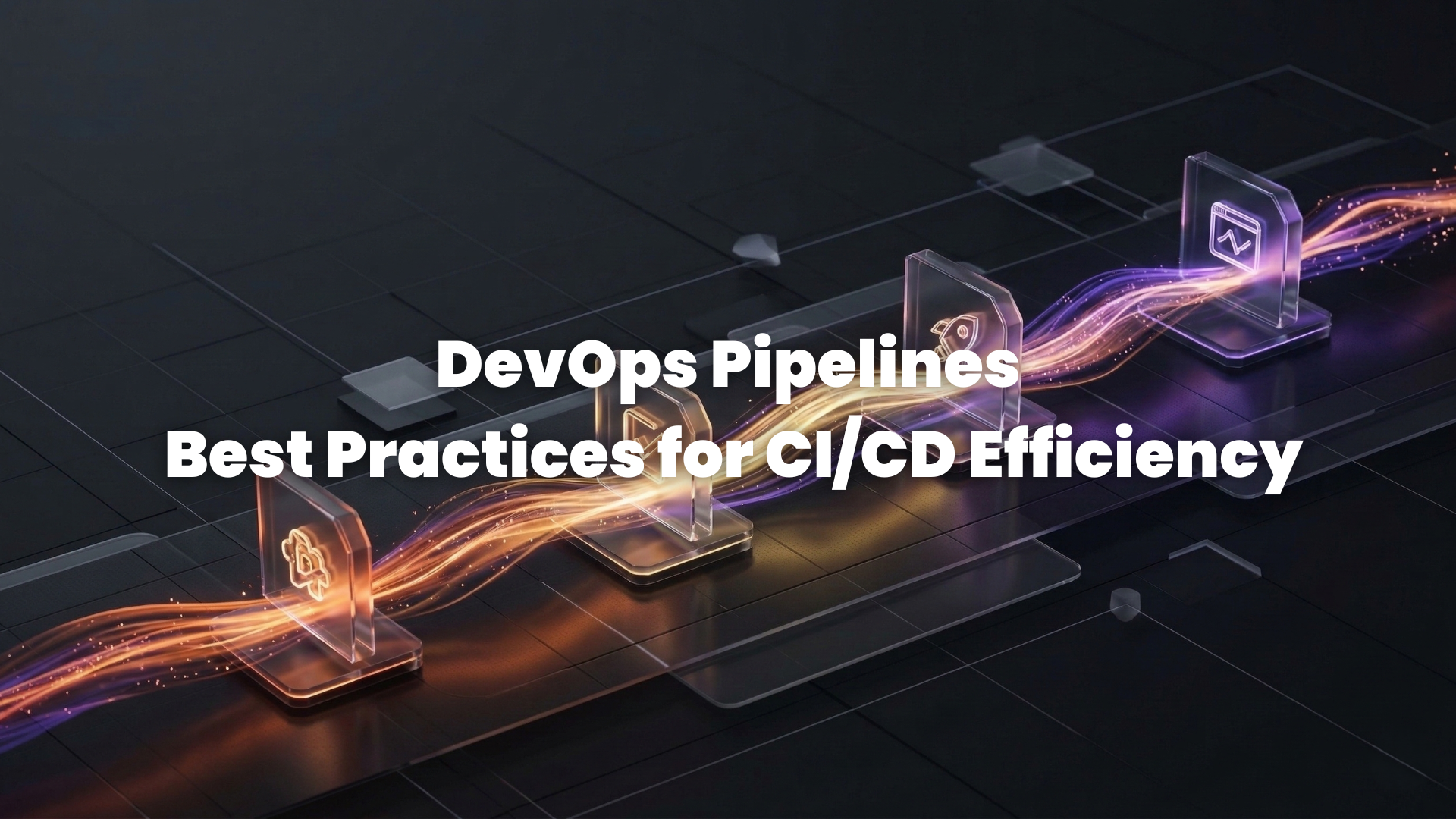
A DevOps pipeline is a series of automated processes that enable software teams to build, test, and deploy applications continuously. These pipelines form the backbone of Continuous Integration and Continuous Deployment (CI/CD) practices.
In a typical workflow, developers push code changes to a version control repository such as Git. The pipeline then automatically triggers a series of steps, including compiling the code, running automated tests, validating security checks, and deploying the application to staging or production environments.
The main goal of a DevOps pipeline is to ensure that every code change moves through a consistent and automated process, reducing manual effort while improving reliability.
By automating repetitive tasks and standardizing workflows, DevOps pipelines allow organizations to release software faster while maintaining high-quality standards.
Key Stages of a CI/CD Pipeline
Understanding the structure of a CI/CD pipeline helps teams identify areas where efficiency can be improved.
Source Stage
The pipeline begins when developers commit code to a version control system. This stage acts as the starting point for automation and ensures that every change is tracked and versioned.
Build Stage
In the build stage, the system compiles the application and generates build artifacts. This process ensures that the codebase is integrated successfully and ready for testing.
Testing Stage
Automated tests are executed to verify application functionality, performance, and security. These tests help detect issues early in the development cycle.
Deployment Stage
Once the code passes all tests, it is deployed to staging or production environments. Deployment automation reduces the risk of errors and ensures consistent releases.
Monitoring Stage
After deployment, monitoring tools track system performance and application health. Continuous monitoring allows teams to detect issues quickly and maintain system reliability.
Best Practices for CI/CD Pipeline Efficiency
To maximize the benefits of DevOps pipelines, organizations must adopt best practices that improve performance, scalability, and reliability.
Automate Everything Possible
Automation is the foundation of an efficient CI/CD pipeline. Tasks such as code integration, testing, security scanning, and deployment should be fully automated.
Automation reduces manual errors and ensures that every deployment follows the same standardized process. The more automated a pipeline becomes, the faster and more reliable the software delivery process will be.
Keep Pipelines Fast and Lightweight
Slow pipelines can frustrate developers and delay releases. Teams should optimize pipeline performance by minimizing unnecessary steps and parallelizing tasks where possible.
For example, test suites can often be divided into smaller groups that run simultaneously. This approach significantly reduces pipeline execution time and accelerates feedback cycles.
Implement Automated Testing Early
Automated testing should be integrated into the pipeline as early as possible. Running tests during the early stages of the pipeline helps detect issues before they reach production.
Unit tests, integration tests, and security checks should all be part of the CI/CD workflow. Early testing reduces the cost and complexity of fixing issues later in the development cycle.
Use Infrastructure as Code
Managing infrastructure manually can introduce inconsistencies across environments. Infrastructure as Code (IaC) allows teams to define infrastructure configurations using code.
This approach ensures that development, staging, and production environments remain consistent and reproducible.
Infrastructure automation also enables faster provisioning of resources, making it easier to scale systems as demand grows.
Monitor Pipeline Performance
Monitoring is essential for maintaining an efficient DevOps pipeline. Teams should track metrics such as build times, deployment frequency, failure rates, and system performance.
These metrics help identify bottlenecks and areas where pipeline performance can be improved.
Continuous monitoring also ensures that teams can respond quickly when issues arise.
Challenges That Affect CI/CD Efficiency
Even well-designed pipelines can face challenges that reduce efficiency.
One common issue is pipeline complexity. As projects grow, pipelines may accumulate numerous steps, tools, and integrations, making them harder to maintain.
Another challenge is environment inconsistency, where differences between development and production environments cause deployment failures.
Finally, resource scaling and cloud infrastructure costs can become difficult to manage when automated pipelines rapidly provision new resources.
Addressing these challenges requires not only technical improvements but also better visibility into infrastructure usage and operational metrics.
Cost Visibility into DevOps Pipelines
While DevOps pipelines focus on automation and speed, it is equally important to understand how automated deployments affect cloud infrastructure usage and operational costs.
As CI/CD pipelines dynamically scale infrastructure for builds, testing environments, and deployments, cloud resources can grow quickly. Without proper visibility, teams may struggle to understand how pipeline activity impacts overall cloud spending.
This is where our platform, Atler Pilot, becomes particularly valuable.
At Atler Pilot, we help engineering and FinOps teams gain real-time visibility into cloud infrastructure usage and cost patterns. As DevOps pipelines automatically provision resources across environments, Atler Pilot provides insights into how those changes influence overall cloud spending.
Instead of manually analyzing billing dashboards, teams can quickly detect cost anomalies, identify inefficient resource usage, and make informed decisions about infrastructure scaling.
By combining DevOps automation with intelligent cost monitoring through Atler Pilot, organizations can ensure that faster deployments and scalable infrastructure remain aligned with financial efficiency.
Conclusion
DevOps pipelines have become a cornerstone of modern software delivery. By automating build, testing, and deployment processes, CI/CD pipelines enable organizations to release software faster while maintaining high reliability. However, achieving true pipeline efficiency requires more than automation alone. Teams must adopt best practices such as automated testing, infrastructure as code, performance monitoring, and continuous optimization.
As organizations increasingly rely on automated pipelines and cloud-native infrastructure, maintaining visibility into operational metrics and infrastructure usage becomes just as important as deployment speed. By combining efficient DevOps pipelines with clear operational insights, teams can build software delivery systems that are fast, reliable, scalable, and financially sustainable.
All in One Place
Atler Pilot decodes your cloud spend story by bringing monitoring, automation, and intelligent insights together for faster and better cloud operations.