
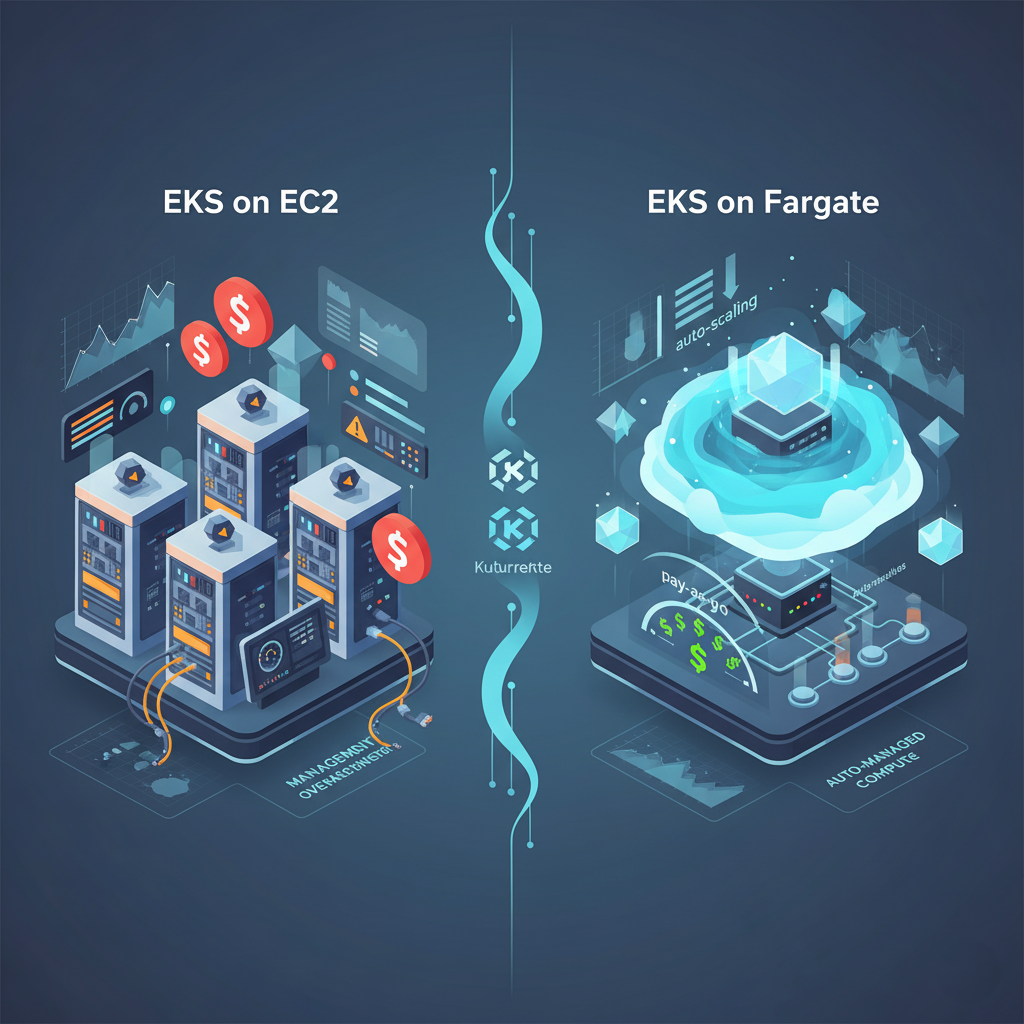
When running Kubernetes on AWS, one of the most fundamental architectural decisions is how to provision your compute capacity. Amazon EKS offers two models: running pods on self-managed EC2 instances or on AWS Fargate, a serverless compute engine. This choice has profound implications for operational overhead, flexibility, and cost. While EC2 may appear cheaper hourly, Fargate's serverless model can offer significant savings by eliminating waste from idle resources.
Understanding the Two Models
The core difference lies in who manages the underlying servers.
EKS on EC2: This is the traditional model. You create and manage a cluster of EC2 instances (nodes), and Kubernetes schedules your pods onto them. You have full control but pay for the entire EC2 instance 24/7, regardless of how many pods are running on it.
EKS on Fargate: This is the serverless model. You do not manage any EC2 instances. You simply define your pod's resource requirements (vCPU and memory), and Fargate automatically provisions the precise compute needed. You pay only for the resources your pod requests for the duration that it is running.
The Cost Comparison: A Tale of Two Pricing Models
EKS on EC2: The Cost of Provisioned Capacity
With the EC2 model, your primary cost is the hourly rate of your worker nodes, and the name of the game is utilization.
Pros: For workloads with high, sustained, and predictable usage, EC2 can be more cost-effective. If you can keep nodes highly utilized ("bin packing"), the lower raw cost of EC2 is cheaper. You also have access to Spot Instances and Savings Plans for deep discounts.
Cons: You are financially responsible for all idle capacity. If your nodes average 30% utilization, you are wasting 70% of your money. This model also carries a significant operational burden for node patching, scaling, and security.
EKS on Fargate: The Cost of On-Demand Usage
With Fargate, your bill is calculated based on the vCPU and memory resources requested by your running pods, billed per second.
Pros: This model eliminates the cost of idle capacity. For bursty or unpredictable traffic, Fargate is almost always cheaper because you aren't paying for empty servers. It also dramatically reduces operational overhead.
Cons: You pay a premium on the per-vCPU and per-GB rates compared to raw EC2 prices. For a workload at 100% utilization 24/7, Fargate will be more expensive than a perfectly sized EC2 instance with a Savings Plan.
The Verdict: Which Model is Right for Your Workload?
The most cost-effective choice depends entirely on your application's usage profile.
Choose EKS on Fargate if:
Your workloads are spiky, intermittent, or unpredictable, like many web applications and dev/test environments.
You want to minimize operational overhead and focus on application development.
You need fine-grained cost allocation, as billing is tied directly to individual pods.
Choose EKS on EC2 if:
Your workloads have high, sustained, and predictable utilization, like batch processing or high-traffic services.
You need maximum control and flexibility, such as custom AMIs or specific kernel parameters.
You want to aggressively optimize costs with Spot Instances, which offer up to 90% savings and are only available with the EC2 model.
The Hybrid Approach: The Best of Both Worlds
For many organizations, the optimal solution is a hybrid strategy, as EKS allows you to run both EC2 nodes and Fargate profiles in the same cluster.
Run your stable, high-utilization workloads on a fleet of EC2 instances, optimized with Savings Plans and Spot.
Configure a Fargate profile to handle bursty or unpredictable workloads, providing "infinite" on-demand capacity without overprovisioning your EC2 node groups.
Conclusion
The EKS Fargate vs. EC2 cost analysis is a classic trade-off. Fargate offers a simple, pay-for-use model ideal for eliminating waste in variable workloads, while EC2 provides the power, flexibility, and deep cost-saving mechanisms needed for large-scale applications. By understanding the financial characteristics of each and leveraging a hybrid approach, you can build a highly efficient and cost-effective EKS architecture.
All in One Place
Atler Pilot decodes your cloud spend story by bringing monitoring, automation, and intelligent insights together for faster and better cloud operations.