
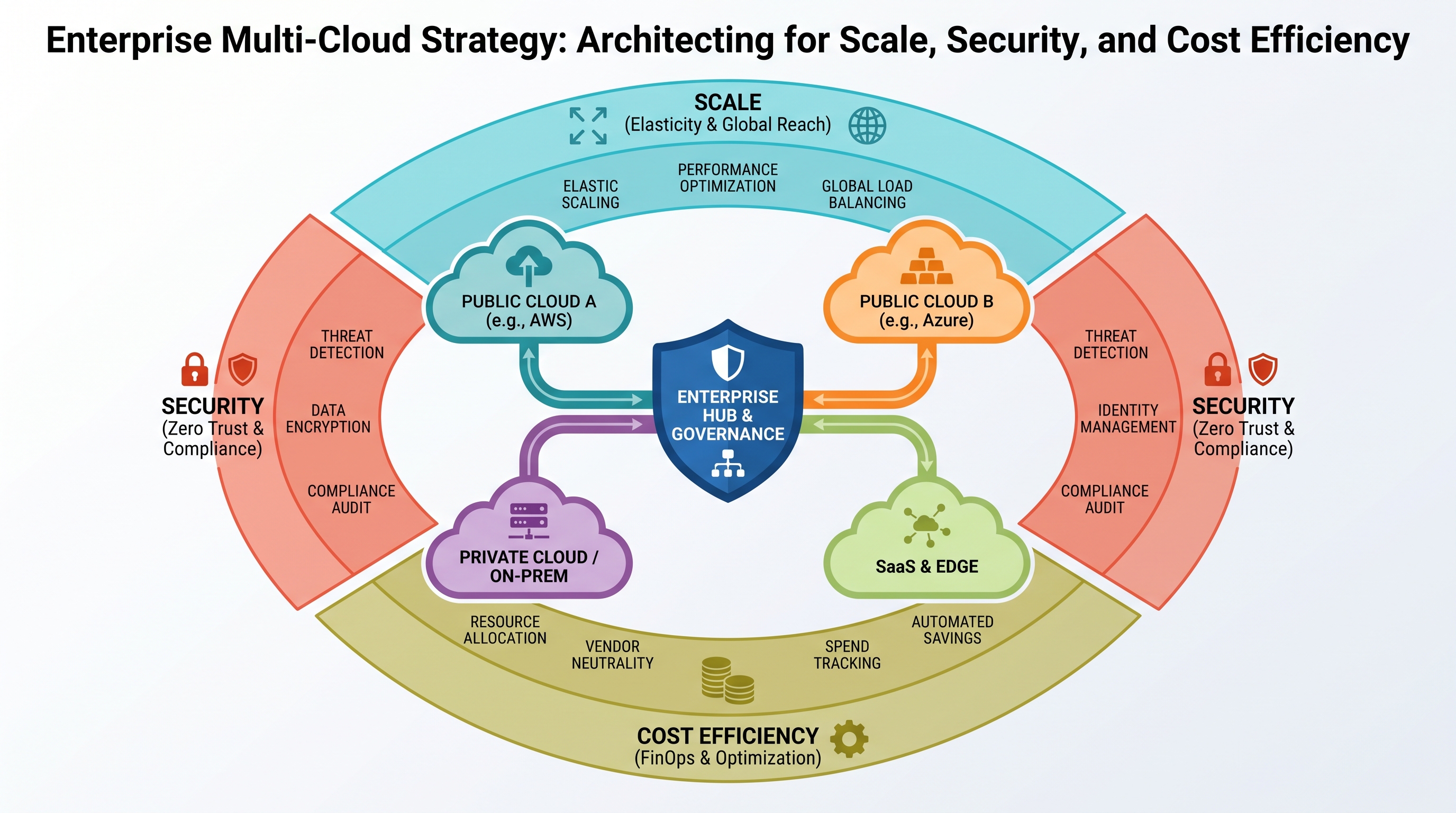
The journey to the cloud for enterprises has evolved from cautious experimentation to strategic multi-cloud adoption. What began as a pragmatic approach to avoid vendor lock-in or leverage specialized services has become a complex architectural challenge. Enterprises today navigate a distributed landscape spanning AWS, Azure, GCP, and often Oracle Cloud Infrastructure, each with its unique services, APIs, and operational paradigms. The imperative is clear: harness the power of multi-cloud without succumbing to its inherent complexities, ensuring that every architectural decision contributes to enhanced scale, uncompromised security, and optimal cost efficiency.
This blog post delves into the technical blueprints and strategic frameworks necessary to build a resilient, secure, and cost-effective multi-cloud environment. We will move beyond the theoretical to provide actionable insights, architectural patterns, FinOps optimization tactics, and security best practices that empower technical leaders to unify their cloud operations.
The Multi-Cloud Imperative: Beyond Vendor Lock-in
While vendor lock-in avoidance remains a significant driver for multi-cloud, the modern enterprise's rationale extends far deeper:
Resilience and Disaster Recovery: Distributing workloads across multiple providers inherently reduces the blast radius of a single cloud outage, enhancing business continuity and disaster recovery capabilities. Active-active or active-passive strategies leveraging distinct cloud regions and providers offer superior fault tolerance.
Best-of-Breed Services: Each cloud provider excels in specific domains. An enterprise might leverage GCP for its AI/ML capabilities, Azure for its seamless integration with Microsoft enterprise tools, AWS for its breadth of services, and Oracle for its database performance. A multi-cloud strategy allows organizations to cherry-pick the most suitable services for each workload.
Regulatory and Data Sovereignty Compliance: Certain industries or geographies mandate data residency within specific jurisdictions. Multi-cloud enables compliance by allowing data to reside in regions offered by different providers that meet these strict requirements. This often involves careful data placement and replication strategies.
Geographic Reach and Latency Optimization: Deploying applications closer to end-users across various global cloud regions minimizes latency, improving user experience and application performance.
Negotiation Leverage: A truly portable multi-cloud architecture provides leverage in commercial negotiations with cloud providers, fostering competitive pricing and service level agreements.
However, realizing these benefits requires a sophisticated architectural approach that meticulously addresses the challenges of integration, governance, and management across disparate environments.
Architecting for Scale in a Multi-Cloud World
Scaling applications and infrastructure across multiple cloud providers introduces unique complexities. An effective multi-cloud architecture must abstract away provider-specific details where possible, allowing for consistent deployment and operation.
Consistent Infrastructure and Application Deployment
The foundation of multi-cloud scale lies in consistent, automated infrastructure provisioning. Infrastructure as Code (IaC) tools are paramount:
Terraform: As a cloud-agnostic IaC tool, Terraform allows engineers to define and provision infrastructure across AWS, Azure, GCP, and Oracle using a single language (HCL). This enables consistent resource deployment, version control, and drift detection. For example, defining a VPC/VNet, subnets, and security groups can be parameterized to work across providers with minimal changes.
Kubernetes: Container orchestration platforms like Kubernetes are ideal for achieving application portability. By standardizing on Kubernetes, applications can be deployed and managed consistently, whether on Amazon EKS, Azure AKS, Google GKE, or Oracle OKE. This abstracts the underlying compute infrastructure, allowing workloads to scale horizontally across cloud boundaries. Tools like Anthos (GCP) or Azure Arc extend Kubernetes management to hybrid and multi-cloud environments, providing a unified control plane.
GitOps: Implementing GitOps principles ensures that infrastructure and application configurations are version-controlled in Git repositories, with automated pipelines synchronizing the desired state across all cloud environments. This provides an auditable trail and promotes consistency.
Global Load Balancing and Traffic Management
Distributing user traffic across geographically dispersed deployments on different clouds is critical for both scale and resilience:
DNS-based Global Load Balancing (GSLB): Services like AWS Route 53, Azure Traffic Manager, and Google Cloud DNS offer GSLB capabilities. A common pattern involves using a primary GSLB (e.g., Cloudflare or a robust on-prem solution) to direct traffic to the optimal cloud provider endpoint based on latency, geographic proximity, or health checks. For instance, a user in Europe might be routed to an Azure Europe region, while a user in North America goes to an AWS US region.
Application-level Load Balancing: Within each cloud, native load balancers (e.g., AWS ALB/NLB, Azure Application Gateway/Load Balancer, GCP Global External HTTP(S) Load Balancer) manage traffic distribution to backend services. Multi-cloud architecture needs to ensure these are properly configured and integrated into the GSLB strategy.
Data Strategy and Replication
Data management is arguably the most complex aspect of multi-cloud at scale. Data gravity often dictates where applications run, but strategies exist to mitigate this:
Data Locality: Keep data as close to the applications consuming it as possible to minimize latency and egress costs.
Cross-Cloud Data Replication: For resilience and failover, critical datasets may need to be replicated across clouds. This often involves custom solutions or third-party tools that can synchronize databases (e.g., using change data capture - CDC) or object storage (e.g., rclone, custom replication agents). Considerations include consistency models (eventual vs. strong), network bandwidth, and encryption.
Hybrid Databases: Solutions like CockroachDB or Cassandra are designed for distributed, multi-region, and multi-cloud deployments, offering strong consistency and high availability across disparate infrastructures.
Centralized Data Lake/Warehouse: For analytics and business intelligence, a common pattern is to ingest data from all cloud environments into a centralized data lake (e.g., S3, Azure Data Lake Storage, GCS) or data warehouse (e.g., Snowflake, Databricks) that can span or connect to multiple clouds.
Interconnectivity and Network Fabric
Seamless and secure communication between clouds is fundamental for multi-cloud scale:
Direct Connect/ExpressRoute/Cloud Interconnect: Dedicated network connections provide high-bandwidth, low-latency, and private connectivity between enterprise data centers and public clouds. Extending this to inter-cloud connectivity via network exchange providers or direct peering agreements between clouds is an advanced pattern.
SD-WAN and Cloud VPNs: Software-Defined Wide Area Network (SD-WAN) solutions can create a unified network fabric across multiple clouds and on-premises environments, simplifying routing, policy enforcement, and traffic optimization. Cloud VPNs (IPsec tunnels) serve as a more accessible, albeit less performant, alternative for connecting virtual networks across providers.
Service Mesh: For microservices architectures, a service mesh (e.g., Istio, Linkerd) can manage inter-service communication, providing traffic management, observability, and security features consistently across Kubernetes clusters deployed in different clouds.
Unified Observability
Monitoring and logging across multiple cloud providers can quickly become a fragmented nightmare. A unified observability strategy is critical for understanding system health, performance, and user experience at scale:
Centralized Logging: Aggregate logs from all cloud environments into a single platform (e.g., ELK Stack, Splunk, Datadog, Grafana Loki). This requires setting up log forwarding from native cloud logging services (CloudWatch Logs, Azure Monitor, GCP Cloud Logging) to the central sink.
Unified Monitoring: Use a single pane of glass for metrics and traces. Tools like Prometheus + Grafana, Datadog, New Relic, or Dynatrace can collect data from various cloud services and custom applications, providing a consistent view of performance. CloudAtler offers operational intelligence capabilities, unifying monitoring and alerting across your AWS, Azure, GCP, and Oracle estates, enabling proactive issue detection and resolution.
Distributed Tracing: Implement distributed tracing (e.g., OpenTelemetry, Jaeger) to track requests as they flow through services deployed across different clouds, critical for debugging complex microservices architectures.
Fortifying Multi-Cloud Security
Security is not merely a feature but a fundamental architectural principle in multi-cloud. The attack surface expands significantly across multiple providers, demanding a holistic and consistent security posture.
Centralized Identity and Access Management (IAM)
Managing identities across disparate cloud providers is paramount:
Federated Identity: Implement a central Identity Provider (IdP) (e.g., Okta, Azure Active Directory, AWS IAM Identity Center) that federates identities to all cloud environments. This ensures a single source of truth for user authentication and authorization.
Role-Based Access Control (RBAC): Define consistent RBAC policies across clouds. Map federated identities to specific roles with least-privilege access. For instance, a "Developer" role might have different permissions in AWS vs. Azure, but the underlying principle of least privilege remains.
Privileged Access Management (PAM): Implement PAM solutions to manage and monitor access to highly sensitive cloud resources, including just-in-time access and session recording.
Multi-Factor Authentication (MFA): Enforce MFA for all user and administrative access across all cloud accounts.
Unified Network Security Architecture
Network security controls must extend consistently across the multi-cloud fabric:
Perimeter Security: Deploy Web Application Firewalls (WAFs) and DDoS protection services at the edge of each cloud environment (e.g., AWS WAF, Azure Front Door/WAF, GCP Cloud Armor). For multi-cloud, a global WAF service (e.g., Cloudflare) can provide a unified layer.
Micro-segmentation: Implement fine-grained network segmentation within and across cloud environments using native security groups/NSGs, network ACLs, and potentially third-party network virtualization solutions. This limits lateral movement in case of a breach.
Intrusion Detection/Prevention Systems (IDPS): Deploy IDPS solutions at critical network choke points and within application tiers across all clouds.
Secure Inter-Cloud Connectivity: Ensure all traffic between cloud environments (e.g., via Direct Connect, VPNs) is encrypted and routed through secure gateways.
Data Security and Encryption Everywhere
Protecting data throughout its lifecycle is non-negotiable:
Encryption at Rest: Mandate encryption for all data stored in object storage, databases, and block storage volumes using provider-managed keys (CMK) or customer-managed keys (BYOK) via services like AWS KMS, Azure Key Vault, GCP Cloud KMS.
Encryption in Transit: Enforce TLS/SSL for all data in transit, both external (client-to-application) and internal (service-to-service communication). Utilize certificate management services from each cloud or a centralized solution.
Data Loss Prevention (DLP): Implement DLP solutions to identify, monitor, and protect sensitive data across all cloud storage and communication channels, preventing unauthorized exfiltration.
Secrets Management: Use centralized secrets management services (e.g., HashiCorp Vault, AWS Secrets Manager, Azure Key Vault, GCP Secret Manager) to securely store and retrieve API keys, database credentials, and other sensitive information, avoiding hardcoding secrets.
Compliance, Governance, and Posture Management
Maintaining a strong security posture requires continuous monitoring and enforcement:
Policy as Code: Define security policies as code using tools like Open Policy Agent (OPA) or native cloud policy engines (AWS Config, Azure Policy, GCP Organization Policies). This allows for automated enforcement and auditing across environments.
Cloud Security Posture Management (CSPM): Implement a CSPM solution to continuously scan and assess configurations across all cloud accounts for misconfigurations, compliance violations, and security drifts. CloudAtler's security management features provide a unified view of your security posture, identifying vulnerabilities and ensuring compliance across AWS, Azure, GCP, and Oracle environments.
Vulnerability Management: Establish a robust vulnerability management program that includes regular scanning of container images, VMs, and web applications. CloudAtler’s patch intelligence helps automate the identification and prioritization of critical vulnerabilities, streamlining patch management across your multi-cloud estate.
Audit and Logging: Centralize audit trails and security logs (e.g., AWS CloudTrail, Azure Activity Log, GCP Cloud Audit Logs) into a Security Information and Event Management (SIEM) system for threat detection, incident response, and forensic analysis.
Optimizing for Cost Efficiency: FinOps in Multi-Cloud
The promise of cloud elasticity often comes with the challenge of escalating costs. In a multi-cloud environment, this challenge is amplified by disparate billing models, lack of centralized visibility, and complex resource utilization patterns. FinOps is the operational framework that brings financial accountability to the variable spend model of the cloud, fostering collaboration between finance, engineering, and operations teams.
Unified Cost Visibility and Allocation
The first step to cost optimization is understanding where money is being spent:
Centralized Cost Dashboard: Aggregate billing data from all cloud providers into a single, unified dashboard. Native cloud billing consoles are provider-specific, making cross-cloud analysis impossible. Platforms like CloudAtler provide a unified dashboard that visualizes spend across AWS, Azure, GCP, and Oracle, breaking down costs by service, account, department, and project.
Tagging Strategy: Implement a mandatory, consistent tagging strategy across all cloud resources. Tags (e.g., Project, CostCenter, Owner, Environment) are crucial for allocating costs back to business units, enabling showback and chargeback models. Automated tagging enforcement and remediation are vital in multi-cloud to prevent tag sprawl and ensure compliance.
Resource Hierarchy Mapping: Map cloud accounts, subscriptions, and projects to your organizational structure to accurately attribute costs.
Resource Optimization and Rightsizing
Eliminating waste and matching resource supply to demand is a continuous process:
Rightsizing: Continuously analyze resource utilization (CPU, memory, disk I/O, network) for VMs, databases, and other services. Downsize or upgrade instances to the most cost-effective size that meets performance requirements. CloudAtler's compute lifecycle analysis provides AI-driven recommendations for rightsizing instances and optimizing compute spend across your multi-cloud footprint.
Eliminate Idle Resources: Identify and terminate idle or zombie resources (e.g., unattached EBS volumes, unutilized virtual machines, old snapshots).
Automated Scaling: Implement auto-scaling groups for compute resources and serverless functions to dynamically adjust capacity based on demand, preventing over-provisioning.
Storage Tiering and Lifecycle Management: Utilize cheaper storage tiers (e.g., infrequent access, archive storage) and implement lifecycle policies to automatically move data to appropriate tiers or delete old data.
Serverless Adoption: Leverage serverless architectures (AWS Lambda, Azure Functions, GCP Cloud Functions) where appropriate, paying only for actual execution time and eliminating idle compute costs.
Strategic Pricing Models and Commitment Management
Leveraging cloud provider pricing models requires careful planning and execution across multiple clouds:
Reserved Instances (RIs) and Savings Plans (SPs): Strategically purchase RIs and SPs across AWS, Azure, and GCP to achieve significant discounts for predictable workloads. This requires accurate forecasting of future resource needs. CloudAtler’s commitment intelligence helps analyze usage patterns and recommends optimal RI/SP purchases, ensuring maximum savings and minimizing under-utilization or expiration risks across providers.
Spot Instances/Preemptible VMs: For fault-tolerant, stateless, or batch workloads, utilize spot instances (AWS), Azure Spot VMs, or GCP Preemptible VMs for substantial cost reductions.
Strategic Cloud Selection: For new workloads, evaluate the pricing of equivalent services across different cloud providers to determine the most cost-effective option for the specific use case.
Budgeting, Forecasting, and Anomaly Detection
Proactive financial management is key to preventing cost overruns:
Predictive Budgeting: Develop accurate cloud budgets by leveraging historical spend data and projected growth. CloudAtler’s budget forecasting capabilities use AI to predict future spend based on current trends and planned initiatives, offering granular insights across your multi-cloud environment.
Cost Impact Analysis: Before deploying new resources or making architectural changes, estimate their cost impact. CloudAtler’s cost impact calculation feature allows you to model potential financial implications of changes, ensuring informed decisions.
Anomaly Detection and Alerts: Implement automated systems to detect sudden spikes or unexpected changes in spend patterns. Set up budget alerts to notify relevant teams when thresholds are approached or exceeded.
Showback/Chargeback: Implement clear showback (reporting costs to business units) or chargeback (billing business units for their cloud consumption) mechanisms to foster financial accountability.
Operationalizing Multi-Cloud with a Unified Platform
The architectural patterns for scale, security, and cost efficiency are robust, but their effective implementation and ongoing management demand a unified operational approach. Without it, enterprises risk creating new silos, increasing operational overhead, and negating the benefits of multi-cloud.
The Challenge of Disparate Tooling and Silos
Native cloud management tools are powerful but provider-specific. Managing a multi-cloud environment with separate dashboards, monitoring systems, security alerts, and billing reports for AWS, Azure, GCP, and Oracle leads to:
Operational Complexity: Engineers and FinOps teams must learn and navigate multiple interfaces, APIs, and command-line tools.
Inconsistent Policies: Enforcing consistent security policies, compliance standards, and cost optimization rules across different cloud providers becomes a manual, error-prone effort.
Delayed Decision Making: Lack of a consolidated view hinders rapid identification of performance bottlenecks, security threats, or cost anomalies.
Increased Staffing Costs: The need for specialized teams for each cloud provider can drive up operational expenses.
The Value of a Unified AI-Powered Platform
This is where an AI-powered platform like CloudAtler becomes indispensable. CloudAtler is designed to unify FinOps, cloud security, and automated operations across AWS, Azure, GCP, and Oracle environments, providing a single control plane for your entire multi-cloud estate.
Centralized Visibility: A single dashboard provides a holistic view of your cloud spend, security posture, and operational health across all providers, eliminating blind spots.
AI-Driven Insights: CloudAtler leverages AI to analyze vast amounts of data from your multi-cloud environment, identifying trends, anomalies, and optimization opportunities that human analysis might miss. This includes predictive monitoring for operations, intelligent budget forecasting, and AI-powered recommendations for resource rightsizing.
Automated Governance and Remediation: Define security policies, compliance guardrails, and cost optimization rules once and apply them consistently across all clouds. CloudAtler automates the detection of violations and can initiate intelligent, safe remediation actions. For instance, if an S3 bucket is publicly exposed in AWS or a storage account in Azure lacks encryption, CloudAtler can alert and automatically rectify the misconfiguration based on defined policies.
Streamlined FinOps: From automated tagging and cost allocation to AI-driven budget forecasting and commitment intelligence, CloudAtler empowers FinOps teams with the tools needed to drive financial accountability and maximize cloud ROI across providers.
Enhanced Security Operations: Unify vulnerability management, security posture assessment, and compliance reporting. CloudAtler's capabilities extend to intelligent patch management, ensuring your multi-cloud environment remains secure and compliant without manual overhead.
Operational Efficiency: By centralizing management and automating routine tasks, teams can focus on innovation rather than operational overhead, improving overall productivity and reducing mean time to resolution for incidents.
By adopting a platform that intelligently unifies these critical functions, enterprises can transform their multi-cloud strategy from a complex challenge into a powerful competitive advantage.
Conclusion
The enterprise multi-cloud journey is a strategic imperative, offering unparalleled opportunities for scale, resilience, and innovation. However, realizing these benefits demands meticulous architectural planning, a robust security framework, and a sophisticated approach to cost management. Architecting for scale involves consistent deployment strategies, global traffic management, intelligent data placement, and a unified network fabric. Security requires centralized identity, pervasive encryption, and continuous posture management across all providers. FinOps, on the other hand, ensures financial accountability through granular visibility, continuous optimization, and proactive budgeting.
The inherent complexity of managing disparate cloud environments necessitates a unified, intelligent platform. CloudAtler provides the critical capabilities to abstract away provider-specific complexities, offering an AI-powered solution for FinOps, cloud security, and automated operations across AWS, Azure, GCP, and Oracle. By consolidating visibility, leveraging AI-driven insights, and automating governance, enterprises can confidently navigate their multi-cloud landscape, achieving the scale, security, and cost efficiency required for sustained success.
Ready to transform your multi-cloud strategy from a fragmented challenge into a unified competitive advantage? Discover how CloudAtler’s AI-powered platform can bring unparalleled visibility, security, and cost efficiency to your AWS, Azure, GCP, and Oracle environments. Unify your cloud operations with CloudAtler today.
All in One Place
Atler Pilot decodes your cloud spend story by bringing monitoring, automation, and intelligent insights together for faster and better cloud operations.