
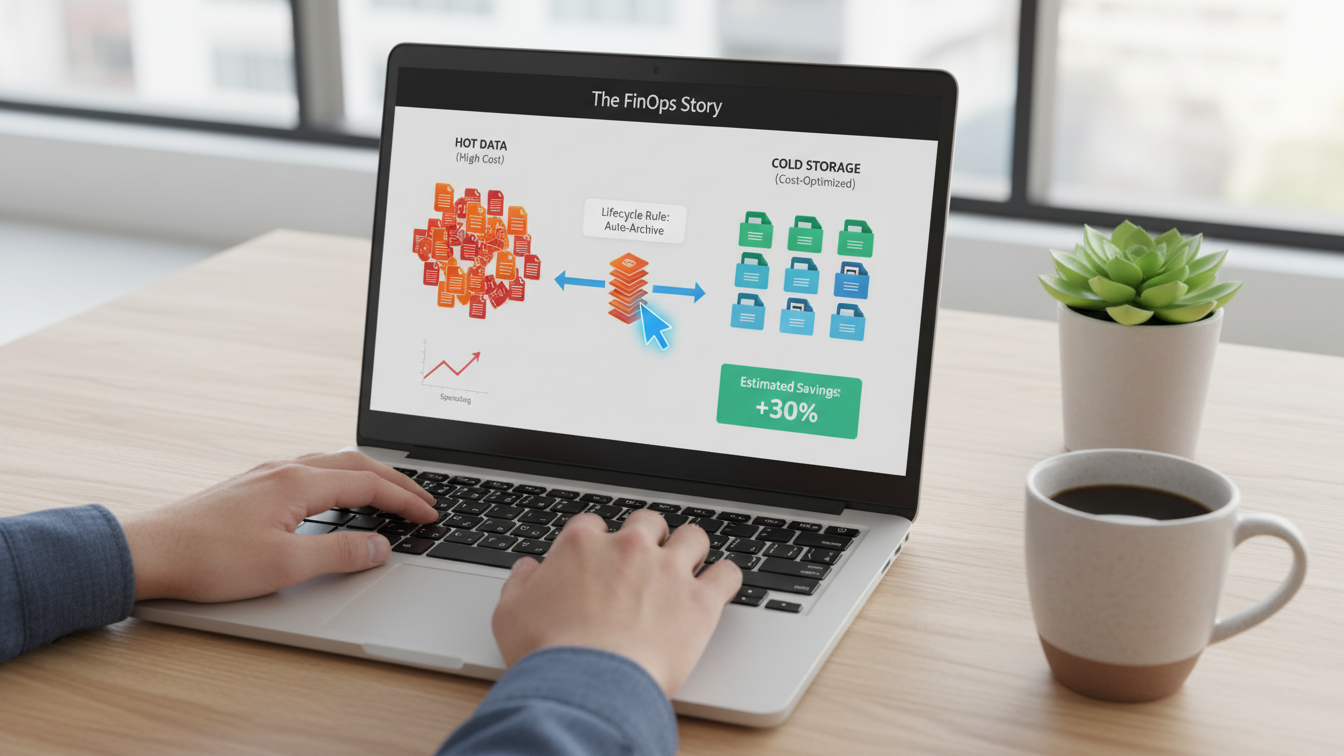
We are now moving into FinOps 2.0, a paradigm where financial accountability is inextricably linked to sophisticated, intelligent storage architecture. A siloed, reactive approach to managing massive, petabyte-scale data volumes across disparate storage tiers is simply not sustainable. Organizations must urgently evolve their established finOps principles to treat data not merely as a passive asset, but as the single largest and most volatile driver of cloud cost, demanding continuous governance and granular optimization.
This transition from managing machines to managing data and its associated lifecycle is the key to unlocking the next decade of cloud efficiency, profitability, and operational excellence. Therefore, let’s get right into how better storage architecture helps in cost-efficient cloud management.
The Ultimate Blind Spot of Cloud Storage
While early cloud spending optimization focused heavily on securing Reserved Instances (RIs) and optimizing CPU utilization, storage often became the quiet, persistent budget killer. The main difficulty lies in the complexity of the modern cloud storage landscape. We deal with a spectrum of services, from high-performance block storage (like EBS) and parallel file systems (like EFS) to various tiers of object storage (S3 Standard, Infrequent Access, Glacier) and each carry its own nuanced pricing model, access fees, request costs, and performance characteristics.
The sheer volume of data compounds the issue. The global datasphere is projected to grow to over 175 zettabytes by 2025. This exponential, unchecked growth means that even marginal inefficiencies in storage architecture, such as keeping low-touch data on the highest-cost tier can translate into immense, unnecessary expenditure that hits the bottom line.
The core issue is misalignment: when high-speed, high-cost storage (designed for milliseconds latency for transactional databases) is used to house "cold" data that hasn't been accessed in 18 months, we are fundamentally violating the finOps principles of cloud optimization and value realization. This technical debt, when aggregated across hundreds of development teams, quickly becomes a significant financial liability.
Evolving FinOps Principles for the Data Layer
FinOps 2.0 requires an architectural mindset of change, integrating the established FinOps principles of collaboration, centralization, and ownership deeply into the data lifecycle.
Shift from Cost Center to Value Stream
Historically, storage was seen as a passive utility expense, which is a necessary cost for doing business. In FinOps 2.0, every dataset must be viewed through the lens of its business value and dynamic usage pattern. Teams must establish data ownership, not just resource ownership. Engineers need to understand the true cost-per-read/write of their data, not just the monthly storage fee. This requires deep collaboration between engineering (who understands the access pattern and latency requirement) and finance (who understands the tiered cost model and request pricing).
For instance, simply enabling S3 Intelligent-Tiering, which automatically moves data between frequent and infrequent access tiers, can lead to savings of up to 30% on data with unknown or changing access patterns.
Embrace Granular Lifecycle Management (Optimization)
The most effective finOps solutions for storage are automated lifecycle policies. This means treating data not as a static object, but as a fluid entity that naturally transitions from expensive, high-performance tiers to cheaper, cold tiers over a defined period. The objective is to match the data's financial cost precisely to its current performance need.
The most significant wastage often comes from overlooked data remnants: old snapshots and abandoned backups. Many organizations retain block storage snapshots far longer than required by compliance or disaster recovery plans, leading to perpetual costs. Identifying and automatically deleting "zombie snapshots" (those unattached, orphaned, or exceeding defined retention policies) is a critical, high-impact finOps solution that requires continuous, automated governance, not manual checks.
Centralized Architecture, Decentralized Execution (Collaboration)
While development teams must retain the velocity and control to provision the resources they need, the rules governing storage tiers and lifecycle management must be centrally enforced. A well-governed storage architecture provides pre-approved guardrails and templates that automatically nudge teams toward cost-efficient choices.
Centralizing policy development such as "all log data older than 90 days must transition to a cold archive tier and be deleted after one year," ensures consistency, minimizes risk, and creates predictable spending. This moves the entire organization from a reactive, end-of-month budget shock scenario to proactive, data-driven cost forecasting.
Architectural Pillars of FinOps 2.0: Deep Dive into Cloud Optimization
Moving beyond basic principles, the focus of FinOps 2.0 must be on technical diligence. Here are three architectural levers that provide immense financial returns:
A. The Power of EBS Optimization and Volume Selection
Many organizations remain on older, less cost-efficient block storage types (like EBS gp2 volumes) out of habit. Modern finOps solutions prioritize migration to GP3 volumes. Why? Because GP3 allows for the decoupling of IOPS (performance) from storage size (capacity). For many workloads, this migration alone yields immediate savings of up to 20% on storage costs without any performance hit. Furthermore, automating the management of underutilized provisioned IOPS is crucial; paying for high IOPS on a volume that sees minimal traffic is pure waste.
B. Leveraging Intelligent Tiering for Unpredictable Workloads
For object storage, manual lifecycle policies fail when access patterns are unpredictable. The most robust finOps solutions make intelligent tiering the default for a majority of non-archival data lakes and content repositories. Instead of guessing whether data will be accessed and choosing between Standard and Infrequent Access, Intelligent-Tiering automates the cost management. It is designed to save cost by automatically moving data that has not been accessed for 30 consecutive days to a lower cost tier and moving it back if it's accessed again. This feature acts as an autonomous finOps tool, ensuring that you are always paying the minimum price for the required performance, minimizing the risk of storing petabytes of cold data on the most expensive tier.
C. The Hidden Cost of Cross-Region Replication (CRR)
Data redundancy is non-negotiable for resilience, but the costs of replication often go unscrutinized. Cross-Region Replication (CRR) incurs two major financial liabilities: the storage cost in the destination region and, critically, the egress fees charged by the source region when the data is copied out. This cost can quickly balloon for petabyte-scale environments. A mature finOps approach requires an analysis: Is CRR necessary, or could the business requirement be met by a lower-cost, geo-redundant storage option, or even a deep archive solution in a second region? Smart organizations only replicate the critical data, not the entire data lake.
The Critical Role of the FinOps Tool for Storage Governance
The sheer complexity of managing these policies across multiple accounts, regions, and services is simply too great for manual oversight. This is why automated FinOps solutions and an intelligent governance platform are critical for FinOps 2.0 maturity.
Our finOps tool is specifically designed to address this architectural debt. It doesn't just read the bill; it analyzes the data behavior at a transactional level. It identifies datasets that are immediately eligible for cheaper tiers, flags block volumes with high capacity but low utilization, and instantly detects misconfigured lifecycle policies, translating raw billing data into actionable, automated remediation tickets. It’s the engine that turns the theoretical finOps principle of 'optimization' into a measurable, continuous reality for storage, often finding millions in savings that manual processes simply lack.
Conclusion: Data-Centric Control
FinOps 2.0 defines a mature cloud strategy where every terabyte of data is correctly architected, tiered, and priced. By adopting this data-centric view and applying stringent finOps principles to storage, your organization can move beyond reactive budget cuts and establish a durable model of continuous cloud economic excellence. Are you struggling to control exploding data costs and achieve storage-level governance in AWS?
Optimize Your Data Architecture Now: Explore our specialized AWS storage packages, designed to implement Intelligent-Tiering and automated lifecycle governance policies across your entire data footprint, guaranteeing maximum performance at minimum cost.
All in One Place
Atler Pilot decodes your cloud spend story by bringing monitoring, automation, and intelligent insights together for faster and better cloud operations.