
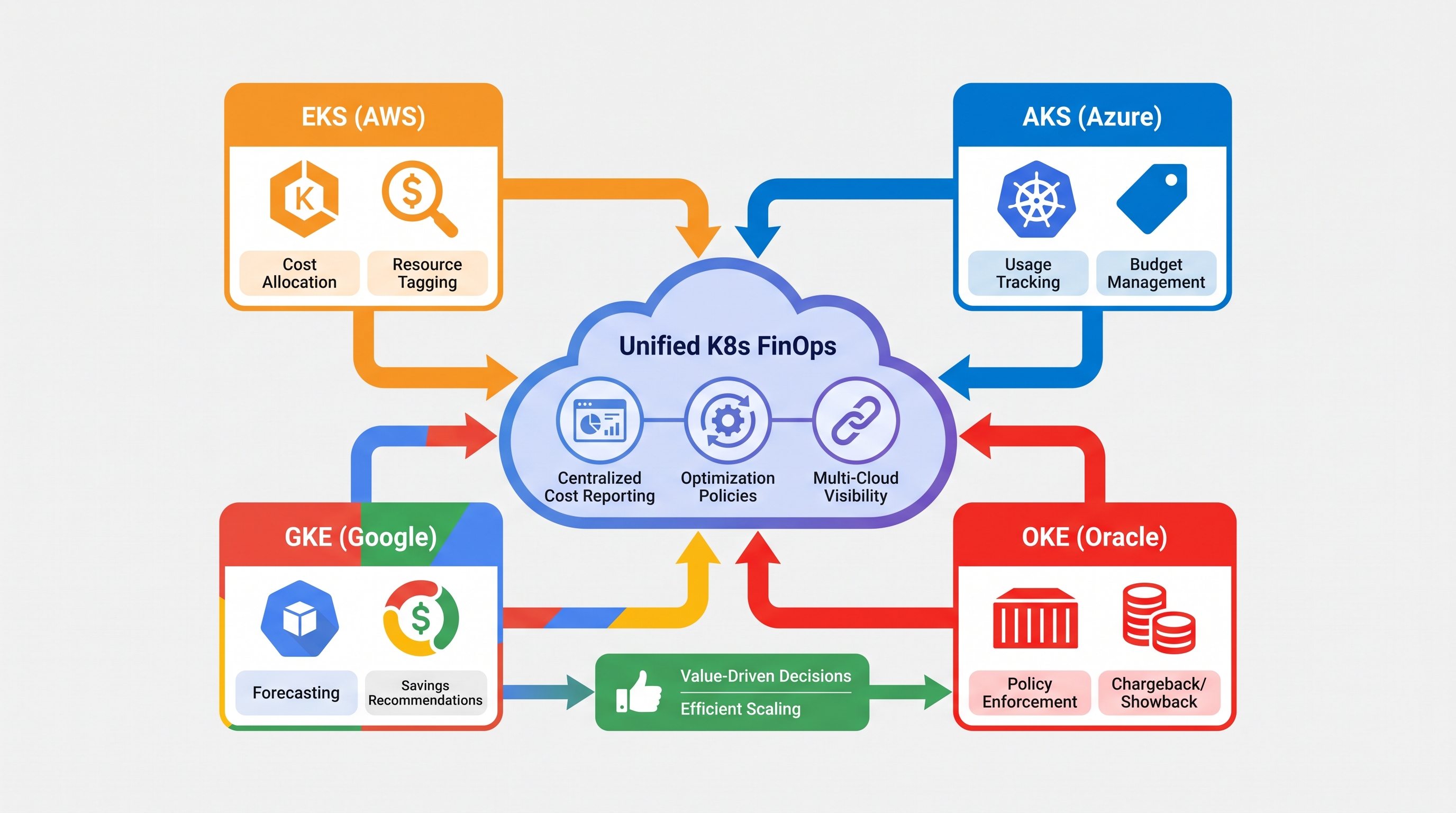
Kubernetes has become the de facto operating system for the cloud-native enterprise, offering unparalleled scalability, portability, and resilience for modern applications. As organizations embrace multi-cloud strategies, it's increasingly common to find critical workloads distributed across managed Kubernetes services such as Amazon Elastic Kubernetes Service (EKS), Azure Kubernetes Service (AKS), Google Kubernetes Engine (GKE), and Oracle Container Engine for Kubernetes (OKE).
While the benefits of multi-cloud Kubernetes are clear – avoiding vendor lock-in, leveraging best-of-breed services, and enhancing disaster recovery – the financial implications often become a complex labyrinth. Without a unified approach, cost visibility dissolves, leading to overspending, inefficient resource utilization, and a lack of accountability. This is where FinOps, the operational framework that brings financial accountability to the variable spend model of cloud, becomes indispensable. However, applying FinOps principles effectively across a heterogeneous Kubernetes landscape requires deep technical understanding and a robust platform capable of normalizing disparate data sources.
This authoritative guide will deep dive into the technical challenges and architectural solutions for achieving true FinOps mastery in a multi-cloud Kubernetes environment. We'll explore strategies for unifying cost visibility, implementing granular attribution, and driving continuous optimization across EKS, AKS, GKE, and OKE, emphasizing actionable insights and real-world implementations.
The Imperative of FinOps in a Multi-Cloud Kubernetes World
The FinOps Foundation defines FinOps as an evolving cloud financial management discipline and cultural practice, enabling organizations to get maximum business value by helping engineering, finance, and business teams to collaborate on data-driven spending decisions. In the context of Kubernetes, this collaboration is even more critical due to the abstraction layer K8s introduces between applications and the underlying infrastructure.
Traditional cloud cost management tools often struggle with Kubernetes because they primarily track VM instances, storage volumes, and network components. Kubernetes, however, orchestrates pods, deployments, services, and namespaces across these resources, dynamically scaling and shifting workloads. This abstraction makes direct cost attribution challenging. When you add multiple cloud providers, each with its own billing model, APIs, and resource types, the complexity multiplies exponentially.
The core FinOps principles—Inform, Optimize, Operate—must be meticulously applied:
Inform: Establishing precise cost visibility, attribution, and allocation for every Kubernetes workload, namespace, and team across all cloud providers. This means understanding not just the total bill, but who is spending what and why.
Optimize: Identifying and acting on opportunities to reduce waste and improve efficiency. This includes rightsizing container requests/limits, optimizing node utilization, leveraging commitment-based discounts (Reserved Instances/Savings Plans), and utilizing spot instances effectively.
Operate: Implementing automated processes, governance policies, and continuous monitoring to ensure ongoing cost efficiency and adherence to budgets. This phase emphasizes the cultural shift, embedding financial accountability into engineering workflows.
Without a unified FinOps strategy, enterprises risk significant financial leakage, delayed innovation due to budget constraints, and a perpetual struggle to reconcile engineering velocity with fiscal responsibility. CloudAtler's AI-powered platform is designed to bridge this gap, offering a unified approach to FinOps, cloud security, and automated operations across AWS, Azure, GCP, and Oracle environments.
Unpacking the Multi-Cloud K8s Cost Visibility Challenge
Achieving a consolidated view of Kubernetes costs across EKS, AKS, GKE, and OKE is fraught with technical hurdles. Each cloud provider offers a distinct set of billing data, resource types, and management interfaces:
Provider-Specific Billing Data and APIs
AWS (EKS): Utilizes the Cost and Usage Report (CUR), a highly granular dataset delivered to an S3 bucket. Parsing CUR requires significant effort to extract Kubernetes-specific costs, often requiring custom ETL processes to correlate EC2, EBS, ELB, and other service costs with EKS clusters.
Azure (AKS): Leverages Azure Cost Management and Billing APIs. Cost data is typically available through the Azure portal or programmatically via APIs. Identifying AKS-specific costs involves filtering by resource groups, tags, and service types (e.g., Virtual Machine Scale Sets, Load Balancers, Azure Disks).
GCP (GKE): Exports billing data to BigQuery. This provides a powerful, queryable dataset, but still requires sophisticated SQL queries to attribute costs to GKE clusters, nodes, and associated services like Persistent Disks and Load Balancers.
Oracle Cloud Infrastructure (OKE): Offers cost analysis tools and APIs to retrieve usage and cost data. Similar to other providers, identifying OKE-related costs requires filtering by compartment, tags, and resource types (e.g., Compute Instances, Block Volumes, Load Balancers).
The sheer diversity in data schema, granularity, and access methods makes a unified data ingestion pipeline a complex undertaking. Furthermore, these raw billing data often lack the Kubernetes-native context required for granular FinOps analysis.
Kubernetes Resource Abstraction and Shared Costs
A key challenge stems from the fundamental architecture of Kubernetes. A single worker node (e.g., an EC2 instance, Azure VM, GCE instance, or OCI Compute instance) hosts multiple pods, potentially belonging to different applications, teams, or namespaces. The cost of that node, its attached storage, and associated network egress must be accurately attributed to the various workloads sharing it.
Control Plane Costs: Managed Kubernetes services (EKS, AKS, GKE, OKE) abstract away the control plane (API server, etcd, scheduler, controller manager). While some providers bundle this into the worker node cost, others charge separately (e.g., EKS charges per cluster hour above a certain free tier). These costs are inherently shared and require a fair allocation mechanism.
Worker Node Costs: These are the most significant cost drivers. Attributing a portion of an underlying VM's cost to a specific pod or namespace requires understanding CPU and memory requests/limits versus actual usage.
Storage Costs: Persistent Volumes (PVs) and Persistent Volume Claims (PVCs) map to cloud-native storage services (EBS, Azure Disks, GCP Persistent Disks, OCI Block Volumes). Tracking these back to the consuming application or namespace is vital.
Networking Costs: Load balancers, NAT gateways, VPNs, and egress traffic contribute significantly. Identifying which Kubernetes services or ingresses drive these costs can be challenging.
Add-ons and Managed Services: Monitoring tools (Prometheus, Grafana), service meshes (Istio, Linkerd), logging solutions, and other ecosystem components often run within the cluster or as managed services, adding to the overall cost footprint.
Inconsistent Tagging and Metadata
Effective cost allocation relies heavily on consistent tagging and labeling. While Kubernetes allows for rich labeling of pods, deployments, and namespaces, ensuring these labels propagate to the underlying cloud infrastructure (VMs, storage, network interfaces) is often a manual or partially automated process, leading to gaps in visibility. A lack of standardized tags across different cloud providers and within various Kubernetes clusters makes consolidated reporting nearly impossible.
Dynamic Nature of Kubernetes
Kubernetes environments are inherently dynamic. Auto-scaling groups adjust node counts, Horizontal Pod Autoscalers (HPA) and Vertical Pod Autoscalers (VPA) dynamically resize workloads, and ephemeral pods come and go. This constant flux makes static cost tracking ineffective and necessitates real-time or near real-time data processing for accurate attribution.
Architecting for Unified K8s Cost Visibility: A Technical Deep Dive
Building a robust FinOps solution for multi-cloud Kubernetes requires a multi-faceted architectural approach, focusing on data ingestion, normalization, attribution, and presentation.
1. Data Ingestion Strategy
The foundation of unified cost visibility is a comprehensive data ingestion pipeline capable of collecting granular usage and cost data from all relevant sources.
Cloud Provider Billing Data:
AWS EKS: Configure an S3 bucket to receive daily AWS Cost and Usage Reports (CUR). Utilize AWS Lambda or an EC2 instance to process these large CSV files, extracting relevant service line items (EC2, EBS, EKS, etc.) and their associated tags.
Azure AKS: Leverage Azure Cost Management's Export feature to regularly dump cost data to an Azure Storage Account, or use the Azure Billing APIs.
GCP GKE: Ensure Google Cloud Billing Export is configured to send detailed billing data to a BigQuery dataset.
OCI OKE: Use OCI Cost Analysis reports or the OCI Usage Report API to extract cost data, typically stored in an OCI Object Storage bucket.
These raw billing datasets provide the "actual spend" figures. The challenge is enriching them with Kubernetes context.
Kubernetes Metrics and Metadata:
Resource Utilization: Deploy a Prometheus-based monitoring stack (or equivalent) within each Kubernetes cluster. Collect metrics from
kube-state-metrics(for K8s object states),cAdvisor(for container resource usage), and node exporters. This provides real-time CPU, memory, network, and storage I/O usage data for pods and nodes.Kubernetes API Access: Regularly query the Kubernetes API server for metadata about pods, deployments, namespaces, services, and nodes. This includes requests/limits, labels, annotations, and ownership information.
Native Cost Allocation Tools: Consider deploying in-cluster tools like Kubecost or OpenCost. These tools provide initial in-cluster cost allocation by correlating K8s resource usage with cloud provider pricing data. While excellent for single-cluster visibility, they still need integration into a broader multi-cloud platform.
2. Data Normalization and Canonical Data Model
Once ingested, the disparate data from various cloud providers and Kubernetes clusters must be normalized into a unified schema. This is a critical step for consolidated reporting.
Standardized Resource Identifiers: Create a consistent way to identify resources across clouds (e.g., a canonical UUID for each VM, storage volume).
Unified Tagging/Labeling: Enforce a standard set of FinOps-relevant tags (e.g.,
cloudatler_environment,cloudatler_project,cloudatler_team,cloudatler_application). This is where CloudAtler's automated tagging capabilities become invaluable, ensuring consistency and propagation across cloud resources and Kubernetes objects. For instance, a Kubernetes namespace labelteam: financeshould ideally be translated into a cloud resource tagcloudatler_team: financeon the underlying worker nodes and associated storage.Common Cost Categories: Map cloud provider-specific service names (e.g., EC2, Compute Engine, Virtual Machines) to a common set of cost categories (e.g., "Compute," "Storage," "Network," "Managed K8s Control Plane").
Hierarchy and Relationships: Establish a clear data model that links Kubernetes objects (pods, deployments, namespaces) to the underlying cloud infrastructure (VMs, storage, network) and ultimately to the raw billing line items. This typically involves a graph-based data model or a relational database with complex joins.
3. Granular Cost Attribution Logic
This is the core of FinOps for K8s – accurately attributing shared infrastructure costs to individual Kubernetes workloads, teams, or applications.
Worker Node Cost Allocation:
Resource Requests/Limits: A common approach is to allocate node costs based on a pod's CPU and memory requests (or limits, if requests are not set). If a node costs $X per hour, and a pod requests Y% of the node's CPU and Z% of its memory, a weighted average can be used to attribute a portion of $X to that pod.
Actual Utilization: For more precise attribution, actual CPU/memory utilization (from Prometheus/cAdvisor) can be factored in, especially for identifying idle or underutilized resources. However, this is more complex due to fluctuating usage.
Overhead Factor: Account for the Kubernetes overhead (kubelet, kube-proxy, container runtime) and operating system overhead. This can be a fixed percentage or dynamically calculated.
Shared Service Cost Allocation:
Control Plane: If charged separately, control plane costs can be allocated evenly across all namespaces or weighted by resource usage within each namespace.
Load Balancers/NAT Gateways: Costs can be attributed to the Kubernetes services or ingresses that utilize them, often based on network traffic volume or a proportional share.
Storage Cost Attribution:
Persistent Volumes are typically tied to PVCs, which are then used by pods within specific namespaces. Direct mapping is often possible here, associating the storage cost directly with the consuming namespace/application.
Tag-Based Allocation:
For resources that can be directly tagged (e.g., dedicated worker node groups, specific storage volumes), tags like
cloudatler_teamorcloudatler_applicationprovide a straightforward allocation mechanism.
This attribution logic must be continuously refined and validated. CloudAtler's platform automates much of this complex attribution, providing clear cost impact calculation for proposed changes and granular breakdowns across your multi-cloud K8s footprint.
4. Presentation and Reporting
The final layer is to present this unified, attributed cost data in an actionable manner. This involves:
Unified Dashboards: A single pane of glass showing costs across EKS, AKS, GKE, and OKE, broken down by environment, team, application, and Kubernetes namespace. CloudAtler's unified dashboard provides this holistic visibility.
Showback/Chargeback Reports: Generating reports that transparently show resource consumption and associated costs to individual teams or business units, fostering accountability.
Anomaly Detection: Identifying sudden spikes or unexpected costs, potentially indicating misconfigurations, resource leaks, or security incidents.
Forecasting and Budgeting: Leveraging historical data and current trends to predict future spending and set realistic budgets. CloudAtler's budget forecasting features are crucial here.
FinOps Optimization Tactics for Multi-Cloud K8s
With unified visibility established, the next phase is continuous optimization. Here are key technical tactics:
1. Rightsizing and Resource Efficiency
Container Requests & Limits:
Analyze actual CPU/memory utilization against configured requests and limits. Over-requesting leads to underutilized nodes and wasted capacity. Under-requesting can lead to OOMKills and performance issues.
Implement Vertical Pod Autoscaler (VPA) in recommendation mode to suggest optimal requests/limits based on historical usage.
Utilize Horizontal Pod Autoscaler (HPA) effectively, scaling pods based on custom metrics beyond just CPU/memory to match application demand.
Node Rightsizing and Consolidation:
Monitor node utilization. Identify nodes that are consistently underutilized.
Use Kubernetes descheduler or cluster autoscaler policies to consolidate workloads onto fewer, larger nodes or to scale down unnecessary nodes.
Consider different instance types (e.g., compute-optimized, memory-optimized) for specific workloads.
2. Workload Scheduling and Placement
Leverage Spot Instances/Preemptible VMs:
For fault-tolerant, stateless, or batch workloads, utilize AWS Spot Instances, Azure Spot VMs, GCP Preemptible VMs, or OCI Preemptible Instances. These offer significant cost savings (up to 90%) but require robust interruption handling.
Kubernetes node pools can be configured to use these instance types, with pod disruption budgets and graceful termination.
Node Affinity, Taints, and Tolerations:
Strategically place workloads on nodes optimized for their needs (e.g., GPU nodes for AI/ML, high-memory nodes for databases).
Isolate critical workloads on dedicated nodes to prevent resource contention.
Serverless Kubernetes Options:
For specific use cases, consider serverless Kubernetes options like EKS Fargate or AKS Virtual Nodes (powered by Azure Container Instances). These abstract away node management and bill per pod, simplifying cost attribution and scaling.
3. Commitment-Based Savings
Reserved Instances (RIs) / Savings Plans (SPs):
Analyze historical worker node usage across EKS, AKS, GKE, and OKE. Identify stable, long-running compute footprints suitable for RIs or SPs.
AWS Savings Plans and EC2 RIs, Azure Reserved VM Instances, GCP Committed Use Discounts, and OCI Reserved Instances can provide substantial discounts (up to 72%).
A unified platform like CloudAtler is crucial for aggregating usage across clouds to make optimal commitment purchases and manage their utilization effectively. CloudAtler's reserved savings optimization ensures you maximize your discounts across your entire multi-cloud estate.
4. Storage and Network Optimization
Storage Classes:
Define and enforce appropriate storage classes for Persistent Volumes, ensuring workloads use the most cost-effective storage type (e.g., standard HDD for logs, SSD for databases, archival for backups).
Implement lifecycle policies for snapshots and old PVCs to prevent orphaned storage.
Network Egress:
Minimize cross-region and cross-cloud data transfer, as egress costs are often a hidden expense.
Optimize load balancer configurations and consider private networking options where appropriate.
5. Automated Governance and Guardrails
Policy Enforcement:
Implement admission controllers (e.g., OPA Gatekeeper, Kyverno) to enforce policies like mandatory resource requests/limits, consistent labeling, and approved image registries.
Integrate these policies with cloud provider native governance tools (e.g., AWS Config, Azure Policy, GCP Organization Policies, OCI Governance).
Budget Alerts and Anomaly Detection:
Set up automated alerts for budget overruns or unusual spending patterns.
Tools like CloudAtler provide guardrails and budget control alerts to prevent cost runaway before it impacts your financial health.
Automated Cleanup:
Implement scripts or operators to identify and clean up orphaned resources (e.g., unattached PVs, idle load balancers, old snapshots) that are no longer used by Kubernetes workloads.
Implementing FinOps with CloudAtler: A Unified Approach
The technical complexities of implementing granular FinOps across multiple Kubernetes environments (EKS, AKS, GKE, OKE) can be overwhelming. Manually integrating billing data, Kubernetes metrics, and applying sophisticated attribution logic across disparate clouds is a monumental engineering effort that often distracts from core business innovation.
This is where CloudAtler provides a decisive advantage. As an AI-powered platform, CloudAtler unifies FinOps, cloud security, and automated operations across AWS, Azure, GCP, and Oracle environments. Our platform is specifically engineered to address the challenges outlined above:
Centralized Data Ingestion: CloudAtler seamlessly ingests and normalizes billing and usage data from EKS, AKS, GKE, and OKE, along with their underlying infrastructure, into a single, cohesive data model.
Granular Cost Attribution: Our AI-driven engine automatically correlates Kubernetes namespaces, deployments, and even individual pods with the precise costs of the underlying cloud resources they consume. This includes complex allocation of shared node, network, and control plane costs.
Automated Tagging and Allocation: CloudAtler enforces consistent tagging policies across all your cloud resources and Kubernetes objects, ensuring accurate cost allocation and reporting without manual intervention.
AI-Driven Optimization Recommendations: Our platform provides actionable, AI-powered recommendations for rightsizing pods and nodes, identifying idle resources, and optimizing your commitment-based savings (RIs/SPs) across your entire multi-cloud footprint.
Unified Visibility and Reporting: Gain a holistic view of your multi-cloud Kubernetes spend through intuitive dashboards. Break down costs by team, application, environment, or any custom tag, fostering a culture of financial accountability.
Proactive Budgeting and Anomaly Detection: Leverage advanced budget forecasting and real-time anomaly detection to prevent cost overruns and identify potential issues before they escalate.
Integrated Security and Operations: Beyond FinOps, CloudAtler integrates cloud security management and automated operations, providing a truly unified platform for managing your entire cloud estate securely and efficiently. This means understanding the cost implications of security vulnerabilities or operational incidents.
By leveraging CloudAtler, enterprises can move beyond the reactive cycle of cost management and embrace a proactive, data-driven FinOps culture that aligns engineering efficiency with business value.
Conclusion
The journey to FinOps mastery in a multi-cloud Kubernetes environment is complex but essential for any enterprise serious about optimizing cloud spend and fostering a culture of financial accountability. The technical challenges of unifying cost visibility across EKS, AKS, GKE, and OKE—from disparate billing data to granular resource attribution—demand a sophisticated, automated solution.
By adopting a structured FinOps framework and leveraging an AI-powered platform like CloudAtler, organizations can transform their approach to cloud financial management. You can gain unprecedented visibility, drive continuous optimization, and empower your engineering, finance, and business teams to make informed, data-driven decisions. Unifying your FinOps, security, and operations is no longer a luxury but a strategic imperative for sustainable growth in the cloud-native era.
Ready to unify your multi-cloud Kubernetes cost visibility and unlock the full potential of FinOps? Discover how CloudAtler can transform your cloud operations. Visit CloudAtler.com to learn more and schedule a demo today.
All in One Place
Atler Pilot decodes your cloud spend story by bringing monitoring, automation, and intelligent insights together for faster and better cloud operations.