
The Alphabet Soup of Cloud Operations
As organizations scale their cloud footprints, their operational structures inevitably fracture into specialized disciplines. The era of the "full-stack sysadmin" who managed everything from racking servers to balancing the IT budget is over. In its place, a triad of operational domains has emerged: DevOps, CloudOps, and FinOps.
While these disciplines share the common medium of the cloud, they have distinctly different primary directives. DevOps optimizes for speed and delivery. CloudOps optimizes for reliability and security. FinOps optimizes for economic efficiency. When these directives conflict—as they invariably do—organizational friction ensues. A developer (DevOps) wants to provision a massive cluster to deploy a feature faster; the infrastructure team (CloudOps) wants to restrict the deployment to ensure compliance; the finance team (FinOps) wants to block it because it exceeds the budget.
Understanding the boundaries, overlaps, and necessary collaboration models between these three disciplines is critical for establishing a functional engineering culture. This guide clarifies the roles and outlines how to orchestrate them into a cohesive cloud operating model.
DevOps: The Engine of Delivery
Primary Directive: Velocity and Flow.
DevOps is the oldest and most established of the three. It is a cultural and technical movement focused on breaking down the silos between software development (Dev) and IT operations (Ops). The goal is to shorten the systems development life cycle and provide continuous delivery with high software quality.
Key Responsibilities:
Designing and maintaining CI/CD pipelines (Jenkins, GitHub Actions, GitLab CI).
Automating application deployment and testing.
Writing application-level configuration management.
Empowering developers to self-serve infrastructure deployment.
DevOps views the cloud primarily as an API—a programmable surface that allows code to be deployed rapidly and repeatedly. Their core metrics are deployment frequency, lead time for changes, and mean time to recovery (MTTR).
CloudOps: The Guardians of Infrastructure
Primary Directive: Reliability, Security, and Governance.
CloudOps (Cloud Operations), sometimes referred to as Platform Engineering or SRE (Site Reliability Engineering) depending on the organizational flavor, is responsible for the foundational health of the cloud environment. If DevOps cares about the application running on the cloud, CloudOps cares about the cloud environment itself.
Key Responsibilities:
Managing network architecture (VPCs, Transit Gateways, peering).
Enforcing Identity and Access Management (IAM) and security guardrails.
Maintaining base infrastructure-as-code (IaC) modules (Terraform, Pulumi) that DevOps teams consume.
Ensuring high availability, disaster recovery, and compliance.
CloudOps views the cloud as a complex datacenter that must be secured and standardized. Their core metrics are uptime, compliance posture, and incident response times. Refer to the Cloud Operations Guide for a deeper dive.
FinOps: The Economics Layer
Primary Directive: Value and Efficiency.
FinOps (Financial Operations) is the newest discipline. It emerged to address the chaotic, decentralized spending patterns inherent in the cloud. FinOps is not about minimizing spend; it is about maximizing the business value of every dollar spent. It brings financial accountability to the variable spend model of the cloud.
Key Responsibilities:
Establishing cost visibility and allocation (tagging strategy, showback/chargeback).
Managing commitment purchases (Reserved Instances, Savings Plans).
Identifying waste and driving rightsizing initiatives.
Translating cloud spend into business unit economics.
FinOps views the cloud as an investment portfolio. Their core metrics are commitment coverage, unit cost trends, and forecast accuracy.
Where the Disciplines Collide
The friction occurs where the responsibilities overlap. Consider the lifecycle of a Kubernetes cluster:
DevOps wants to rapidly deploy a new microservice to the cluster using an automated pipeline, requesting excessive CPU and memory to ensure the deployment doesn't fail.
CloudOps mandates that the cluster must be deployed using a standard Terraform module, locked down with strict network policies, and integrated with the central logging platform.
FinOps flags that the requested CPU allocation will push the project 40% over budget and demands the deployment be scaled down or moved to Spot instances.
Without a collaboration model, this scenario results in a standoff. DevOps bypasses the rules, CloudOps blocks the deployment, or FinOps escalates to the CFO.
Building the Triumvirate: How They Must Work Together
A high-functioning organization integrates these disciplines into a unified operating model. They do not operate in silos; they provide specialized lenses on the same infrastructure.
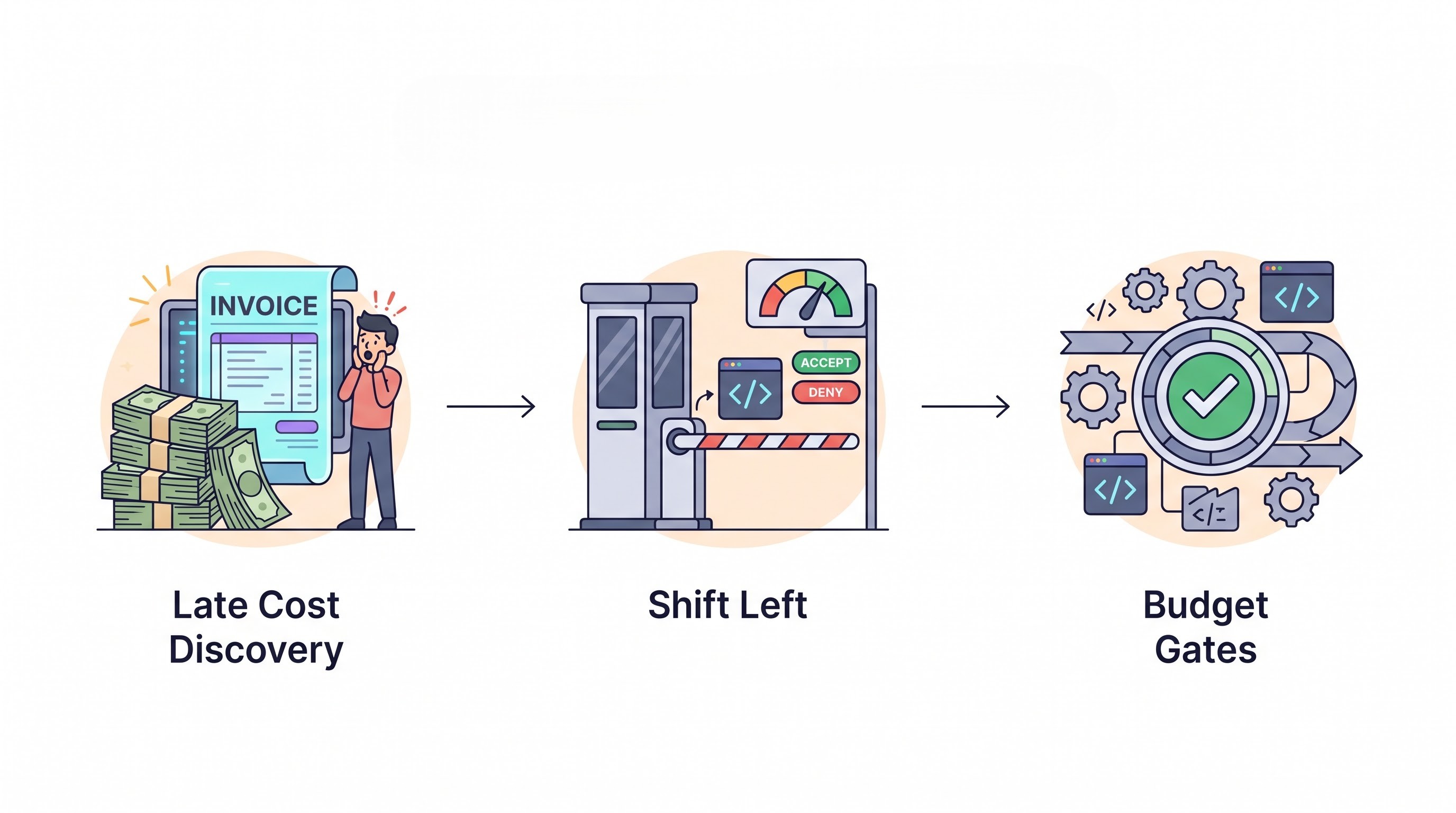
1. "Shift-Left" Cost and Security
Just as DevOps "shifted left" on testing (bringing it earlier in the development cycle), FinOps and CloudOps must shift left. FinOps should integrate cost estimation tools (like Infracost) into the DevOps CI/CD pipelines, allowing developers to see the financial impact of a pull request before it is merged. CloudOps should provide pre-approved, secure IaC templates that DevOps can consume without friction.
2. The Golden Path (Platform Engineering)
The modern solution to aligning these teams is building an Internal Developer Platform (IDP). CloudOps builds the underlying infrastructure components (the "Golden Path"). FinOps ensures these components are pre-configured for cost efficiency (e.g., defaulting to ARM processors or Spot instances where appropriate) and automatically tagged. DevOps consumes these components via self-service portals to deploy their applications rapidly, securely, and cost-effectively.
3. Cross-Functional Metrics
Break down silos by sharing metrics. DevOps should be evaluated on unit economics alongside deployment frequency. FinOps must understand that aggressive rightsizing that impacts application MTTR (a DevOps metric) is a failed optimization.
Organizational Anti-Patterns to Avoid
The "Cost Police" FinOps Team: If FinOps acts solely as an auditor that scolds engineering for overspending, they will be ignored. FinOps must act as an enabler, providing data and tools that help engineers make better decisions.
CloudOps as a Bottleneck: If every infrastructure change requires a manual ticket review by CloudOps, DevOps agility is destroyed. CloudOps must transition from gatekeepers to tool-builders (policy-as-code).
Developers Without Cost Accountability: If developers can provision limitless resources without ever seeing the bill, FinOps will fail. Implementation of a Showback model is mandatory.
Key Takeaway
DevOps builds the engine, CloudOps paves the road, and FinOps manages the fuel economy. They are not competing disciplines; they are three facets of modern cloud engineering. Success requires shifting security and cost constraints "left" into the development pipeline, establishing cross-functional accountability, and leveraging platform engineering to provide developers with pre-secured, cost-optimized infrastructure building blocks.
All in One Place
Atler Pilot decodes your cloud spend story by bringing monitoring, automation, and intelligent insights together for faster and better cloud operations.