
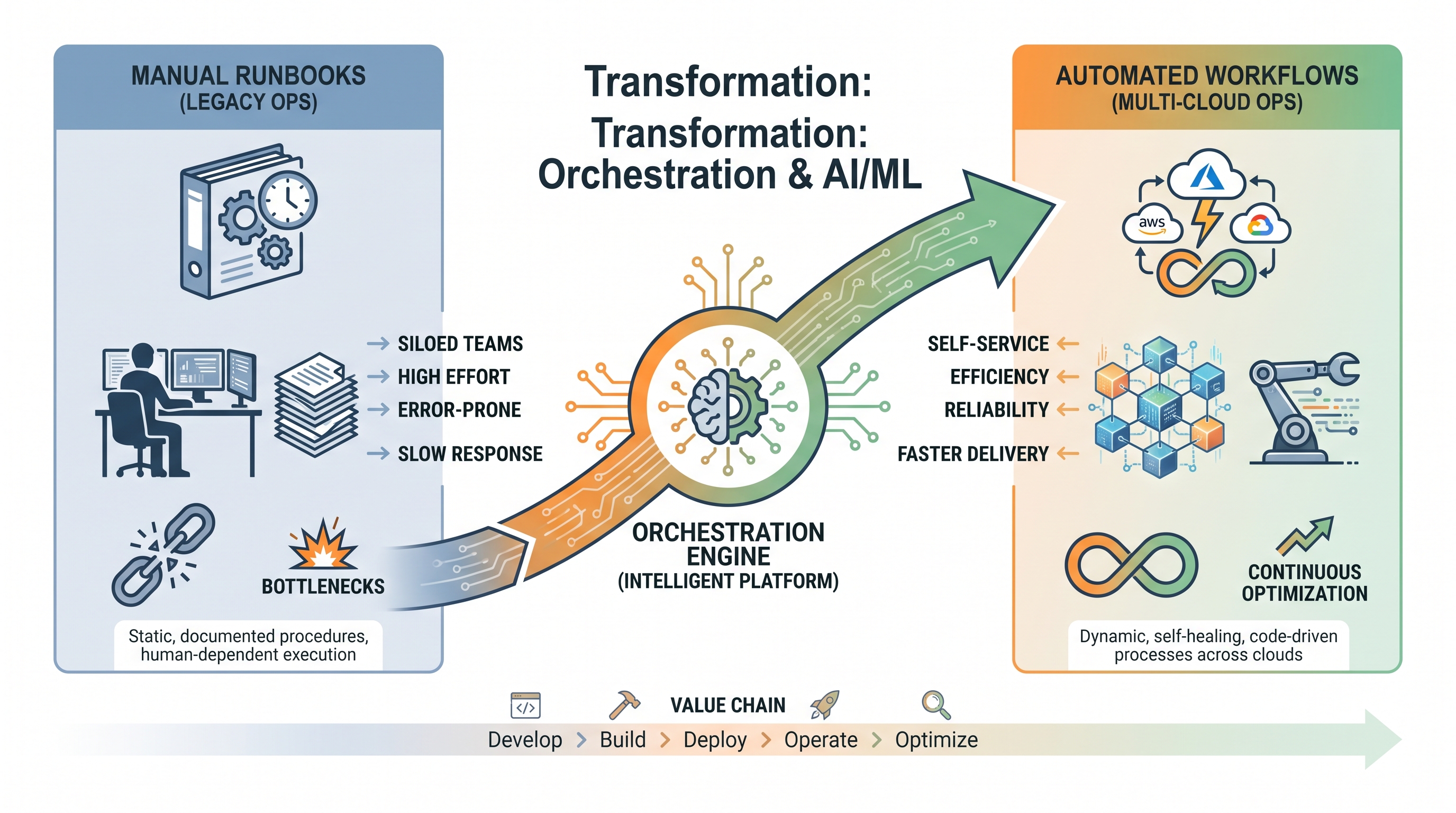
The Inevitable Shift: Why Manual Runbooks Fail in Multi-Cloud
In the nascent days of cloud adoption, enterprise operations teams, often accustomed to on-premises methodologies, ported their manual runbook approaches directly to their cloud infrastructure. These meticulously documented, step-by-step procedures served as the backbone for incident response, deployment, and maintenance. While adequate for monolithic applications in controlled, single-vendor environments, the proliferation of multi-cloud strategies has exposed critical vulnerabilities in this traditional model.
Today's enterprise landscapes are characterized by distributed applications spanning AWS, Azure, Google Cloud Platform (GCP), and Oracle Cloud Infrastructure (OCI). This heterogeneity introduces an exponential increase in complexity. A manual runbook designed for AWS EC2 instances may not translate directly to Azure VMs or GCP Compute Engine. The nuances of networking, identity and access management (IAM), storage, and monitoring vary significantly across providers, rendering generic runbooks inefficient at best, and dangerous at worst.
The core issues stemming from reliance on manual runbooks in a multi-cloud context are profound:
Human Error and Inconsistency: Even the most skilled engineers are susceptible to errors, especially under pressure during critical incidents. A single missed step or misconfigured parameter can lead to widespread outages, security breaches, or significant cost overruns. The lack of standardization across cloud providers exacerbates this, as operators must constantly context-switch between different console UIs and CLI commands.
Slow Response Times: Incident resolution, often guided by lengthy runbooks, becomes a time-consuming ordeal. Diagnosing issues across disparate cloud logs, correlating events, and manually executing remediation steps delays mean time to recovery (MTTR), directly impacting service level objectives (SLOs) and customer satisfaction.
Escalating Operational Costs (FinOps Impact): Manual operations are inherently expensive. The engineering hours spent on repetitive tasks, troubleshooting, and manual deployments detract from strategic initiatives. Furthermore, delayed responses to cost anomalies—such as inadvertently provisioned high-cost resources or unoptimized spending patterns—can lead to substantial financial waste across multiple cloud bills.
Security and Compliance Gaps: Manual configuration changes introduce configuration drift, making it challenging to maintain a consistent security posture. Auditing manual processes for compliance with industry regulations (e.g., HIPAA, PCI-DSS, GDPR) is arduous and prone to oversight. Misconfigurations, often a result of manual intervention, are a leading cause of security vulnerabilities and breaches in cloud environments.
Scalability and Agility Bottlenecks: Manual processes cannot scale with the dynamic demands of cloud-native applications. Deploying new services, scaling resources up or down, or performing routine maintenance across hundreds or thousands of instances manually becomes an insurmountable task, hindering business agility and innovation.
Consider an enterprise scenario where a critical microservice experiences elevated error rates across its multi-cloud deployment. A manual runbook might instruct an engineer to log into the AWS console, check CloudWatch logs, then switch to Azure Monitor for an Azure-hosted component, and finally query GCP Stackdriver logs. This fragmented approach not only delays diagnosis but also prevents a holistic understanding of the problem's root cause, which could span inter-cloud dependencies. The inherent limitations of this approach underscore the urgent need for a paradigm shift towards automated workflows.
Pillars of Multi-Cloud Automation: A Technical Foundation
The transition from manual runbooks to automated workflows in a multi-cloud context is built upon several foundational technical pillars. These pillars enable consistency, repeatability, and efficiency across diverse cloud environments.
Infrastructure as Code (IaC) for Unified Provisioning
IaC is the cornerstone of modern cloud operations. Instead of manually clicking through cloud consoles, infrastructure is defined in human-readable, machine-processable files (e.g., HCL for Terraform, YAML/JSON for CloudFormation, Bicep for Azure). This approach offers:
Version Control: Infrastructure definitions are stored in Git repositories, enabling change tracking, rollbacks, and collaborative development.
Consistency: Ensures that environments (development, staging, production) are provisioned identically across AWS, Azure, GCP, and OCI. This minimizes configuration drift and enhances reliability.
Security Baseline: Security best practices (e.g., encrypted storage, restricted network access, IAM policies) can be codified directly into the infrastructure templates, enforcing a secure baseline from inception.
Portability (with abstraction): Tools like Terraform, with its provider model, allow for defining infrastructure in a cloud-agnostic way, then translating it to specific cloud APIs. For instance, a module for a virtual network can be written once and deployed to AWS VPC, Azure VNet, or GCP VPC with minimal changes.
A practical example involves deploying a standard web application stack. With Terraform, you can define an Auto Scaling Group in AWS, a Virtual Machine Scale Set in Azure, and a Managed Instance Group in GCP using a common module, abstracting away the cloud-specific syntax while maintaining standardized configurations for compute, networking, and load balancing.
Configuration Management for Desired State
While IaC provisions the underlying infrastructure, configuration management tools ensure that the software and services running on that infrastructure are configured to a desired state. Tools like Ansible, Chef, and Puppet are crucial for:
Operating System Hardening: Applying security patches, disabling unnecessary services, and configuring firewall rules consistently across heterogeneous operating systems (Linux, Windows) in any cloud.
Application Deployment: Automating the installation, configuration, and update of application components and their dependencies.
Patch Management: Orchestrating the patching cycle for operating systems and middleware across multi-cloud instances. This includes identifying vulnerabilities, staging patches, deploying them, and verifying successful application. CloudAtler offers comprehensive patch intelligence to identify critical vulnerabilities across your multi-cloud estate, streamlining this complex process significantly.
For instance, an Ansible playbook can ensure that all application servers across AWS EC2, Azure VMs, and GCP Compute Engine have the latest security patches, specific packages installed, and application configuration files deployed with environment-specific variables pulled from a centralized secret store.
Event-Driven Automation and Serverless Functions
This paradigm shifts operations from scheduled tasks to reactive responses based on specific events. Cloud-native services like AWS CloudWatch Events/EventBridge, Azure Event Grid, and Google Cloud Pub/Sub, coupled with serverless functions (Lambda, Azure Functions, Cloud Functions), enable real-time automation:
Security Remediation: An event triggered by an AWS GuardDuty finding (e.g., a public S3 bucket) can invoke a Lambda function to automatically apply a restrictive bucket policy. Similarly, an Azure Security Center alert can trigger an Azure Function to quarantine a compromised VM.
Cost Optimization: Detecting an idle resource (e.g., an EC2 instance with low CPU utilization for an extended period) can trigger an automation to stop or terminate it, after appropriate notifications.
Operational Resilience: An application error log ingested into a centralized logging system (e.g., Splunk, ELK stack) can trigger an alert, which in turn invokes a serverless function to restart a specific service or scale out an affected component.
This "if-this-then-that" logic significantly reduces MTTR and enables proactive problem resolution, often before human intervention is required.
Orchestration and Workflow Engines
For complex, multi-step processes that span multiple services and potentially multiple clouds, dedicated orchestration tools are essential:
CI/CD Pipelines: Tools like GitLab CI/CD, GitHub Actions, Azure DevOps, or Jenkins orchestrate the entire software delivery lifecycle, from code commit to deployment across multi-cloud environments. They automate testing, artifact building, and deployment using IaC and configuration management.
Cloud-Native Workflow Services: AWS Step Functions, Azure Logic Apps, and Google Cloud Workflows allow defining complex state machines for long-running, distributed processes. These can be used for things like multi-stage application deployments, compliance workflows, or incident response playbooks that involve human approvals and conditional logic.
Kubernetes: While primarily a container orchestrator, Kubernetes extends automation to application deployment, scaling, and self-healing across any cloud where it can be deployed (AKS, EKS, GKE, OKE). Its declarative nature and extensibility via operators make it a powerful automation platform for containerized workloads.
Imagine a new application deployment that requires provisioning infrastructure (IaC), configuring application servers (configuration management), deploying containers (Kubernetes), and integrating with cloud-specific services. An orchestration engine ties all these steps together into a single, automated workflow, ensuring consistency and reducing manual effort.
Architecting Automated Workflows for Multi-Cloud: Practical Implementations
Building effective automated workflows across a multi-cloud estate requires a thoughtful architectural approach that integrates security, FinOps, and operational intelligence. The goal is a unified, intelligent system that can act autonomously or with minimal human intervention.
Centralized Control Plane and Data Ingestion
The fundamental challenge of multi-cloud is fragmentation. An effective automation strategy mandates a centralized control plane capable of ingesting, normalizing, and correlating data from disparate cloud providers. This involves:
API Integration: Leveraging native cloud APIs (AWS SDK, Azure CLI, GCP gcloud) to interact with resources across all environments.
Data Normalization: Standardizing metadata, logging formats (e.g., OpenTelemetry, common JSON schema), and monitoring metrics (e.g., Prometheus exporters) from AWS CloudWatch, Azure Monitor, GCP Stackdriver, and OCI Monitoring. This allows for a unified view and consistent analysis.
Event Bus Integration: Consolidating events from various cloud event sources (CloudWatch Events, Event Grid, Pub/Sub) into a single, enterprise-wide event bus for cross-cloud automation triggers.
Unified Dashboard: Presenting a consolidated view of resources, costs, security posture, and operational health across all clouds. This is where platforms like CloudAtler excel, providing a truly unified dashboard that aggregates critical insights into a single pane of glass.
Architecturally, this might involve a central data lake (e.g., S3, Azure Data Lake Storage, GCP Cloud Storage) to store normalized logs and metrics, processed by a serverless analytics engine (e.g., AWS Athena, Azure Synapse Analytics, GCP BigQuery) to feed a central operational intelligence platform.
Security Automation: Proactive Defense and Remediation
Automating security in a multi-cloud environment is paramount to maintaining a strong defense posture against evolving threats. This involves:
Policy as Code and Automated Enforcement: Defining security policies (e.g., encryption requirements, network segmentation, IAM roles) as code (e.g., AWS CloudFormation Guard, Azure Policy, GCP Organization Policies) and automatically enforcing them during provisioning and continuously thereafter. Any deviation triggers an automated remediation workflow.
Vulnerability Management Automation: Integrating automated vulnerability scanning tools (e.g., Qualys, Tenable, AWS Inspector, Azure Security Center) into CI/CD pipelines and production environments. Identified vulnerabilities are automatically triaged, prioritized based on CVSS scores and asset criticality, and remediation actions (e.g., patch deployment, configuration updates) are initiated. CloudAtler offers robust security management capabilities that span across your multi-cloud estate, providing a holistic view of your security posture.
Incident Response Automation (SOAR): Automating playbooks for common security incidents. For example, detecting an unauthorized port scan from an IP address could automatically update security group/network ACL rules across all clouds to block that IP, notify security teams, and trigger a forensic snapshot of the affected instance.
Compliance Automation: Continuously auditing cloud configurations against regulatory frameworks (NIST, ISO 27001, PCI-DSS) using automated tools. Deviations trigger alerts and automated remediation, ensuring continuous compliance.
A concrete example: A rule detects an S3 bucket configured for public access. An automated workflow immediately modifies the bucket policy to restrict public access, revokes any associated public ACLs, and logs the action for audit purposes. This prevents data leakage and ensures compliance without manual intervention.
FinOps Automation: Cost Optimization and Governance
Automated FinOps workflows are crucial for controlling and optimizing cloud spend across multiple providers, ensuring financial accountability and efficiency.
Cost Anomaly Detection and Remediation: Implementing automated systems to detect unusual spikes in spending (e.g., a sudden increase in data transfer costs or unbudgeted resource creation). Upon detection, an alert is triggered, and a workflow can automatically identify the root cause (e.g., a runaway process, an over-provisioned resource) and take corrective action, such as scaling down or stopping the resource.
Rightsizing and Resource Optimization: Leveraging AI/ML-driven insights to recommend optimal instance types, storage tiers, or database configurations based on actual utilization patterns. Automated workflows can then apply these rightsizing recommendations (e.g., changing an EC2 instance type, adjusting a VM size in Azure) during off-peak hours or with approval.
Reserved Instance (RI) and Savings Plan (SP) Optimization: Automating the analysis of usage patterns to recommend optimal RI/SP purchases and renewals across AWS, Azure, and GCP. Workflows can even automatically purchase or adjust commitments based on predefined policies, ensuring continuous savings. CloudAtler provides advanced tools for optimizing reserved instance savings, leveraging AI to maximize your cost efficiency across clouds.
Automated Tagging and Resource Governance: Enforcing tagging policies across all cloud resources (e.g., assigning cost centers, project IDs, owner tags). Automated workflows can identify untagged or improperly tagged resources and either automatically apply correct tags or alert resource owners for remediation. This is vital for accurate cost allocation and chargeback.
Budget Enforcement: Integrating budget limits with automated actions. If a project's spending approaches a predefined threshold, automated workflows can trigger alerts, restrict further resource provisioning, or even automatically scale down non-critical resources until the budget is reviewed.
A common FinOps automation involves identifying idle development/test environments. An automated workflow can scan for instances with low CPU/network activity outside business hours and automatically shut them down, restarting them at the beginning of the next workday, saving significant compute costs.
Operational Intelligence & Performance Management
Beyond security and cost, automated workflows enhance operational resilience and performance across multi-cloud environments.
Predictive Monitoring and Proactive Resolution: Utilizing AI/ML to analyze historical performance data and detect anomalous patterns that might indicate impending issues (e.g., disk space exhaustion, memory leaks, unusual network latency). Automated workflows can then trigger proactive measures like scaling up resources, clearing caches, or initiating self-healing scripts before an outage occurs. CloudAtler leverages predictive monitoring operations to anticipate and mitigate issues across complex multi-cloud deployments.
Self-Healing Infrastructure: Designing systems to automatically recover from common failures. For instance, if a VM becomes unresponsive, an automated workflow can attempt to restart it, or if that fails, provision a new instance and detach/reattach storage volumes, effectively replacing the faulty component.
Automated Capacity Management: Dynamically adjusting resource capacity based on real-time demand and predictive analytics. This includes auto-scaling groups in AWS, virtual machine scale sets in Azure, or managed instance groups in GCP, all managed by unified policies and metrics.
Root Cause Analysis Automation: While full RCA is complex, automation can gather all relevant logs, metrics, and configuration changes leading up to an incident, significantly accelerating the human-led analysis process.
An example is an application experiencing increasing latency. An automated workflow, triggered by a threshold breach in a centralized monitoring system, identifies that a specific database replica is overloaded. It then automatically provisions a new replica, reconfigures the load balancer to distribute traffic, and scales down the overloaded replica once the issue is resolved, all without manual intervention.
Implementing Automated Patch Management: A Deep Dive Example
Patch management is a critical, often underestimated, aspect of multi-cloud operations, directly impacting security, compliance, and system stability. Manual patching across diverse operating systems and cloud providers is a notorious source of errors, downtime, and vulnerability. Automating this process is a prime example of transforming runbooks into robust workflows.
The Multi-Cloud Patching Challenge
Consider an enterprise running a mix of RHEL and Windows Server instances on AWS EC2, Azure VMs, and GCP Compute Engine. Each cloud provider has its own patching tools (AWS SSM Patch Manager, Azure Update Management, GCP OS Config), and each OS has its package manager (yum/dnf, apt, Windows Update). Manually coordinating patches, ensuring compatibility, scheduling downtime, and verifying successful application across this heterogeneous environment is a logistical nightmare.
Automated Patch Lifecycle with Unified Workflows
A comprehensive automated patch management workflow typically involves several stages, unified by a central platform:
Discovery and Inventory:
Automation: Automatically discover all compute instances (VMs, containers, serverless functions if applicable) across AWS, Azure, GCP, and OCI. Collect detailed inventory data including OS type, version, installed software, and current patch level.
Tools: Cloud provider APIs, configuration management databases (CMDBs), and agent-based inventory tools (e.g., AWS SSM Agent, Azure Arc, GCP OS Config Agent).
Vulnerability Assessment and Prioritization:
Automation: Continuously scan instances for missing patches and known vulnerabilities (CVEs). Correlate vulnerabilities with asset criticality (e.g., production vs. development, public-facing vs. internal) and CVSS scores to prioritize patching efforts.
Tools: Vulnerability scanners (e.g., AWS Inspector, Azure Security Center, Tenable.io), integrated with a central vulnerability management platform. CloudAtler's patch intelligence provides deep insights into your vulnerability landscape, helping prioritize remediation efforts effectively.
Patch Staging and Testing:
Automation: Automatically create segregated "patch rings" or environments (e.g., dev, test, staging, production). Deploy patches to non-production environments first. Execute automated integration and regression tests to identify potential conflicts or regressions before wider deployment.
Tools: CI/CD pipelines, IaC for environment provisioning, automated testing frameworks (e.g., Selenium, JMeter).
Automated Patch Deployment:
Automation: Orchestrate patch deployment across production environments based on predefined schedules, maintenance windows, and approval gates. This includes pre-patch snapshots/AMIs, actual patch application, and post-patch health checks.
Tools: AWS SSM Patch Manager, Azure Update Management, GCP OS Config, Ansible playbooks. A central orchestrator (e.g., CloudAtler) can trigger these cloud-native services based on a unified policy. CloudAtler's patch remediation features automate the execution of these critical updates across your multi-cloud infrastructure.
Pre- and Post-Patch Validation:
Automation: Before patching, take snapshots or create AMIs/VM images for easy rollback. After patching, execute automated health checks (e.g., service status checks, application endpoint probes, synthetic transactions) to verify system stability and functionality.
Tools: Cloud snapshot APIs, monitoring agents, automated testing scripts.
Rollback Mechanisms:
Automation: In case of critical failures or regressions detected during post-patch validation, automatically initiate a rollback to the pre-patch state using snapshots or previous AMIs/VM images. CloudAtler facilitates safe rollbacks, minimizing downtime and risk.
Tools: Cloud snapshot/image restoration APIs, configuration management tools to revert configurations.
Change Management Integration:
Automation: Integrate the entire patch workflow with existing IT Service Management (ITSM) systems (e.g., ServiceNow, Jira Service Management) to automatically create change requests, update status, and close tickets. This ensures compliance with change advisory board (CAB) processes without manual overhead.
Tools: ITSM APIs, workflow orchestration engines.
By unifying these steps, CloudAtler transforms patch management from a reactive, error-prone manual process into a proactive, secure, and efficient automated workflow across your entire multi-cloud estate, significantly reducing operational burden and enhancing security posture.
Overcoming Challenges in Multi-Cloud Automation
While the benefits of multi-cloud automation are clear, the journey is not without its hurdles. Enterprises must strategically address several common challenges:
Tool Sprawl and Integration Complexity: Each cloud provider offers a rich ecosystem of native automation tools. When combining AWS, Azure, GCP, and OCI, organizations often face a bewildering array of services (e.g., AWS Step Functions vs. Azure Logic Apps vs. GCP Workflows) and monitoring solutions. Integrating these disparate tools into a cohesive workflow can be complex and resource-intensive. The solution lies in adopting a unified platform that abstracts away cloud-specific complexities and provides a common interface for automation across all environments.
Skill Gaps and Cultural Resistance: The shift from manual operations to automation requires a significant uplift in skills, particularly in IaC, scripting (Python, PowerShell, Go), API interaction, and understanding cloud-native automation services. Furthermore, operational teams accustomed to manual runbooks may resist the change, fearing job displacement or a loss of control. Investing in continuous training, fostering a culture of "operations as code," and demonstrating the value of automation (e.g., by freeing up engineers for more strategic work) are crucial.
Data Silos and Lack of Unified Visibility: Despite efforts to centralize data, disparate logging, monitoring, and billing systems across clouds can still create silos. This makes it challenging to gain a holistic view of performance, security, and cost across the entire multi-cloud estate, hindering effective automated decision-making. A robust data ingestion, normalization, and correlation strategy, feeding into a unified operational intelligence platform, is essential.
Security and Governance of Automation Itself: Automating operations introduces a new attack surface. If automation scripts or orchestrators are compromised, they could potentially cause widespread damage across all connected cloud environments. Implementing strict security practices for automation tools—such as least privilege access, secrets management, regular security audits of automation code, and secure CI/CD pipelines for automation artifacts—is critical. Establishing clear governance frameworks for automated actions, including approval workflows for high-impact changes, is equally important.
Managing State and Idempotency: Automated workflows, especially those involving IaC, must be idempotent, meaning executing them multiple times yields the same result without unintended side effects. Managing the state of infrastructure and configurations across multiple clouds and ensuring that automation gracefully handles failures and retries requires careful design and robust error handling.
Addressing these challenges requires a strategic, platform-centric approach that provides a unified control plane, automates security and FinOps, and fosters a collaborative culture between development, operations, finance, and security teams.
The CloudAtler Advantage: Unifying Multi-Cloud Ops Transformation
The journey from manual runbooks to automated workflows in a multi-cloud enterprise environment is complex, demanding a platform that can seamlessly integrate FinOps, cloud security, and automated operations across diverse cloud providers. This is precisely where CloudAtler delivers its unparalleled value.
CloudAtler is an AI-powered platform designed to be the central nervous system for your multi-cloud operations. It eliminates the fragmentation and complexity inherent in managing AWS, Azure, GCP, and Oracle environments by providing a truly unified approach. Instead of juggling multiple cloud-native tools and struggling with custom integrations, CloudAtler offers a single, intelligent platform to orchestrate, optimize, and secure your entire cloud footprint.
Our platform directly addresses the challenges discussed, transforming your operations:
Unified Control Plane: CloudAtler provides a unified dashboard that aggregates critical data from all your cloud providers. This single pane of glass offers real-time visibility into your entire multi-cloud estate, from resource utilization and cost trends to security posture and compliance status. This eliminates data silos and provides the comprehensive operational intelligence needed for informed decision-making.
AI-Powered FinOps Automation: CloudAtler’s AI capabilities are purpose-built for enterprise FinOps. We automate cost anomaly detection, providing instant alerts and actionable insights to prevent budget overruns. Our platform delivers intelligent rightsizing recommendations and automates the optimization of Reserved Instances and Savings Plans, ensuring you always achieve maximum cost efficiency across AWS, Azure, and GCP. Beyond just reporting, CloudAtler enables automated budget enforcement and intelligent cost allocation, turning financial insights into automated actions.
Advanced Cloud Security Automation: Security in multi-cloud is paramount. CloudAtler unifies security management across all your environments, automating vulnerability prioritization, policy enforcement, and incident response. Our platform provides continuous compliance monitoring, automatically detecting and remediating misconfigurations that could expose your organization to risk. From automated patch intelligence and remediation to proactive threat detection, CloudAtler strengthens your security posture with intelligent, automated defenses.
Intelligent Operational Automation: Moving beyond simple scripts, CloudAtler leverages AI for predictive monitoring operations, anticipating issues before they impact your services. Our platform automates routine operational tasks, from infrastructure provisioning to self-healing mechanisms, dramatically reducing MTTR and improving service availability. This includes advanced capabilities like automated patch governance, safe rollbacks, and multi-resource detection, ensuring your operations are resilient and efficient.
Seamless Integration and Governance: CloudAtler integrates with your existing CI/CD pipelines, ITSM systems, and native cloud services, ensuring that automation is embedded within your existing workflows. We provide robust governance features, enabling you to define guardrails and approval processes for automated actions, maintaining control while maximizing efficiency.
By unifying FinOps, cloud security, and automated operations, CloudAtler empowers enterprises to move beyond the limitations of manual runbooks
All in One Place
Atler Pilot decodes your cloud spend story by bringing monitoring, automation, and intelligent insights together for faster and better cloud operations.